
“The Two Eyes”: See Pansori Like Never Before
What happens when centuries-old folk storytelling meets pixels, light, and sound? The Two Eyes reimagines pansori — Korea’s ancient vocal tradition — through the lens of media art.
Sense of Wander: ★★★★☆
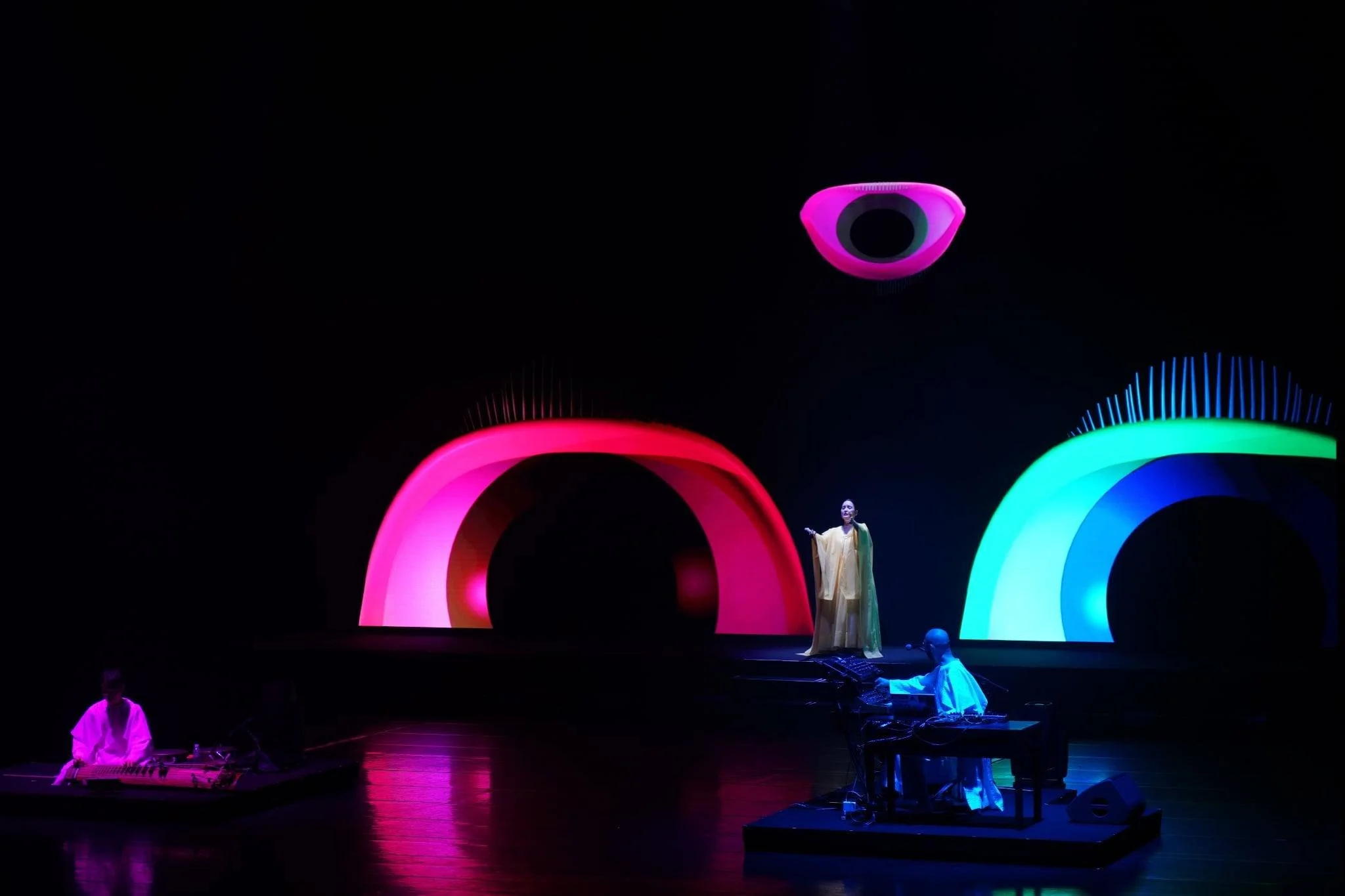
The Two Eyes reimagines centuries-old pansori tradition through contemporary lens. Image courtesy of Taiwan Traditional Theatre Centre.
TAIPEI, Taiwan — This afternoon, ancient voices are heard in Taipei. And it all begins with the sound of a drumbeat.
A gosu, or drummer, sits at the lip of the stage, her back turned toward the audience as though she were captaining a boat into open waters. And in a way, she is.
The steady percussion pulls us from wherever we came from — the traffic outside, our phones, the noise of everyday life — and carries us to somewhere in southwestern Korea during the Joseon Dynasty (1392-1897), where the tradition of pansori first took root among the people.
Even the word “pansori” says a lot about what it is: pan, meaning a place where people gather; sori, meaning song. In many ways, pansori is a meeting ground between storytellers and those gathered to listen.
Long before streaming platforms and algorithmic feeds competed for our attention, the sorikkun — the singer-narrator of pansori — could hold audiences for as long as eight hours, accompanied by nothing more than a drummer and the sheer force of the human voice.
Today, that voice is heard in The Two Eyes, a flagship production of National Asian Culture Centre, and it wastes no time finding its way under your skin.
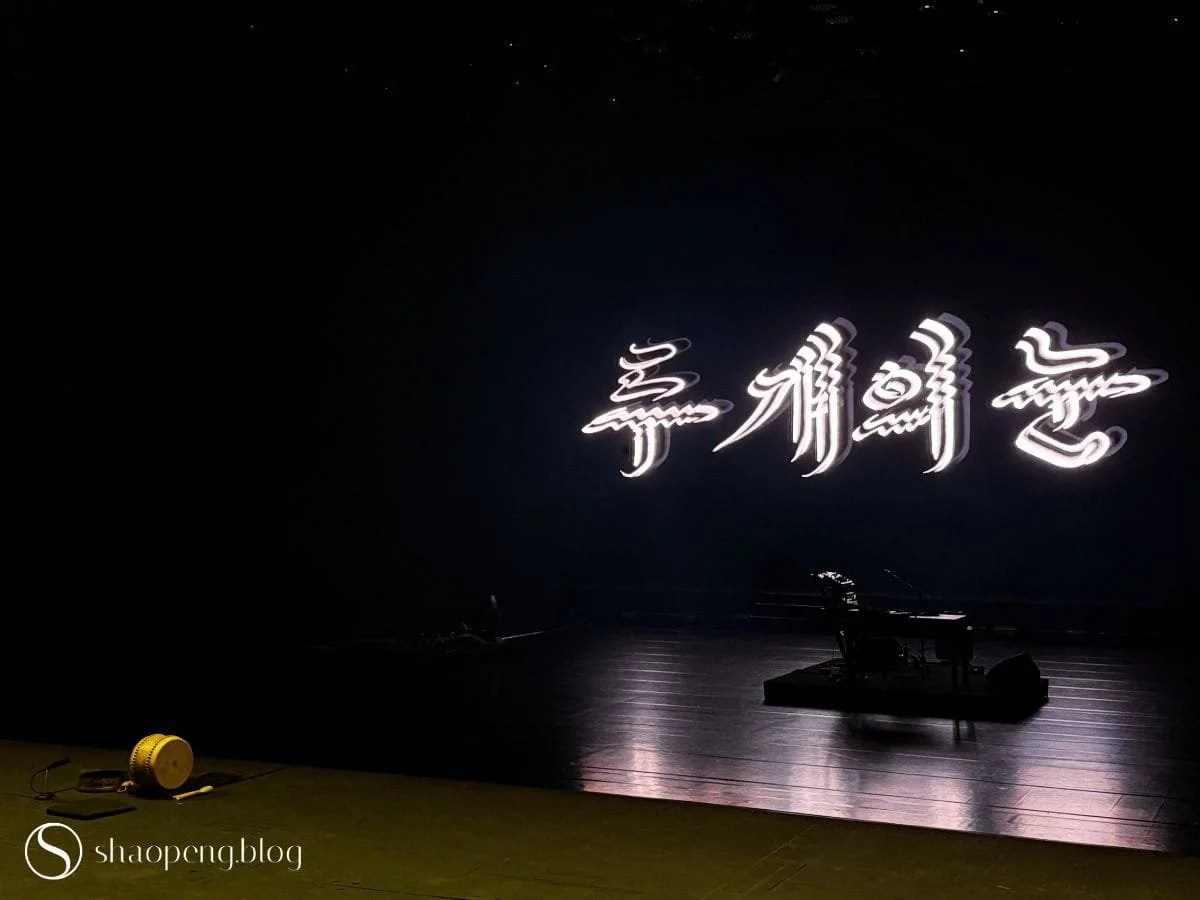
The stage set for The Two Eyes moments before the performance begins.
The story is drawn from Simcheongga, one of the five pansori repertoires to have survived. Sim Cheong, a filial daughter, sacrifices herself to the God of the Sea in exchange for 300 seoks of rice — a desperate offering meant to sustain her elderly blind father, Sim Hak-Gyu.
What strikes you immediately is that none of this requires translation to be felt. The sorikkun’s voice moves through registers that seem to bypass language — you could feel the weight of Sim Hak-Gyu’s helplessness in your chest before fully processing the subtitles. Watching the blind father beg neighbouring women to nurse his newborn daughter, you understand why audiences once travelled days to watch this art form.
As Sim Cheong grows up, poverty forces her to beg in order to support her father. Eventually, she sacrifices her life and throws herself into the waters of Indangsu.
As the narrative unfolds, media art blooms across the auditorium, shedding light on how this centuries-old tradition might look like stepping into the present. Woven into the narration is the sound of the geomungo, a traditional Korean six-string zither whose strings are at times plucked and at times bowed, producing a low, sustained ache reminiscent of the Chinese erhu.
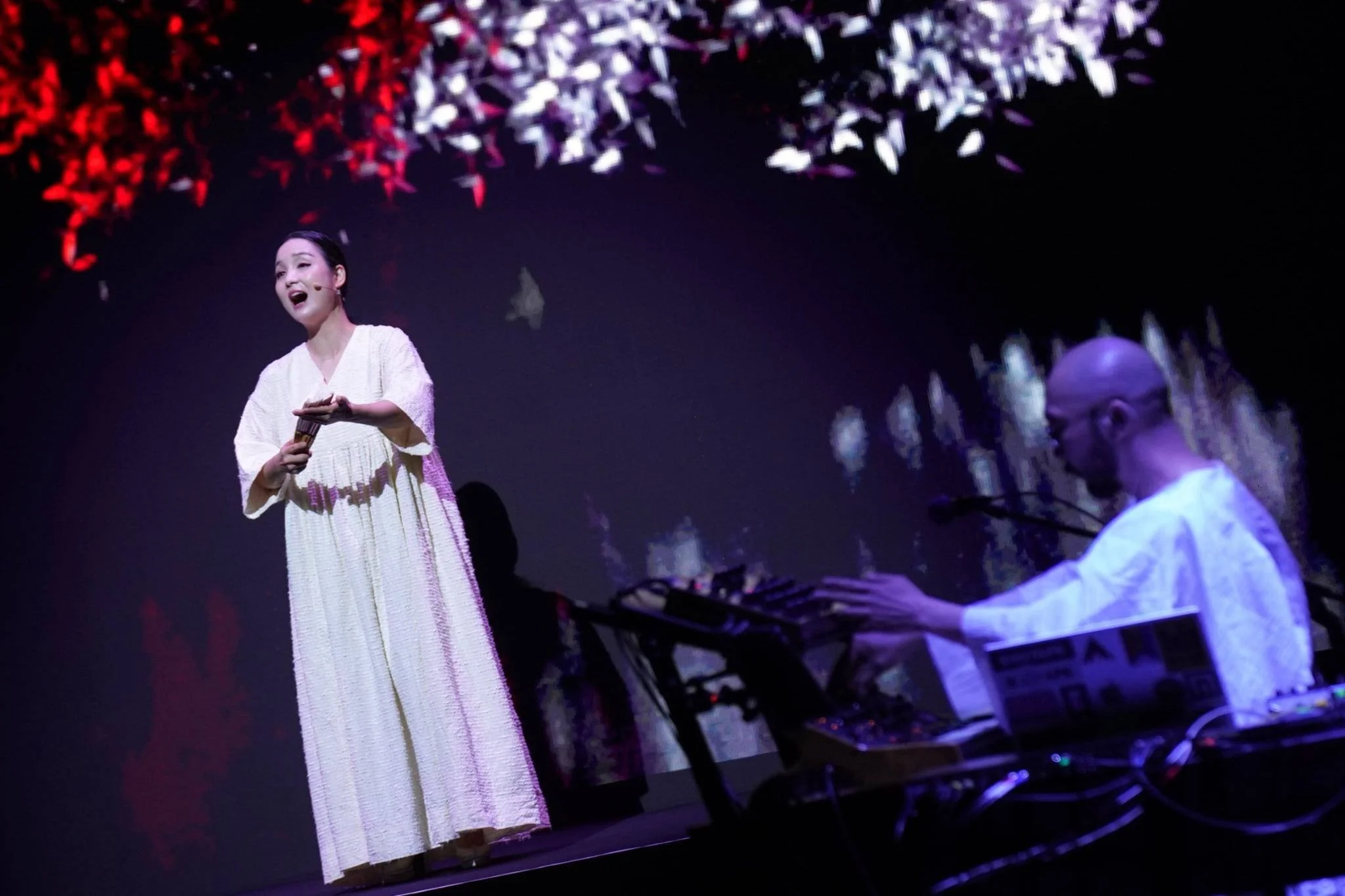
The Two Eyes staged at the Taiwan Traditional Theatre Centre in Taipei. Image courtesy of Taiwan Traditional Theatre Centre.
The Two Eyes is not content to recount this centuries-old tale in the way it has always been told, and this is where it earns its name. The production is a collaboration between MUTO, known for its experimental productions, and IPKOASON, a company devoted to reimagining traditional pansori for modern audiences.
Alongside the LED projections and music, kinetic lasers sweep across the hall, dissolving the boundary between stage and audience.
What also makes The Two Eyes compelling is the way it continually shifts between third-person narration and the perspective of Sim Hak-Gyu. We gain access to his inner world, inhabiting his darkness, his fumbling tenderness, and the long years that follow after Sim Cheong is gone. This is not only a story of filial devotion, but also one about the struggles of ordinary people.
The climax arrives when the narrative returns to the reunion between Queen Sim Cheong and her father, who now bids him to open his eyes and look at her. Without warning, the LED screen floods pink. Yet rather than telling us whether Sim Hak-Gyu’s sight is restored, The Two Eyes leaves it for us to decide.
Perhaps sight was never really the point. That pair of eyes that appear on the screen throughout the performance — blinking, watching, waiting — seems to ask whether we are capable of seeing those closest to us, the people whose suffering we so often move around without touching.
Seventy minutes — that is all it takes for decades of someone else’s sorrow to pass through you and settle within you.
Undoubtedly, The Two Eye’s media art earns its place. It guides your eye, anchors the unfamiliar, and gives those outside the language somewhere to rest. But it would be a mistake to credit the technology with carrying the performance. Strip away the lasers and fancy projections, and what remains is the drumbeat of the gosu, patient and relentless as the tide, and the voice of the sorikkun penetrating straight into your soul.
Now the drum has stopped, yet something of its rhythm lingers, as though the captain has not fully brought us ashore.
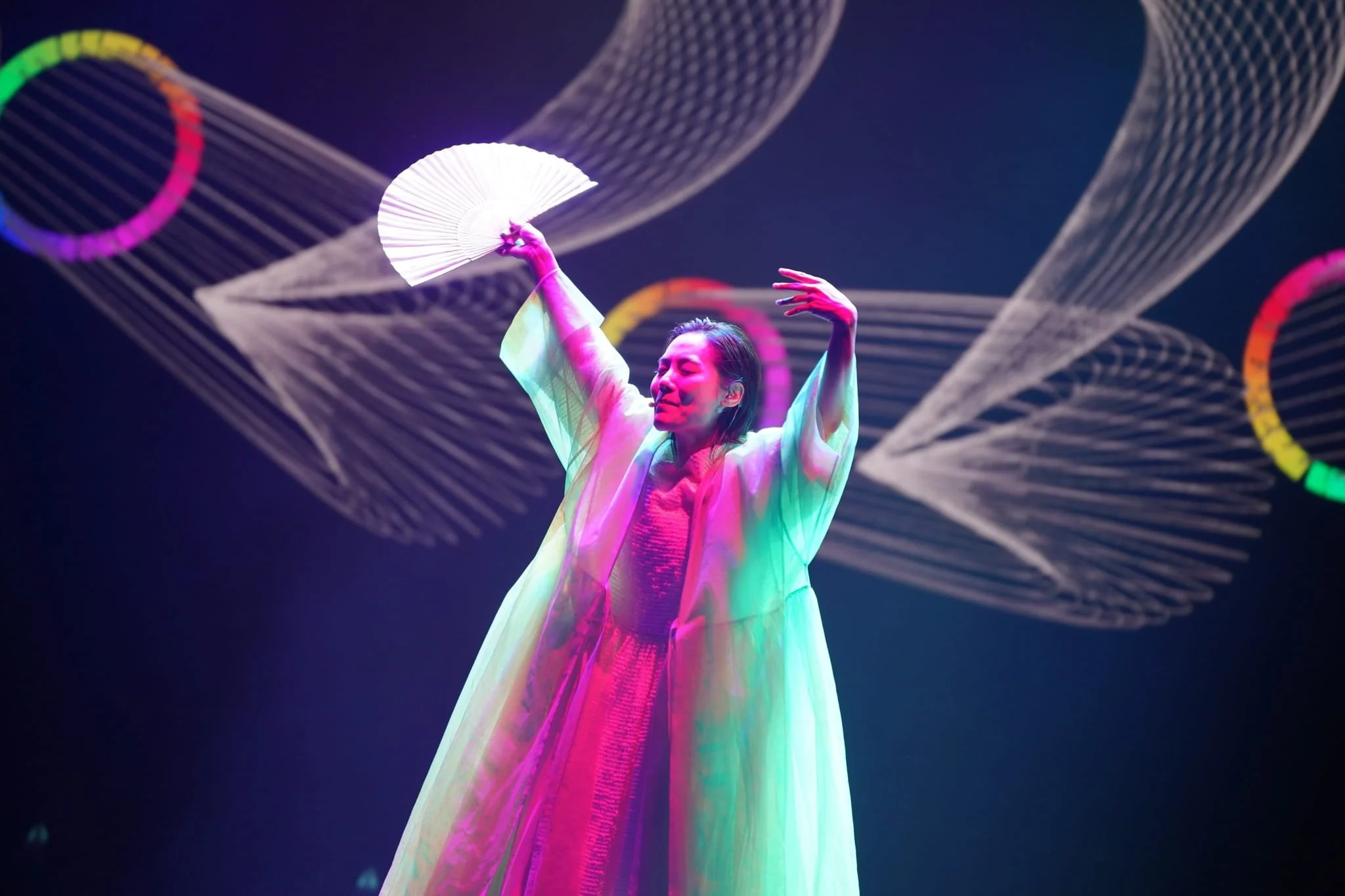
The integration of media art heightens the emotional intensity of the narrative. Image courtesy of Taiwan Traditional Theatre Centre.
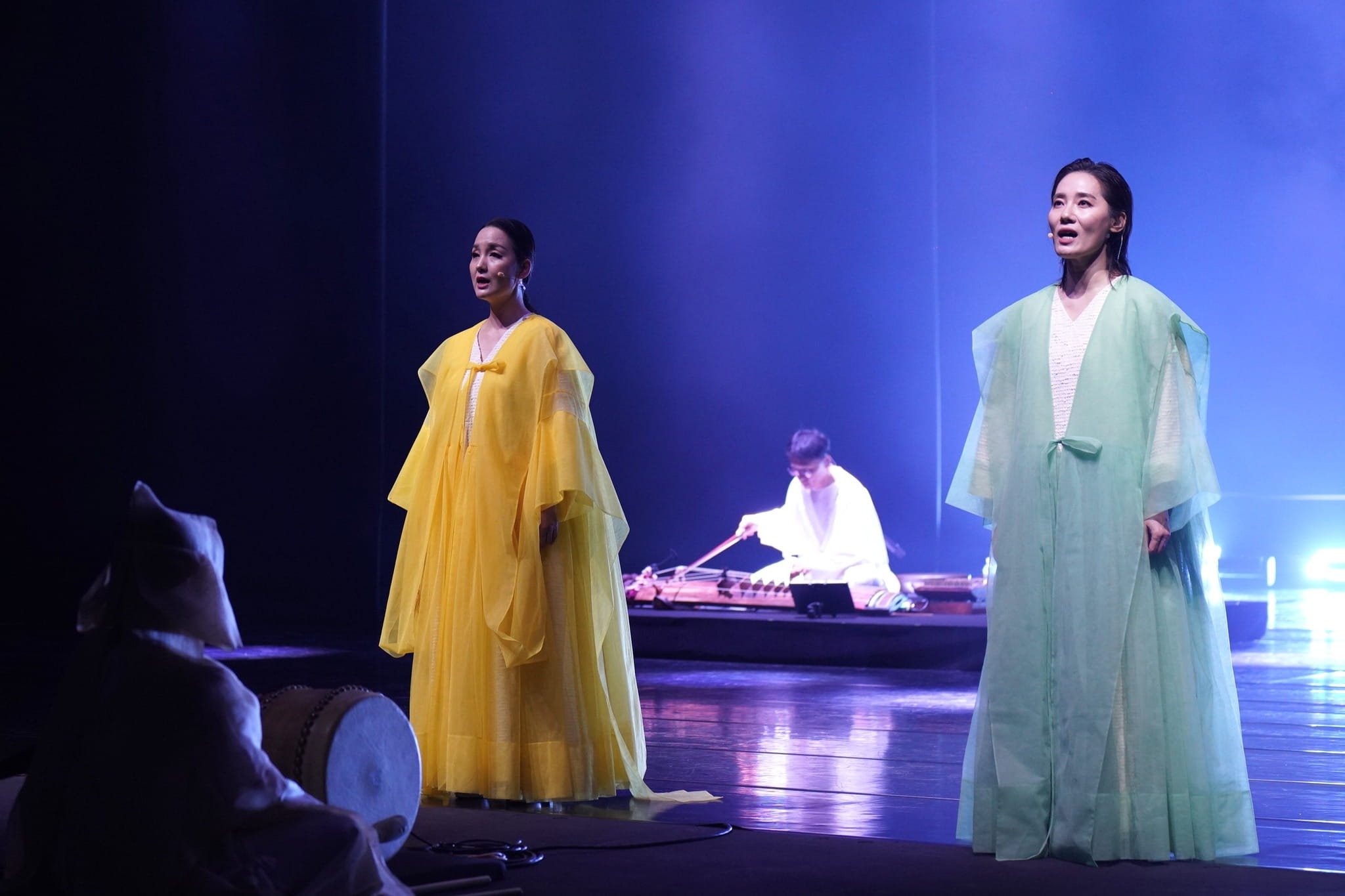
Two pansori singer-narrators from IPKOASON perform in The Two Eyes. Image courtesy of Taiwan Traditional Theatre Centre.
The Two Eyes was staged at the Taiwan Traditional Theatre Centre from May 1–3, 2026.