
The Journey of a Legendary Landscape Painting breathes new life into a 12th-century masterpiece, reimagining its landscapes, colours, and stories through dance.
Sense of Wander: ★★★★☆
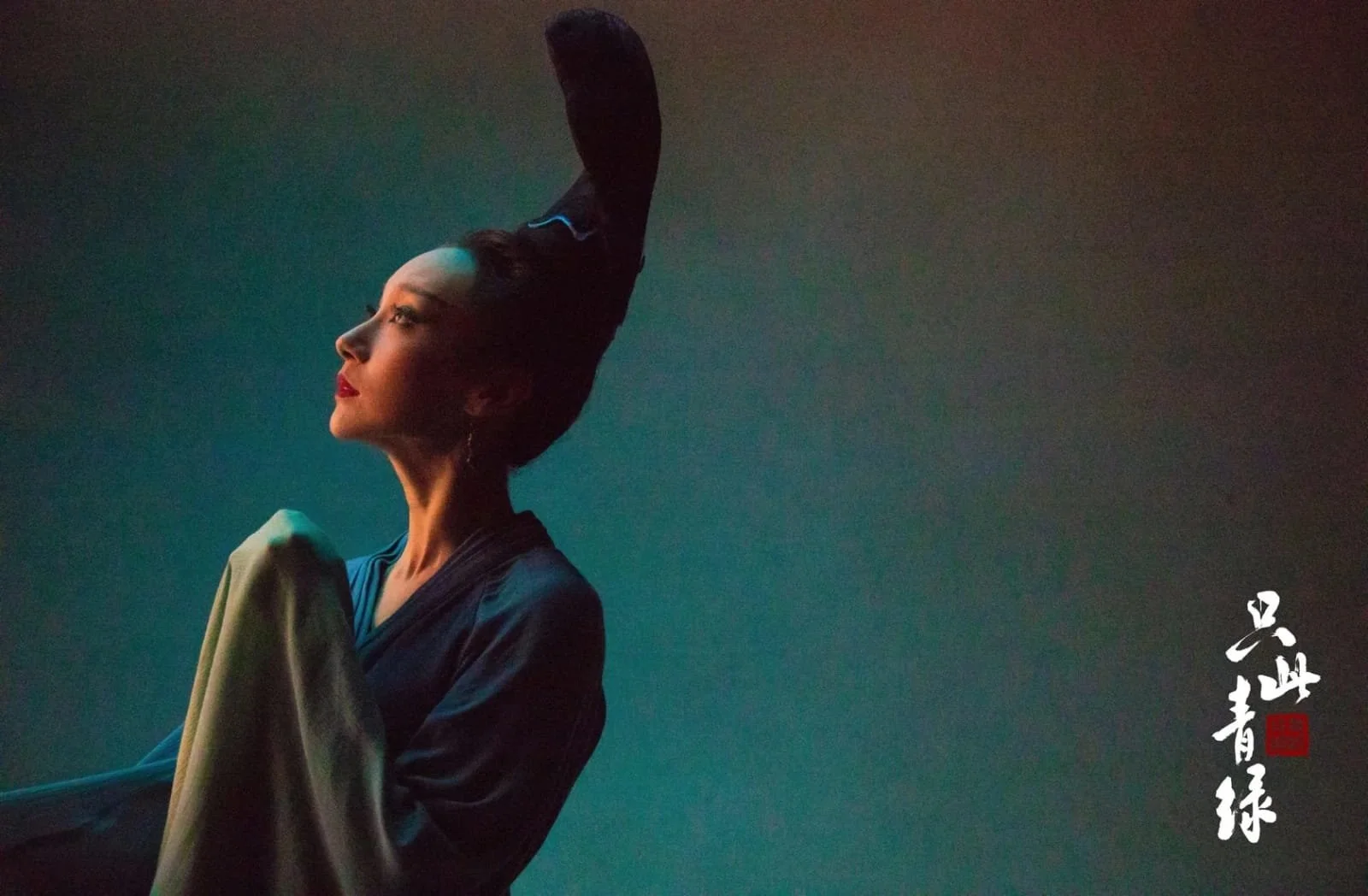
Splashes of blue and green from the painting are reimagined through the dancers. Image courtesy of China Oriental Performing Arts Group.
TAIPEI, Taiwan — This is a story that began nearly a thousand years ago, in the Northern Song dynasty (960–1127), when an 18-year-old boy named Ximeng picked up his brush and embarked on an almost impossible task: painting a panorama of mountains onto a single scroll of silk.
What emerged was nearly twelve metres of rolling hills, rivers, waterfalls, and bridges connecting villages and terrains. Completed in 1113, this masterpiece came to be known as A Thousand Li of Rivers and Mountains. Painted in azurite and malachite, its blues and greens have — through a fortunate twist of fate — resisted fading despite the passage of nearly a millennium. Today, it stands as one of the greatest examples of qinglü shanshui — blue-and-green landscape painting — of the Song dynasty, and arguably one of the most remarkable achievements in Chinese art.
I had read about the painting before, but I never expected to see it in a theatre. Yet it feels almost inevitable that such an extraordinary work would inspire The Journey of a Legendary Landscape Painting, a poetic dance production by the China Oriental Performing Arts Group, created in collaboration with the Palace Museum in Beijing.
As both an art history graduate and a performing arts lover, I couldn’t resist the opportunity to witness what The Journey of a Legendary Landscape Painting would bring to my city. I was curious to see how its story would unfold through movement and, most of all, how a 12th-century masterpiece could be reimagined on stage.
I was not prepared for how deeply it would move me.
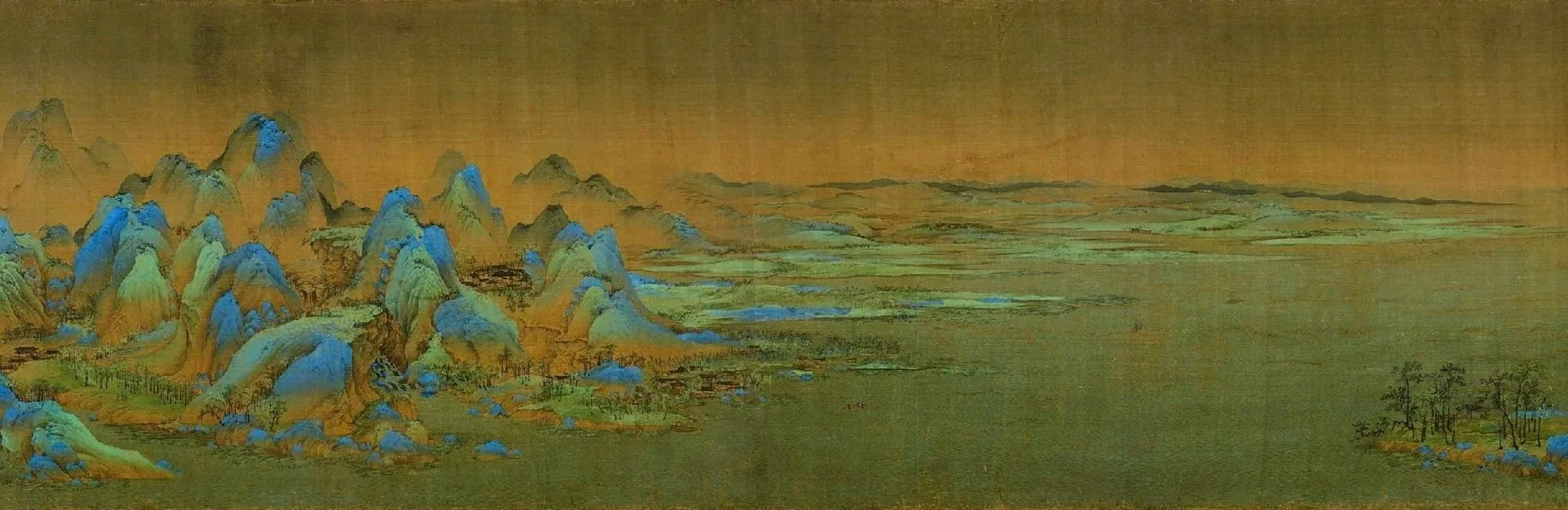
A section of Wang Ximeng’s A Thousand Li of Rivers and Mountains. Image courtesy of Palace Museum.
The dance unfolds across seven chapters: “Unfolding the Scroll,” “Tracing the Seal,” “Reeling the Silk,” “Pursuing the Stone,” “Making the Brush,” “Grinding the Ink,” and “Into the Painting.” It begins with a present-day researcher who, on the eve of an exhibition opening for Ximeng’s scroll, somehow slips out of his own time and into the world of the young painter.
What follows feels like a pilgrimage. We walk alongside him as he watches Ximeng wrestle through sleepless nights lit by candlelight, search for the minerals needed to create his colours, and rely on a group of unnamed craftsmen — seal carvers, silk weavers, stone seekers, brush makers, and ink grinders — who help bring the painting to life.
Each chapter is a journey of its own. “Reeling the Silk” transports us into a dreamlike world, where dancers in flowing white robes cradle bamboo baskets used for silkworm cultivation, moving with the unhurried elegance that seems to recall the sensibility of the Song dynasty.
In “Pursuing the Stone,” the young painter ventures into the mountains in search of natural pigment, and the dancers transform themselves into the landscape. Clad in voluminous fabrics that seem to carry the weight of mountains, they crouch, kneel, and fold their bodies into the contours of ridgelines.
There is no dialogue and narration throughout the journey to tell us where we are. There is only movement — the wordless language of the body.
By the time each craft has taken its turn, the spotlight returns to Ximeng. He sits down to create his masterpiece, and one by one, the artisans who have contributed to the creation of his painting — the seal carver, silk weaver, stone seeker, brush maker, and ink grinder — gather silently behind him, as if offering their presence and support.
Watching this scene, I realise how easy it is to overlook these craftsmen and how rarely we pause to consider the many hands behind a work of art beyond the artist to whom it is attributed. Most of these craftsmen left no names behind at all. But without their contributions, Ximeng’s landscape could never have come into being — just as the long history of Chinese art has been shaped by countless unnamed hands across generations.
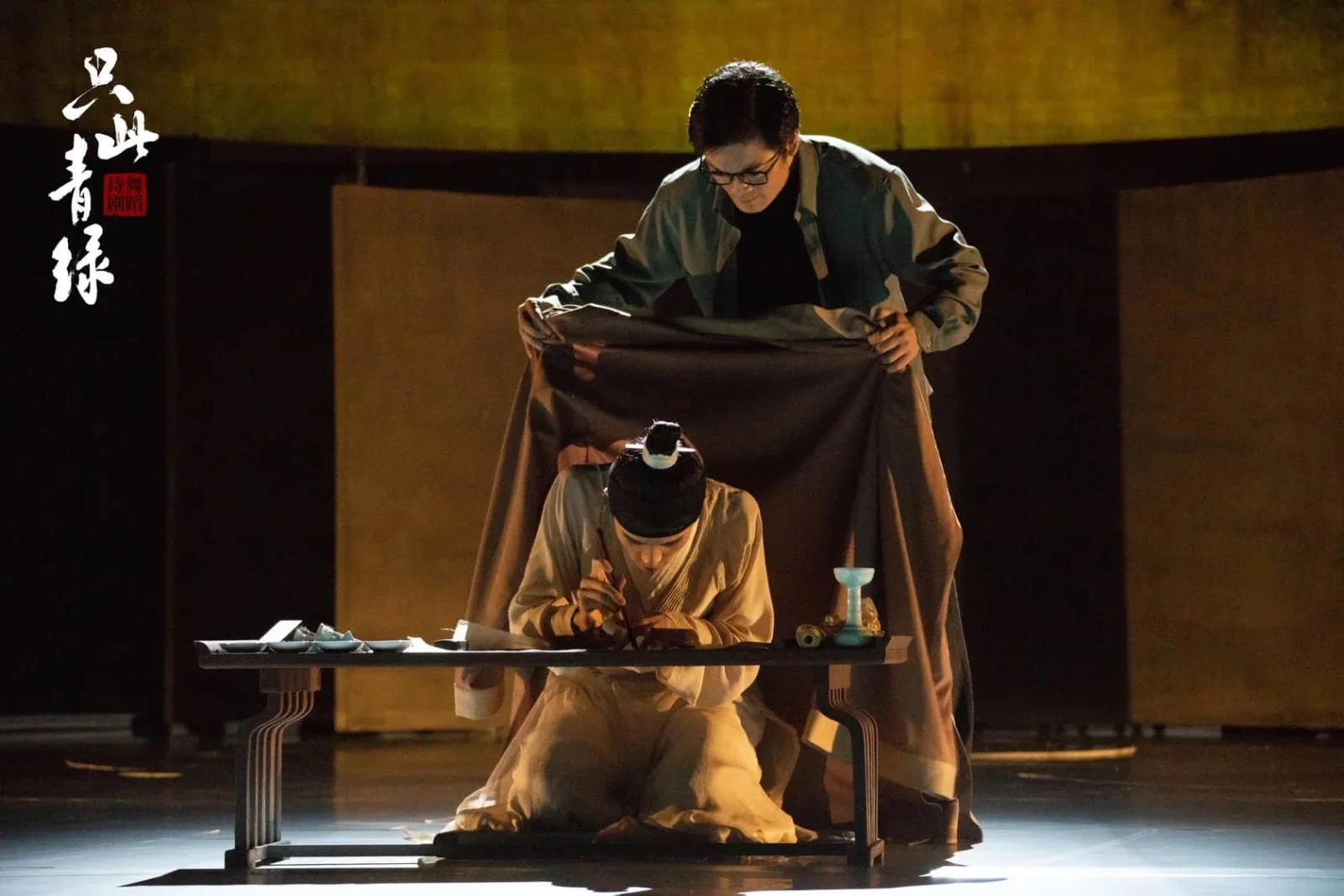
The researcher travels across time and space to meet the young artist Ximeng at work. Image courtesy of China Oriental Performing Arts Group.
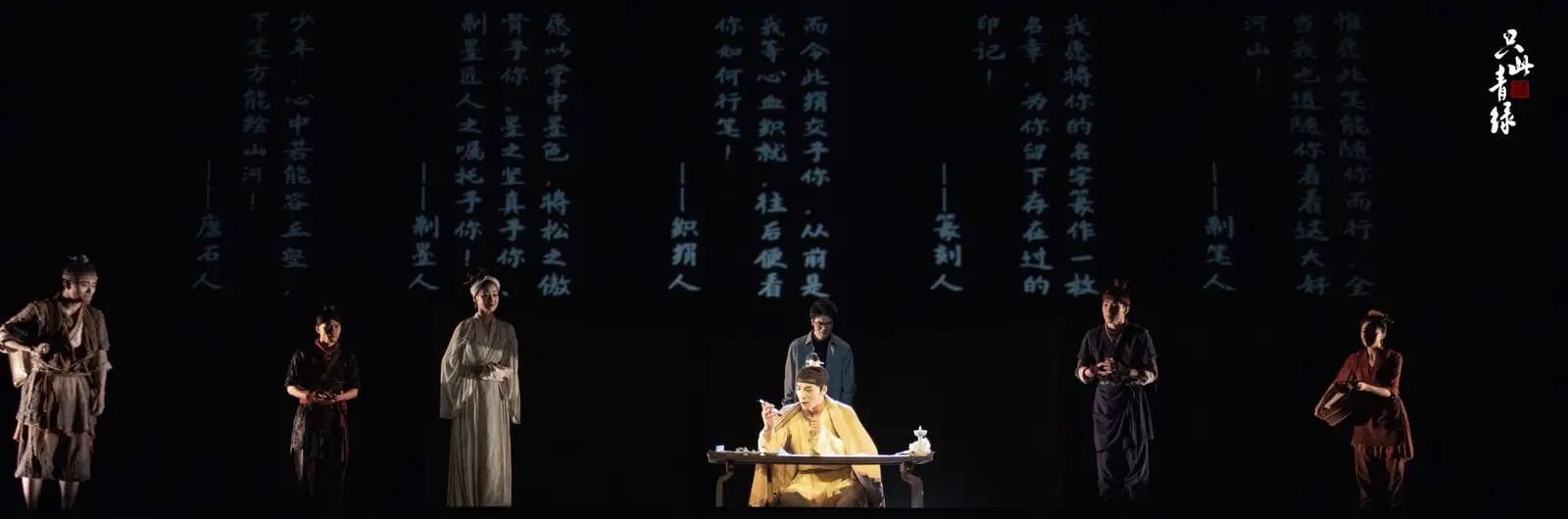
Artisans gather behind Ximeng, each having played a critical role in the painting’s completion. Image courtesy of China Oriental Performing Arts Group.
Every long road has its summit — the moment that makes the entire journey worthwhile. This production saves its summit for the final chapter, “Into the Painting.”
A dozen or so dancers appear onstage, transforming themselves into the blue-and-green landscape. Among the movements is a particularly demanding sequence in which the dancers arch backwards and remain suspended in that position for an extended amount of time. They then move toward the silk backdrop and arrange themselves — some seated, some kneeling, others standing in varied postures — until their water sleeves and flowing robes simulate, before our eyes, into the rolling hills and jagged peaks of Ximeng’s scroll.
It is not paint that brings this handscroll of landscape to life, but the dancers’ bodies caught in motion.
Sitting there, I find myself thinking: this is what A Thousand Li of Rivers and Mountains might look like if it were painted today, in the 21st century, not with brushes but with bodies. It is the kind of scene that makes an entire evening worthwhile, much like hiking for hours just to reach a single breathtaking view.
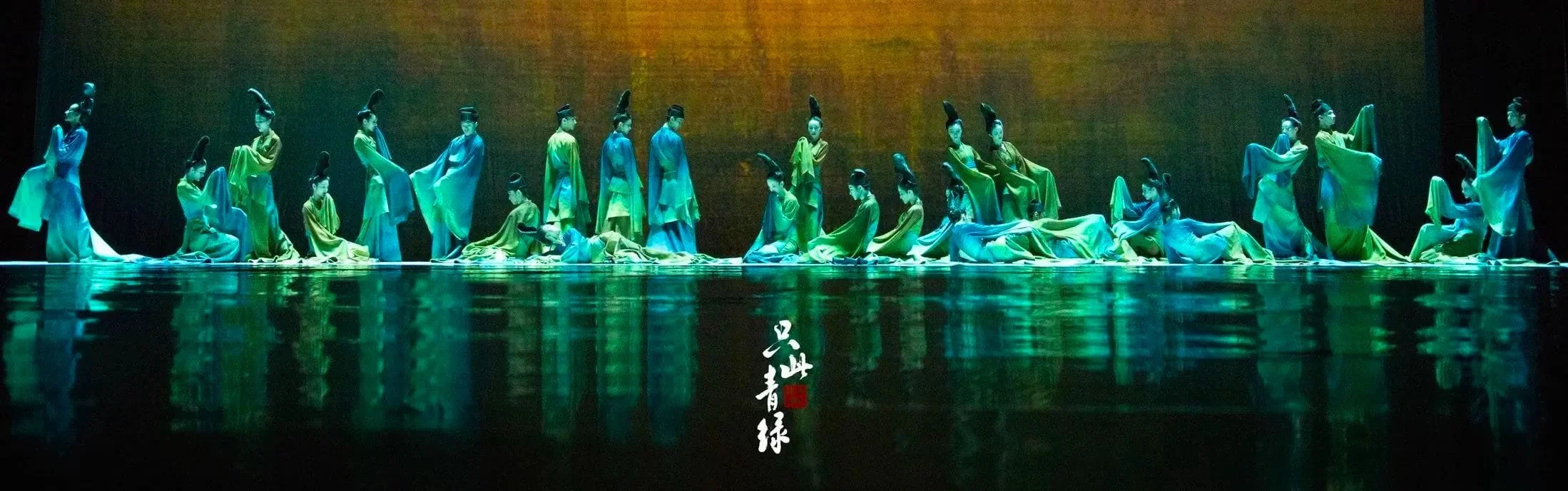
The 12th-century masterpiece is reimagined by dancers on stage in The Journey of a Legendary Landscape Painting. Image courtesy of China Oriental Performing Arts Group.
In the closing scene, the exhibition opens and visitors from all walks of life stream in to admire this one-of-a-kind masterpiece. As the crowd gradually disappears, the researcher and Ximeng find themselves standing at opposite ends of the painting, facing each other across nearly a millennium.
The researcher bows respectfully to the artist, as though the gesture were being offered on behalf of all of us — everyone who has ever stood before this scroll and felt something within themselves transformed.
If I have one disappointment about this journey, it is the path the production chose not to take. Emperor Huizong (reigned 1100–1126) — the Song emperor who was himself a celebrated painter and who, according to historical accounts, may have personally guided the young Ximeng through the creation of the work — never appears.
Some scholars have even suggested that Ximeng may have been a name used by Huizong himself. The sheer extravagance of pigment layered across twelve metres of silk suggests imperial patronage, if not royal hands. And there’s another remarkable detail: despite its immense scale, the painting was completed in only half a year. Ximeng, exhausted by the effort, is said to have died not long after putting down his brush.
Whoever Ximeng was, the journey he undertook to bring this landscape into existence remains undeniable. What he left behind is not just an imaginative terrain, but something closer to the shared utopia that Chinese literati have long envisioned across centuries: an idyllic refuge where the heart still longs to wander, and perhaps finally find rest.
The Journey of a Legendary Landscape Painting first premiered in Beijing in 2021 and has since become a cultural phenomenon across China, picking up awards and touring beyond its borders. This September, its journey continues to New York’s David H. Koch Theater, as it moves closer toward the milestone of its 1,000th performance in October. If you find yourself anywhere along its path, follow it.
Some journeys are worth taking twice: once as a painting and once, poetically, as a dance.
Poetic Dance: The Journey of a Legendary Landscape Painting was staged at National Theatre in Taipei, Taiwan, from July 2-5, 2026.