
The Abode of Maya: Zhang Daqian’s Final Residence
Wandering through Zhang Daqian’s final home, you’ll find stopped clocks, a photograph with Picasso, and a garden where the master himself is laid to rest.
Sense of Wander: ★★★☆☆
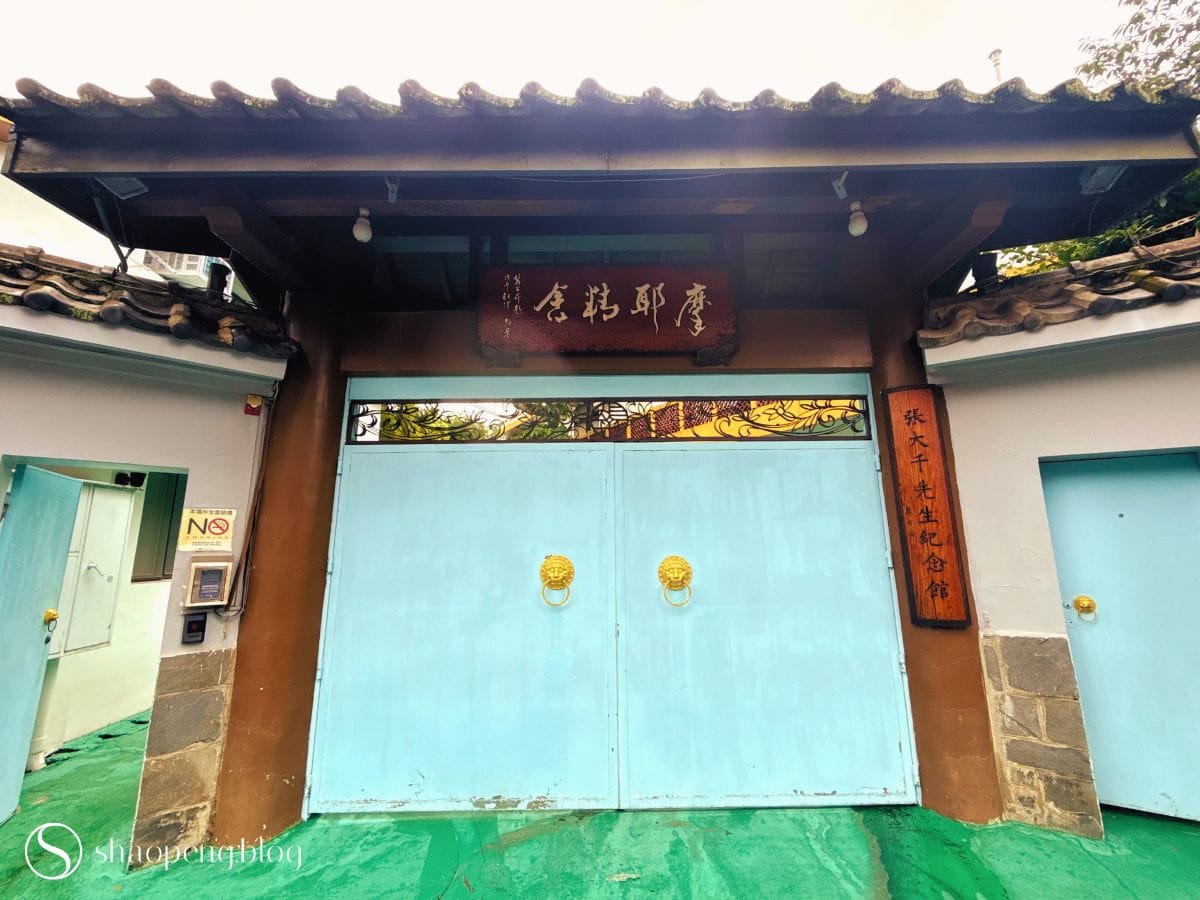
The entrance gate to the Abode of Maya.
TAIPEI, Taiwan — For over a thousand years, ink painting has occupied a central place in Chinese art, where a dialogue between brush, ink, and paper flow in the act of creation. Through landscapes, flowers, birds, and figures, generations of painters have sought not just to depict the visible world but to capture its spirit.
Among the masters who carried this tradition into the modern era, few names are as celebrated as Zhang Daqian (1899–1983). Born in Sichuan, he’s often regarded as one of the greatest Chinese painters of the 20th century — both a guardian of tradition and a restless innovator, equally at home in meticulous gongbi brushwork and the wild, splashed-ink compositions that chartered new territory for Chinese ink painting.
Over a long and wandering lifetime, he travelled across Asia, Europe, and the Americas, becoming one of the most internationally recognised Chinese artists of his generation.
After decades abroad, Zhang was invited to settle in Taiwan in 1976, and it was here, tucked into the foothills of Taipei, that he built his final home — a place he called the Abode of Maya (摩耶精舍).
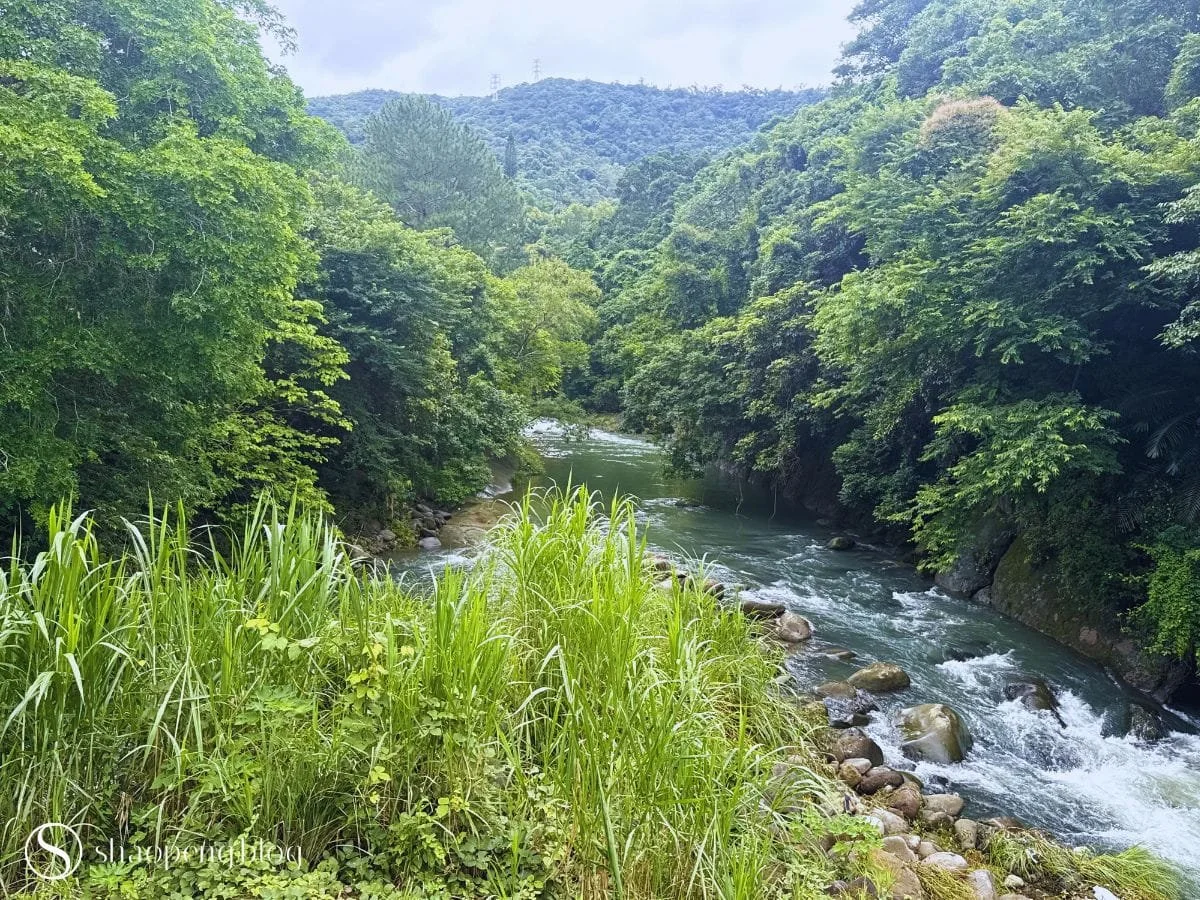
View from the pavilion in the Plum Garden overlooking the point where the river diverges.
Finding the Abode
Today the residence sits almost shyly among the modern villas of Taipei’s Waishuangxi district, easy to miss if you’re not looking for it. But when Zhang first chose this plot of land, it must have felt like a retreat emerged from one of his own paintings.
The site lies at the meeting point of two rivers, with water gathers around the property and mountains rise behind it. The neighbourhood has filled in since then, but if yo wander slow enough, you can still see traces of the original landscape that drew him here.
Zhang Daqian was born Zhang Yuan, but the name he became known by — Daqian — comes from the Buddhist idea of the “Great Thousand Worlds”, an immense, interlocking cosmos rather than a single world. For a man whose travels stretched from the cave murals of Dunhuang to the Andes and the forests of Brazil, the name fits almost inevitable.
The residence’s own name carries a different weight. Maya, in Buddhism, refers to illusion — the shifting, transient nature of the world we move through. Standing before one of Zhang’s paintings, it’s hard not to recall this idea, where mountains, clouds, and water dissolve into a liminal space between reality and dream.
Entering the residence, you are greeted by a pond edged with greenery. Above the entrance, the building’s turmeric-yellow facade — evoking a subtle Tibetan sensibility — catches the light, while a gold inscription gifted by Chiang Ching-kuo (1910–1988), former President of the Republic of China, marks the esteem Zhang held in his lifetime.
Off to one side sits his car, preserved almost as if it were still in use. It reminds us that behind the legend was a man who lived in the modern world, someone who might needed to step out at any moment for ordinary errands, like anyone else.
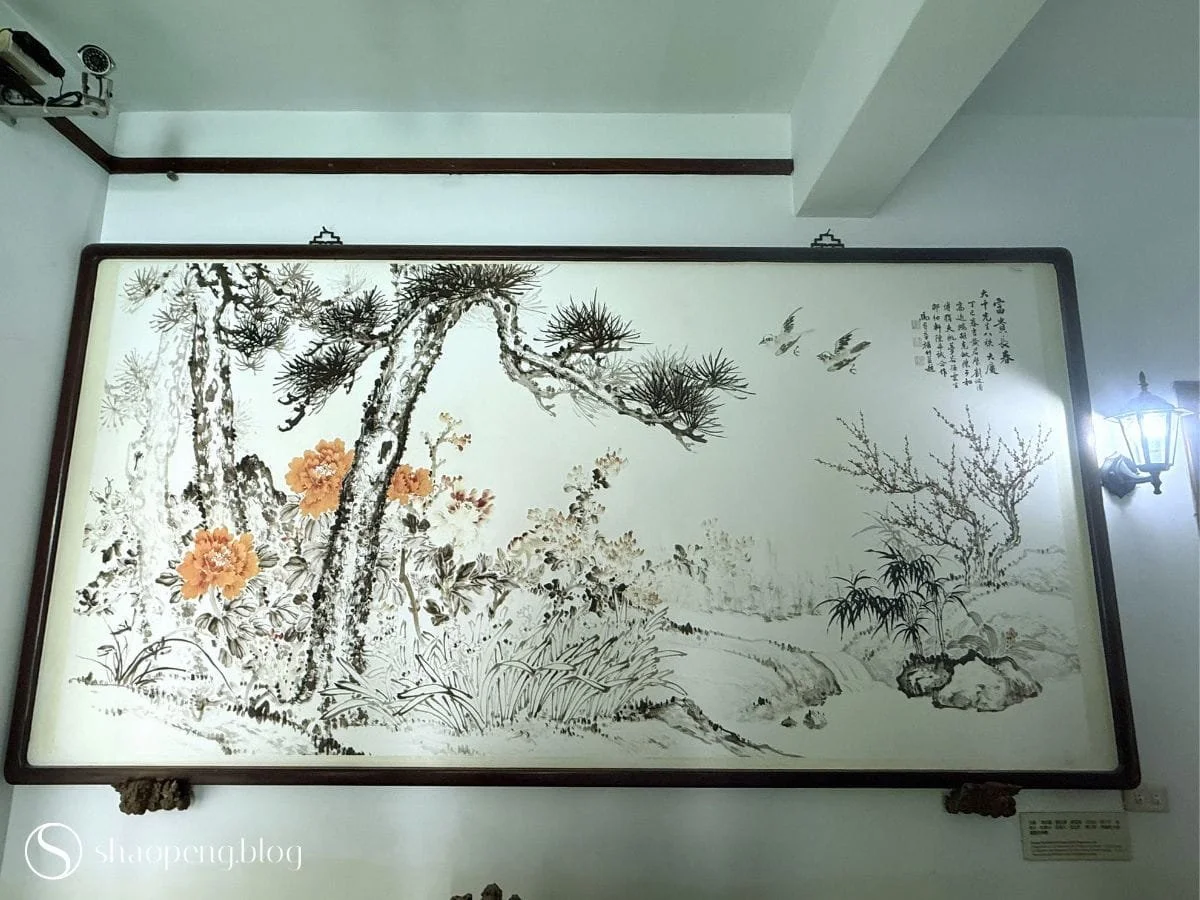
A Long and Prosperous Life, a painting gifted to Zhang Daqian by his peers.
Rooms Filled with Memories
Step into the dining room and you enter into Zhang’s social world. Just outside hangs A Long and Prosperous Life, a painting created jointly by eleven artists as a birthday gift. Wander further and you would notice a subtle detail: every clock in the house is stopped at 8:15, the hour of Zhang’s death. Time here doesn’t move forward, but remains suspended.
The meeting room reveals another side of him. Shelves are lined with books, while prized scholar’s stones are arranged with the restraint of a serious collector. On one wall hangs a photograph that often arrests visitors: Zhang Daqian and Pablo Picasso, two masters of entirely different traditions, standing side by side.
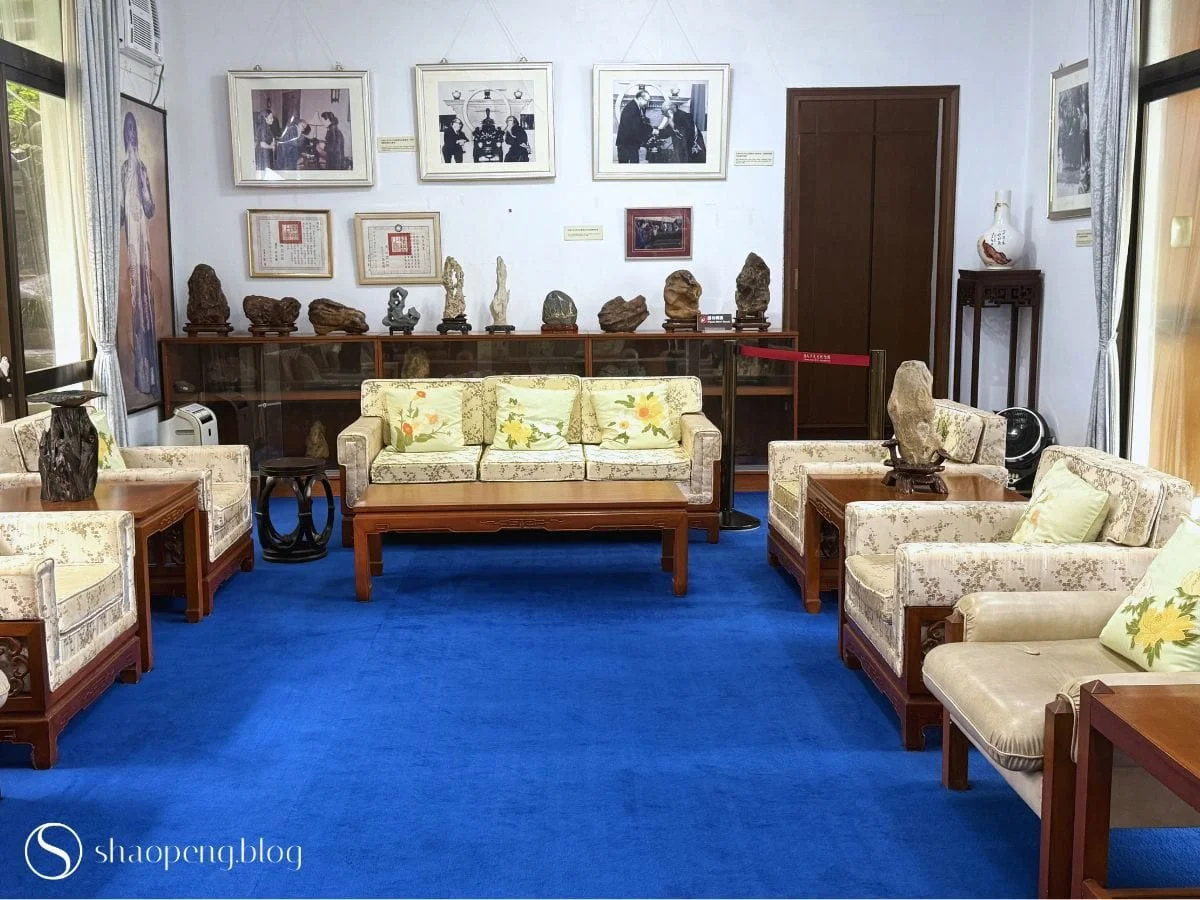
The residence’s main meeting room.
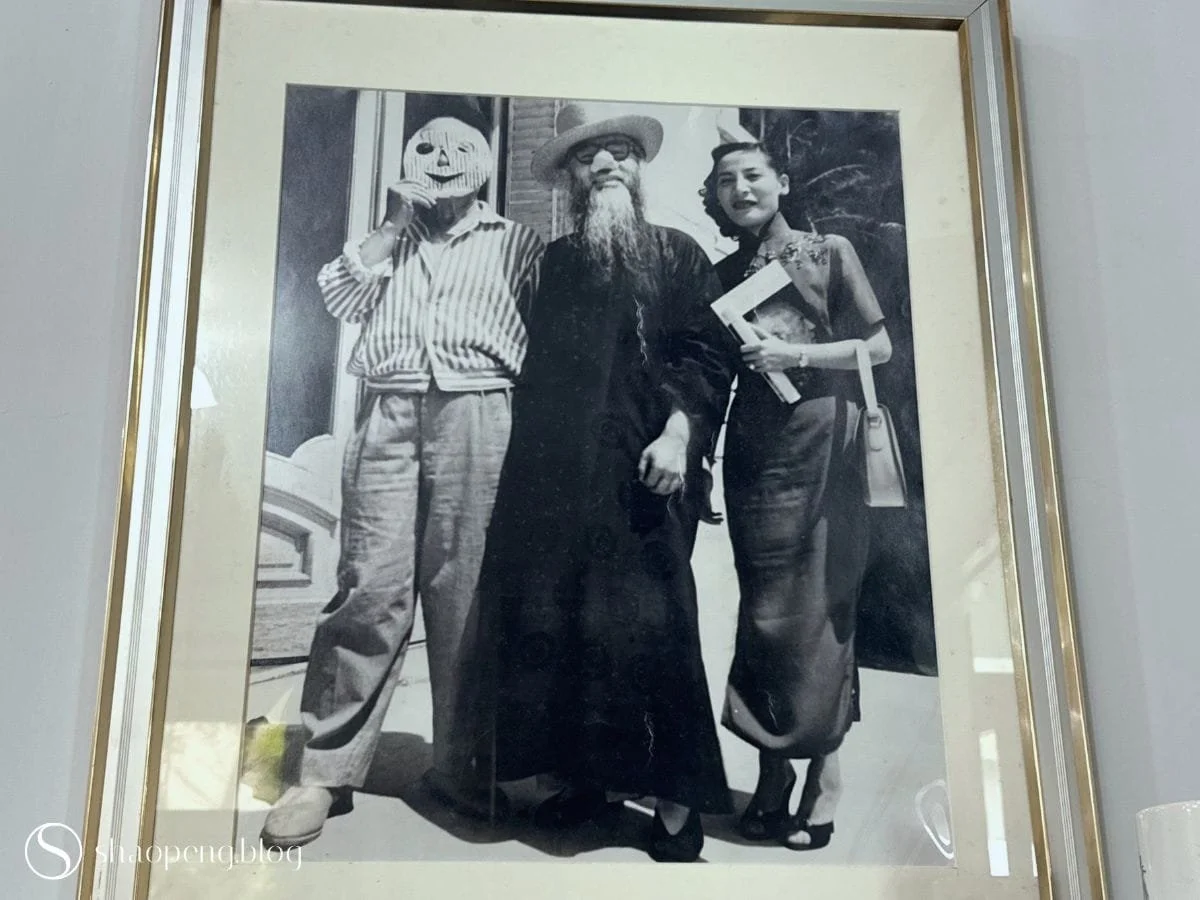
A photograph of Zhang Daqian (centre) and Pablo Picasso (left) taken in 1956.
My favourite room is the painting studio. A mannequin of Zhang stands at his desk, poised as if still in the act of painting. Next to it is a preserved specimen of his beloved black gibbon. According to family lore, the night before his birth, his mother dreamed of an old man presenting her with a black gibbon; the following day, Zhang was born. He was therefore named Yuan — the word for gibbon itself. Peacocks and cranes once lived here too, companions that lingered in the residence long after the artist’s passing.
Zhang began painting in childhood, first taught by his mother, Zeng Youzhen (1861–1936), herself skilled in the delicate gongbi tradition of flower-and-bird painting. A copy of her work Cat and Butterfly hangs here as a testament to her expertise. Later, he studied in Shanghai under Zeng Xi (1861–1930) and Li Ruiqing (1867–1920), absorbing poetry, painting, and calligraphy as a single continuum of practice. He was also trained in Japan, where dyeing and textile techniques sharpened his sensitivity to colour. At one point, he briefly became a Buddhist monk, and later travelled to China’s far west to copy the ancient murals of the Dunhuang grottoes — a journey that left its mark on everything he painted thereafter.
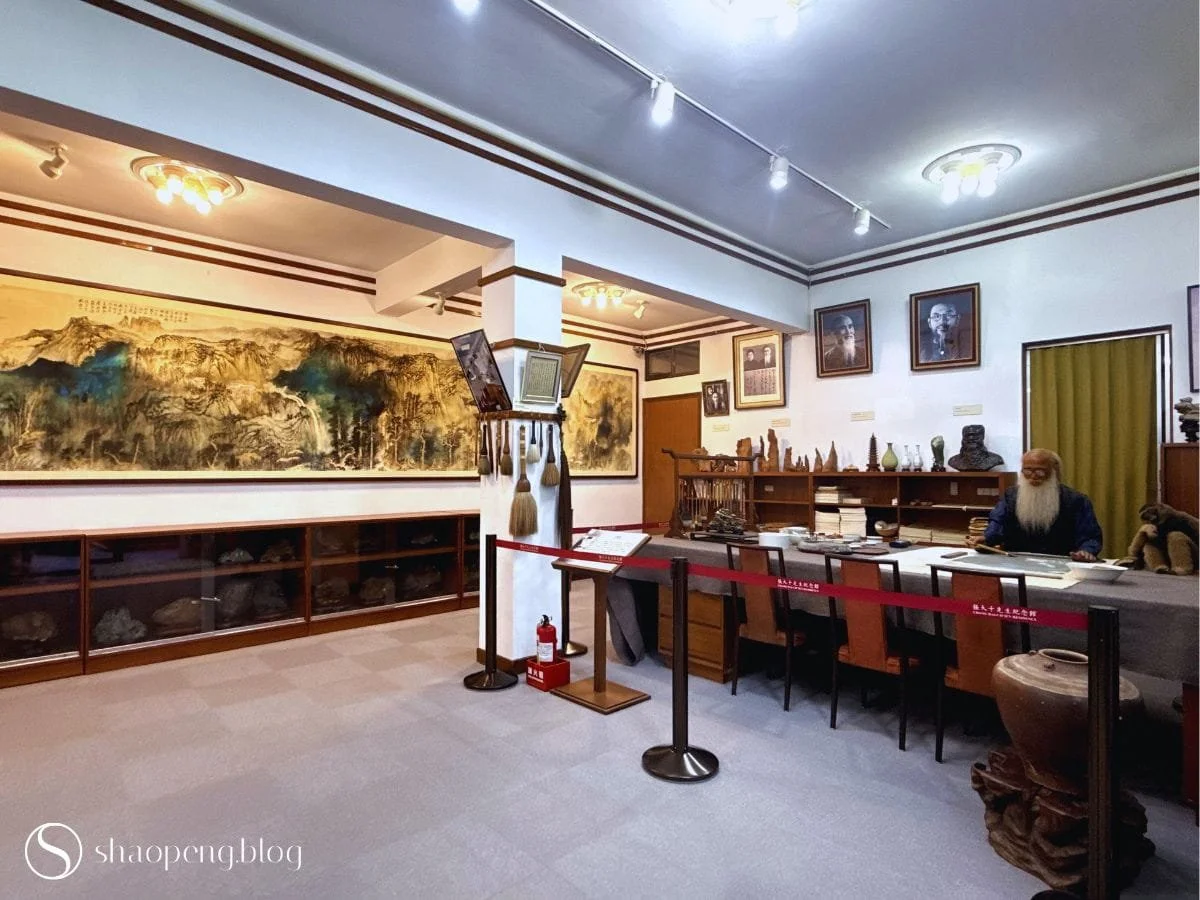
Zhang Daqian’s studio within his residence.
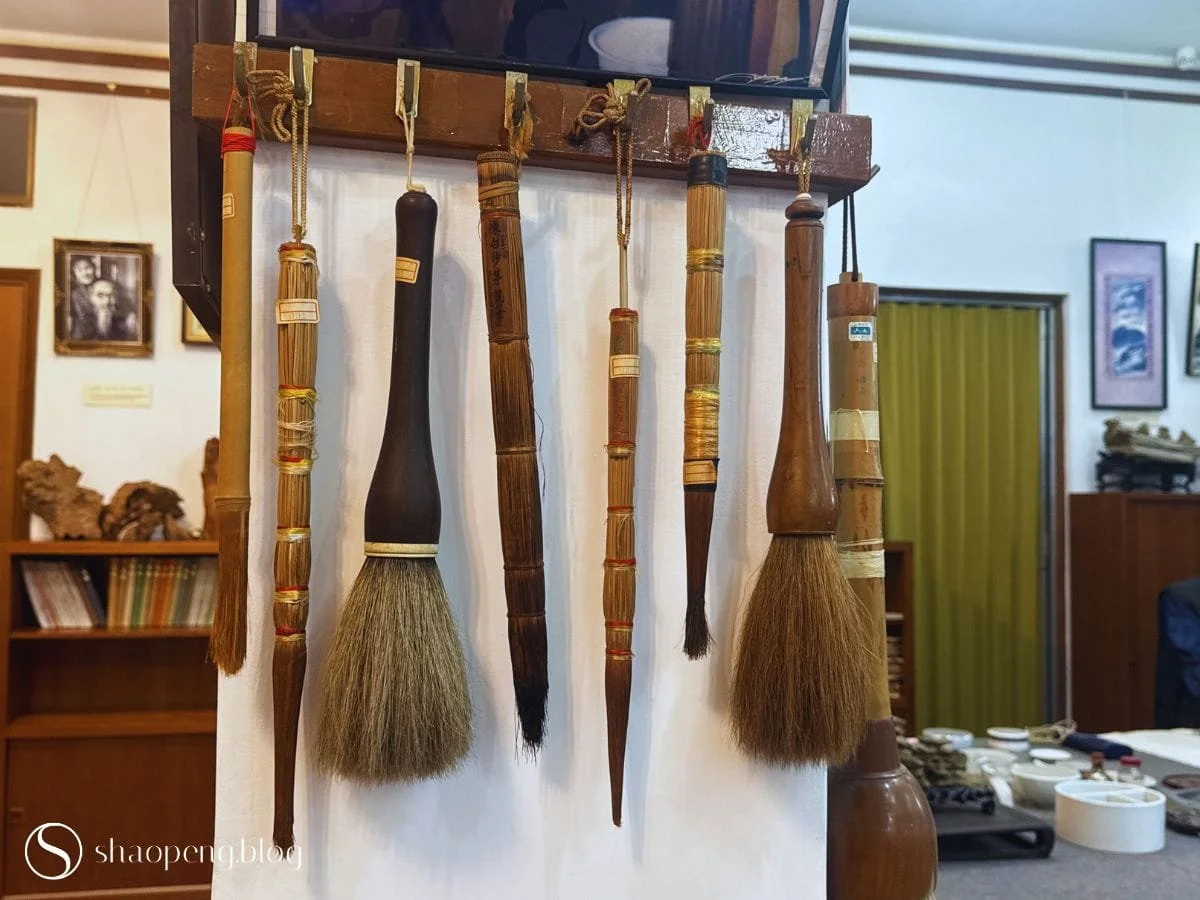
His studio is filled with brushes of different types and sizes.
The studio remains cluttered with brushes and other painting tools, as though work might resume at any moment, while on the wall a replica of his final painting brings the story to a close.
All these rooms open onto a central garden. It is easy to imagine Zhang at the window, watching the seasons shift: flowering trees, the chattering sound of a small waterfall, and light changing through the day. The garden does not feel separate from the studio so much as an extension of it: a living field of inspiration for the artist’s gaze.
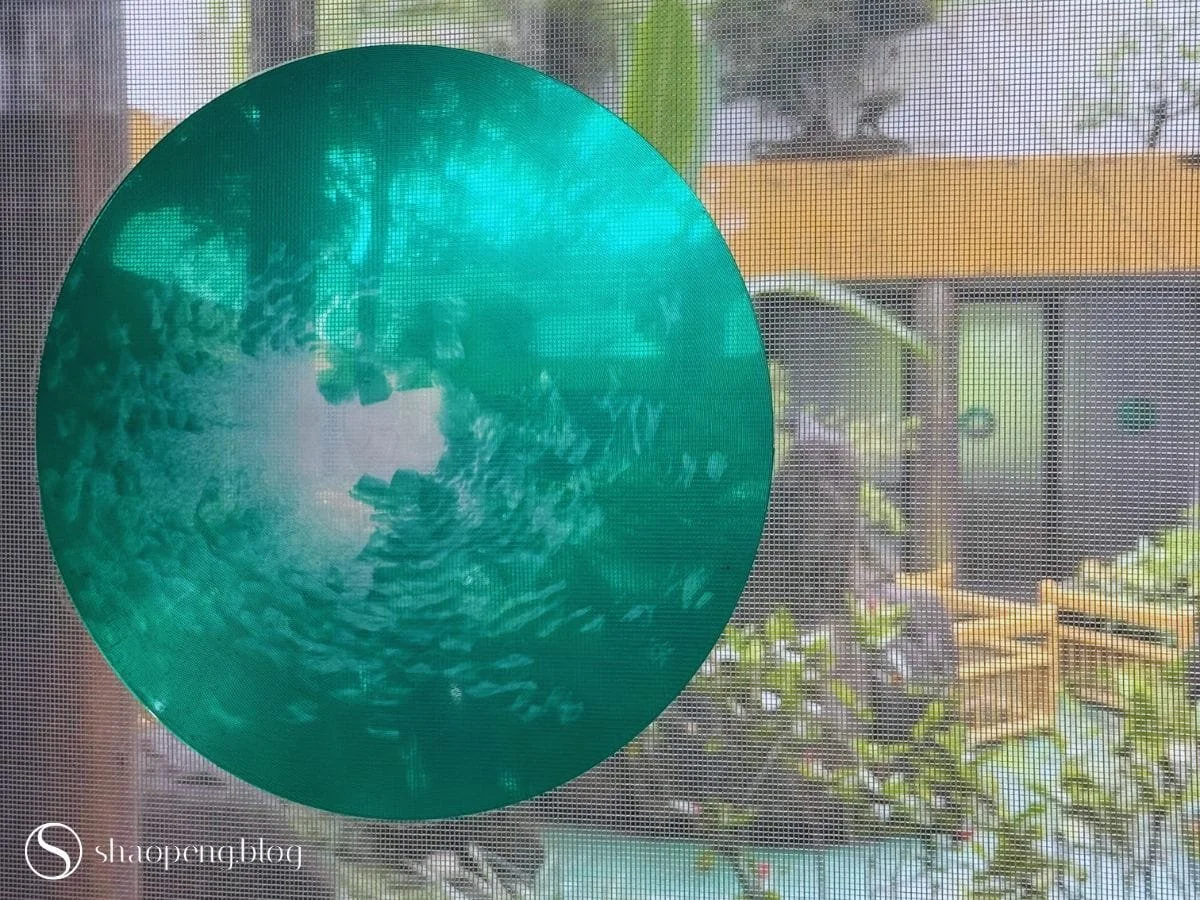
Optical lens as such create a magnifying effect, allowing Zhang to view the garden from within the room.
The Plum Garden
At the back the residence lies the Plum Garden, where Zhang was laid to rest.
Inside, a banana tree brought originally from Brazil blooms with a soft pink flower, while lotus plants mark the turning of the seasons. There is something unique about seeing lotus here, given that it was one of Zhang’s most beloved subjects and among what he is best remembered for painting.
A more unexpected presence is a Mongolian barbecue stand. Despite its name, the dish has no real roots in Mongolia; it was actually invented in Taiwan. Nearby sit rows of ceramic urns brought from Zhang’s native Sichuan, once used for fermenting the pickles he loved.
In a corner of the garden, a pavilion overlooks the point where the river diverge, their waters flowing in two directions. The view feels composed rather than simply found. Standing here, you might even think of Mesopotamia, one of the earliest civilisations formed between two rivers, and begin to understand why Zhang chose this plot of land in the first place. Mountains, water, and sky come together like an ink painting drawn by nature’s hand.
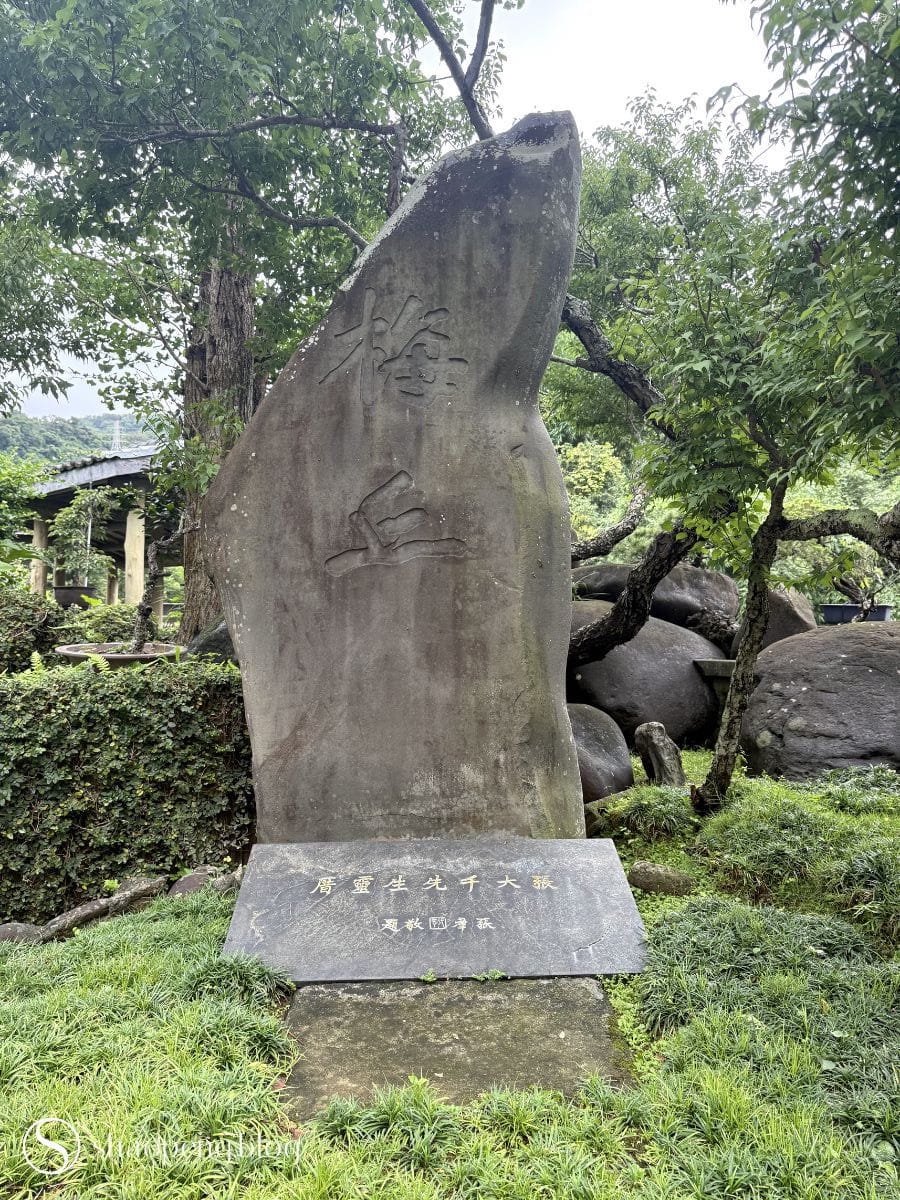
Zhang Daqian’s resting place in the Plum Garden.
The Unseen Second Floor
One part of the house, though, remains closed to visitors.
The second floor houses a zhuangbiao (mounting) studio, the very room that first drew me here. Zhang was famously exacting about how his works were mounted and framed, and he kept a specialist mount-maker living on site, devoted entirely to the mounting of his paintings.
For anyone who has spent time learning that craft, as I have, this room carries a particular pull. Mounting is sometimes called the “second creation” of a work of painting or calligraphy — the unseen labour that determines not only how a piece is displayed and perceived, but whether it survives at all. That Zhang maintained a dedicated studio for this practice, tucked away upstairs, says something about how seriously he treated every stage of making art, including those few ever notice.
I leave without ever setting foot in that room, and somehow its absence feels appropriate. Some spaces remain beyond reach. Sometimes, closed doors say more by staying closed. And perhaps that is fitting for a house named after illusion.
The Abode of Maya does not reveal much more than what can already be found in texts about the artist, but it does bring you closer to Zhang Daqian in another way. You leave not only with the image of a cultivated scholar, a lover of animals and gardens, but of a man who spent his life transforming the visible world into something more intangible, more tender, and more enduring than it was before he brought it into being.
Wanderer’s tip — Today, the Abode of Maya forms part of a residential community with restricted access. Visits are only possible through a pre-booked guided tour, with just one tour slot offered each Saturday and Sunday. Now managed by the National Palace Museum, the residence welcomes visitors by reservation, which can be made through the museum’s website.