
“The President’s Cake” in the Kingdom of Reeds
In Hasan Hadi’s The President’s Cake, a schoolgirl’s search for cake ingredients in 1990s Iraq opens a window onto a world where beauty ripples across the water, and fear sits close to everyday life.
Sense of Wander: ★★★★☆
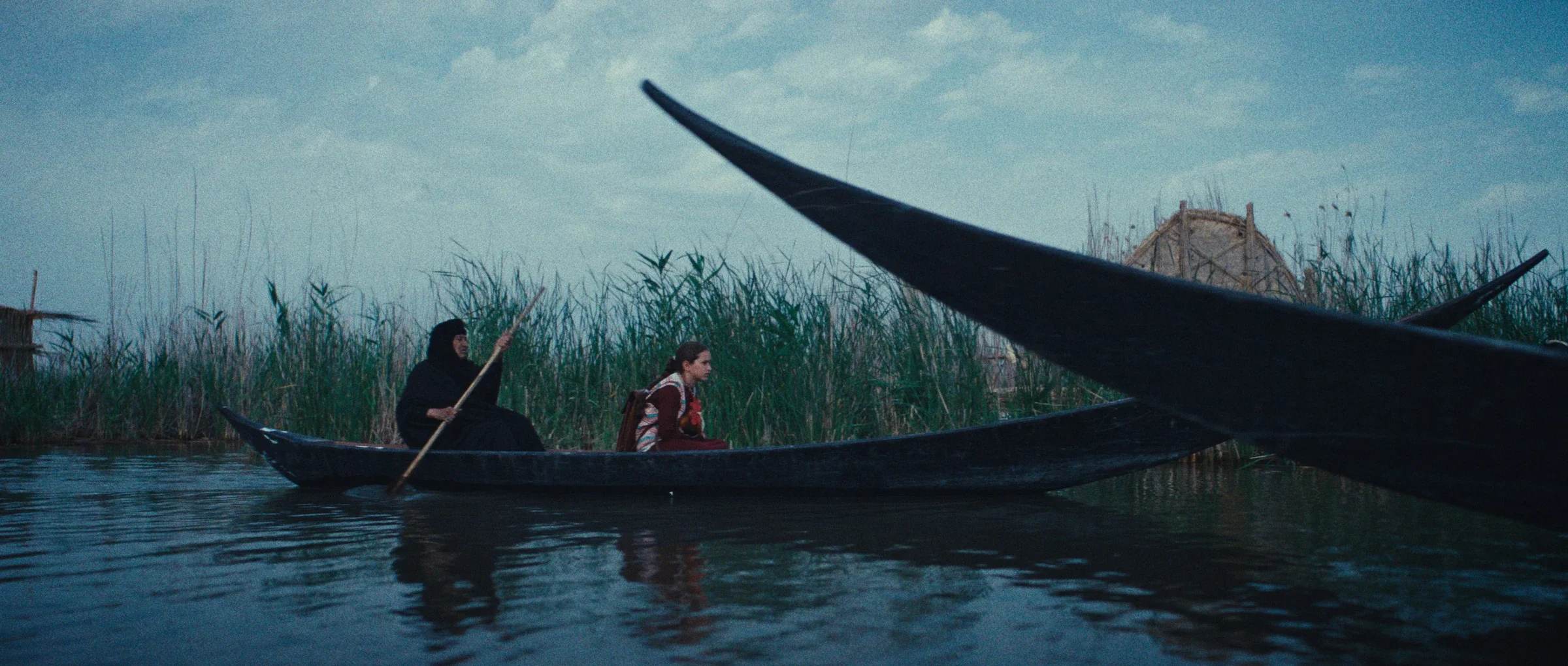
The President’s Cake opens with an idyllic calm amid the Mesopotamian Marshes of southern Iraq.
Spoilers ahead.
TAIPEI, Taiwan — Hasan Hadi’s debut film, The President’s Cake, first finds me through a poster: a man’s portrait sits inside an eight-lobed medallion, blooming with lush vines and flowers glittering in gold. Only later do I learn the face at the centre is Saddam Hussein, who ruled Iraq from 1979 to 2003.
The film takes us to the 1990s and opens with an idyllic portrait of village life. Lamia sits beside her grandmother — whom she calls Bibi — on a small boat gliding through the Mesopotamian marshes of southern Iraq. Here, reeds billowing in the wind are daily companions to a large community whose livelihood depends on these waterways.
Bibi speaks to Lamia as if the marsh itself is listening. She quotes a line from The Epic of Gilgamesh to the nine-year-old:
“God told Gilgamesh: ‘Look into the water, and you shall see your loved one. And God promised those with pure hearts shall see the image of their loved one in the water.’”
It’s one of those lines you carry through a film like a seashell collected from the beach — small, curious, yet heavy with meaning. But the calm of reeds and reflections doesn’t last. The film’s poetry is soon overshadowed by the harsh realities of an authoritarian state and the country’s deepening poverty under United Nations sanctions after the Gulf War, where scarcity is measured in flour, sugar, and eggs.
Yet the regime still demands celebration. Saddam Hussein’s birthday approaches, and each class must produce a cake for the Ba’ath Party leader. In Lamia’s classroom, the teacher — based on a real character — parades his connections and his power; he reminds the children he is an informer, and that obedience here is not a virtue, but survival.
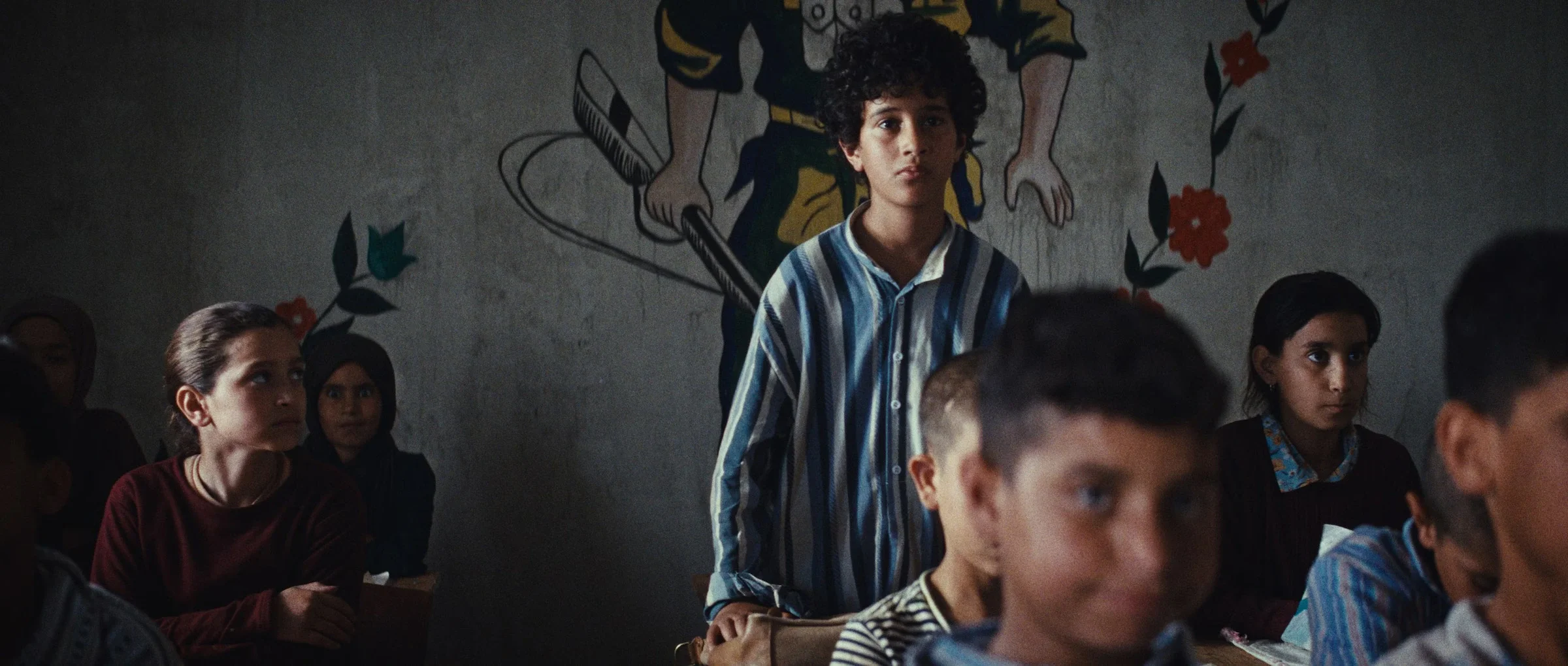
Lamia’s classmate, Saeed, is tasked with bringing fruit for Saddam Hussein’s birthday celebration.
Lamia wins the draw she tried but failed to escape: she’s tasked with baking a cake for the president’s banquet, a patriotic “honour.” Here, the film lets us feel what it is like for a child too young to understand politics — yet old enough to understand punishment — to carry that weight.
Back home, Bibi recites the ingredients like a prayer:
“Three eggs, for fertility. One kilo of flour, for life. 500 grams of sugar, for a sweet life. And baking powder, for a fluffy cake.” While the list sounds like an ordinary recipe to most of us, these modest ingredients are mostly expensive and not readily available in the age of sanctions.
In search of these ingredients, Bibi and Lamia travel from the marshes to the city. Markets are loud with negotiation, and shops carry the weight of suspicion. Even the simplest items are expensive and scarce.
And then the journey takes an abrupt turn. In the city, Bibi has plans Lamia doesn’t fully grasp. In a surge of guilt and panic, the little girl slips away from her grandmother. What follows becomes her own odyssey, with her pet rooster, Hindi, held tight in her arms
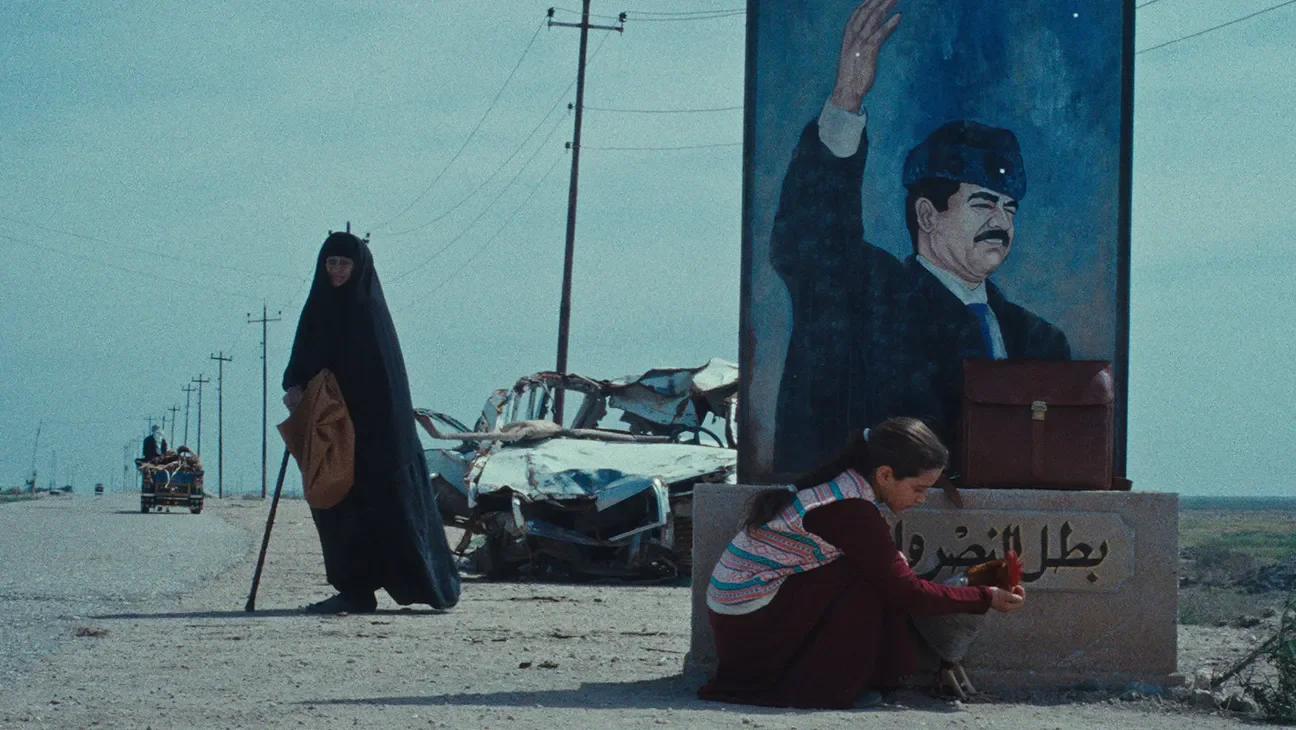
Bibi and Lamia travels to the city to find ingredients for the cake.
From here, The President’s Cake becomes a journey through the regime’s realities. Lamia moves through the city streets, gripping her mission and her fear with the same small hands.
Soon she is joined by Saeed, a classmate whose name has been drawn too. He is tasked with bringing fruits for the celebration. Together they navigate stalls, markets, and warehouses with a child’s logic and stamina: they barter, bargain, trade what they can — and eventually steal. What they go through becomes an intimate portrait of sanctions: “a form of terror,” Hadi says, that cuts into the basics of food and medicine.
Wherever Lamia and Saeed turn, Saddam’s face turns with them — on walls, posters, and billboards. The gaze is constant, silent, and everywhere. Yet they keep finding ways to stay children: a joke here, a small game there. These moments of play don’t erase the misery, but they loosen the pressure just enough for the heart to breathe.
The city, however, is not a place that lets children wander unharmed. Lamia narrowly escapes a predatory shopkeeper. She is caught by police. And then, in a turn that feels almost like the marsh’s mercy in human form, a kindhearted mailman who has been helping Bibi search for her steps in. He rescues the girl and brings her back, carrying not only Lamia, but also the weight of what has been lost.
After Bibi’s burial, Lamia is alone on the boat again. Night thickens the water into a black mirror. She leans in and looks. In the dark, she sees her grandmother’s reflection, as if the marsh itself is reassuring her that love is not absent, if the heart is pure enough.
But Lamia doesn’t have the luxury of mourning for long. The cake still must be made. Saeed’s mother helps her, repeating the same mantra Bibi recited earlier: eggs for fertility, flour for life, sugar for a sweet life. It’s as if naming these ingredients might protect them. Yet the struggle to obtain them becomes the film’s clearest indictment: this simple cake has already cost too much.
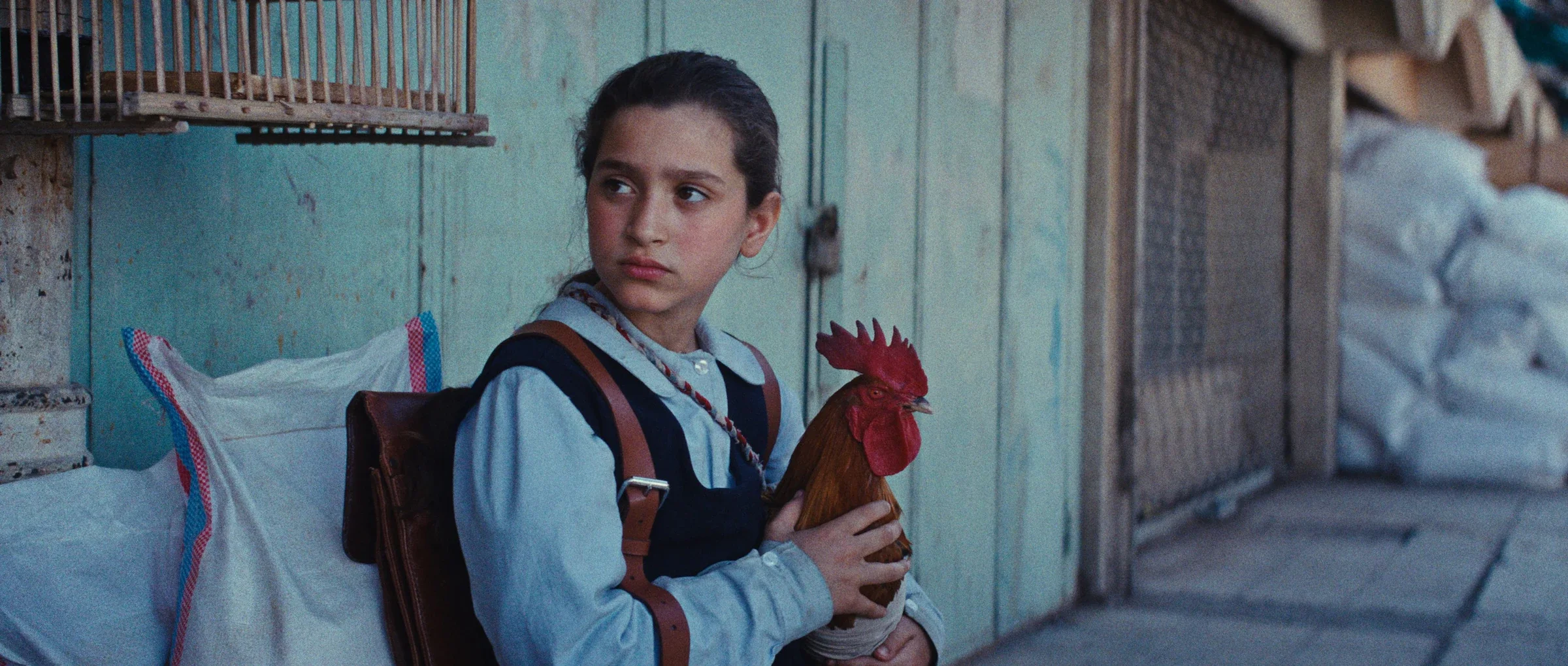
Lamia’s pet rooster, Hindi, accompanies her on an odyssey from the marshes to the city.
At school, the teacher praises Lamia’s cake. Then a missile strikes. The shock is immediate, but what lingers is something poignant: Lamia and Saeed are terrified, yet not surprised. It’s as if the world has trained them to treat catastrophe as weather. They look at each other and play a game — who blinks first — trying to hold fear at bay with the only tool they fully own: childhood. Yet in their eyes, there’s nothing but fear.
The film closes with archival footage of Saddam Hussein celebrating his birthday before a towering cake. By then, we all know what such a cake costs — not in money, but in hunger, humiliation, and lives lost.
The English title, The President’s Cake, centres on the regime: the absurdity of political ritual, and the pressure placed on ordinary people like Lamia and her community. But its Arabic title, مملكة القصب — “Kingdom of Reeds” — tilts the focus toward Iraq’s land and identity.
The “kingdom” is the marsh itself, a landscape woven into Iraqi memory, where ways of life have persisted across millennia. Hadi has said he wanted to take audiences to an Iraq they haven’t seen before. The title makes that intention feel like an invitation: come to the reeds and water, to a place where our people have continued living even when history presses down. Only later do we learn how fragile that kingdom is: the marshes were drained and devastated under Saddam’s regime after the uprisings of 1991.
And reeds, after all, are resilient. They bend. They endure. They survive by yielding to the wind instead of fighting it. In The President’s Cake, that resilience belongs not only to the marshland, but to the people shaped by it, including a nine-year-old girl asked to carry a nation’s performance on her shoulders.
Reference:
Fahim, J. (2025, July 4). ‘The President’s Cake’: Hasan Hadi on Iraq, sanctions and his Cannes-winning debut. Middle East Eye. https://www.middleeasteye.net/discover/presidents-cake-hasan-hadi-iraq-sanctions-and-his-outstanding-cannes-winning-debut