
As you wander from chased metalwork to marble inlay, from jade carvings to exquisite jewellery, and into miniature paintings that seem to hold the whole world in the width of your palm, Treasures of the Mughal Court leaves today’s creatives with an inexhaustible well of inspiration.
Sense of Wander: ★★★★☆
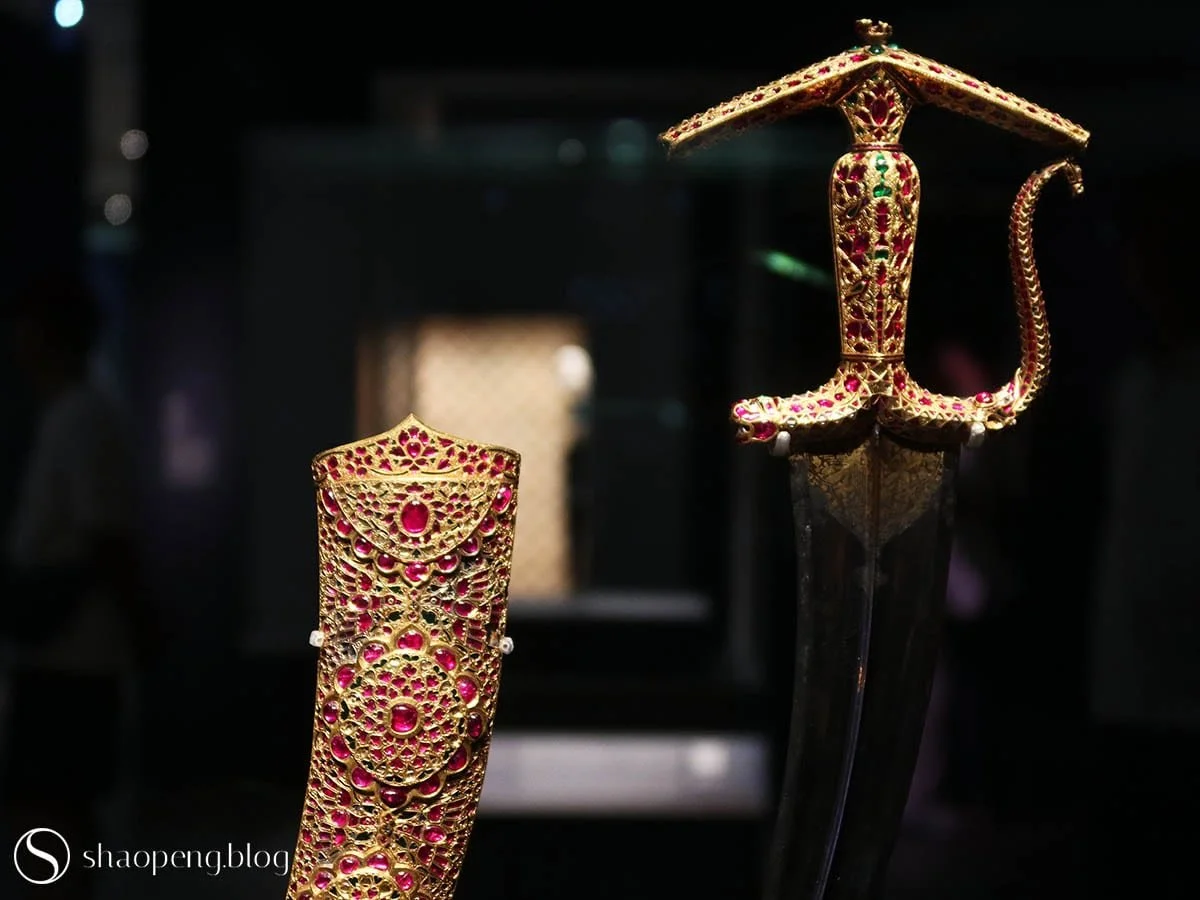
A dagger and scabbard, dated around 1620, richly ornamented with rubies, diamonds, emeralds, glass, ivory, and agate.
HONG KONG — Currently on view at the Hong Kong Palace Museum, Treasures of the Mughal Court doesn’t rush you through history; it invites you to look closely at how the craft of a bygone empire still feels very much alive.
A travelling exhibition from London’s Victoria and Albert Museum — first introduced as The Great Mughals: Art, Architecture and Opulence — the Hong Kong presentation celebrates the extraordinary creative output of the Mughal Empire (1526–1857), with its focus on three reigns that shaped what we now recognise as unmistakably “Mughal”:
Akbar (reigned 1556–1605)
Jahangir (reigned 1605–1627)
Shah Jahan (reigned 1628–1658)
Together, these three emperors built an artistic legacy that grows increasingly self-assured — an imperial aesthetic that reinterprets influences from South Asia, China, Iran, and Europe, and crystallises during the court’s “golden age,” from the 1560s to the 1660s.
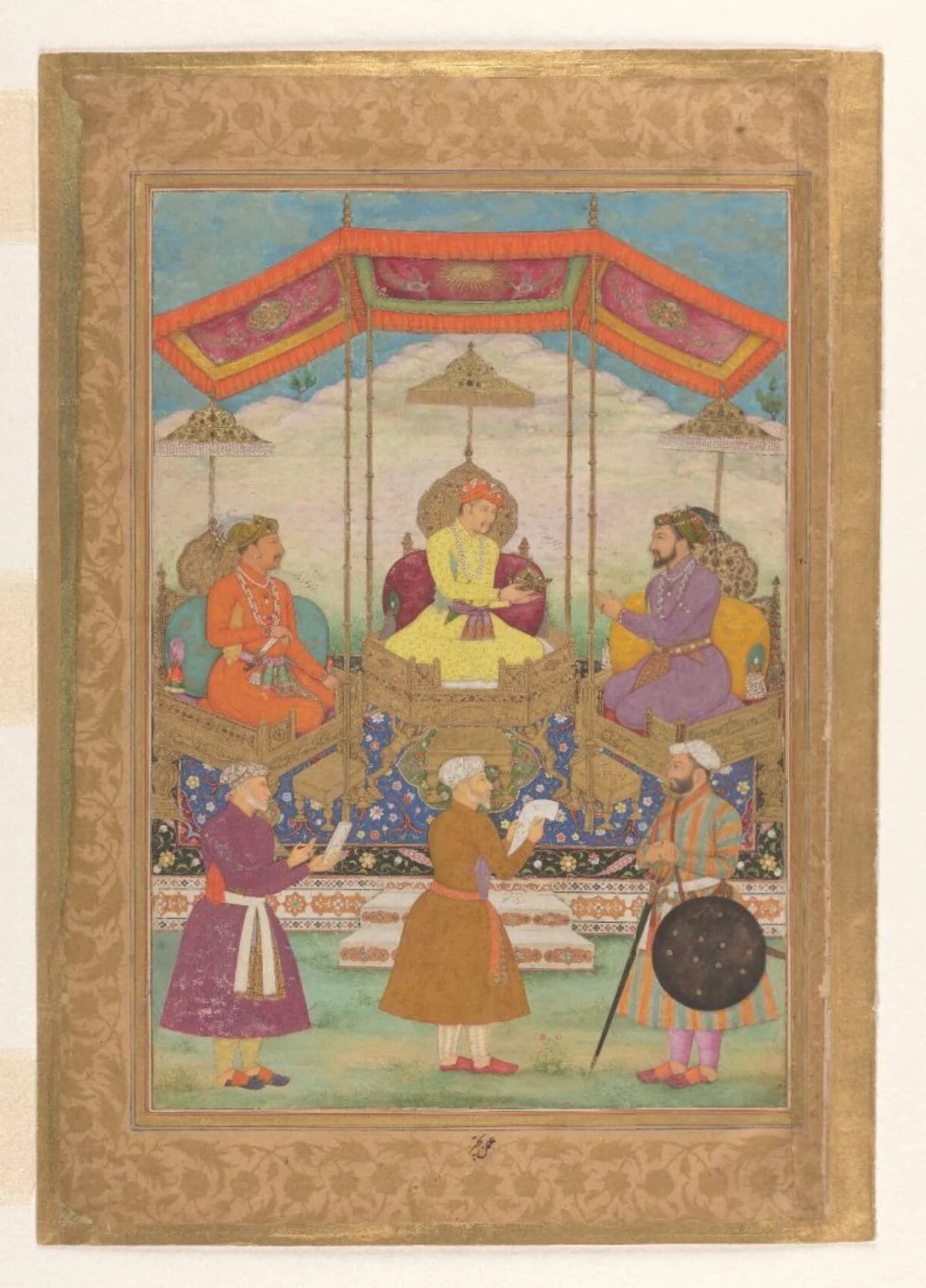
A folio from the Minto Album depicts Mughal emperors Akbar, Jahangir, and Shah Jahan. Image courtesy of Chester Beatty Library.
Inside the galleries, you wander from elegantly chased metalwork and jewelled weaponry — objects that carry both ceremony and threat — to semi-precious stone inlay so precise it recalls the floral surfaces of the Taj Mahal, and into miniature paintings that seem to hold the whole world in the width of your palm.
You step into the exhibition through an immersive installation that draws out the Taj Mahal’s architectural details — an invitation to meet the monument through design and patterns. This mausoleum in Agra is inseparable from its love story: built by Emperor Shah Jahan for Mumtaz Mahal (1593–1631), who died giving birth to their fourteenth child.
The Taj’s making gathered a constellation of talent, and its Quranic inscriptions are closely associated with Iranian calligrapher ‘Abd al-Haqq Shirazi, known by the title Amanat Khan. Persian, the language of courtly culture and administration, threads through the Mughal world: from architecture to albums, from poetry to the titles carved into stone.
The Taj is famous, but the artistic legacy of its patrons — as well as the foundations laid by his predecessors — are less often approached at this distance. Here, the exhibition brings you closer, illuminating how the Taj is the culmination of earlier choices: the establishment of workshops, the gathering of artists, and the sourcing of materials — all of which shaped a distinctive taste.
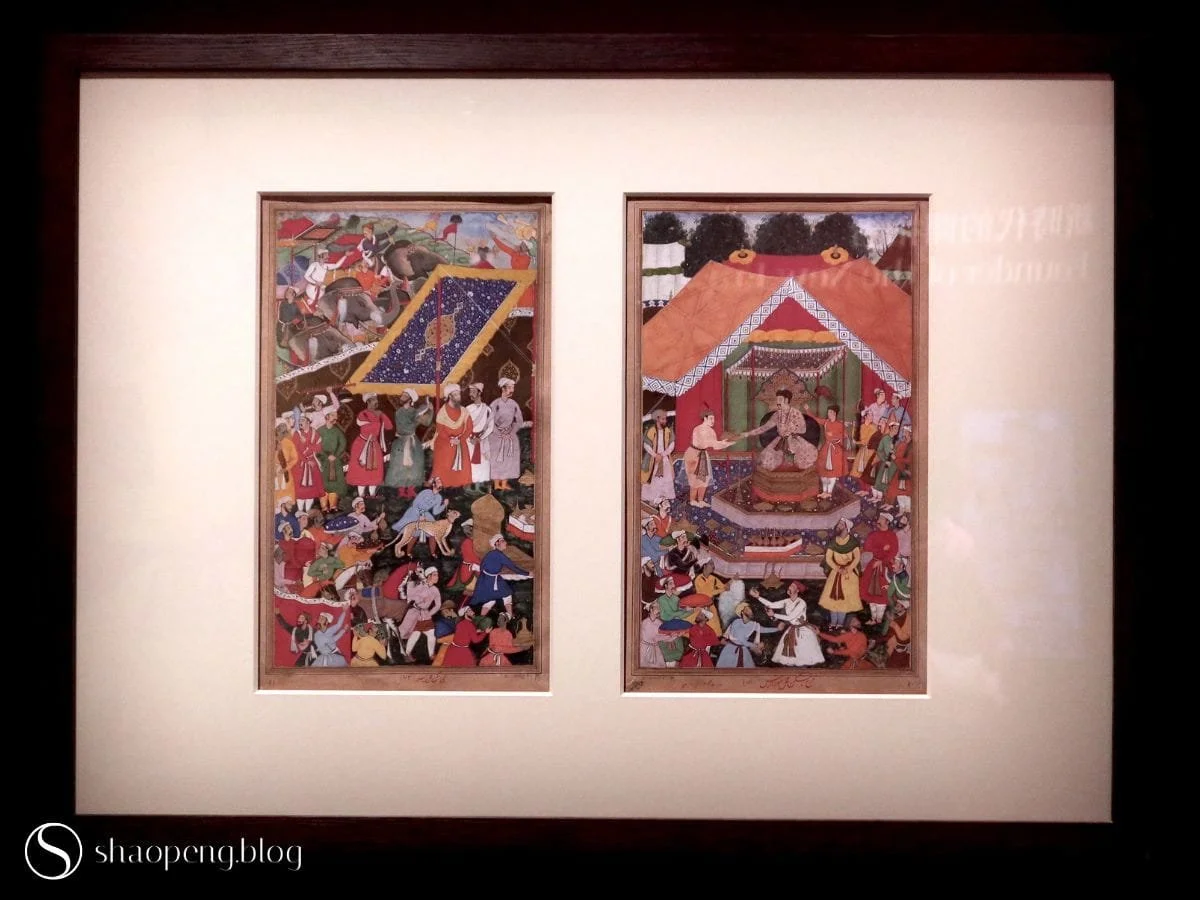
Emperor Akbar being entertained by Azim Khan at Dipalpur in 1571
Akbar: From Empire-Building to Workshops
The golden age begins under Akbar — grandson of Babur, founder of the Mughal dynasty. He took the throne in 1556 at about fourteen, and grew into the emperor who consolidated Mughal power across present-day northern India, Pakistan, Afghanistan, Kashmir, and Bangladesh.
In the exhibition, Akbar’s world is felt in the colour and texture of court life. A miniature painting showing the emperor entertained at Dipalpur stages him at the centre of attention: servants, musicians, performers, and objects of intrigue arranged as if the ceremony itself is another kind of ornament. The scene echoes what court chronicles describe — a culture where gifts travelled in from every direction: bejewelled caskets from the Deccan, gold brocades from Gujarat, brocades from Anatolia, Yazd and eastern Turkestan, and rare cloth from Europe.
Akbar’s legacy is not only territorial. It is infrastructural in the artistic sense: he established imperial workshops that specialisd in multiple traditions, drawing Hindu and Muslim artisans alongside Iranian migrants skilled in painting, calligraphy, weaving, and architecture. Under this patronage, “Mughal” became a meeting point rather than a single origin — an art that learned to absorb without losing itself.
Two vessels on display — a brass ewer and a bronze ablution vessel — make that process visible. The ewer’s fluted body, tapering neck, and animal-head spout lean toward Iranian inspiration. The ablution vessel carries bold naskh inscriptions and floral decoration that evokes Safavid design, while its interior is filled with Quranic text.
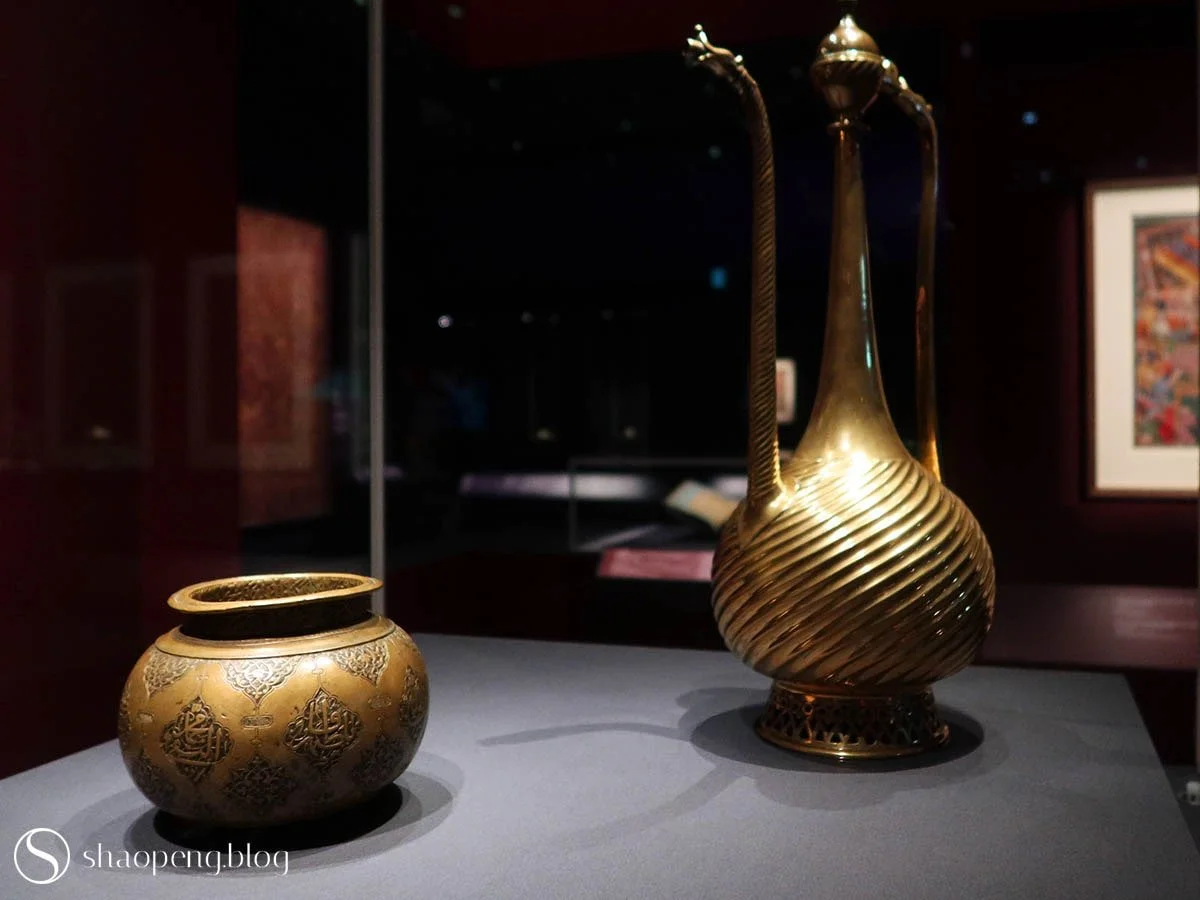
A set of metalwares crafted by Mughal court artisans shows influences from beyond the empire.
From the 1580s, Europe entered the picture as Jesuit missions arrived from Portuguese Goa. The workshops responded not with imitation, but with interpretation.
A Gujarati altar frontal — a wooden panel with ivory inlay — is believed to have been commissioned by Portuguese Christians. It presents Christian imagery: angels before a sacred altar. Along its border runs a Portuguese inscription, Lovvado sea Osantissimo Sacramento (“Blessed be the Holy Sacrament”), flanked by motifs that belong unmistakably to the Mughal imagination: simurgh, elephants, falconers, dancers in court dress.
Ivory, here, was not confined to inlay. It was sculpted in the round as well. A priming flask — made to carry powder for matchlocks — turns a utilitarian object into a carved theatre of birds and animals in combat.
Gujarat’s traditional crafts, such as ivory and mother-of-pearl work, flourished during Akbar’s reign. On display, a selection of mother-of-pearl–inlaid objects takes on vessel shapes derived from European prototypes. This is another proof of how easily forms travel, and how readily the Mughal court makes them its own.
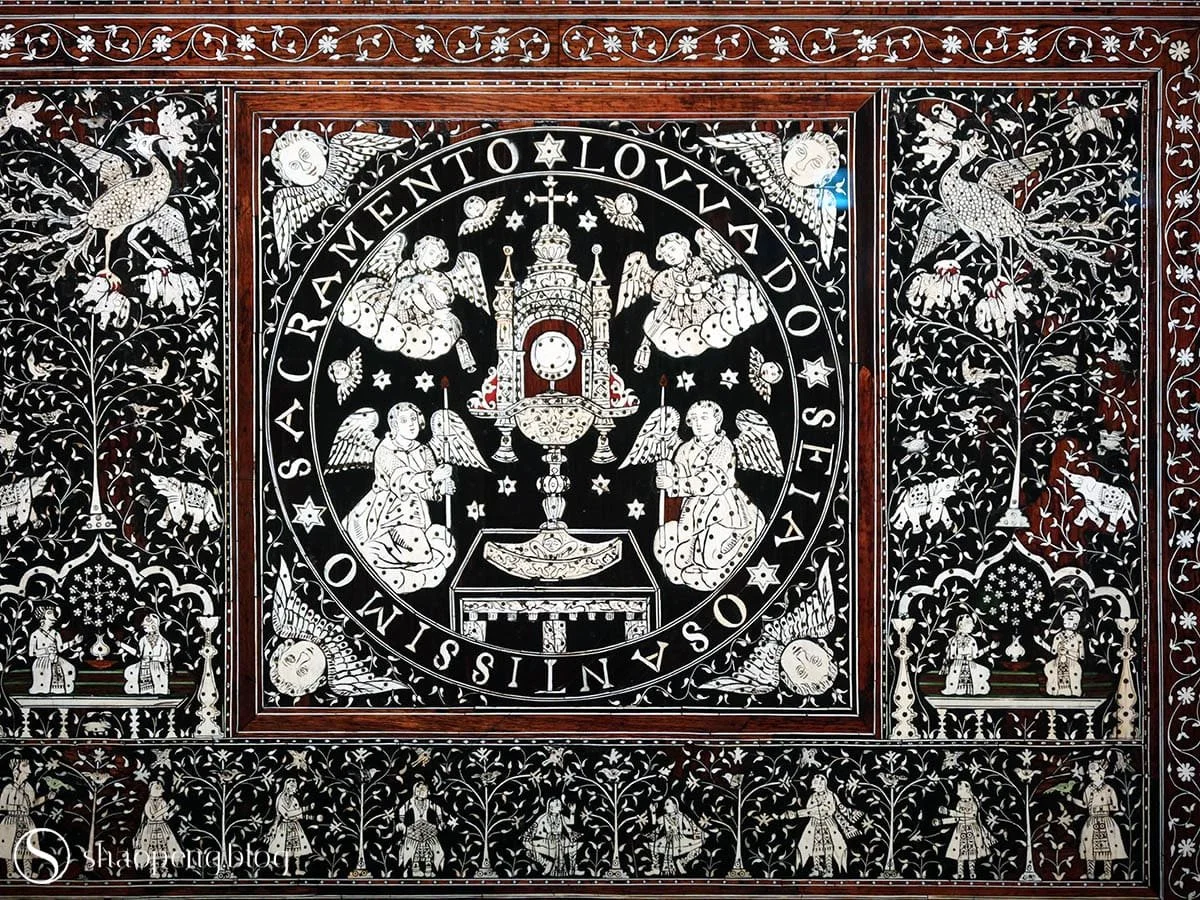
Made in Gujarat around 1600, this altar frontal is adorned with both European and Mughal iconography.
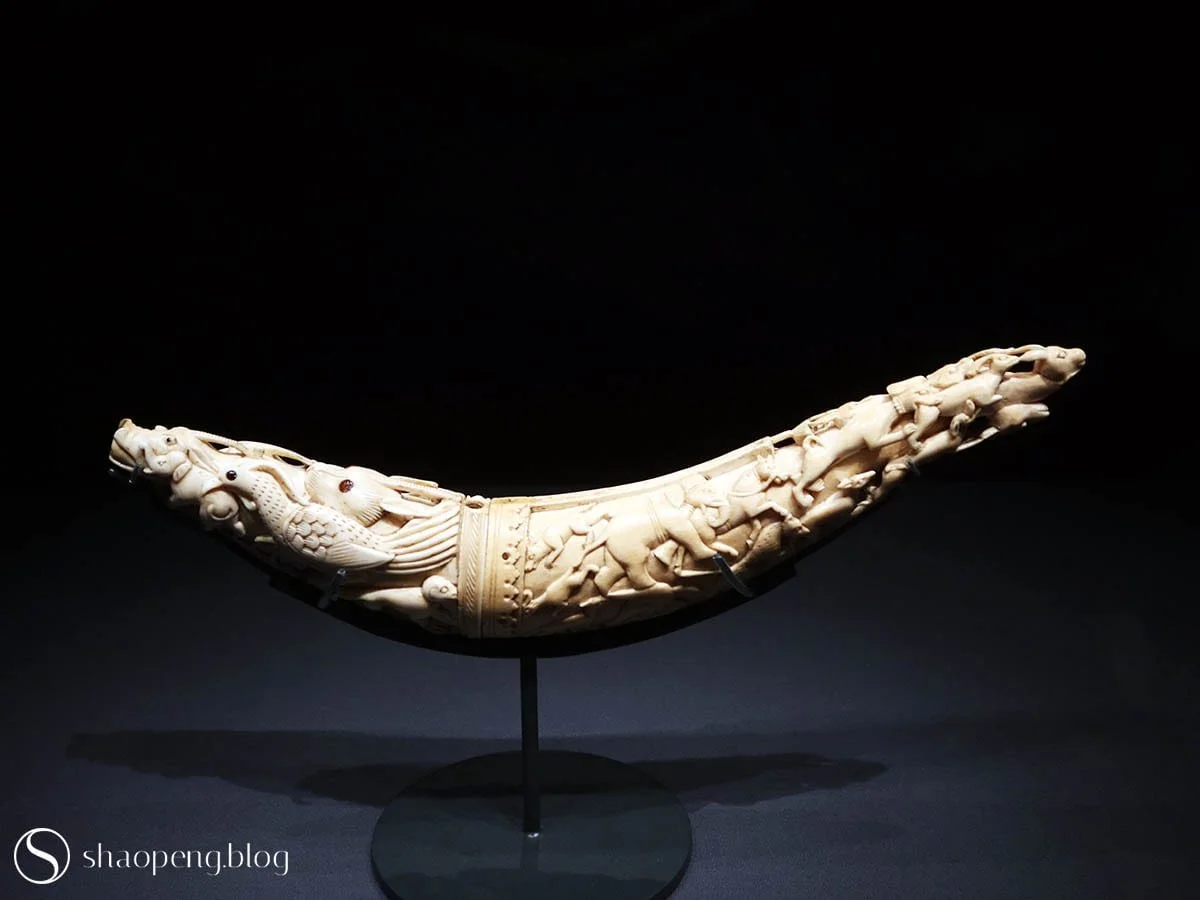
This priming flask captures the height of ivory carving under Akbar’s reign.
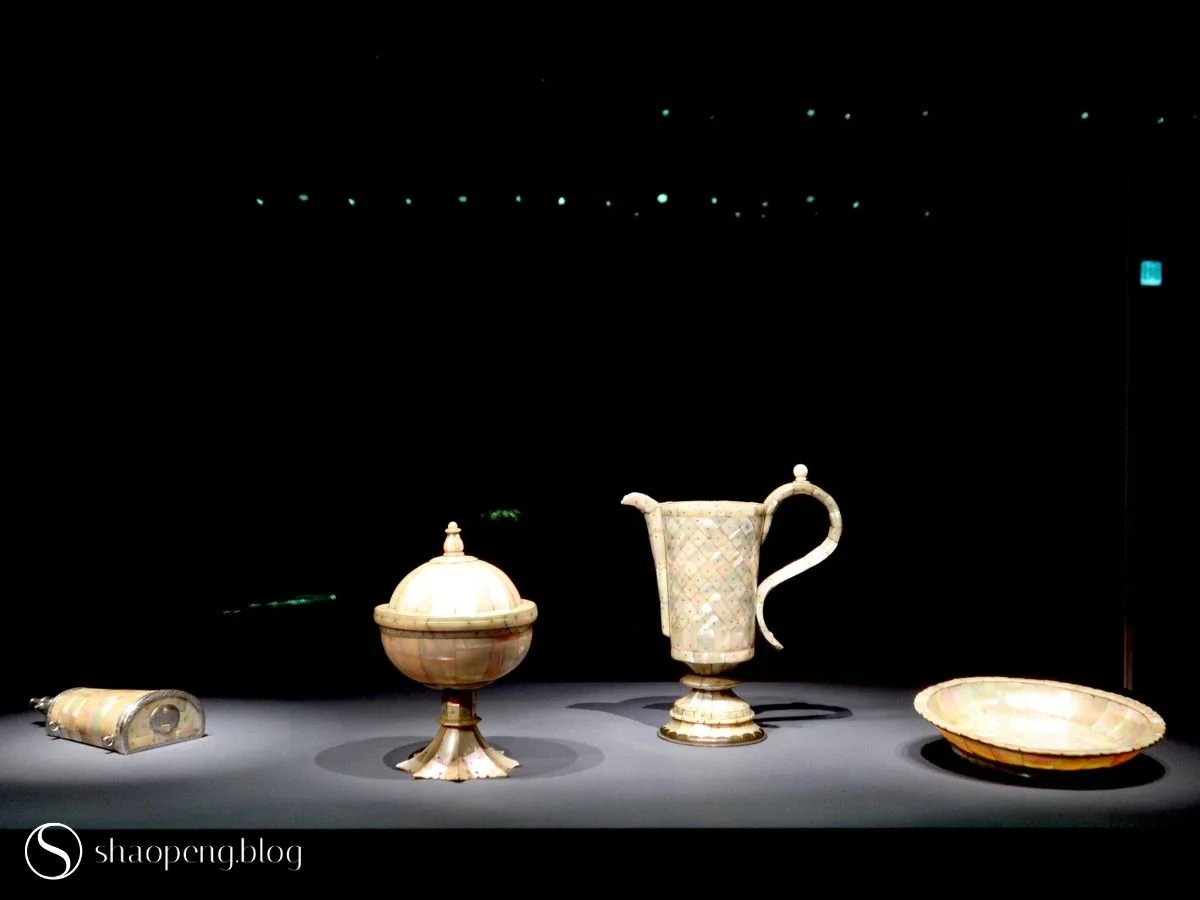
A selection of mother-of-pearl–inlaid vessels from Gujarat.
Then the exhibition draws you into paper.
The ketab-khana (House of Books) was the court’s studio, where painters, calligraphers, bookbinders, and gilders worked side by side on manuscripts such as the Hamzanama. Calligraphy, valued more highly than painting, became a prestige art in itself. Mughal elites collected samples in albums called muraqqa, preserving the line the way one might preserve a gem.
Among the calligraphers was Muhammad Husayn Kashmiri, whom Akbar honoured with the title Zarrin Qalam (“Golden Pen”). His artistry appears in a copy of Sa’di’s Gulistan — a Persian classic used in Mughal education. The manuscript carries poems and stories by Sa’di (circa 1213–1291), copied in Muhammad Husayn’s hand: flowing strokes that seem to take flight from the page amid birds, framed by gold illumination where flora and fauna unfold across a soft, pastel-blue ground.
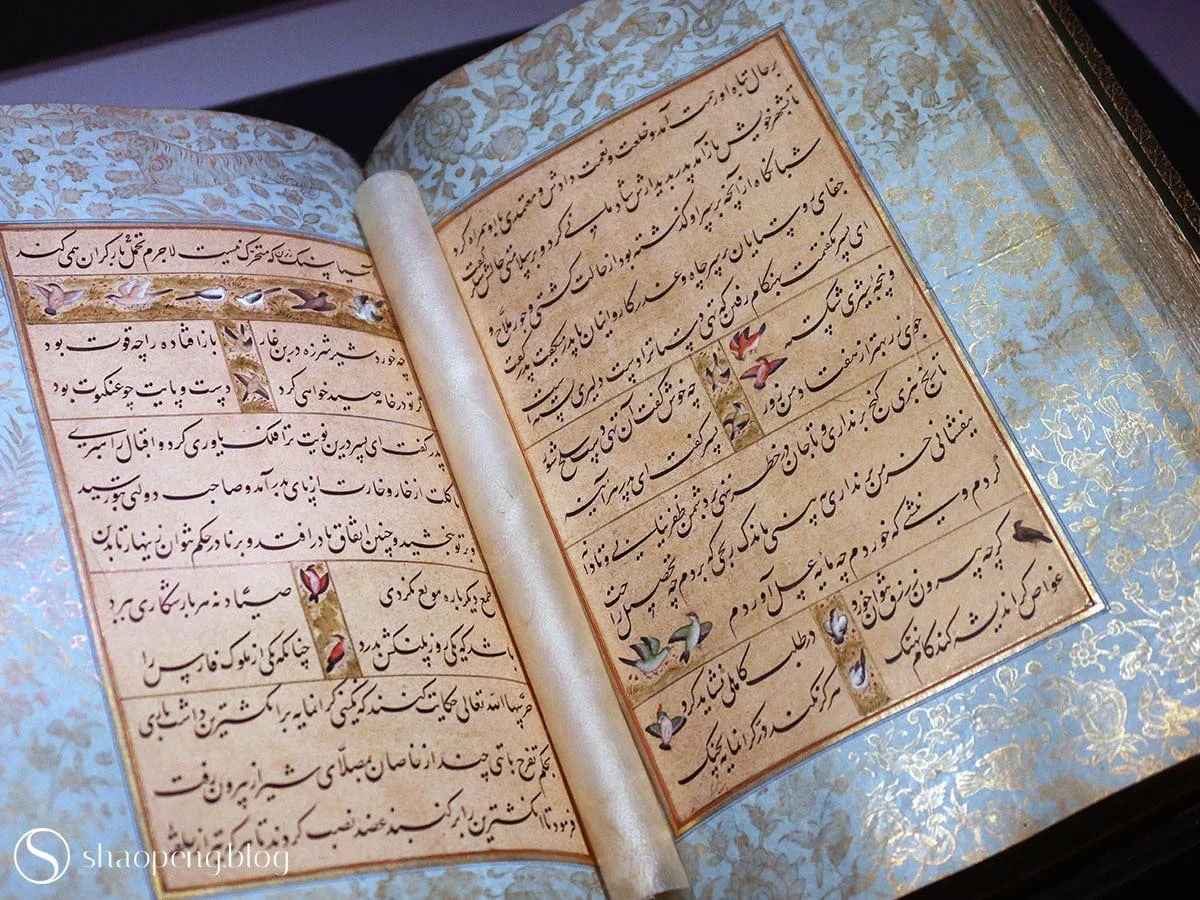
Sa’di’s Gulistan, copied by Mughal court calligrapher Muhammad Husayn Kashmiri.
Akbar’s reign also witnessed the expansion of the imperial library, where illuminated Qurans commissioned by Mughal rulers sat alongside literary manuscripts. An opening page from a monumental Quran, dated to the first half of the 17th century, centres on an eight-lobed medallion inscribed with verses in thuluth — a script prized for its architectural elegance.
Wealth, too, formed part of this ecosystem. The A’in-i Akbari, a late-16th-century survey of the empire, details twelve imperial treasuries storing coins, precious stones, gold, and jewelled objects.
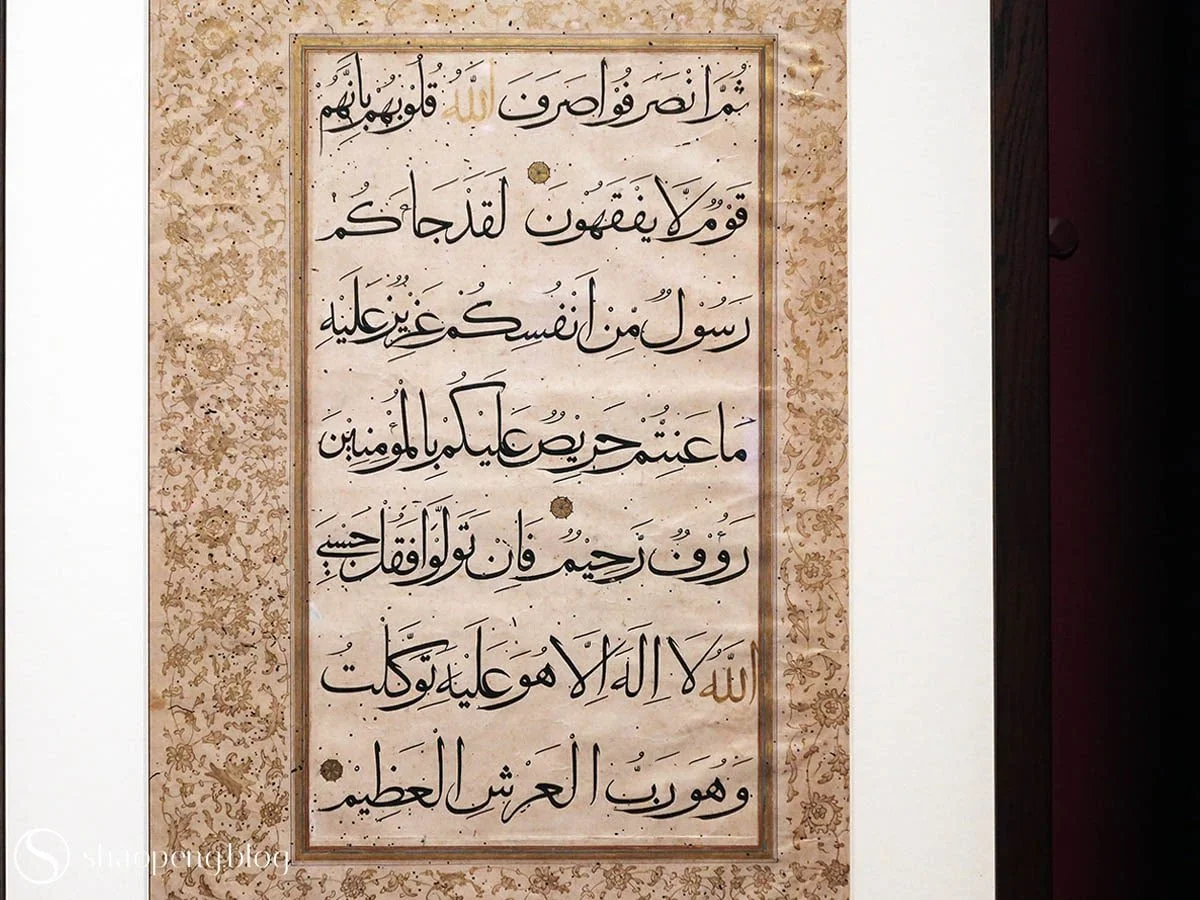
A monumental Quran folio from the early 17th century.
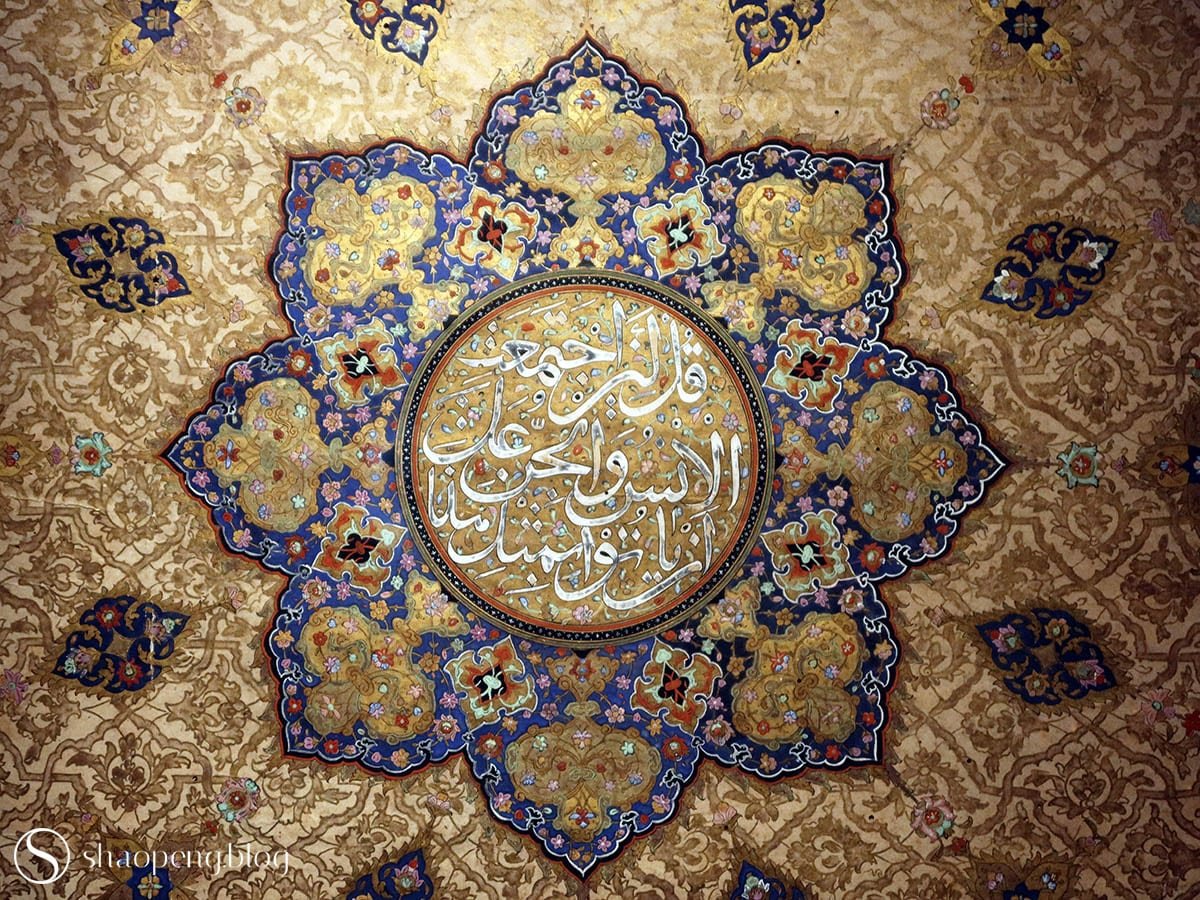
This beautifully illuminated Quran folio reflects the luxury of Mughal imperial commissions.
Jahangir: Explorer of World Treasures
Akbar’s son, Jahangir, inherited a stable and wealthy empire. He turned his gaze outward, toward the treasures of the world. One of the first objects in his section is a celestial globe, brass inlaid with silver. It recalls the way court painters often portrayed him holding or standing on a globe. Even his chosen name, Jahangir — meaning “world-seizer” — carried that ambition.
His treasuries overflowed with gold, precious stones, jewelled objects, porcelains, and luxuries moving across empires. A yellow-glazed porcelain dish from the Ming imperial kilns in Jingdezhen commands attention. Painted in a colour once reserved for Chinese emperors, the dish is curiously displayed upside down to reveal the Chinese reign mark, while a Persian inscription is found along the foot rim.
The dish’s presence in a Mughal treasury feels like a small miracle of circulation. It entered Jahangir’s court in 1016 AH (1612–1613), possibly through diplomatic exchange via Safavid Iran.
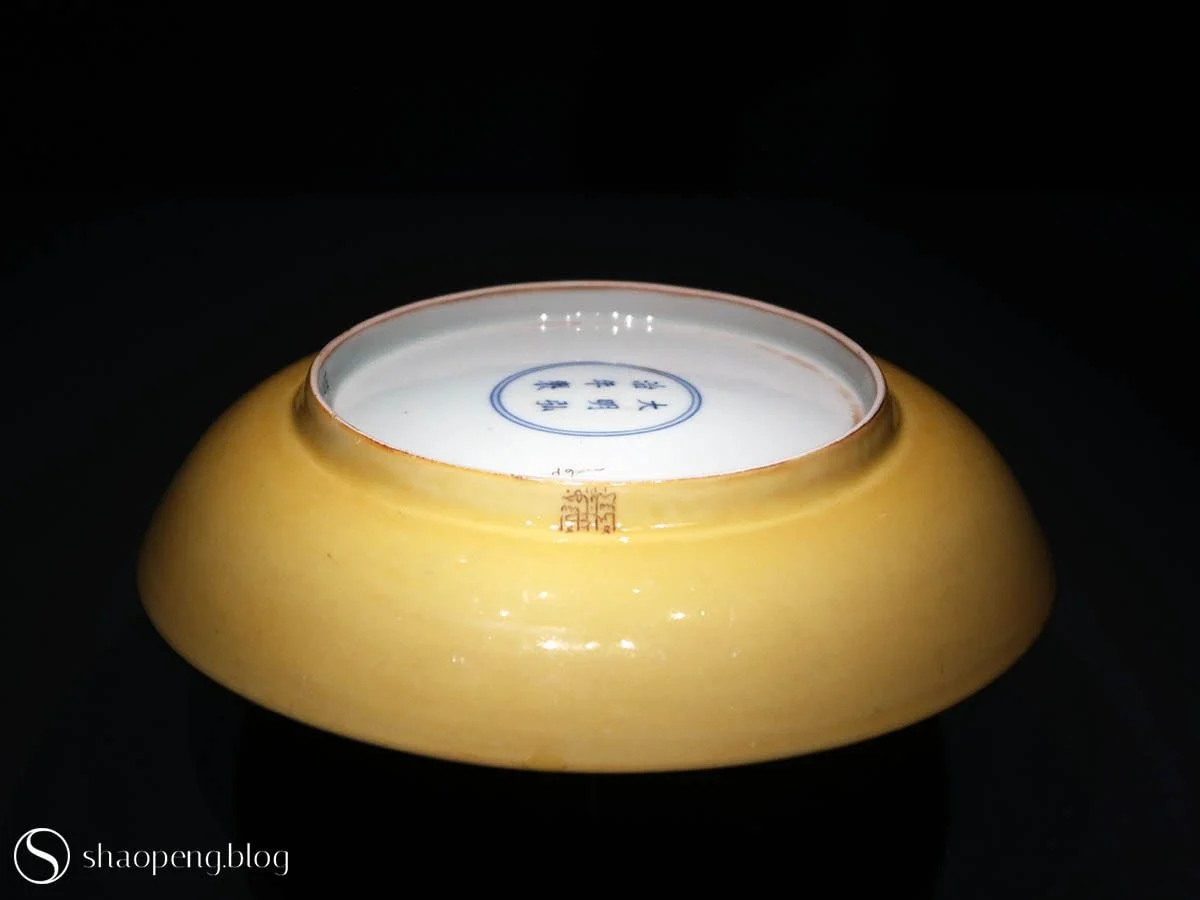
A yellow-glazed porcelain dish bearing a Chinese reign mark and a Persian inscription is a unique presence in the Mughal treasury.
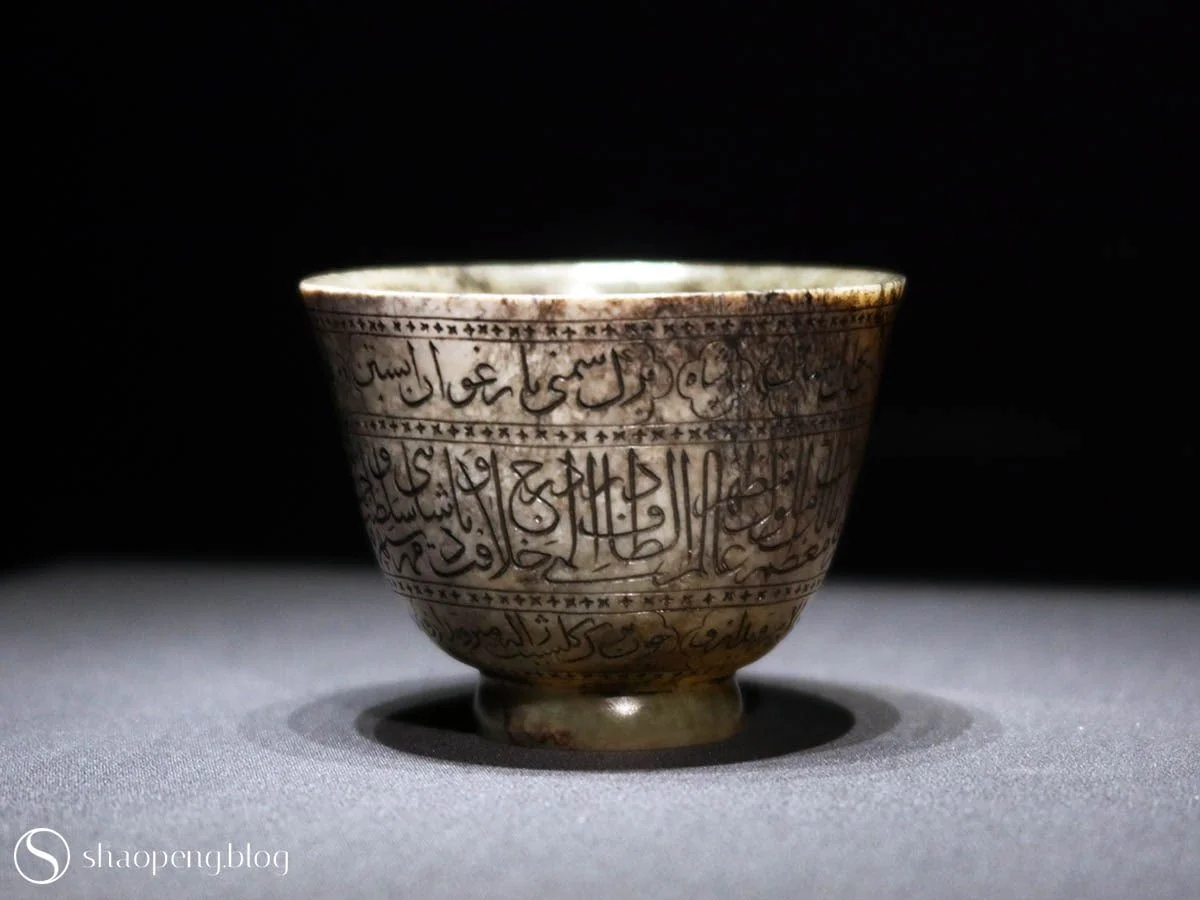
This wine cup commissioned by Emperor Jahangir is the earliest known dated Mughal jade.
Nephrite from Khotan was a rare material for the Mughal court, and artisans fashioned it into vessels with remarkable taste and precision. The exhibition includes what is considered the earliest dated Mughal jade cup commissioned by Jahangir, inscribed with his titles, the year of manufacture, and Persian verses in praise of wine. While Islam prohibits alcohol, wine still played an important role in the Mughal court life and ritual. The engraving is believed to have been executed by Sa’ida Gilani, an Iranian calligrapher and court goldsmith working under Jahangir.
Jahangir travelled extensively, often accompanied by a close circle of artists and craftsmen. His curiosity about nature left fingerprints on the period’s aesthetic development. He commissioned artists to record flora and fauna with near-scientific attentiveness, and those studies migrated into other media: miniature painting, jewellery, weaponry, and objects meant for the treasury.
A jade pendant dated about 1610–1620 embodies the emperor’s love for nature. Birds amid floral vines are delicately rendered in rubies and emeralds; their tiny emerald eyes — set in kundan — are so subtle they feel like an inside joke between the jeweller and the viewer. They may be hoopoes — a symbol of wisdom in Persianate culture — admired by Mughal elites who often compared themselves with this learned, luminous ideal.
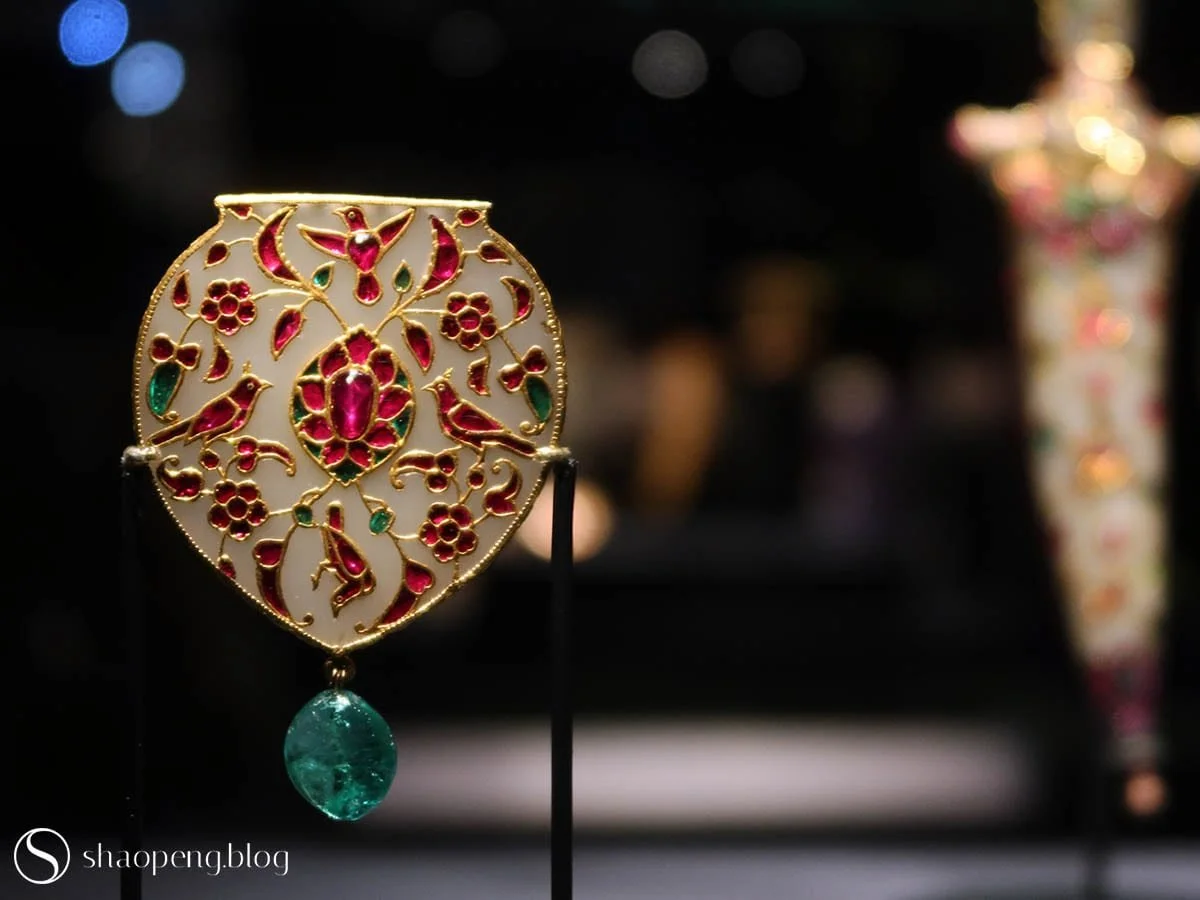
A jade pendant dated to about 1610–1620, adorned with birds and floral motifs.
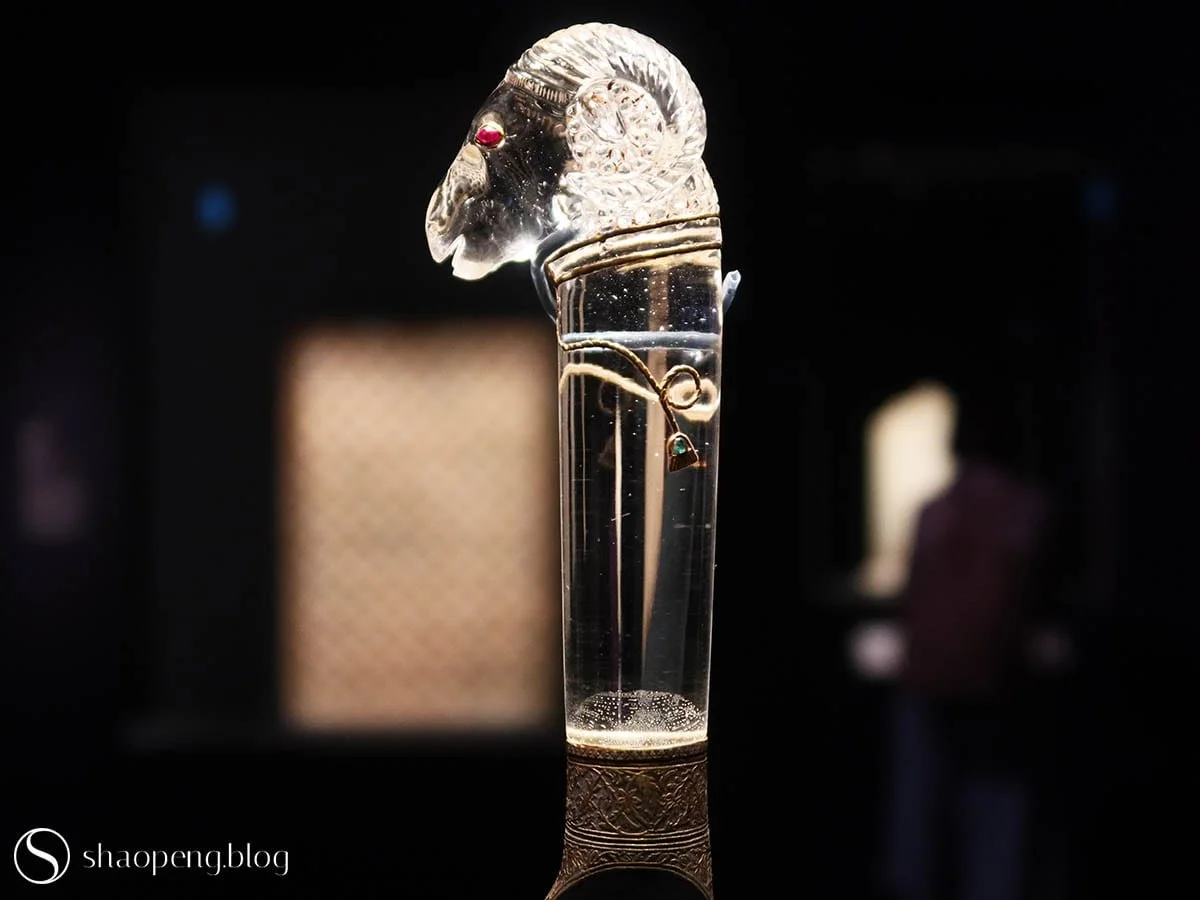
A dagger pommel intricately carved from rock crystal as a ram’s head, set with ruby eyes.
When England’s ambassador Sir Thomas Roe (circa 1581-1644) visited Jahangir’s court, he famously called it a “treasury of the world,” marveling at the profusion: “rubies as great as walnuts,” pearls that “amazed” his eyes.
In Jahangir’s own memoirs, jewels appear again and again as offerings, diplomatic gifts, and courtly presentations — with values and quantities recorded — suggesting a mind attentive not only to spectacle, but to worth, grading, and provenance.
Shah Jahan: Jewelled Perfection
Shah Jahan became emperor after his father, Jahangir, died in 1627. His reign was built on the vast wealth accumulated at court.
If Jahangir was a collector, Shah Jahan was a connoisseur. A portrait painted in the first year of his reign shows Shah Jahan laden with necklaces, armlets, bracelets, and turban jewels while holding a large emerald in one hand. Nearby, an emerald of similar scale anchors the jewellery section, alongside aquamarines, sapphires, spinels, and diamonds in impressive sizes.
The global gem routes are part of this story. Goa, under Portuguese control, served as a node in the wider trade, including the circulation of Colombian emeralds.
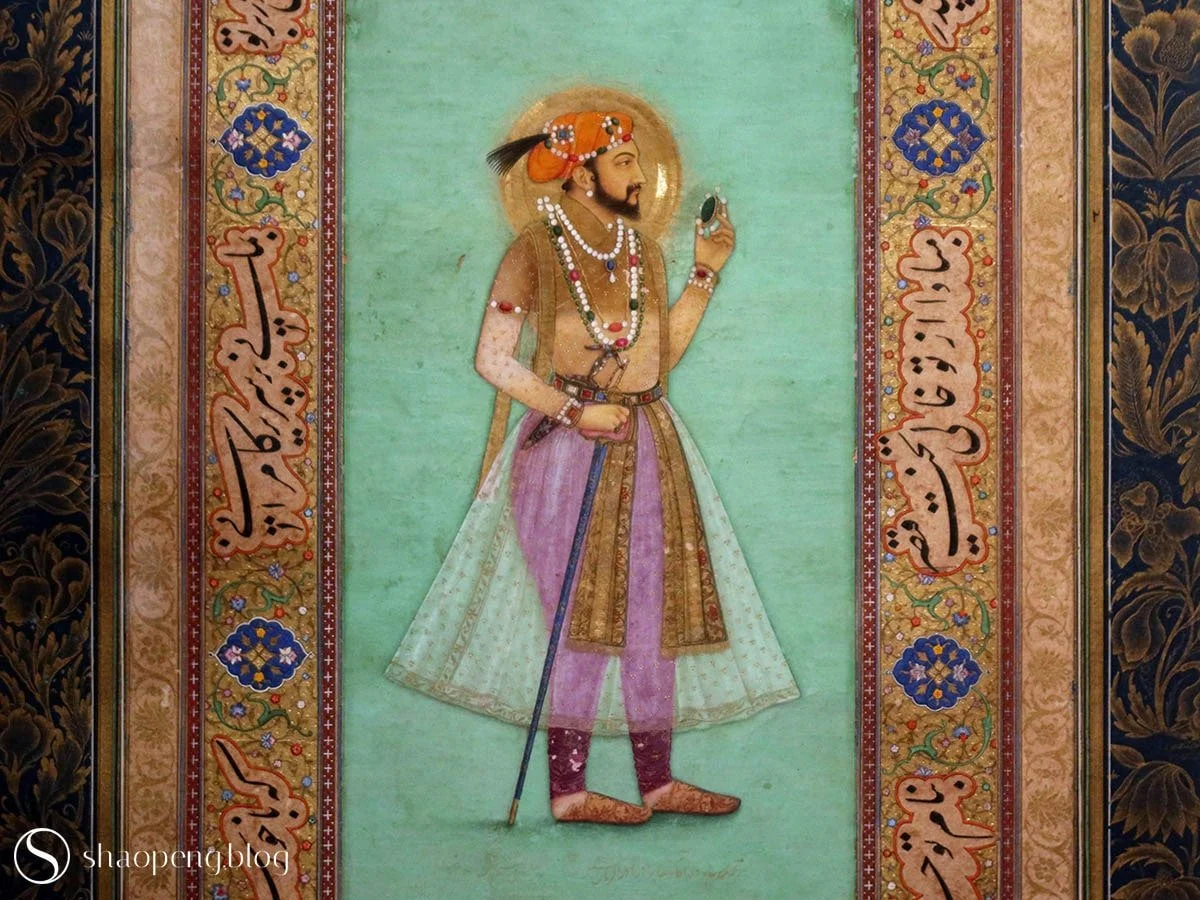
A portrait of Shah Jahan shows him lavishly adorned with pearls, spinels, and emeralds.
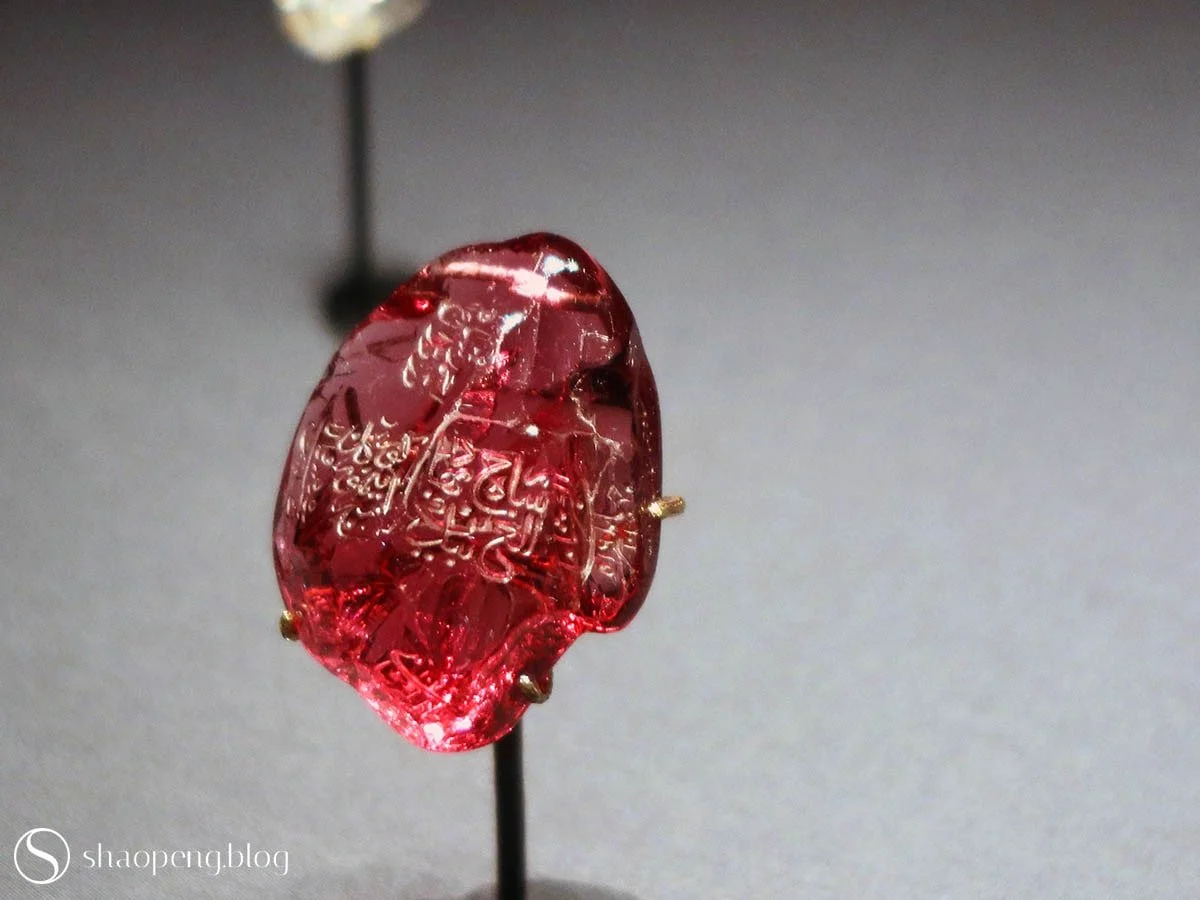
A remarkable spinel inscribed with the names of Ulugh Beg and Emperor Jahangir, from the Al Sabah Collection, Kuwait.
Pink spinels from Badakhshan were deeply valued, carrying high prestige at court and in Persian poetry. One spinel in the exhibition is significant not only for its beauty but for its inscriptions, which stitch together lineage and political memory: it bears the name of Ulugh Beg (a Timurid ruler and Mughal ancestor), alongside later inscriptions associated with Jahangir. Here, dynastic legitimacy is carried in a gem.
Iranian artisans played an important role in engraving imperial titles onto spinels. Among them was Mawlana Ibrahim of Yazd, renowned for his mastery of the nasta’liq and reqa scripts.
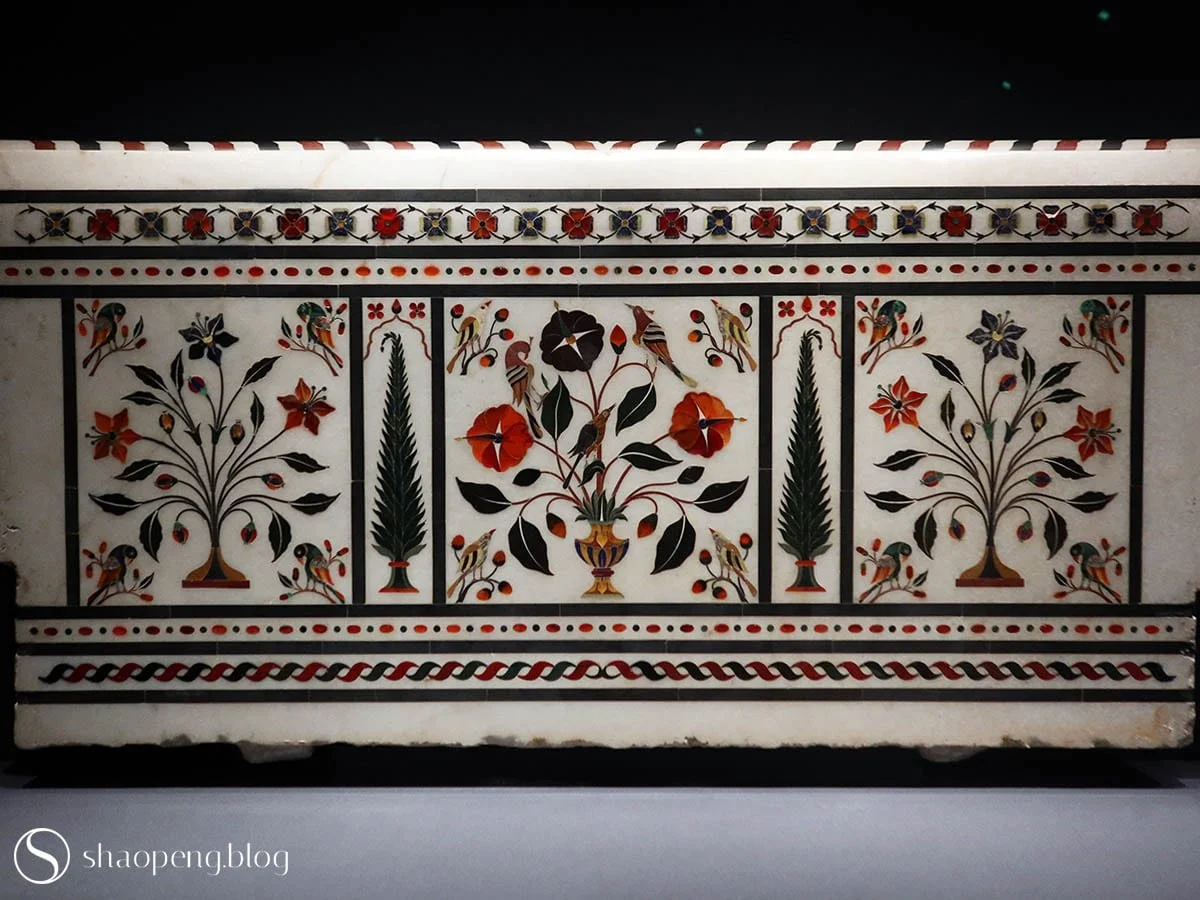
An 18th-century balustrade shows how Agra continued to adorn palaces with stone inlay.
Shah Jahan’s reign witnessed the pinnacle of jewelled display — one executed with a disciplined refinement that made opulence feel controlled rather than chaotic. Yet the often-overlooked Tomb of Itimad-ud-Daulah in Agra, also known as the “Baby Taj,” served as a precursor to the visual language Shah Jahan later refined and amplified.
And the craft outlives Shah Jahan. Stone inlay continued to adorn palaces and monuments beyond his reign. A selection of marble balustrades on display — each inlaid with semi-precious stones in floral designs — shows how the Mughal court turned motif into identity.
If you visit Agra today, you’ll see the city remains an active centre of this craft — a topic I’ve explored in Mughal Stone Inlay: A Close-Up Encounter. The “Touch and See” section walks visitors through the steps behind this painstaking work, from selecting and cutting to setting, so the “miracle” becomes legible as labour.
Treasures of the Mughal Court showcases an empire that spoke not only in conquest, but in refinement — craft pushed to its zenith, still testing the eyes and hands of makers today.
For those who want to dive deeper, I recommend reading The Great Mughals: Art, Architecture and Opulence, published by Victoria & Albert Museum, especially if you want the scholarship and object stories that go beyond the gallery walls.
Reference:
Stronge, S. (Ed.). (2024). The Great Mughals: Art, Architecture and Opulence. V&A Publishing.
Treasures of the Mughal Court from the Victoria and Albert Museum runs through February 23, 2026.