
Wander in Abu Dhabi: Abrahamic Family House
In an era where religion is often wielded to incite division, the Abrahamic Family House is an argument — in concrete and light — that another way is possible and already standing.
Sense of Wander: ★★★★★
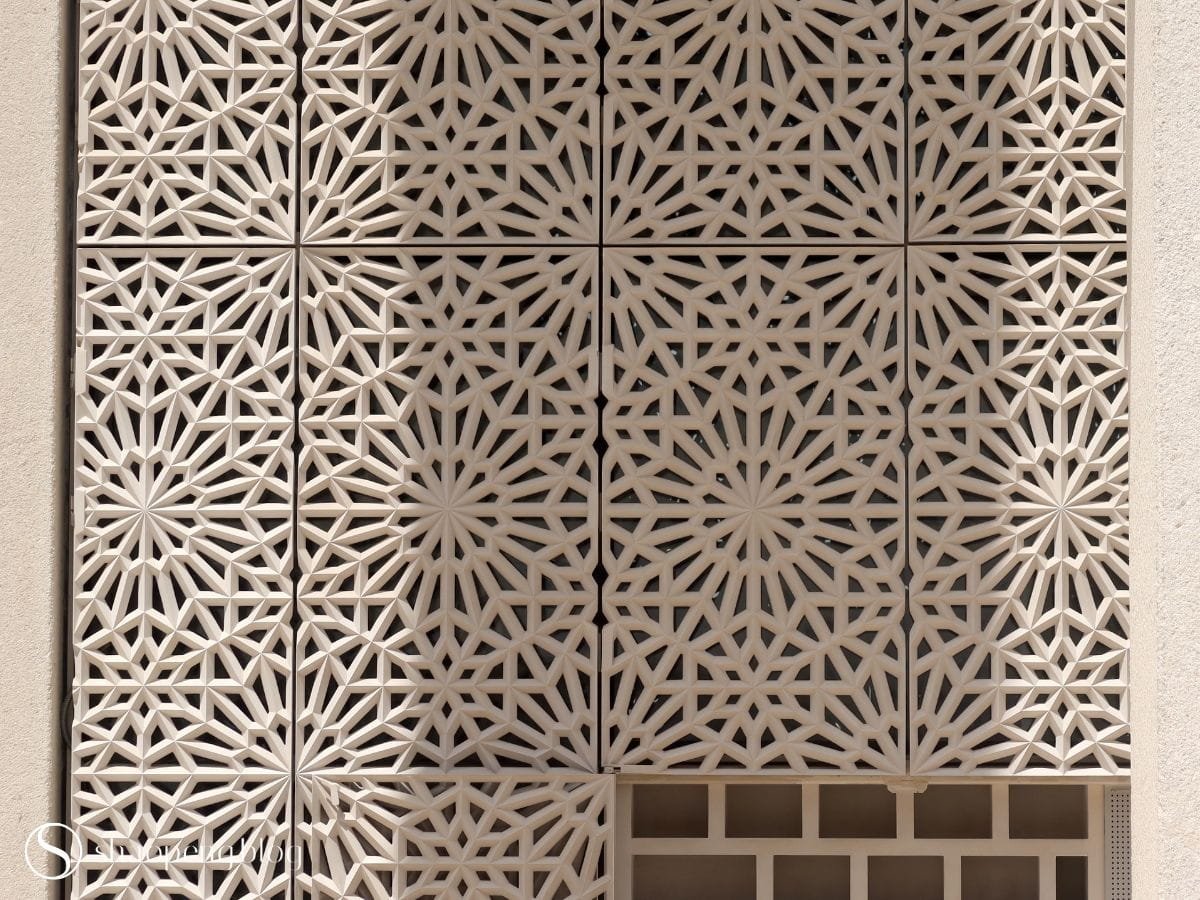
Facade of the Eminence Ahmed El-Tayeb Mosque.
ABU DHABI, UAE — Most travellers come to Saadiyat Island with the Louvre Abu Dhabi pinned on their map, or perhaps the newly opened Zayed National Museum. But the best discoveries are rarely the ones you plan for.
Wander a little further along Saadiyat Island’s sun-warmed paths and you’ll come across something the guidebooks often overlook: the Abrahamic Family House, where a synagogue, a church, and a mosque stand at a crossroads.
At first glance, the sight might seem unexpected. But linger a little longer and curiosity rewards you: Judaism, Christianity, and Islam are not strangers to one another. All three faiths trace their roots to Abraham, and all three bow to one God.
In a world that finds division easier than unity, there is something radical about this place. It reminds us that coexistence is not a utopia out of reach, but a practice often forgotten. It’s a choice, made daily, in the present.
Come wander with me:
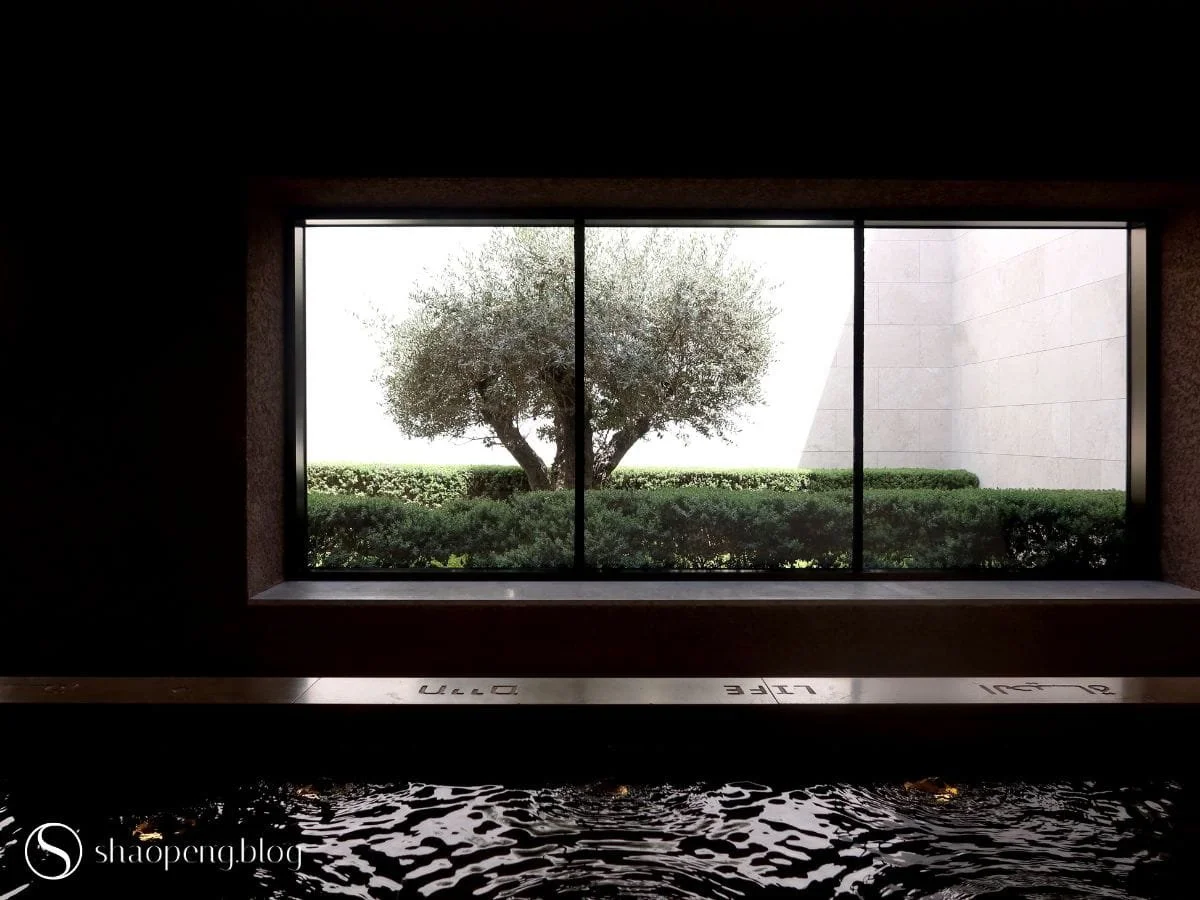
An olive tree, over a century old and visible from the Forum’s window, serves as a powerful symbol of peace across the three Abrahamic faiths.
The Forum: Where Faiths Unite
As always, luck is on my side. When I arrive at the Abrahamic Family House, I happen to walk into the beginning of a guided tour — a small gift that allows me to explore places I might otherwise have past by without fully seeing.
The tour begins in the Forum, where attention is drawn to the foundation stone: a humble slab of stone, protected behind glass, bearing the signatures of those who set this vision in motion. It was signed in 2019 by His Highness Sheikh Mohammed bin Zayed Al Nahyan, President of the UAE and Ruler of Abu Dhabi; His Highness Sheikh Mohammed bin Rashid Al Maktoum, Vice President and Prime Minister of the UAE and Ruler of Dubai; His Holiness Pope Francis; and His Eminence Dr. Ahmed Al Tayeb, Grand Imam of Al Azhar, as part of the Document on Human Fraternity. It is moving to stand before it — a promise still being fulfilled — especially now, knowing that Pope Francis is no longer with us.
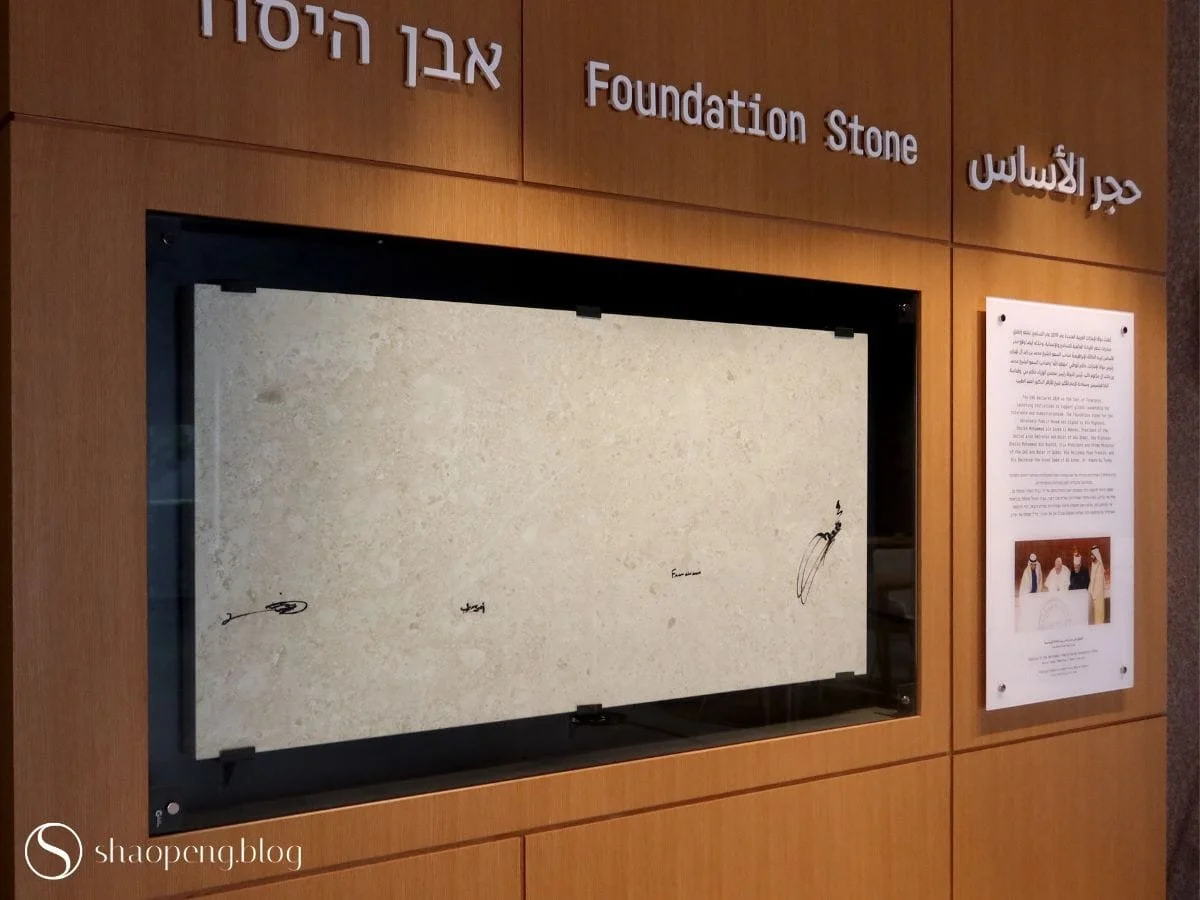
The Abrahamic Family House’s foundation stone symbolises a vision of unity.
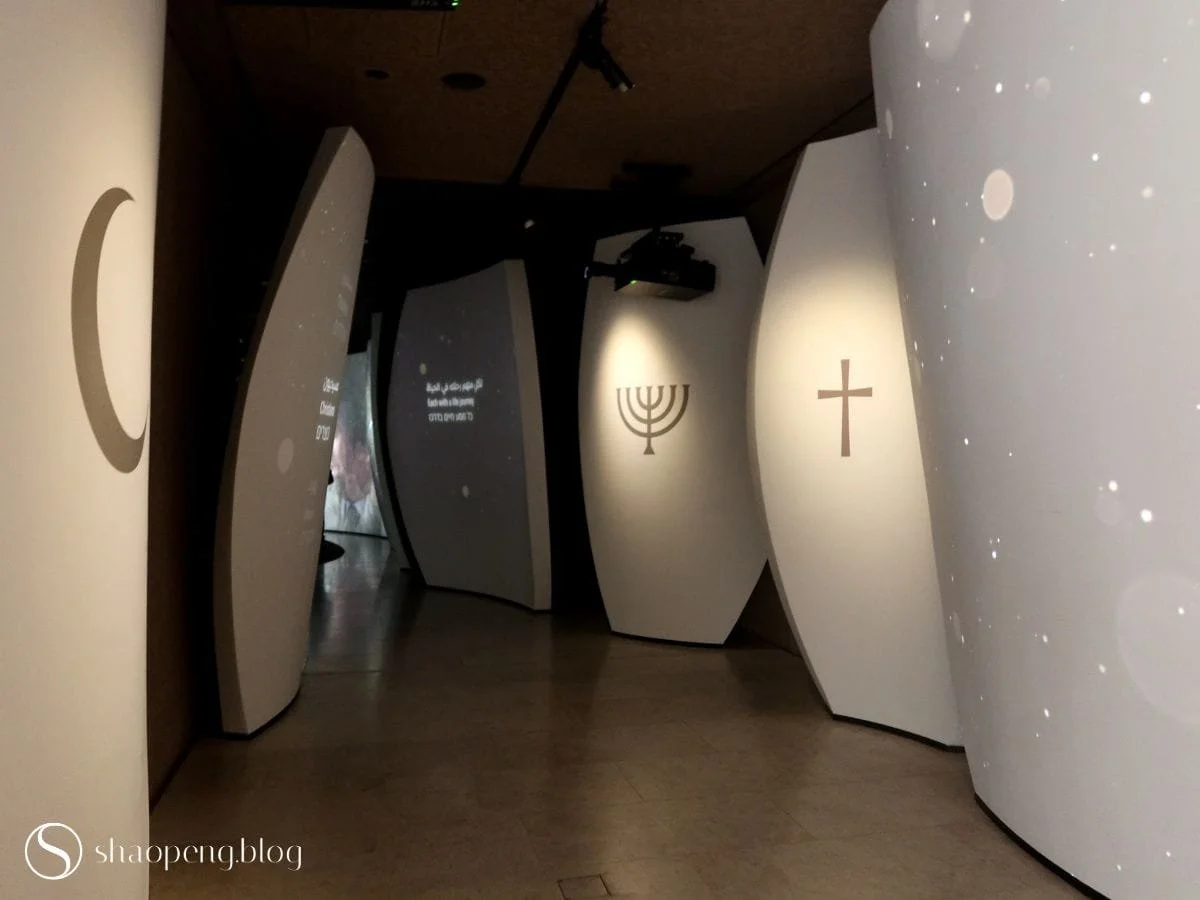
Entrance to the Forum’s exhibition.
The calm of the Forum is anchored by a water feature: a channel for ablution whose edges are inscribed in Hebrew, Arabic, and English. It evokes something like a river of time: life moving forward, carrying all of us with it. Outside the window stands a century-old olive tree, a powerful symbol of peace across the three Abrahamic faiths.
The Forum also houses a small exhibition — perhaps the best entry point for any visitor — that clarifies what distinguishes each faith while tracing the principles they share. The experience is enriched through interactive media.
My favourite is a room in near darkness, where brief projections cast the outlines of the three houses of worship one at a time — synagogue, church, mosque — before fading back into shadow and silence. The sequencing feels deliberate and seems to mirror how we tend to see religion: one faith at a time, in contrast to the others. And yet when the lights go off entirely, all three coexist in the same darkness.
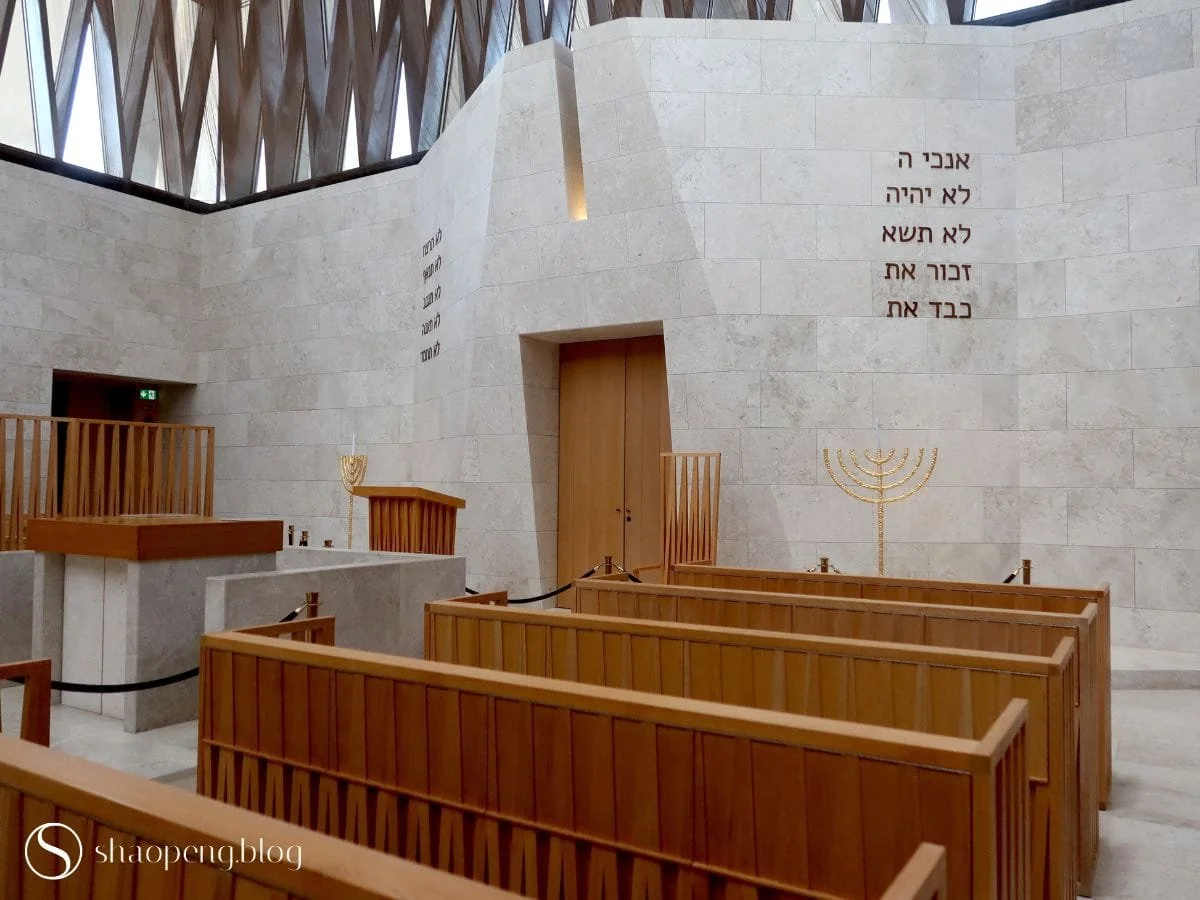
Inside Moses Ben Maimon Synagogue.
Moses Ben Maimon Synagogue
Of the three Abrahamic faiths represented here, Judaism is the oldest, with roots traditionally traced back to the covenant between God and Abraham around 2000 BCE.
The Moses Ben Maimon Synagogue is the first purpose-built synagogue in the UAE. It is named after Moses ben Maimon, a 12th-century scholar, philosopher, and physician from the Jewish community of the Middle East, a figure who long served as a bridge between faiths centuries before this building existed.
I must admit: the number of synagogues I’ve visited over the years is only a handful. Perhaps that is why stepping into this one feels particularly memorable.
Upon entering, visitors are greeted by a Hebrew phrase, translated into English as:
“How beautiful are your tents, O Jacob; your dwellings, O Israel.”
(מַה־טֹּבוּ אֹהָלֶיךָ יַעֲקֹב, מִשְׁכְּנֹתֶיךָ יִשְׂרָאֵל)
This is a well-known verse from the Hebrew Bible. It is part of a blessing spoken by Balaam and is traditionally recited at the beginning of Jewish morning prayers upon entering a synagogue.
Nearby, a few Jewish names are engraved on the walls, marking the presence of a small local community.
Inside, the Ten Commandments are inscribed in Hebrew across off-white concrete walls, flanked below by two golden menorahs.
Triangular motif permeates throughout the space — from the exterior facade to the pews. The overlapping V-shaped designs evoke the palm fronds of the sukkah, the temporary hut built during Sukkot, commemorating the Israelites’ shelter in the wilderness.
Look up, and you’ll see a bronze mesh canopy is suspended from the ceiling, catching daylight that filters through the central oculus. It hovers above the congregation like a tent in mid-air, not only evoking the portable sanctuary of the Israelites during the Exodus, but also creates a sense of warmth and contemplation.
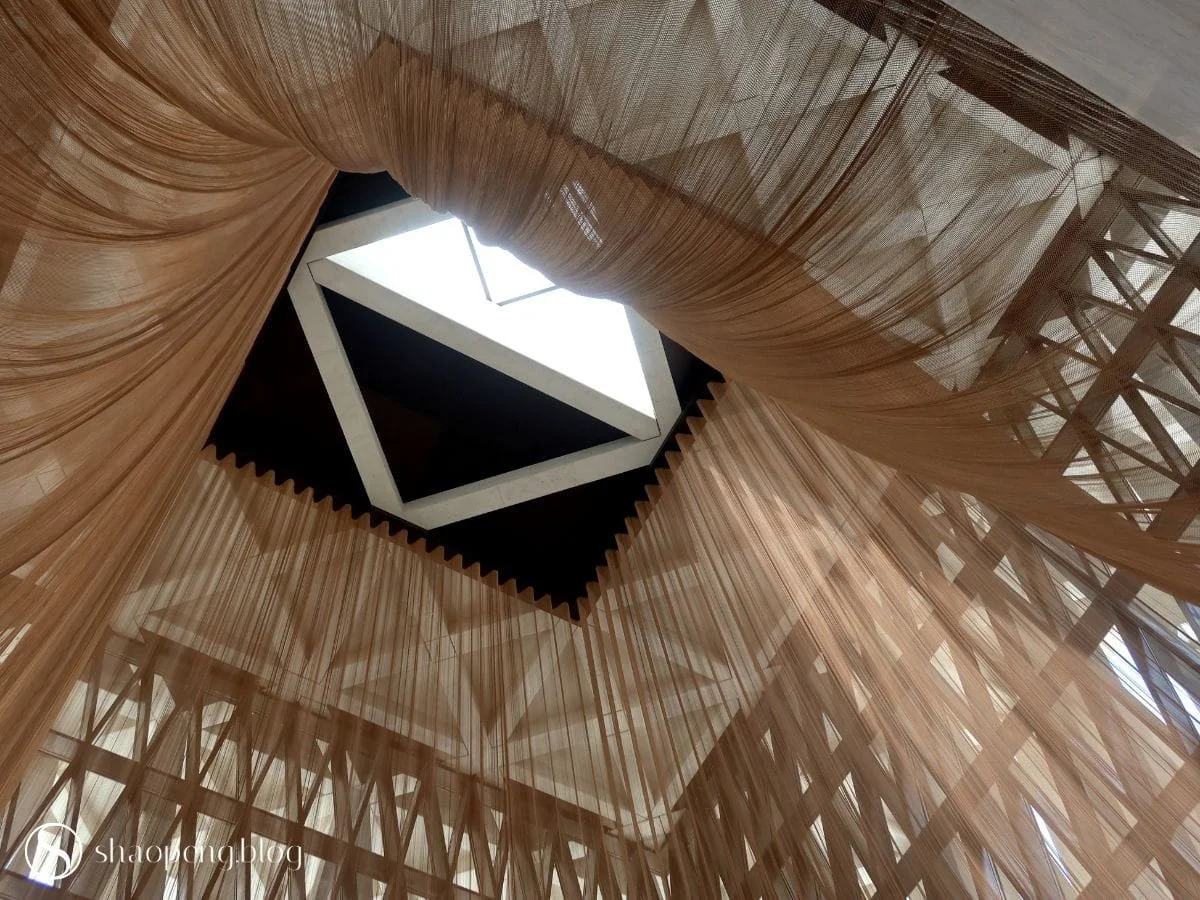
The intricate bronze mesh canopy gracefully hovers above the congregation space of the Moses Ben Maimon Synagogue.
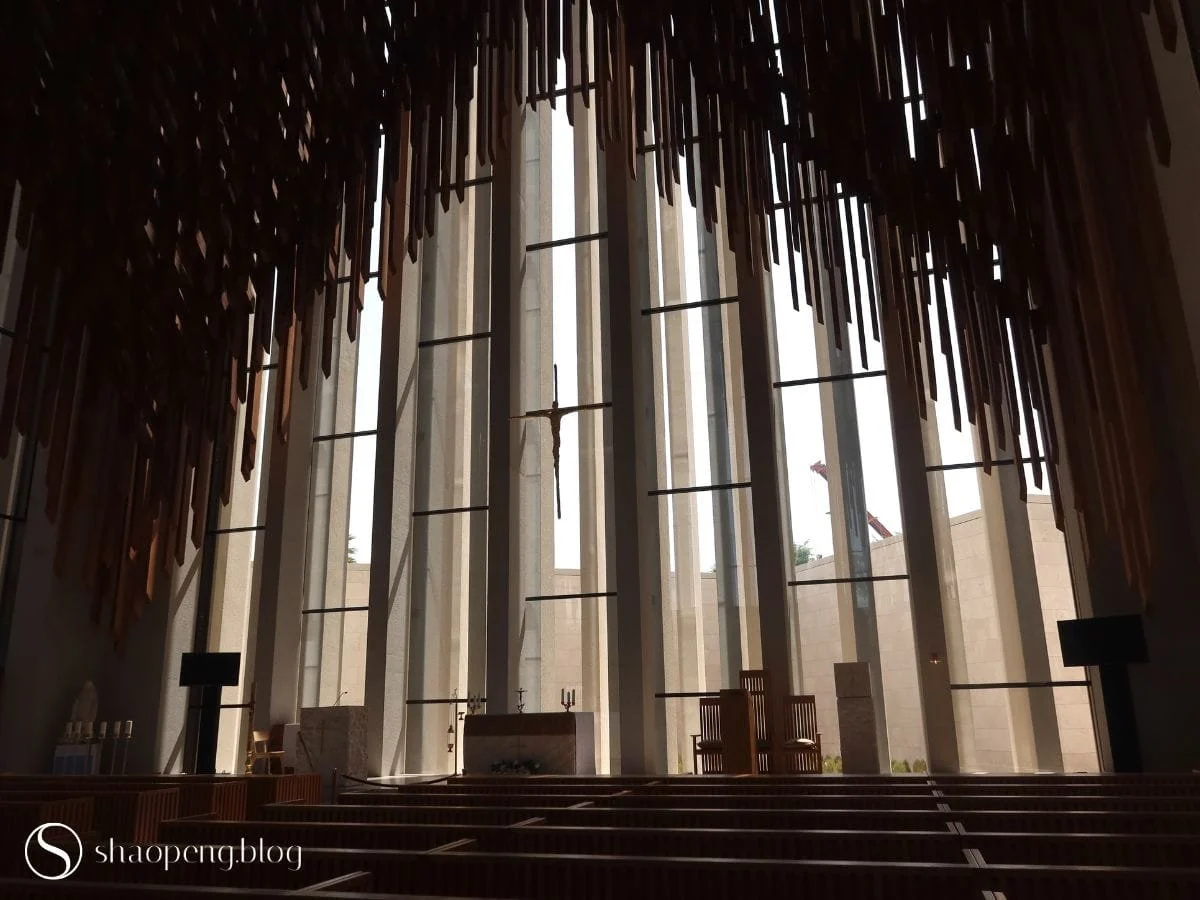
Inside St. Francis Church at Abrahamic Family House.
St. Francis Church
Christianity emerged from within Judaism in the 1st century CE, through the life and teachings of Jesus of Nazareth, whom Christians regard as the Messiah and Son of God.
The St. Francis Church here belongs to the Catholic tradition and is named after St. Francis of Assisi, the 13th-century friar who renounced wealth in favour of radical poverty, humility, and dialogue with those of other faiths — a fitting patron for a place shaped by encounter.
Stepping inside, the eye is immediately drawn upward: the vaulted ceiling is lined with timber battens that cascade downward like shafts of light. At night, I’m told, the effect becomes even more extraordinary.
At the centre of the church stands a crucifix by an Italian artist, its presence becoming the emotional anchor of the space.
The baptistry sits just outside, in an adjacent courtyard. What is remarkable is that it remains in active use.
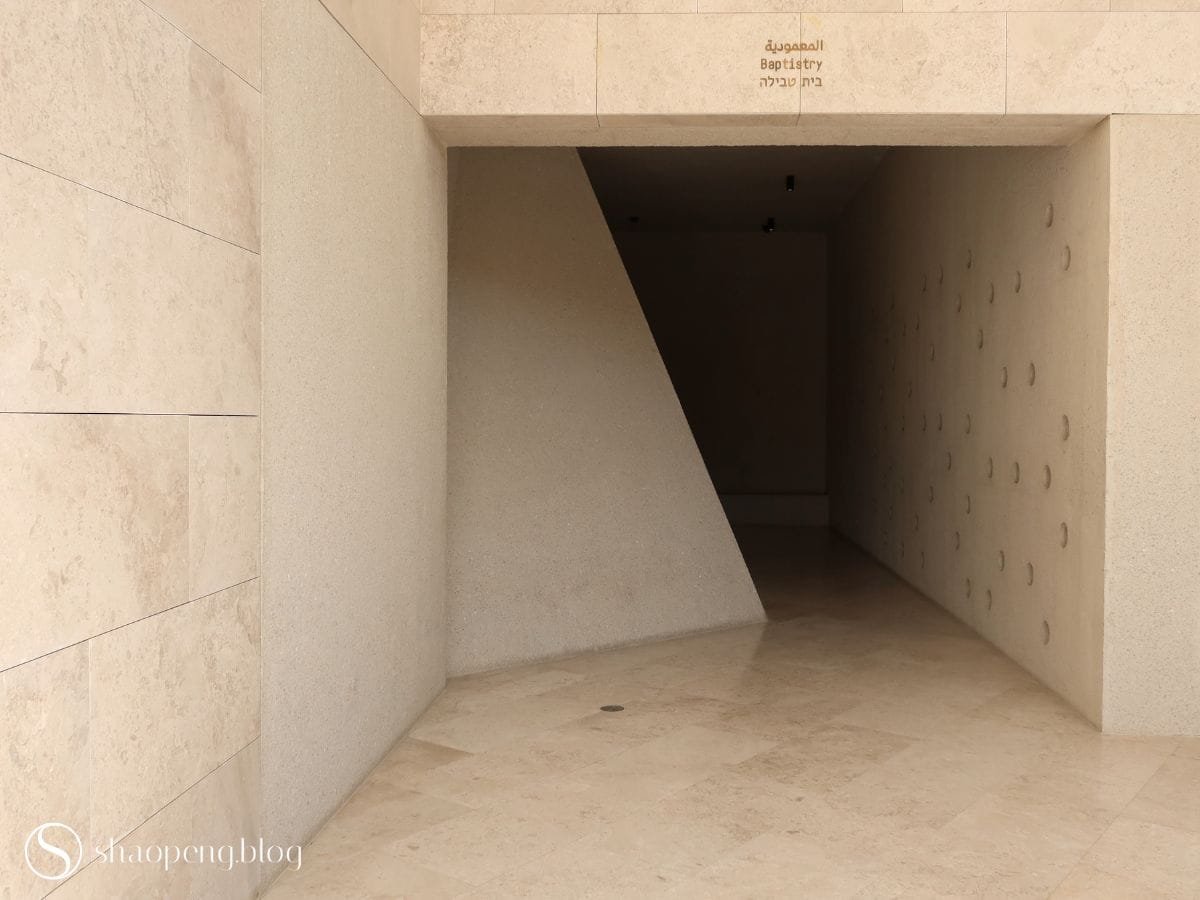
Entry to St. Francis Church’s Baptistry.
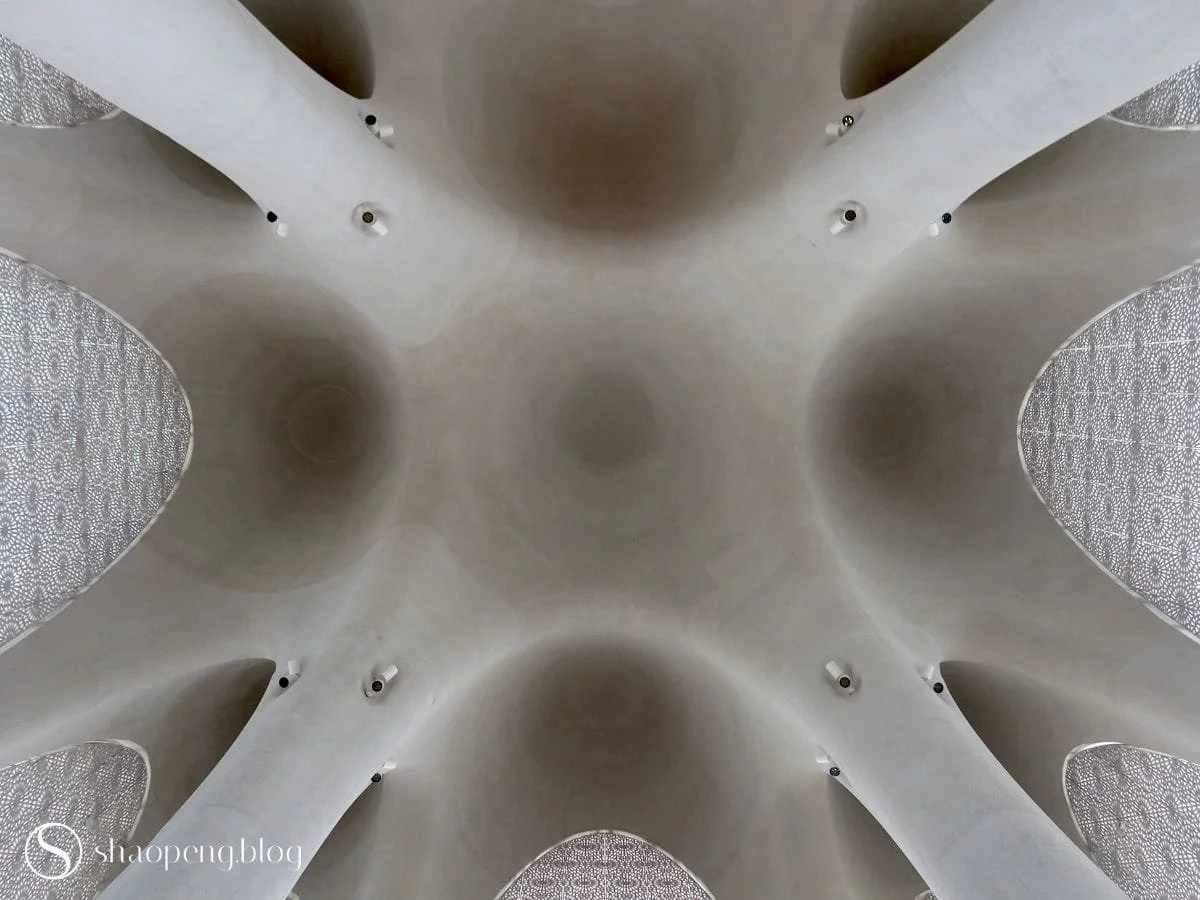
Looking up toward the domed ceiling of the Eminence Ahmed El-Tayeb Mosque, where minimal design invites contemplation.
Eminence Ahmed El-Tayeb Mosque
Of the three houses of worship in the Abrahamic Family House, the mosque is perhaps the most compelling to me. The short answer is simplicity. The longer answer is everything that lies beneath it.
Entering the Eminence Ahmed El-Tayeb Mosque feels like stepping into an otherworldly space: cooler, quieter, and stripped of everything unnecessary. The architecture itself is a meditation: mashrabiya-inspired lattice screens filter the light, while the organic, skeletal concrete structure seems almost alive — recalling, at times, Antoni Gaudí’s Casa Batlló, where form feels grown rather than built.
If the mosque has a defining architectural gesture, it is its columns. Four columns rise and gradually dissolve into the central dome above, while a central column transforms into the mihrab, the niche indicating the direction of the Kaaba in Mecca, toward which Muslims pray. Together, they subtly represent the Five Pillars of Islam.
The minbar, from which the khutbah or Friday sermon is delivered, emerges from the floor with similar inevitability, as though shaped by the building itself rather than placed within it.
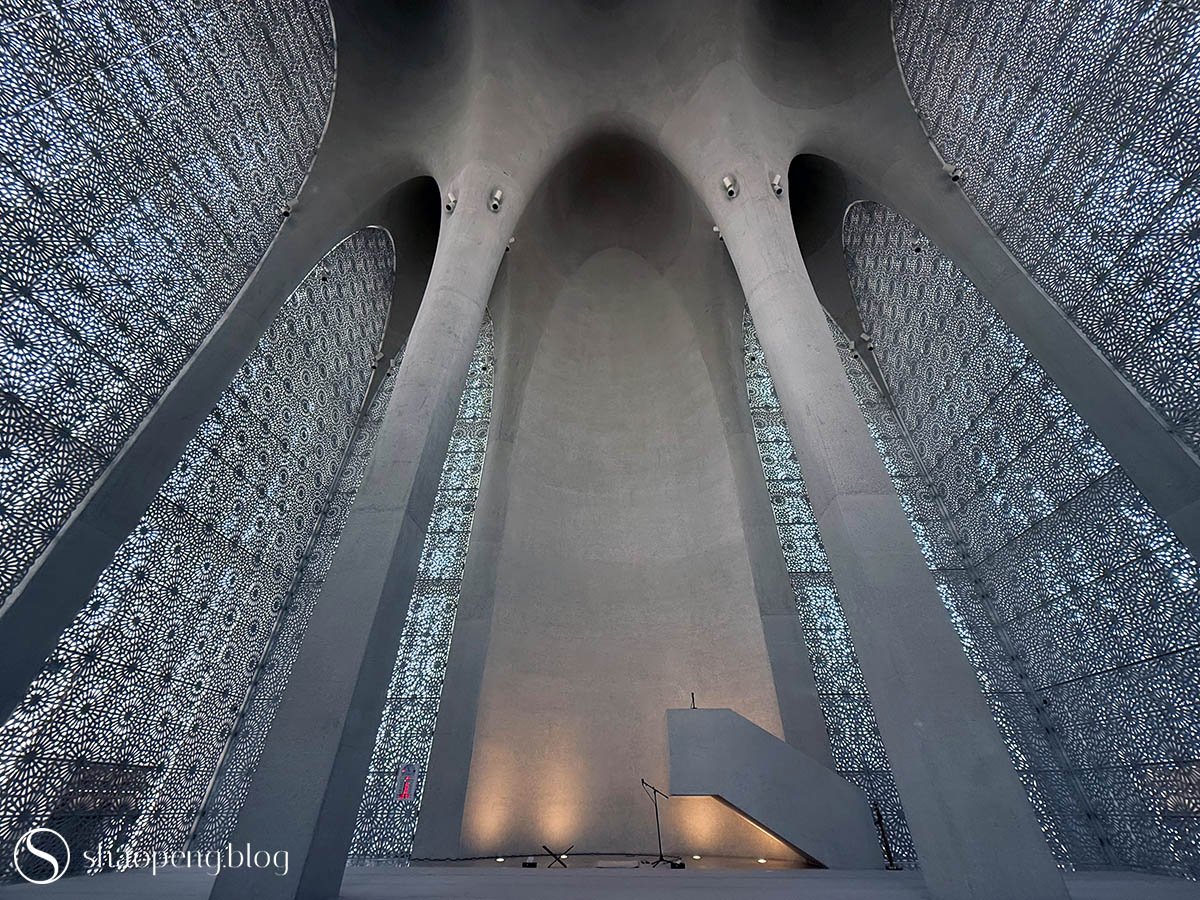
The mosque’s architecture subtly alludes to the Five Pillars of Islam, a foundation of Muslim faith and practice.
Everything within, from air conditioning to Qurans and other functional elements of worship, is thoughtfully concealed behind screened walls, leaving the space free of distraction. What remains is a contemplative space that turns worshippers’ attention inward: toward presence, reflection, and the divine.
Islam emerged in the 7th century with the Prophet Muhammad. In Islamic belief, he is regarded as the final prophet in the Abrahamic line, and the Quran — revealed between 610 and 632 CE — is regarded as the culmination of the same divine message that began with Abraham.
The Abrahamic Family House was designed by Sir David Adjaye, and each of the three houses of worship takes the form of a cube — thirty metres deep, thirty metres wide, thirty metres tall — built in the same material, distinguished only by the faith practiced within. The architecture makes the argument before a single word is spoken: no faith stands taller, no tradition takes precedence.
In an era where religion is often wielded to incite division, the Abrahamic Family House is not a relic of optimism, but an argument — in concrete and light — that another way is possible and already standing.
Wanderer’s tip — To explore the complex with real depth, book a guided tour in advance. Trust me, it makes an enormous difference.