
The Art of Zhuangbiao: Mounting Chinese Calligraphy and Painting
Somewhere between the artist’s last brushstroke and the scroll hanging on a wall, there is something most people never see: zhuangbiao, the craft that carries a work of art over generations.
Sense of Wander: ★★★★☆
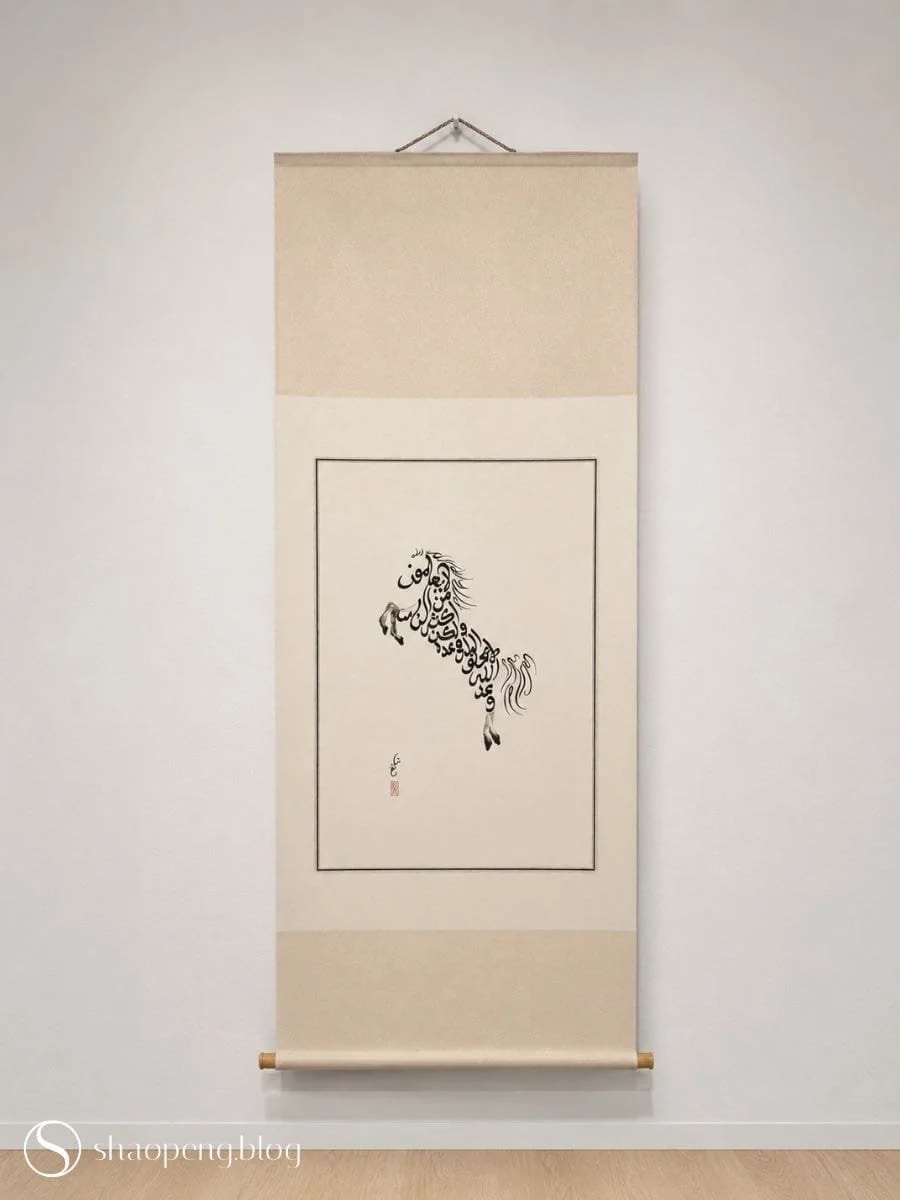
It’s a curious feeling to see a work of art you have created from its making to its mounting.
Image © Shaopeng
TAIPEI, Taiwan — There are journeys you plan, and journeys that find you. This year, I find myself on several of the latter kind, and perhaps the most unexpected has been into the world of zhuangbiao (裝裱), the ancient Chinese art of mounting calligraphy and painting.
Those who have followed my wanderings know that I’ve been practicing Arabic calligraphy for some years now, with a particular focus on the Sini script — that one-of-a-kind tradition practiced by Chinese Muslims. Sini, which translates simply as “Chinese style,” carries within it the memory of two civilisations meeting on paper, where Arabic letters adapt themselves to Chinese ink, xuan paper, and regional aesthetic ideals.
In China, traditional paintings and calligraphy are executed on materials very different from those commonly used in the West, and consequently presented in different ways. While Western paintings on canvas are often stretched across wood frames or displayed within them, Chinese paintings and calligraphy are traditionally created on juan silk or xuan paper. Al Sini calligraphy follows this practice, adopting xuan paper as its primary writing surface. Yet xuan paper is as light and perishable as morning mist, demanding its own philosophy of preservation. This is where zhuangbiao comes in.
At its heart, zhuangbiao is far more than a decorative finishing process; it is an art devoted to preservation, presentation, and transformation. Through the hands of the mounting specialist, a fragile sheet of paper becomes an object capable of surviving generations. Some even compare a good mounting to good makeup, as it allows an artwork to be seen in a different light.
Over centuries, Chinese calligraphy and painting have been mounted in a variety of distinctive formats, the most common being the hanging scroll, designed to be suspended on a wall and appreciated from a distance. Handscrolls, often used for horizontal compositions, invite a more intimate encounter, revealing their content gradually as they are unrolled section by section. Album leaves gather individual paintings or calligraphic works into book-like collections. Each format shapes how a work is experienced, much like how different modes of travel alter one’s perception of a landscape.
Wandering through museum galleries across East Asia, I had always assumed the hanging scrolls I admired arrived in the world already whole. Yet watching a scroll being mounted for the first time feels something like watching a city being built, where a single sheet of paper — carrying the inked exhalation of whoever wrote or painted upon it — gradually acquires structure, layers, and presence. The artwork I had thought of as destination turns out to be only one milestone along a much longer creative endeavour.
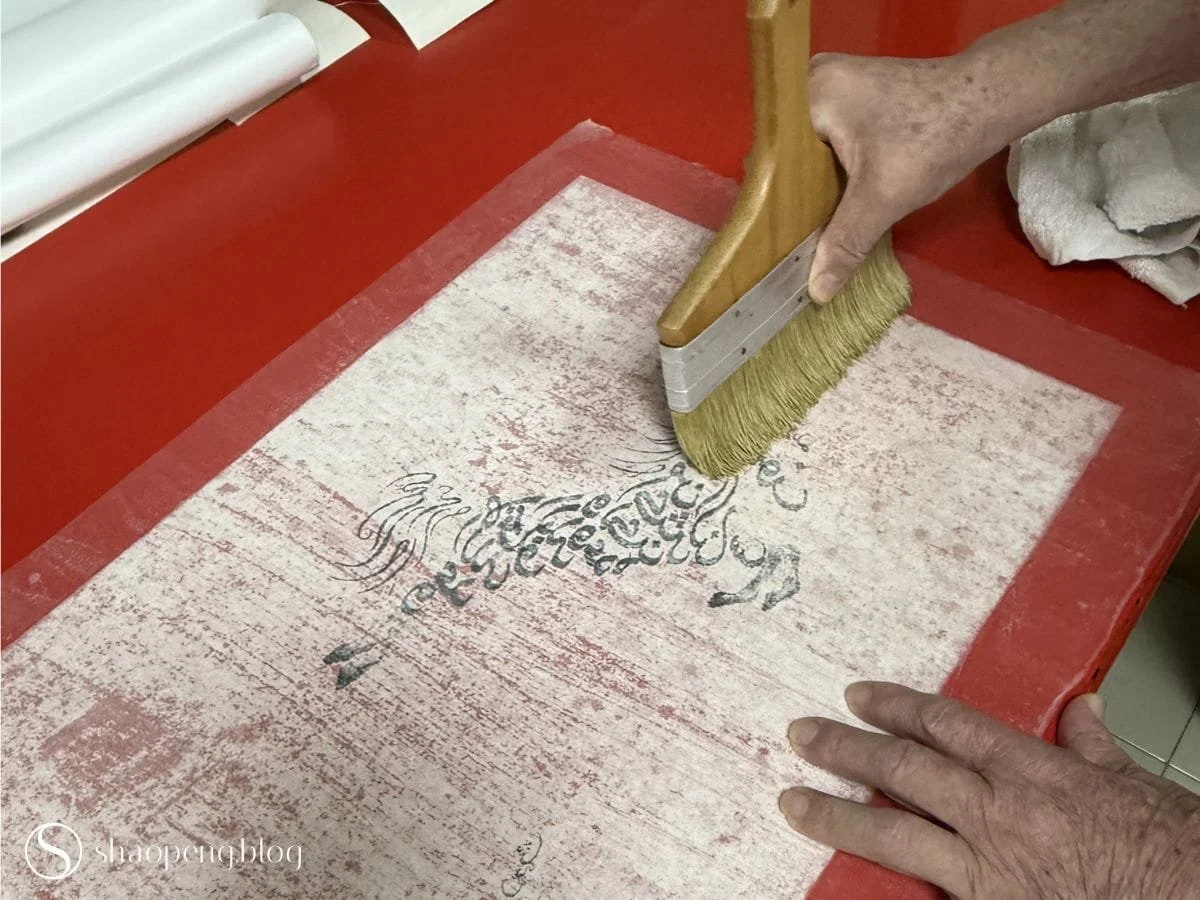
The first layer of backing paper is carefully adhered to the reverse of the work, beginning the mounting process.
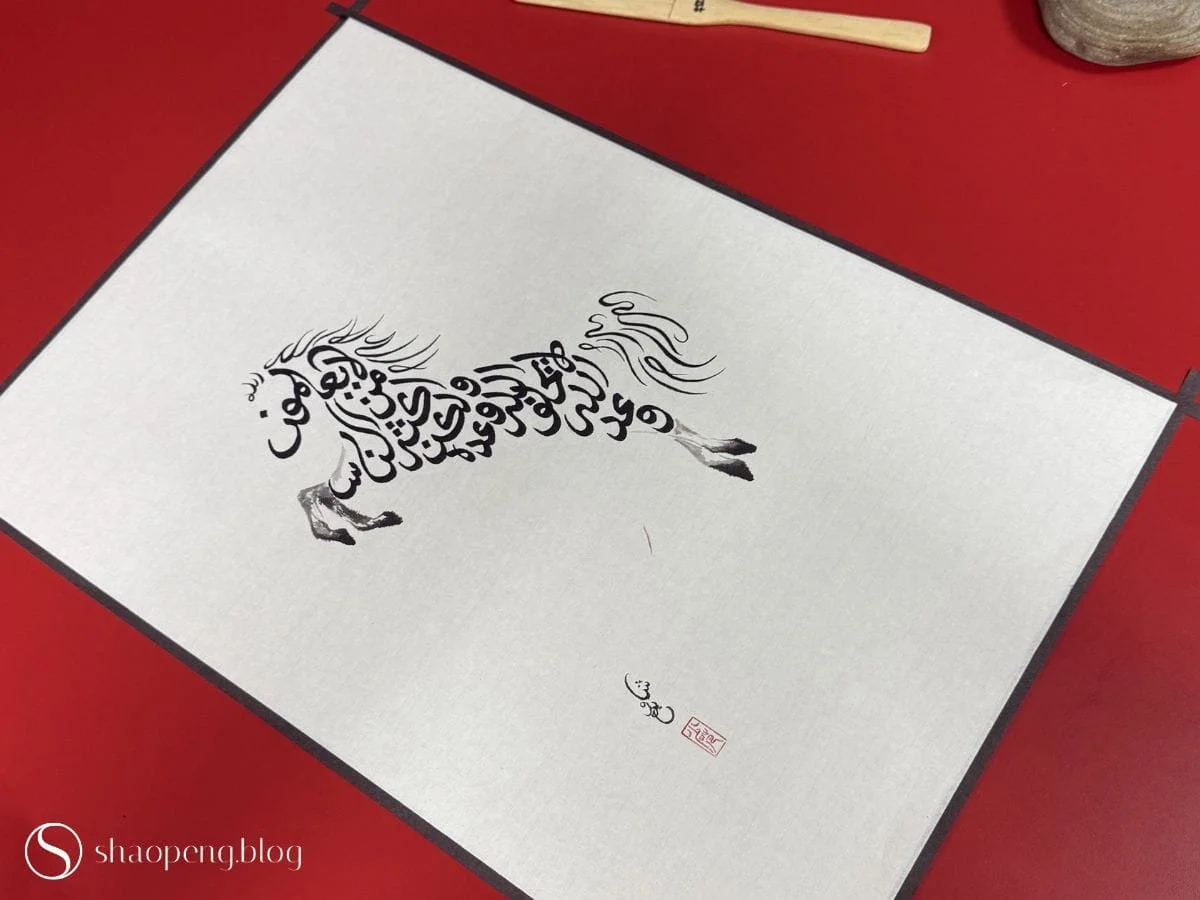
Adding the jutiao, a thin strip of paper, along all four edges of the work to form a protective border.
For my first hanging scroll, I chose a piece of Al Sini calligraphy composed in the form of a galloping horse, inspired by a dream I had earlier this year.
The first stop on this journey is tuobiao, the backing stage. A thin sheet of handmade cotton paper is adhered to the reverse of the work, which the mounting specialist refers to as the huaxin, literally “the heart of the painting.”
What looks like a simple procedure transforms the artwork from fragile to durable, capable of lasting generations. Once backed, the piece is brushed flat onto a drying board and left to rest in a process known as shangban, or “putting it on the board.” Classical texts advise that autumn is the best season for this stage. I imagine it as the artwork pausing at a roadside inn, gathering itself before continuing its journey.
Once fully dried, the piece is trimmed and the real construction begins. First comes the jutiao, a thin strip of paper bordering all four sides of the work, acting as a protective buffer against damage while leaving room for future restoration.
Silk or brocade is then selected, cut, and attached around the central work. These textiles do far more than frame a piece, as their colours, patterns, and proportions shape how the artwork is ultimately perceived.
A skilled mounting specialist must consider the relationship between image and framing, balancing elegance with restraint. The wrong choice can overwhelm a quiet work, whereas the right one enhances it. It is at this stage that the mounting specialist becomes something closer to a curator; though they do not create the artwork, they play a critical role in how it will be seen.
For my piece, I opted for a two-colour mounting rather than a single-colour one, hoping to lend the work a little more life and character.
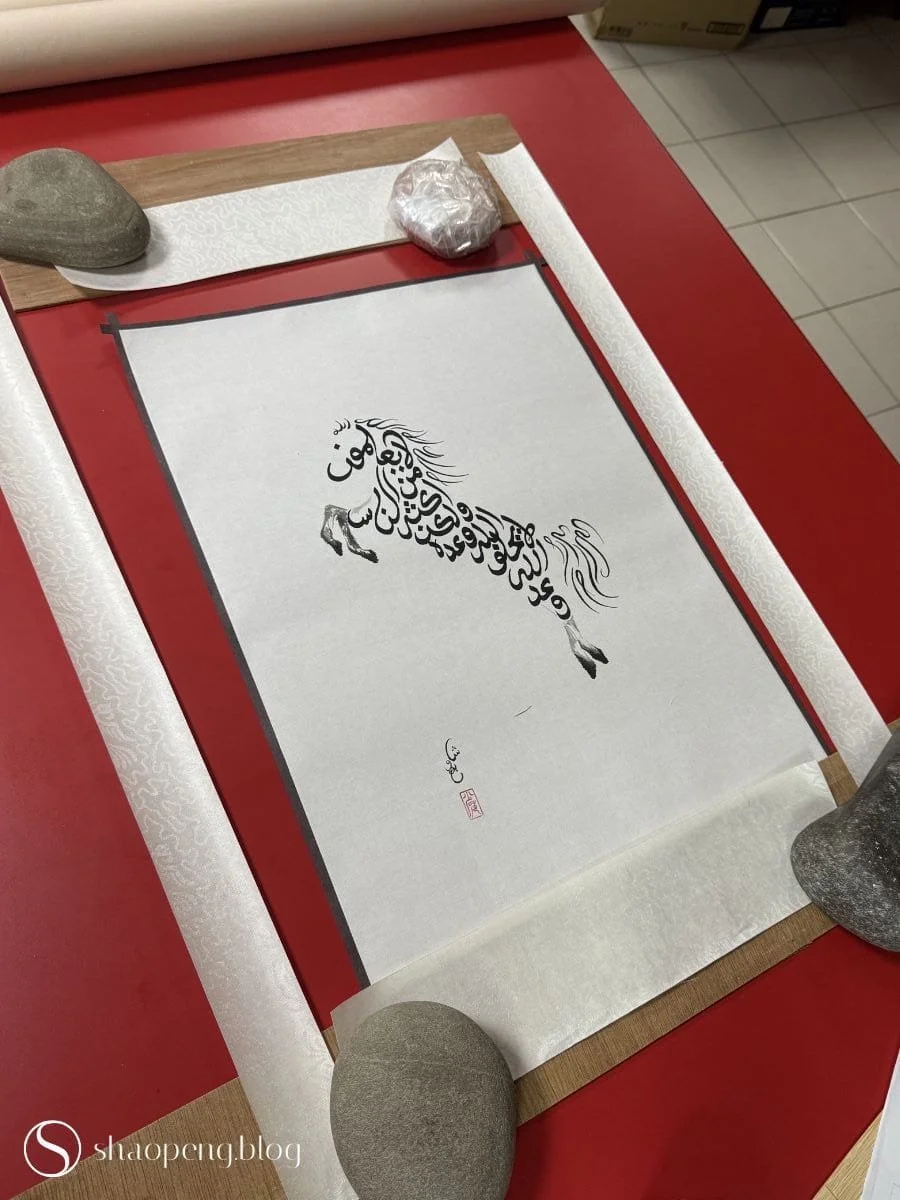
Brocade is selected, cut, and attached to frame the central work.
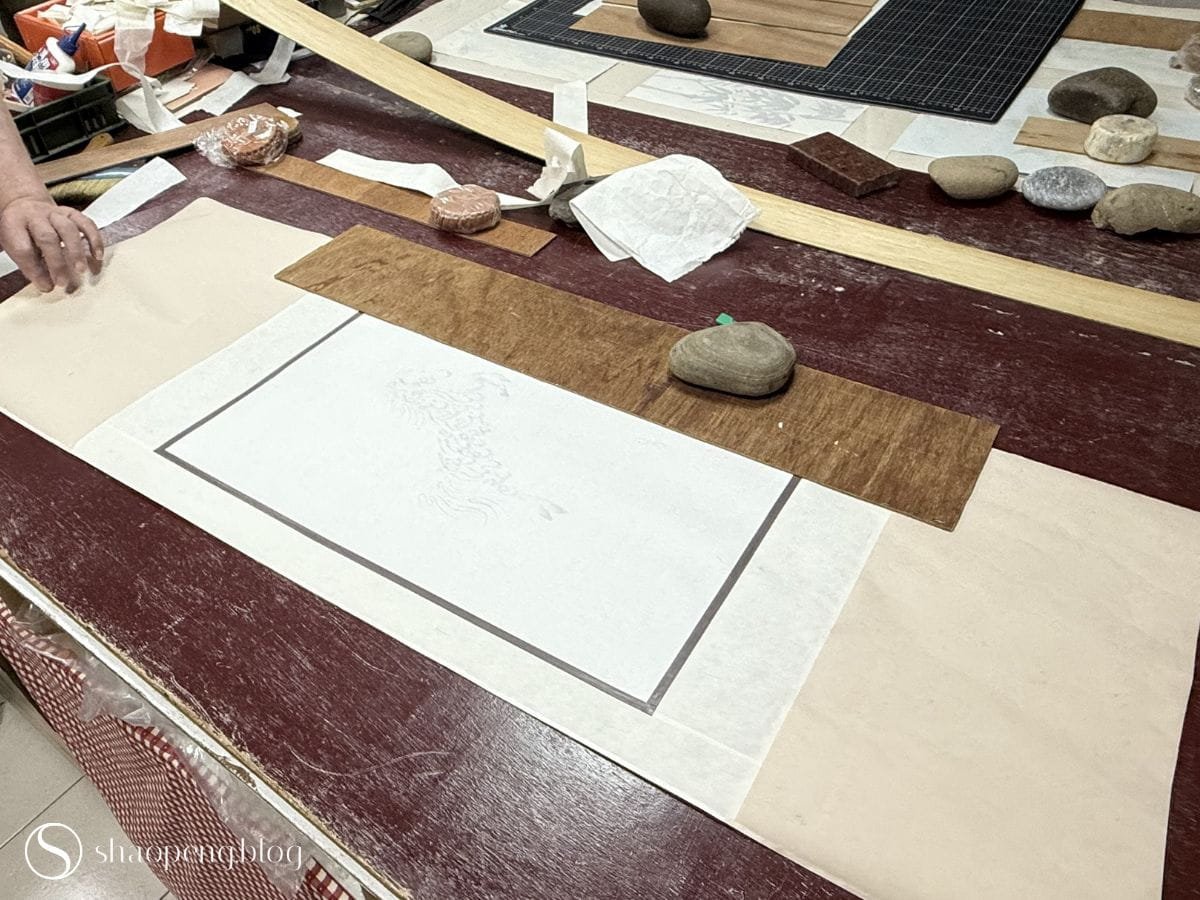
Before attaching the second backing layer, the long edges of the hanging scroll are folded to reinforce their strength.
As I construct the visual architecture section by section, the piece begins to resemble those I have seen in museums and in the studies of scholars depicted in centuries-old woodblock prints.
Once completed, a second backing layer is added and left to air-dry on the board for several more days. When fully dry, the reverse of the work is burnished with wax.
To transform the work from a two-dimensional surface into a hanging scroll, a rod is fitted to the top and a roller to the bottom. The roller, which carries considerable weight, not only stabilises the scroll when it is hung, but also allows it to be rolled up for easy storage.
I had not anticipated that I would need to trim the rod and roller myself with a mechanical saw, which I did. Surrounded by wood shavings, I find myself feeling more like a carpenter than an artist. Finally, cords are attached at the top, and the scroll is ready to be hung.
And voilà — as the French would say.
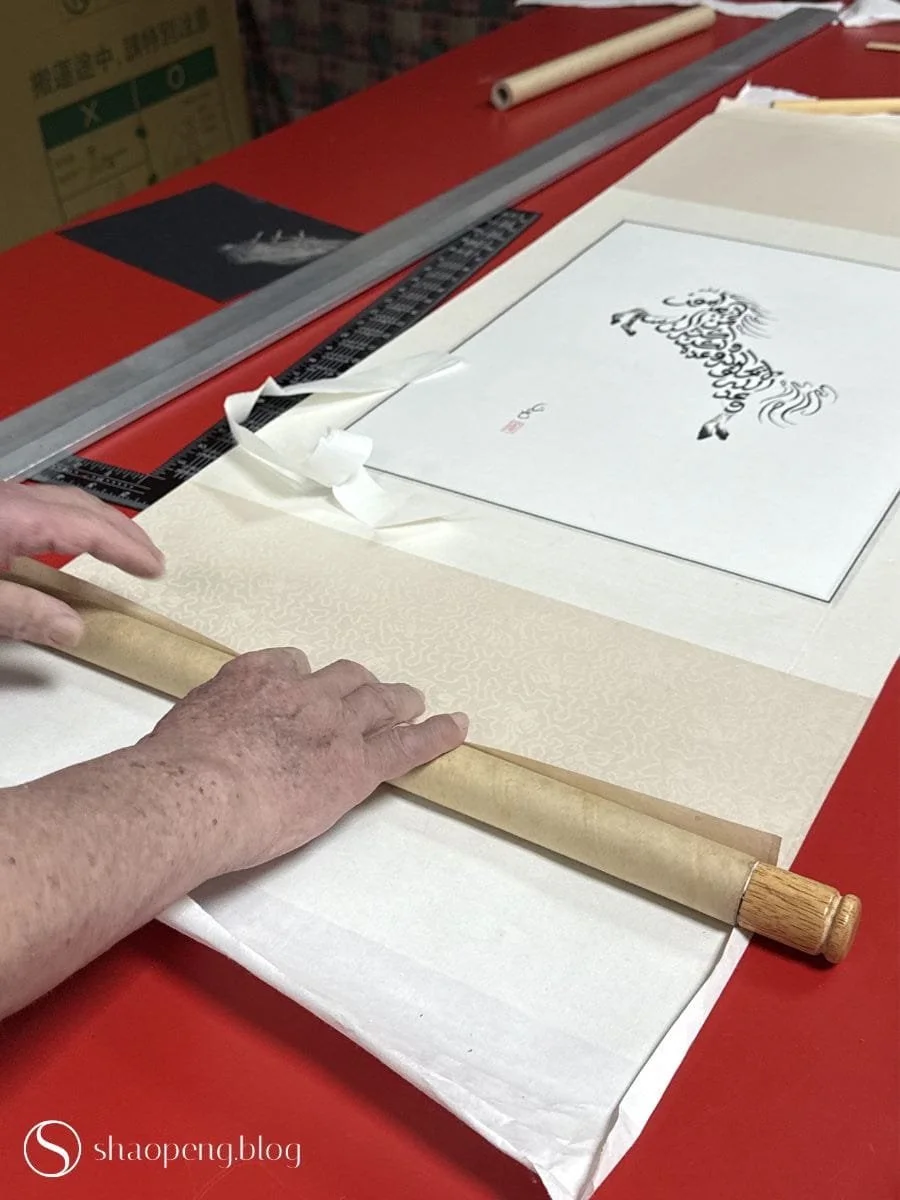
The weighted roller at the bottom of the hanging scroll provides stability when displayed and allows the scroll to be rolled up for preservation.
Having mounted a hanging scroll myself from beginning to end, I keep returning to the curious position occupied by both zhuangbiao and the mounting specialist. Without this delicate craft, many works would never survive the long passage of time. But preservation is only part of the story. The mounting, though almost invisible to most viewers, exerts an unspoken influence on how a work is perceived and experienced.
The entirely manual process also teaches something about patience in a world of speed. It celebrates materials whose qualities reveal themselves only through careful handling. Perhaps that is what makes zhuangbiao so compelling: it is an art that rarely stands in the spotlight, yet without it many of the masterpieces we admire today would never have survived centuries of time.
Today, manual zhuangbiao is gradually being replaced by more efficient machine-made mounting and ready-made scrolls. Yet zhuangbiao insists that presentation is itself a craft, and what happens to a work takes after it leaves the artist’s hands remains part of its story. Each layer of paper, each strip of silk, and each day spent resting on the drying board are part of the work’s becoming.
I dived in to the world of zhuangbiao thinking I was learning a finishing technique. What it taught me instead is that finishing is also part of the creative process itself. Some journeys, it turns out, begin right where you thought they ended.
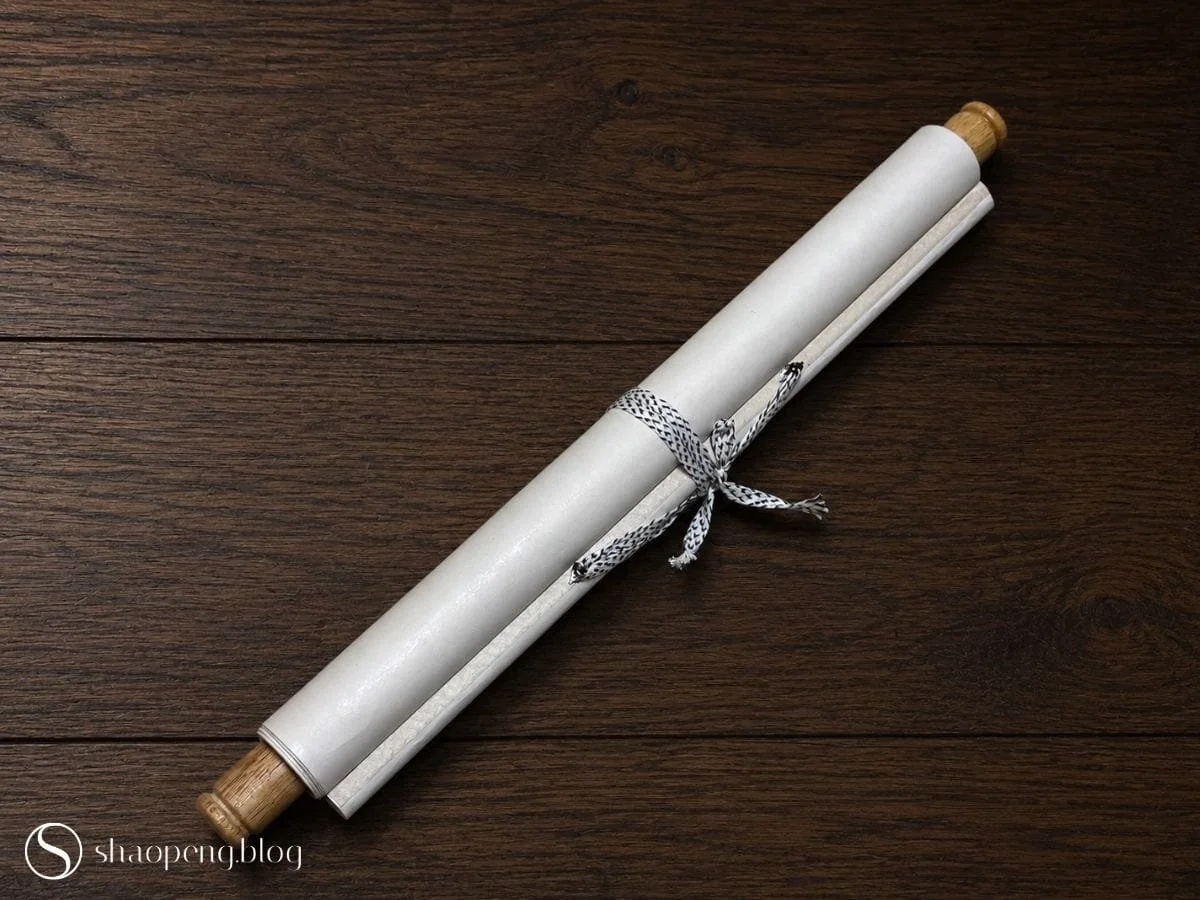
A hanging scroll can be rolled up, allowing it to be stored and preserved with ease.
Reference:
Liu, F. (Ed.). (2008). 書畫裝潢藝術 (The art of mounting Chinese painting and calligraphy). National Palace Museum, Taipei.
Zhou, J. (2012). 裝潢志 (Zhuanghuang zhi). Zhonghua Book Company.