
Wander in Abu Dhabi: An Arts & Culture Guide
Abu Dhabi tells its story through ancient fortresses, world-class museums, and sacred sanctuaries, and all you have to do is start wandering.
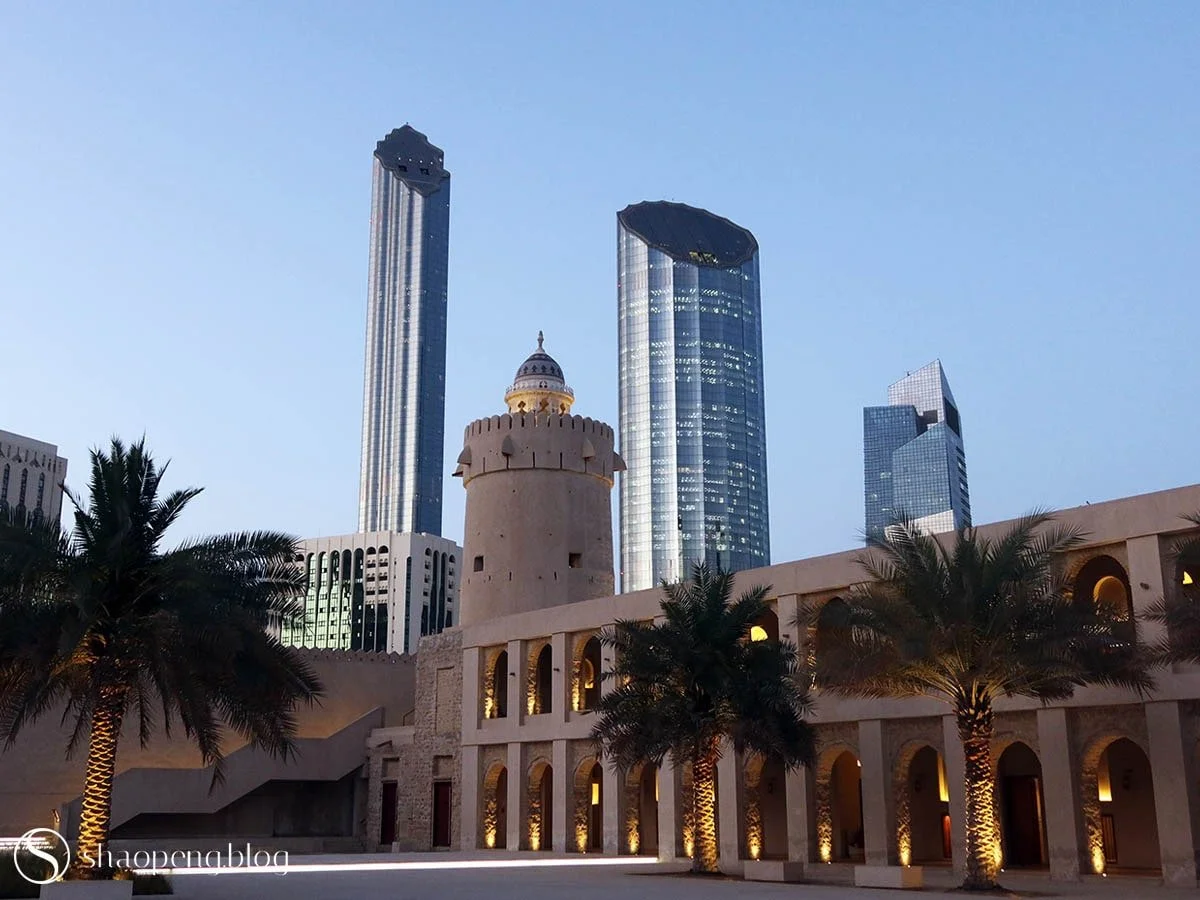
The centuries-old watchtowers of Qasr Al Hosn stand firm amid Abu Dhabi’s shimmering forest of glass and steel.
ABU DHABI, UAE — In contrast to its louder, glittering neighbour Dubai, Abu Dhabi draws you in slowly, deliberately, and far more deeply than you might expect.
As the capital of the United Arab Emirates, Abu Dhabi has long been planning something ambitious. From the annual Abu Dhabi Art Fair to the renowned Louvre Abu Dhabi, the long-awaited Zayed National Museum, and the forthcoming Guggenheim Abu Dhabi taking shape on Saadiyat Island, the emirate’s multi-billion-dollar cultural vision is no longer just a blueprint. It is becoming one of the world’s great stages for art, ideas, and cultural exchange.
As a curious wanderer myself, I’ve put together this guide for those who travel not just to see, but to feel the spirit of a place in its galleries, fortresses, and prayer halls. If you’re ready to wander, here’s where to begin:
Qasr Al Hosn
Sense of Wander: ★★★☆☆
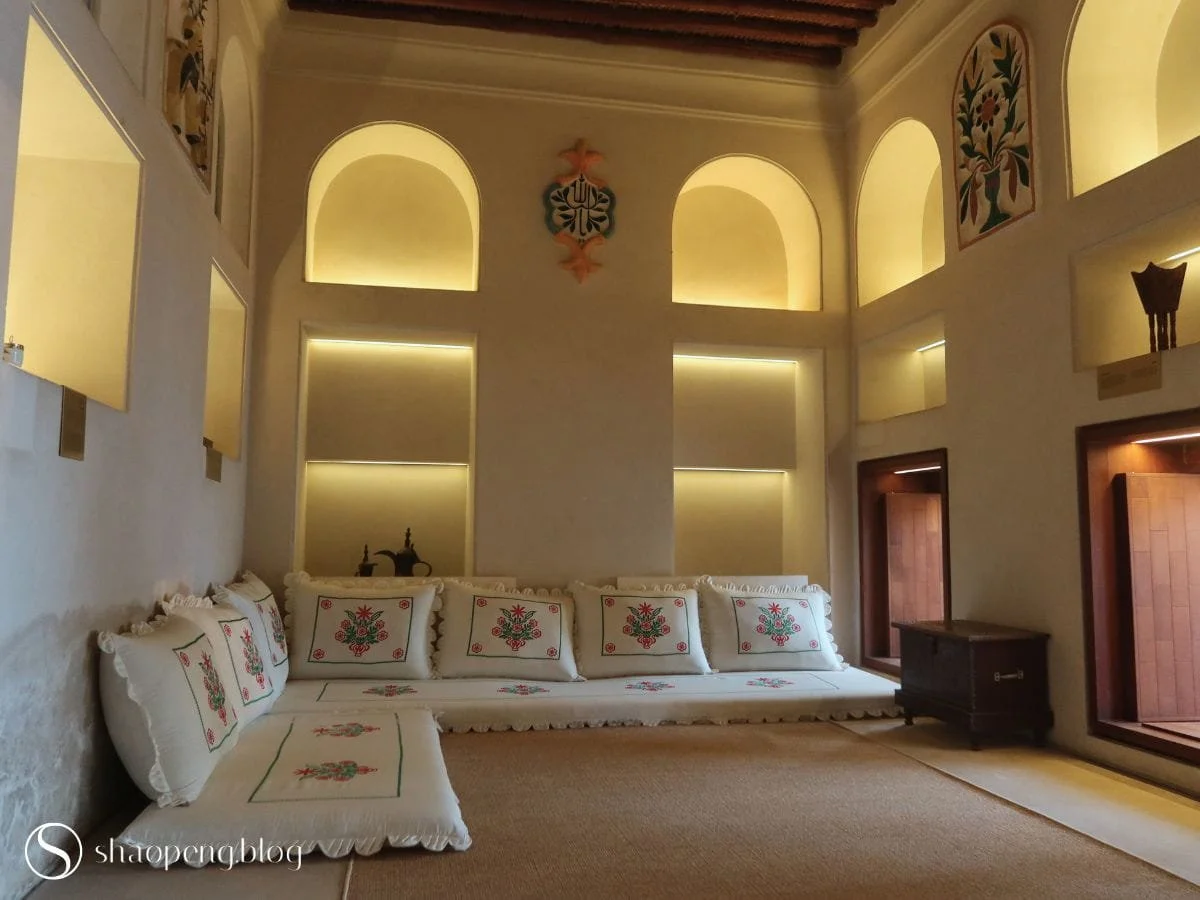
Inside the women’s majlis at Qasr Al Hosn.
To understand Abu Dhabi, begin at its heart where Qasr Al Hosn has stood for more than 250 years.
Its name says it all: Qasr Al Hosn translates literally as “Fort Palace,” a triple identity that reflects the building’s function as part military stronghold, part seat of government, and part royal residence. It is the oldest standing structure on Abu Dhabi island, and the ancestral home of the Al Nahyan family, whose roots trace back to the Bani Yas tribes who first discovered freshwater here and built a simple watchtower to protect it. That watchtower became this palace. Those tribes became a dynasty.
Built from the island’s own materials — coral stone and palm wood — the fort is arranged around a central courtyard, its surrounding wings lined with rooms decorated in carved plaster low-relief. Each room features exhibition dedicated to a different theme, some offering an intimate peek into the palace life across two centuries.
I’m particularly fascinated by the women’s majlis. This was the domain of Sheikha Salama bin Butti, mother of the revered Sheikh Zayed bin Sultan Al Nahyan. Known as Umm Al Shiyukh (“Mother of the Sheikhs”), she was, in every sense, the heart around which palace life turned. In these rooms, women and children came to seek her counsel; Emirati women and overseas visitors alike were welcomed here.
Wanderer’s tip — Visit Qasr Al Hosn in the afternoon, then head next door to the House of Artisans. Before sunset, return to the fort using the same ticket and linger until dusk, when the the palace takes on an entirely different mood. Every extra minute spent there is worth it.
House of Artisans
Sense of Wander: ★★★☆☆
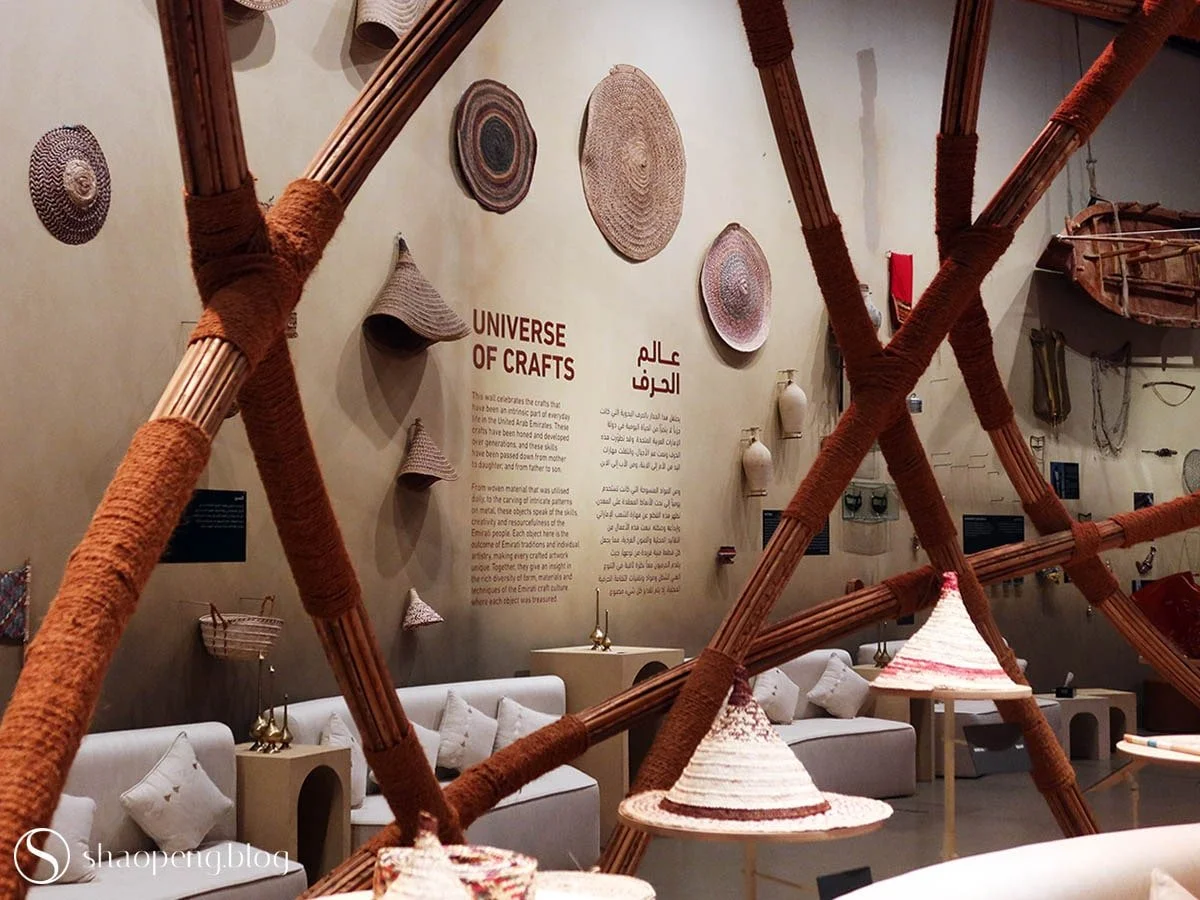
The House of Artisans illustrates the richness of traditional Emirati crafts that shape everyday life.
Just next door to Qasr Al Hosn, the House of Artisans is the kind of place that earns its own dedicated hour — or two — if you let it.
At its core is a permanent exhibition that celebrates the ingenuity of a people shaped by one of the harshest environments on earth. What you see on display are not crafts made for decoration but for survival, and that urgency gives everything here an unspoken dignity.
The exhibition unfolds across a constellation of subjects, each devoted to a different craft in what the space poetically calls its Universe of Craft. Wander through and you’ll move from the desert to the sea: boats built for pearling and fishing, nets and traps, hand-sewn garments, personal adornments, and aromatic perfumes that have long since crossed from necessity into cultural ritual.
What makes the exhibition relevant is the conversation between old and new: traditional handmade objects placed in dialogue with contemporary designs rooted in the same heritage, proving that these traditions are not relics but living inspiration for today’s creatives.
If you’re lucky, you may find local artisans at work within the space. During my visit, I stumbled upon a group of Emirati women at their loom, their hands moving through the geometry of al-sadu weaving — one of those unplanned encounters that makes a visit truly memorable.
Wanderer’s tip — Before you leave, make time for the gift shop. The products here are made by local artisans, which makes them worth far more than the average souvenir.
Emirates Heritage Village
Sense of Wander: ★★★★★
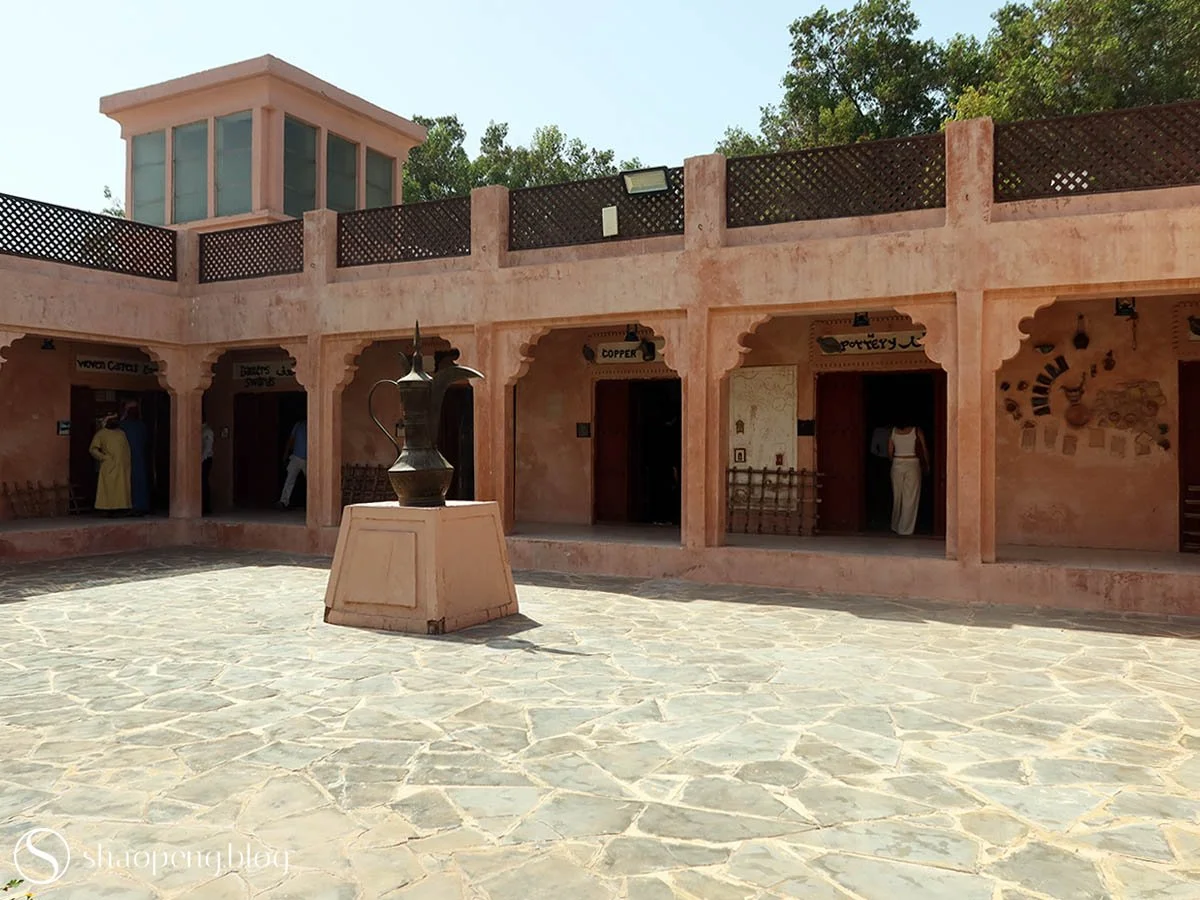
The Handicraft Market at Emirates Heritage Village offers visitors an intimate encounter with local artisans.
The Emirates Heritage Village may not appear on the average Abu Dhabi itinerary, but it should. Of all the places I visited, this is the one I find myself recommending most to those who want to feel Emirati heritage rather than simply read about it.
And feel it you will, because this is not a museum in the traditional sense. It is, quite literally, a village — complete with a mosque, a traditional souk, and small museums dedicated to coins, jewellery, and artefacts collected across generations. Wander through the Handicraft Market and you’ll find artisans absorbed in their work: metalsmith shaping copper plate, potter throwing clay on the wheel, and carpenter carving wooden chests.
Bedouin tents — Bait Al Sha’ar, woven from goat hair to keep out the winter cold — are pitched alongside Al Hadeera, open-air shelter made from tree branches where guests have traditionally been welcomed with qahwa and dates. Standing here, the desert life that shaped this emirate feels less like history and more like yesterday.
My favourite discovery, though, is easy to miss: a modest building marked only by a small plaque reading Women Handicraft above its doorway. Step inside and you’ll find an extraordinary world of craft made entirely by local women: al khous, the intricate art of palm weaving; al sadu, the Bedouin technique of weaving camel and goat hair into geometric patterns; and al talli, an embroidery tradition of braiding coloured threads with metallic strands. And the best part? Everything is available to purchase at a price that feels almost too reasonable.
Wanderer’s tip — When your feet need a rest, follow the path to the coastline. There’s a stretch of beach where you can sit, breathe in the salt air, and let the Persian Gulf do the rest.
Sheikh Zayed Grand Mosque
Sense of Wander: ★★★★★
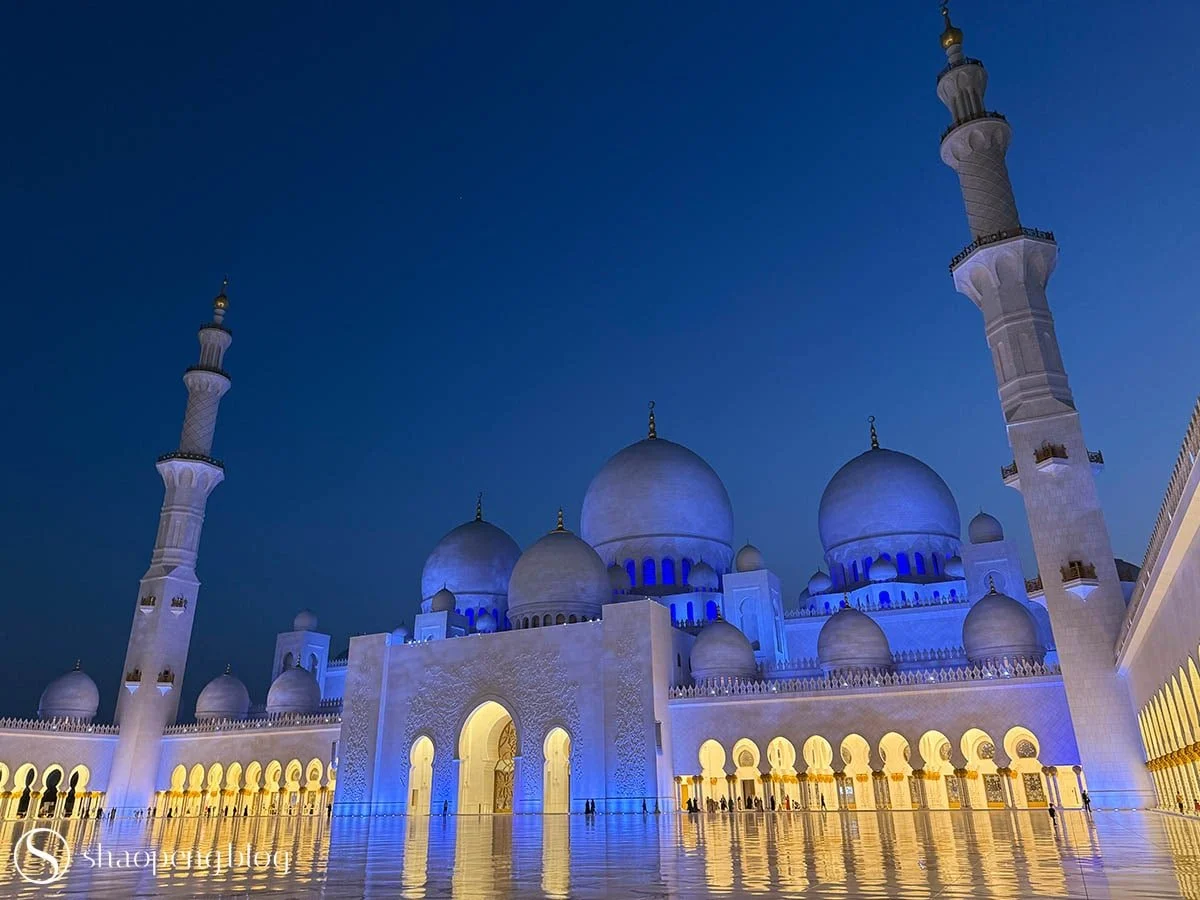
Glowing softly in the night, Sheikh Zayed Grand Mosque stands as both a sanctuary for the faithful and a beacon for souls adrift.
Some places need no introduction, and Sheikh Zayed Grand Mosque is one of them. Yet no amount of photographs quite prepares you for the moment you step through its gates.
One of the world's great mosques, it was established under the Sheikh Zayed Grand Mosque Centre in 2008, but its origins are more personal than institutional. It was Sheikh Zayed bin Sultan Al Nahyan himself, the UAE’s founding president and Abu Dhabi’s beloved ruler, who directed this extraordinary architectural undertaking. He did not live to see it fully realised; following his death in 2004, he was buried in the mosque's courtyard, as per his own wish. Today, his tomb sits in the mosque’s courtyard, where you’ll hear the recitation of the Quran running, without pause, twenty-four hours a day.
The mosque spreads across more than 165,000 square metres, its facade clad in sivec marble from Macedonia and Greece. There are 96 domes and 1,096 columns rising across the complex. Designed by Syrian architect Yousef Abdelky, the architecture draws fluidly from Mughal, Persian, and Moorish traditions. Standing before it, the silhouette inevitably calls to mind the Taj Mahal in Agra, though the opulence here seems to rival that wonder.
Look closely and you’ll find Mughal-style stone inlays — lapis lazuli, amethyst, jasper, mother-of-pearl — adorning the marble floors up the columns and across the walls. This grandeur is the collaborative effort of more than 3,000 artisans drawn from across the world.
Inside, the world’s largest handwoven Persian carpet unfurls beneath the world’s largest chandelier. The sheer density of artistry embedded in every surface is the kind that leaves you in awe — something I’ll explore in greater details in a forthcoming article, inshallah.
Sheikh Zayed Grand Mosque is a living place of worship that opens its doors to all, offering people from every walk of life an encounter with the Muslim faith through beauty, craft, and devotion.
Wanderer’s tip — Entrance is free but requires advance booking. I would strongly recommend joining a guided tour at the entrance — it is only with an official guide that you’ll be permitted to set foot into the prayer hall. If you can time it right, arrive before sunset: the mosque in golden light and the mosque under darkness are two entirely different experiences, and you’ll want both.
Abrahamic Family House
Sense of Wander: ★★★★★
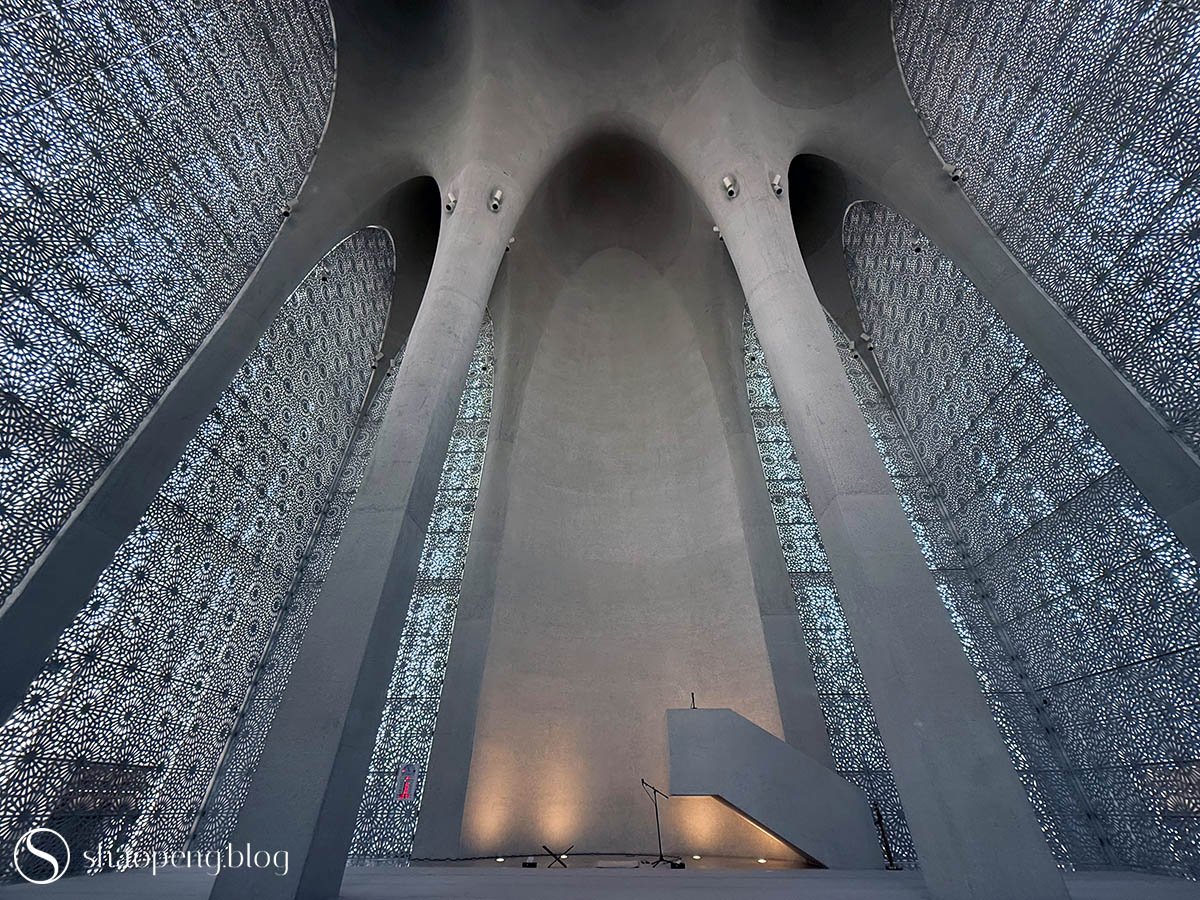
Free of excessive ornamentation, the mosque at Abrahamic Family House guides the beholder’s gaze toward the mihrab — the sacred direction of the Kaaba in Mecca.
Where the Sheikh Zayed Grand Mosque draws the crowd, the Abrahamic Family House draws the contemplative — and it may be the most moving place in Abu Dhabi.
Just a short walk from Louvre Abu Dhabi, this singular complex brings together a mosque, a church, and a synagogue within a shared sanctuary — a statement of unity that feels especially urgent in an age of division and conflict. It is one of those places that simply stands, and remind you that the three faiths, so often set against one another in the world outside, actually share the same ground in peace.
Designed by Ghanaian-British architect David Adjaye, the complex is an exercise in deliberate equality. Three cubic buildings — each measuring precisely 30 metres in width, length, and height — rise in the same material, distinguished only by the faith practiced within. The architecture makes the argument before a single word is spoken: no faith stands taller, no tradition takes precedence. All three are rooted in the same Abrahamic belief, and the buildings state this with clarity.
In a region where faith is woven into the fabric of daily life, the Abrahamic Family House feels less like a tourist destination and more like a necessary reminder of what is possible.
Wanderer’s tip — To explore the complex with real depth, book a guided tour in advance — it makes an enormous difference. For non-muslim female visitors entering the mosque, a clean shawl is available at the receptionist for hair covering.
Louvre Abu Dhabi
Sense of Wander: ★★★★☆
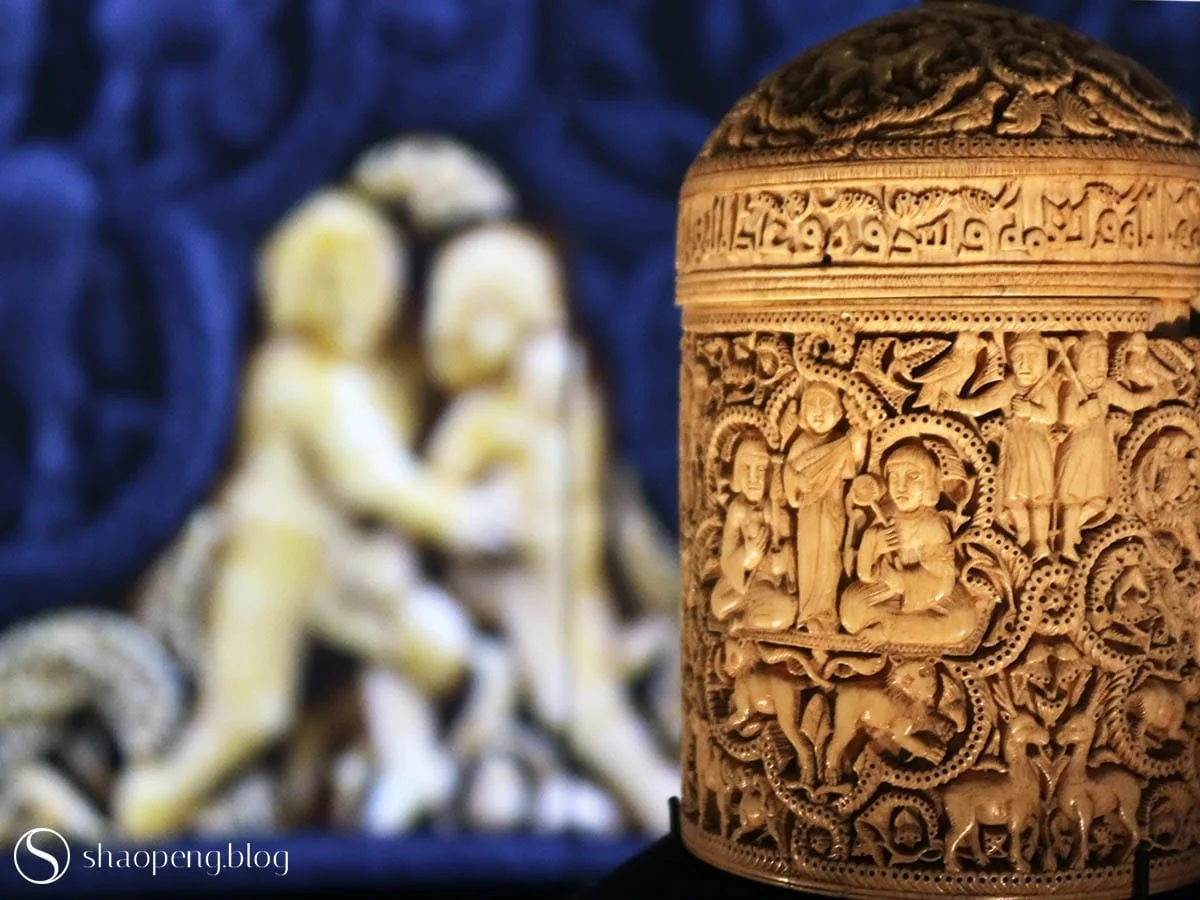
A masterpiece of ivory craftsmanship from Al-Andalus, the Pyxis of Prince Al-Mughira is on view at Louvre Abu Dhabi until November 2026.
Even if art is not your primary reason for coming to Abu Dhabi, Louvre Abu Dhabi will likely find its way onto your itinerary.
The fruit of a landmark partnership between Abu Dhabi and France, the museum occupies a unique position in the art world. With an ambition to present art and culture across civilisations and millennia, its galleries trace the universal threads that connect humanity across geography, faith, and time. In a country that sits at the crossroads of East and West, there is something fitting about a museum whose premise rests on a simple idea: we have always had more in common than we imagine.
I’ll admit to a small disappointment: the collection from the Islamic world feels thinner than a museum of this scale and location might lead you to hope. But then you find the Pyxis of Prince Al-Mughira, a breathtaking ivory carving from the Umayyad royal workshop of Al-Andalus. It’s the kind of object that exists in every Islamic art history textbook but hits differently when you’re standing before the real thing.
I’ll admit a small disappointment: the Islamic art collection feels lighter than one might anticipate from a museum of this scale and context. That is, until you encounter the Pyxis of Prince al-Mughira, a breathtaking ivory carving from the Umayyad royal workshops of Al-Andalus. It is the kind of object that appears in every Islamic art history textbook, but it lands differently when you are standing before it.
For those less drawn to art or artefacts, Jean Nouvel’s architecture alone makes the journey worthwhile. The museum’s vast dome — its geometric latticework drawn from the vocabulary of Islamic design — filters Abu Dhabi’s sunlight into a shifting, dappled pattern that moves across water and stone flooring below. On a clear day, the building feels like a meditation on light itself.
Wanderer’s tip — Louvre Abu Dhabi draws significant crowds, so arrive when the doors open to enjoy the galleries at their quietest. Set aside at least three hours to do justice to both the permanent collection and any special exhibitions on display during your visit.
Zayed National Museum
Sense of Wander: ★★★★★
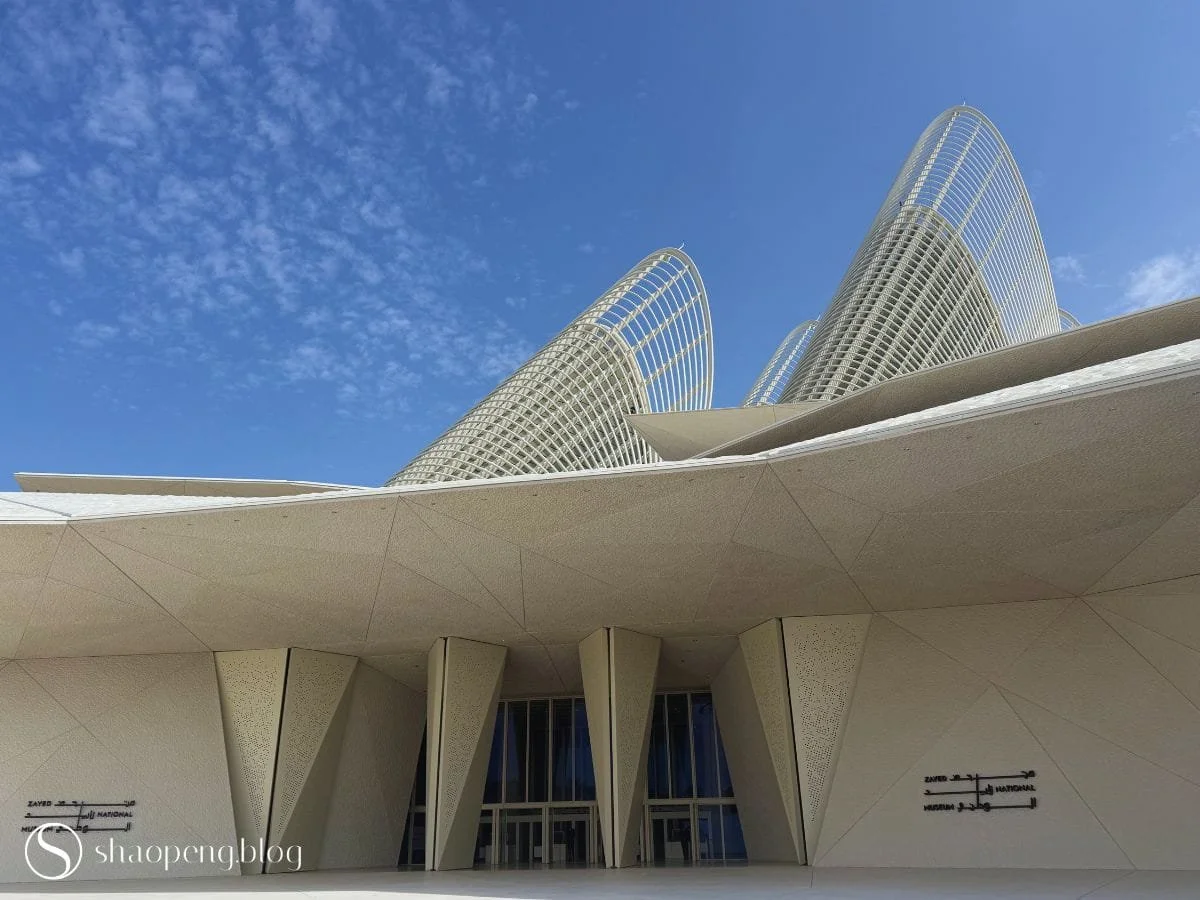
Entrance to the newly opened Zayed National Museum.
Long anticipated and years in the making, the Zayed National Museum finally opened its doors in December 2025.
A tribute to Sheikh Zayed bin Sultan Al Nahyan, the museum traces the story of the land and its people from ancient times to the present, bringing together cutting-edge technology, soundscapes, visual narratives, artefacts, and historical objects to create an immersive visitor experience.
Inside, six permanent galleries unfold across two floors, spanning 300,000 years of human history — from the UAE’s natural landscapes and ancient heritage to its coastal traditions and cultural evolution. The collection brings together artefacts from across the UAE alongside international loans.
The exhibitions recount stories that may be familiar from other museums in the UAE, but with greater depth and detail. I’m particularly drawn to the Abu Dhabi Pearl — the world’s oldest known natural pearl — so small and easily overlooked that I missed it on my first visit, only to return to the gallery a second time just to find it.
Designed by Foster + Partners, the architecture draws on Emirati culture, with five soaring steel towers evoking the wings of a falcon. They function not only as a visual statement but also as solar thermal chimneys that channel cool air into the galleries below, akin to a modern interpretation of the traditional barjeel wind tower.
Wanderer’s tip — The Zayed National Museum stands just right across the street from Louvre Abu Dhabi, within easy walking distance.
Qasr Al Watan
Sense of Wander: ★★★★☆
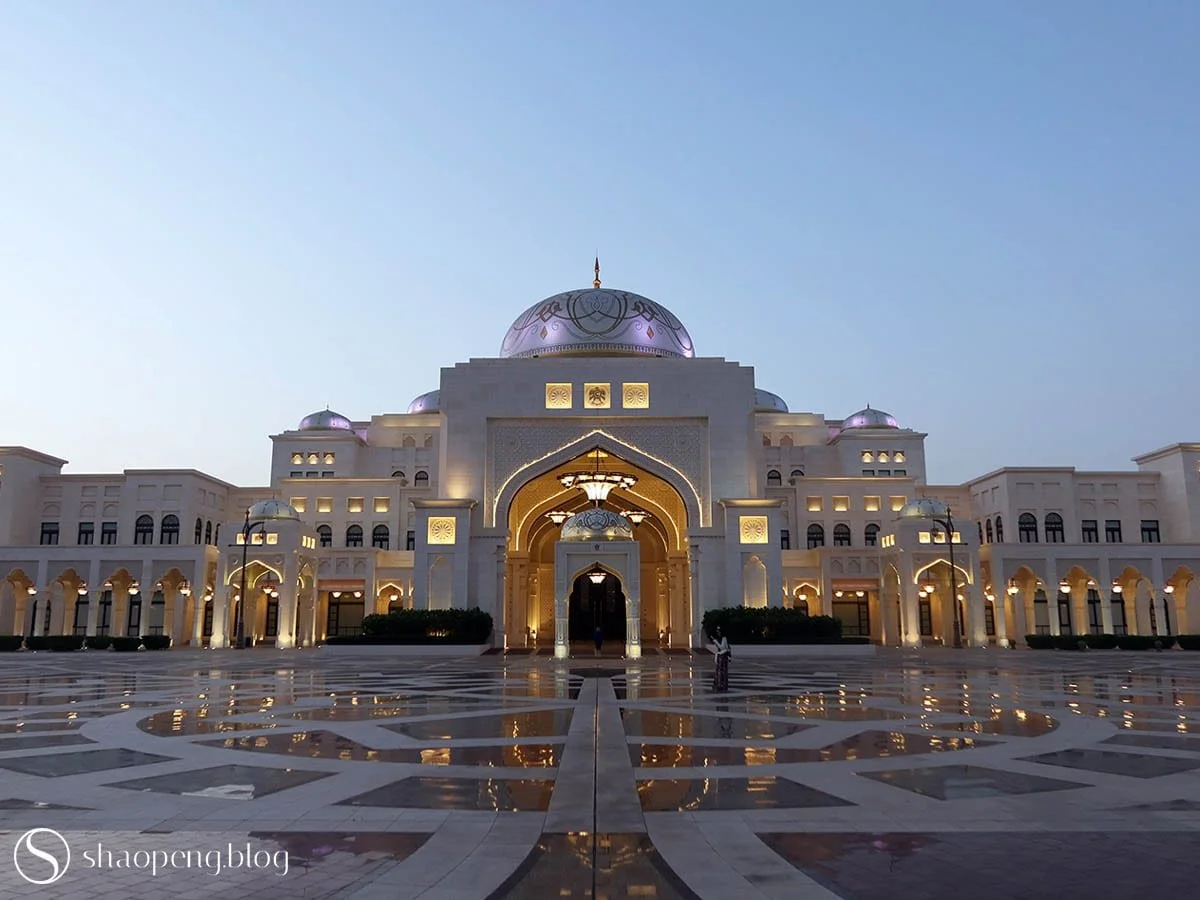
At night, the grandeur of Qasr Al Watan is amplified by its luminous facade.
To end your wandering in Abu Dhabi, there is no more fitting place than Qasr Al Watan, the Presidential Palace. It is also one of the grandest spaces in the emirate you will ever walk through.
This is still a working palace. Foreign dignitaries are received here; state summits take place within these very halls. What’s more fascinating is that the sections open to visitors are precisely those ceremonial spaces — the rooms where the world leaders have sat, negotiated, and been welcomed. You are unlikely to cross paths with a head of state during your visit, as the palace closes to the public during official events. The weight of what happens here lingers in the air nonetheless.
Besides its immense scale, it’s the interior that that draws the eye. The palette is deliberate and deeply symbolic: pastel tones of brown, blue, and white represent the desert, the Gulf, and peace, respectively. The intricate mosaics carry the same spirit of craftsmanship you may have encountered at the Sheikh Zayed Grand Mosque. Alongside the Mughal-style stone inlays, you’ll find mosaics composed of fine tesserae that speak to a Roman sensibility — a subtle reminder that great civilisations have always borrowed from one another.
During my visit, two exhibitions were on display inside the palace. The first presents gifts received from foreign dignitaries, arranged by theme and category. The collection is surprising in both variety and craftsmanship, with many pieces reflecting the finest traditions of their countries of origin. Browsing it feels like a journey through artistic traditions from around the world.
The second exhibition traces the contributions of Arab scholars to the fields of science, astronomy, and philosophy, weaving their legacy together with the values of leadership embodied by Sheikh Zayed bin Sultan Al Nahyan throughout his life.
Wanderer’s tip — Plan to arrive at least two hours before closing so you can explore at your own pace and still secure a good spot for the Light & Sound Show, which transforms the palace facade into a canvas for light and colour after dark.