
Wandering Into Kyosai’s World: Master Painter, Satirist and Jester
Frogs playing the shamisen, skeletons in top hats, and a painter jailed for his jokes. Meet Kawanabe Kyosai, the eccentric 19th-century master whose humour still makes us laugh.
Sense of Wander: ★★★★☆
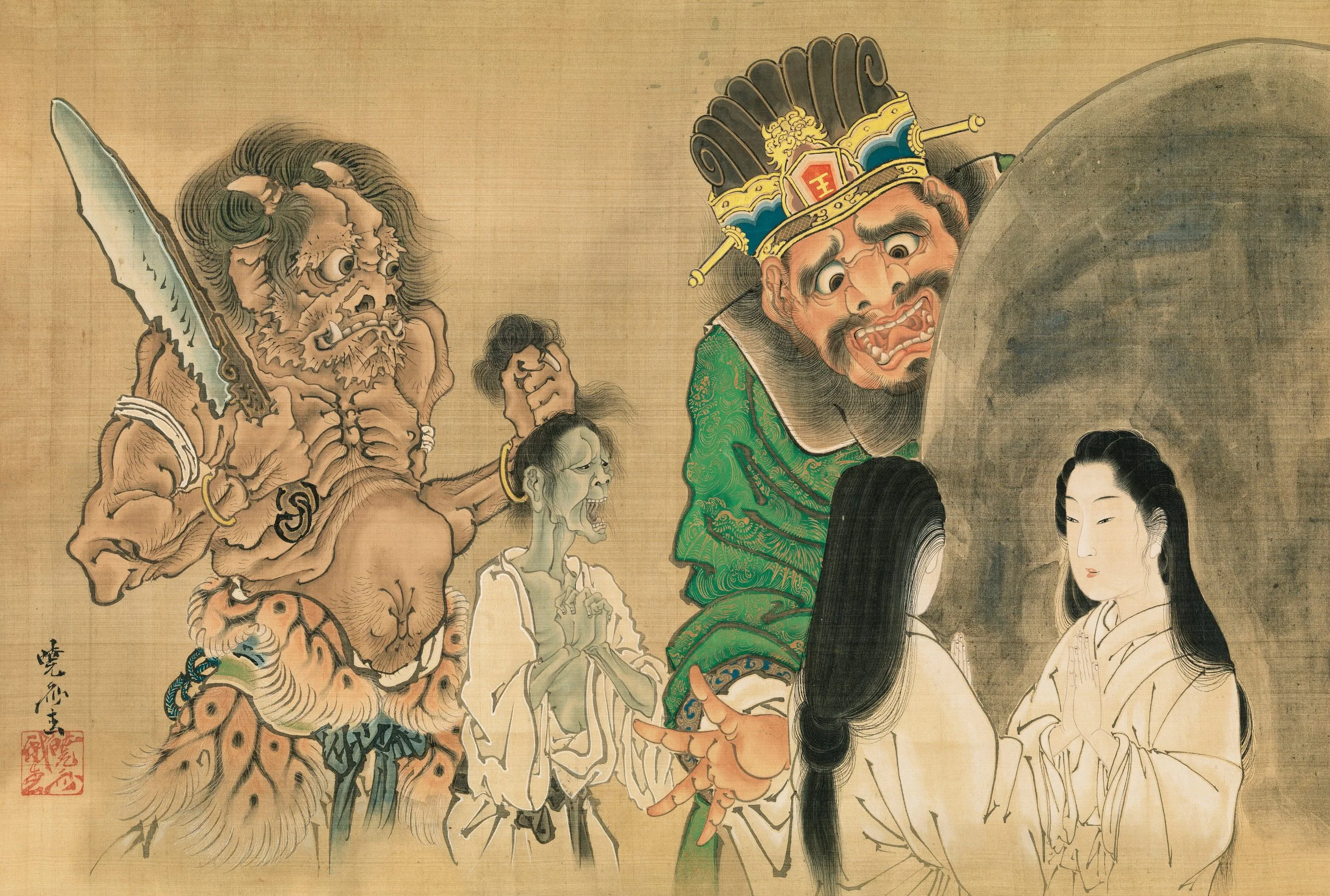
A Beauty in Front of King Enma’s Mirror (1871-89) by Kawanabe Kyosai.
KOBE, Japan — The waves and post-road vistas of Hokusai and Hiroshige are usually what come to mind when we think of the ukiyo-e prints of Edo Japan. But on a recent visit to Kobe, I found myself drawn into the orbit of someone far more eccentric: a painter who moved freely between classical ink, woodblock prints and something that looks like early manga. His name was Kawanabe Kyosai (河鍋暁斎, 1831–1889).
Kyosai could produce a highly finished traditional masterpiece. He could also draw a joke sharp enough to get himself arrested more than once. Beneath the satire was a born jester who filled his paintings with tipsy monks, dancing skeletons, and animals in combat.
For decades, he was overshadowed by the big names of Japanese printmaking. Then, in 2022, the Royal Academy in London gave him his first UK exhibition in nearly 30 years, built around the collection of London dealer Israel Goldman.
This year, the exhibition returned to Japan, opening at Tokyo’s Suntory Museum of Art before travelling to the Kobe City Museum, where around 110 works are on view, several of them shown in Japan for the first time.
Upon entering the exhibition, you meet the frogs, and it’s hard not to grin. One hanging scroll, rendered in soft ink wash, could pass for a Zen painting at first glance. Look closer and you find a large frog balancing a lotus stem on his nose, while a smaller one lounges on the seed pod, strumming a shamisen made from a tiny lotus bud. In the corner, another frog chants while beating a drum made from a lotus pod.
The frog was Kyosai’s lifelong companion. His first sketch as a young child was of a frog, and the animal remained a favourite throughout his life. Across the galleries, frogs appear as street performers and rickshaw drivers. In Frog School, a frog teacher points to a lotus-leaf wall chart in front of his frog pupils, a wink at Japan’s newly established public school system. Frogs even go to war, standing in for the real conflicts during the Meiji era (1868-1912).
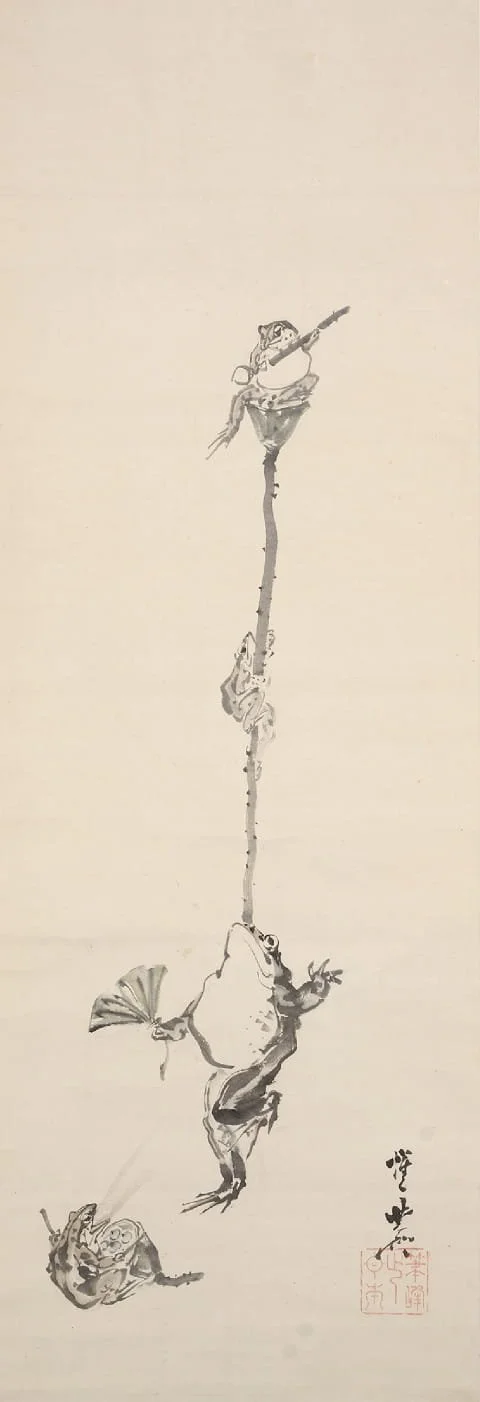
Frog Acrobats (1871-89) by Kawanabe Kyosai. Image courtesy of Israel Goldman.
Kyosai was put into Utagawa Kuniyoshi’s studio at around the age of six, where he was taught to capture the “spirit and force” of a subject rather than merely its appearance. Legend has it that he once fished a severed head out of a river, took it home and sketched it.
His family later moved him to the more respectable Kano school. From the age of ten, he trained for nine years at its Surugadai branch, where his teacher, Maemura Towa, gave him a nickname that stayed with him for life: Gaki, meaning the “demon of painting.” The Kano school combined Chinese-style ink painting (kanga) with Japanese colour painting (yamato-e), an approach that can be seen in the artist’s more traditional works.
The crow scrolls show this particularly well. Crows became Kyosai’s emblem of success after Winter Crow on a Withered Branch won a prize at the Domestic Industrial Exposition in 1881, helping to propel his career. In these paintings, the controlled ink and expressive brushwork reflect the rigour of his formal training.
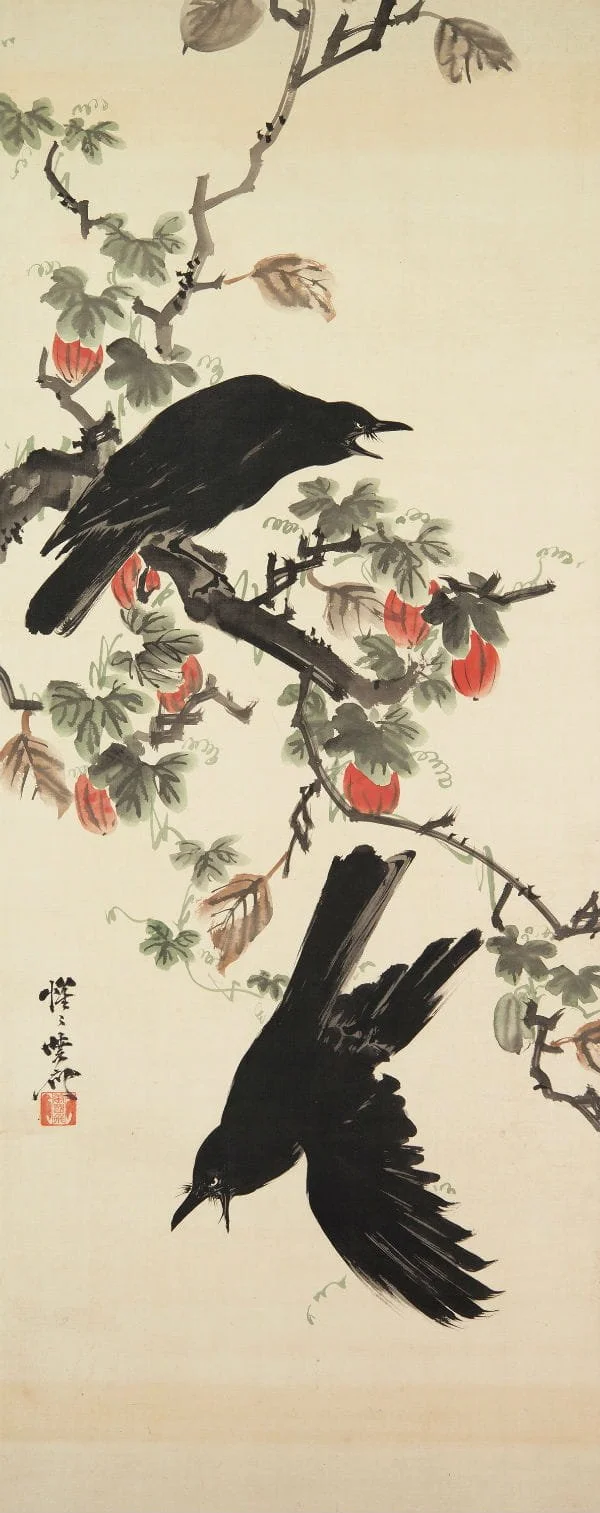
Two Crows with ‘Crow Gourd’ (1871-89) by Kawanabe Kyosai. Image courtesy of Israel Goldman.
Then there is kyoga, meaning “comic” or “crazy pictures,” the satirical tradition that came to define him. Around 1857, he began using the art name Kyosai, incorporating the character 狂 (kyo), the same character found in kyoga, meaning “mad” or “wild.”
The exhibition’s showpiece is Hell Courtesan, Dancing Ikkyu and Skeletons. The courtesan Jigoku, suspicious of the eccentric Zen monk Ikkyu, spies on him and finds him dancing with the house’s entertainers, all now skeletons. Her robe alone is worth a closer look, embroidered with scenes of hell: King Enma, the bodhisattva Jizo, infernal officers, and demons. Kyosai brings the meticulous finish of serious painting to an elaborate joke.
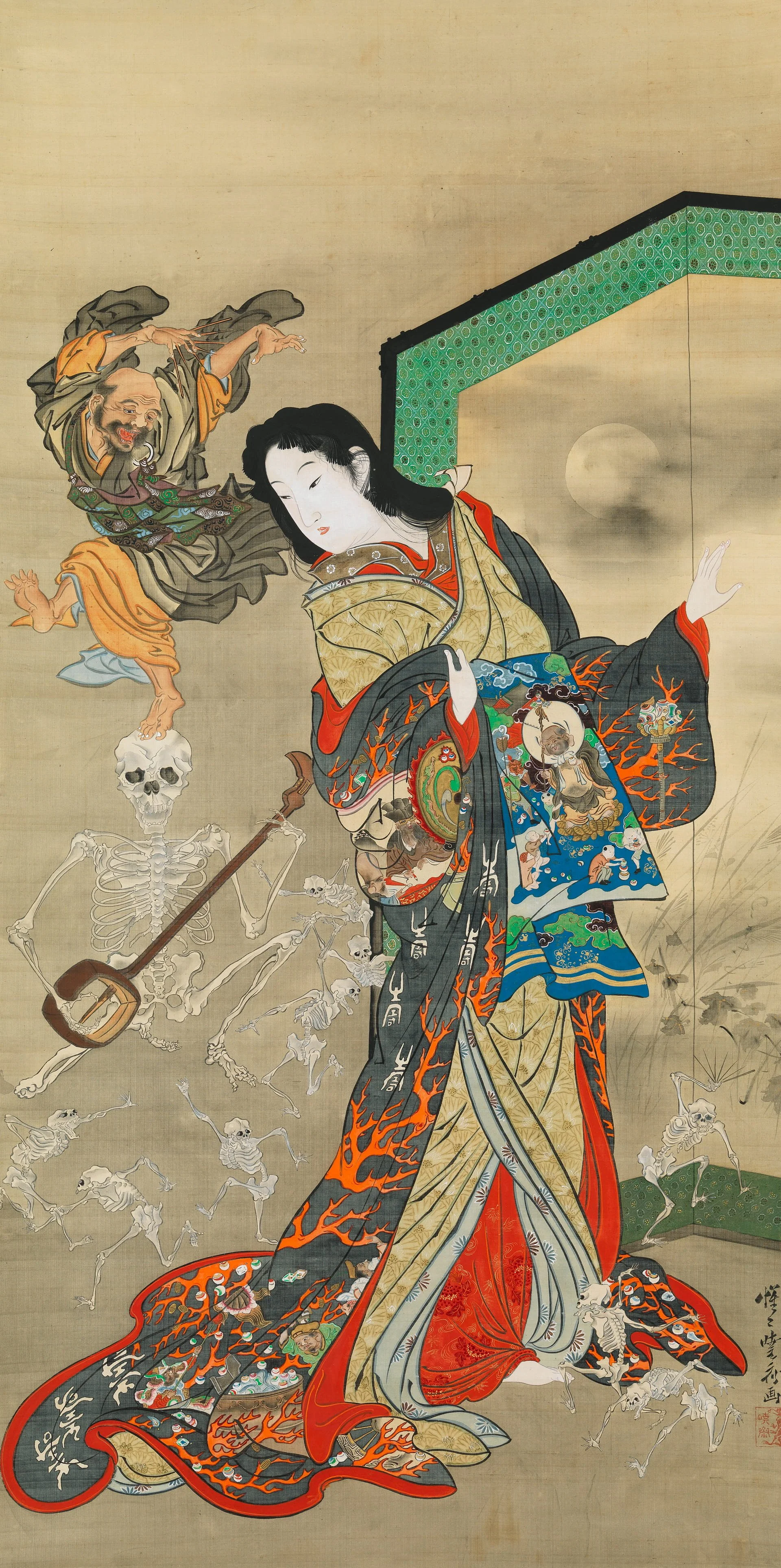
Hell Courtesan (Jigoku-dayu, Dancing Ikkyu, and Skeletons (1871-89) by Kawanabe Kyosai. Image courtesy of Israel Goldman.
He turned the same wit on Enma in A Beauty in Front of King Enma’s Mirror. Here, the King of Hell is astonished when his mirror, which should reveal the woman’s sins, shows only a beautiful reflection. With her back to us, we cannot tell whether the mirror is revealing her inner beauty or simply her outward appearance.
Nearby, the ghost paintings take you in the opposite direction. One slender scroll shows a female apparition in a white robe. A lantern’s light cuts across her face, revealing her dishevelled hair, downcast gaze and exposed ribs. As someone who also works with ink, I stand there wondering how ink, through Kyosai’s brushstrokes, can send such a chill down my spine. It may not be obvious at first, but Kyosai used expensive gold to depict this haunting subject, an unusual choice, but then again, this is Kyosai.
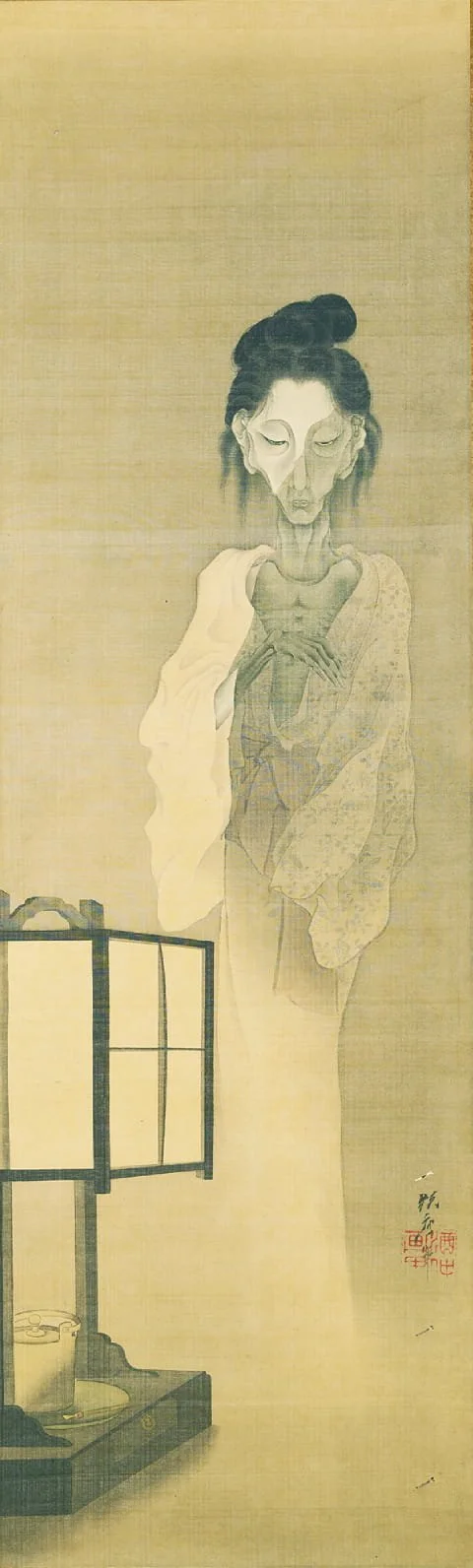
Ghost (1868-70) by Kawanabe Kyosai. Image courtesy of Israel Goldman.
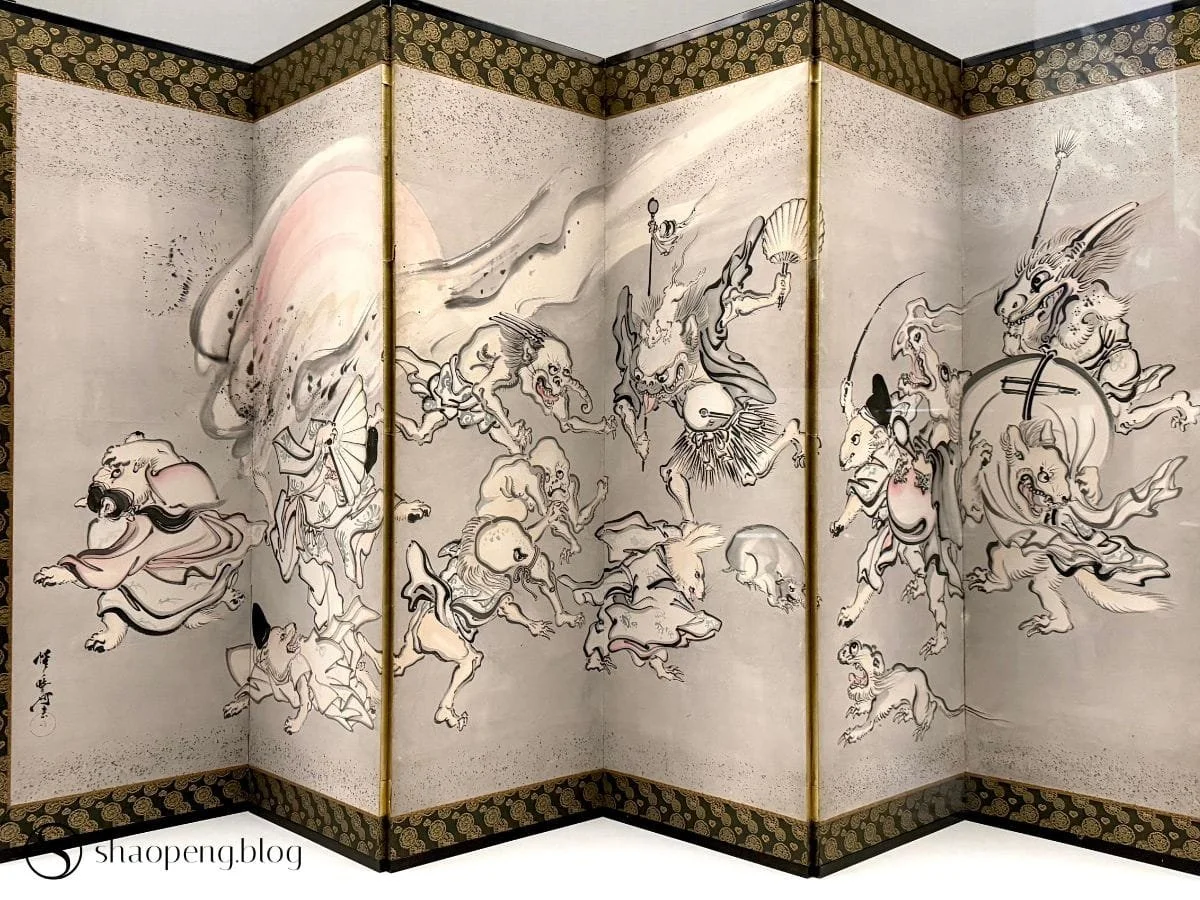
Part of Night Procession of One Hundred Demons (1871-89) by Kawanabe Kyosai. Image courtesy of Israel Goldman.
Then the ghosts give way to the demons. Kyosai’s imagination had no ceiling, and nowhere does it run wilder than in Night Procession of One Hundred Demons. A pair of folding screens is filled with a rowdy parade of yokai, drawn from the folklore of hyakki yagyo, the legendary night when spirits pour into the streets of the human world.
Look closely and you’ll find possessed household objects marching alongside them, including temple gongs (waniguchi) and wooden mokugyo drums. Kyosai reworked these characters from earlier paintings of the same theme, but the mischief is entirely his own. It seems fitting for a man who proudly carried the nickname “demon of painting.”
Kyosai lived in the age of the shogakai, calligraphy-and-painting gatherings where artists worked live before an audience, often with plenty of sake.
The exhibition features examples of sekiga, or impromptu paintings, including a collaborative work Kyosai organised with 54 other artists. He painted the human figures, leaving blank spaces for the others to fill with their own art and poetry. The scene offers a glimpse of the atmosphere of a shogakai, where the act of making art was as much a part of the occasion as the finished work itself.
Kyosai was a star at shogakai, famous for his lightning-fast brushwork and legendary appetite for drink. That combination got him arrested. In October 1870, he became heavily intoxicated and painted works mocking the authorities. Throughout his lifetime, Kyosai was imprisoned multiple times for his satirical images. Strangely though, the notoriety only bolstered his reputation, making his name even more commercially sought-after.
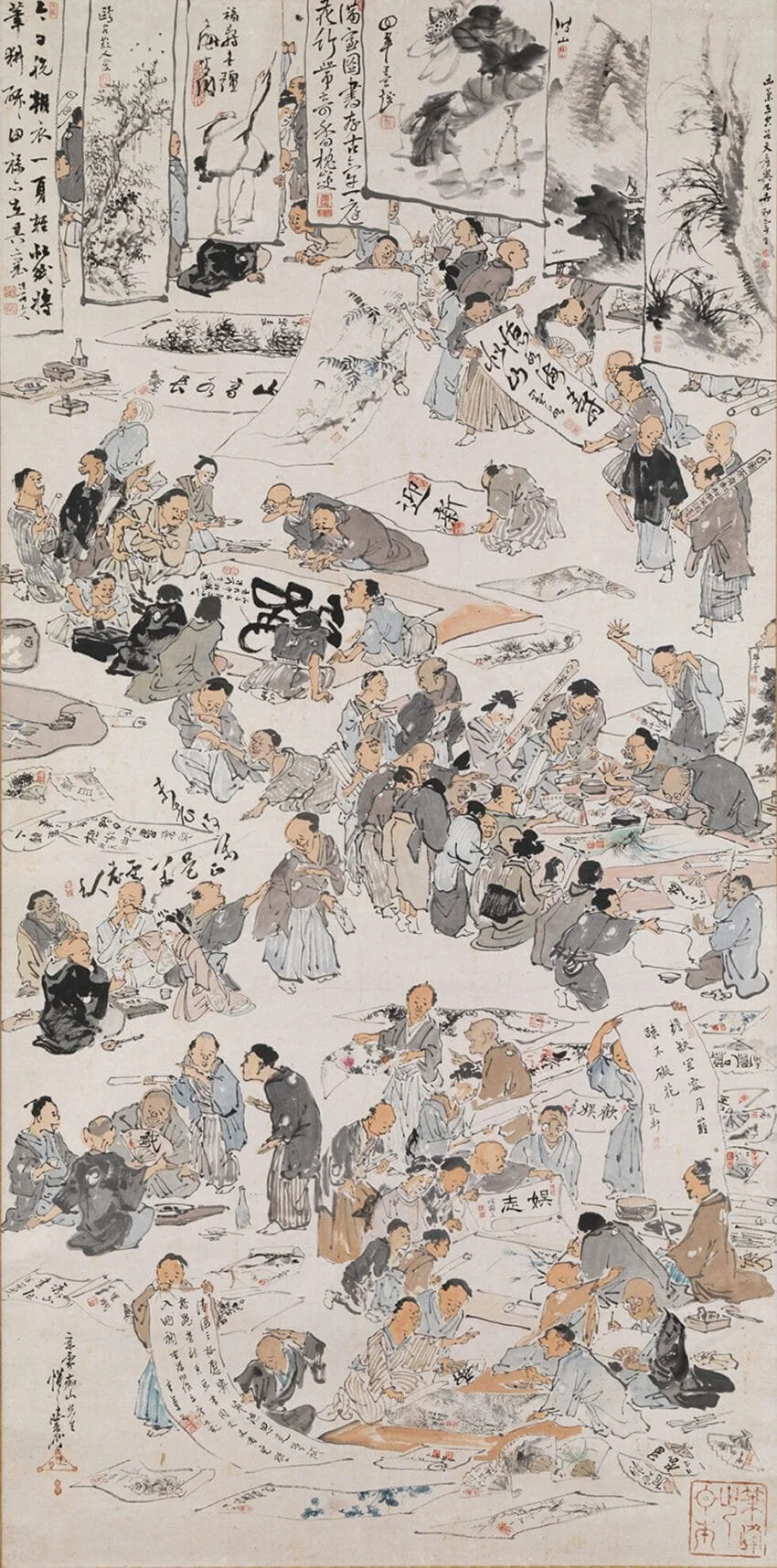
Shogakai (1876-1878) by Kanawabi Kyosai, Taki Katei, Okuhara Seiko, and 52 other artists and calligraphers. Image courtesy of Israel Goldman.
For pure fun, head to the He-gassen, the “fart battles.” This comic tradition reaches back to the 12th century, when monks sketched absurd battles to poke fun at human ego and competition. Kyosai took the joke further, turning farts into cannon fire and blasts of wind that send bystanders flying. In one inventive scene, a farter is “fired” by having his belly squeezed with a length of cloth.
My favourite is Ink Battle. Two rival groups — medieval courtiers and warriors — are in combat with giant brushes and splashes of ink flying across the scene. Kyosai’s contemporaries may have seen it as a nod to the clashes between supporters of the shogunate and the imperial side during the turbulent 1860s.
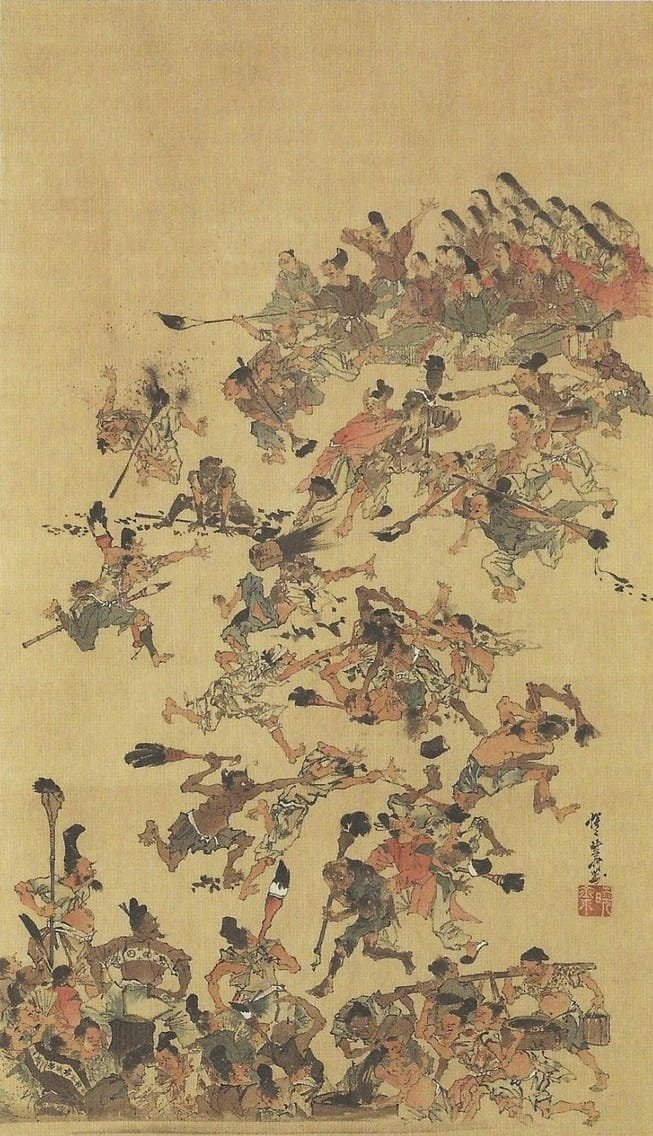
Ink Battle (1871-89) by Kawanabe Kyosai. Image courtesy of Israel Goldman.
Kyosai was not a political activist, but he had a reflex for responding to whatever was happening around him, and his brush was always within reach. During that time, Japan was in upheaval. The shogunate had fallen, and the country was rattled by political, social and economic uncertainty. Nothing captures people’s anxiety better than the painting I linger over longest: a skeleton in a top hat and Western suit, strumming a shamisen, with a samurai sword poking out from behind him.
Foreign fashions were sweeping through Meiji Japan, and here Kyosai captures a nation trying on a new outfit without quite letting go of the old one. The painting is often read as a comment on Westernisation and the way the samurai past lingers beneath the new clothes. The skeleton adds a sly reminder that no fashion, Eastern or Western, can change the fact that we are all headed the same direction.
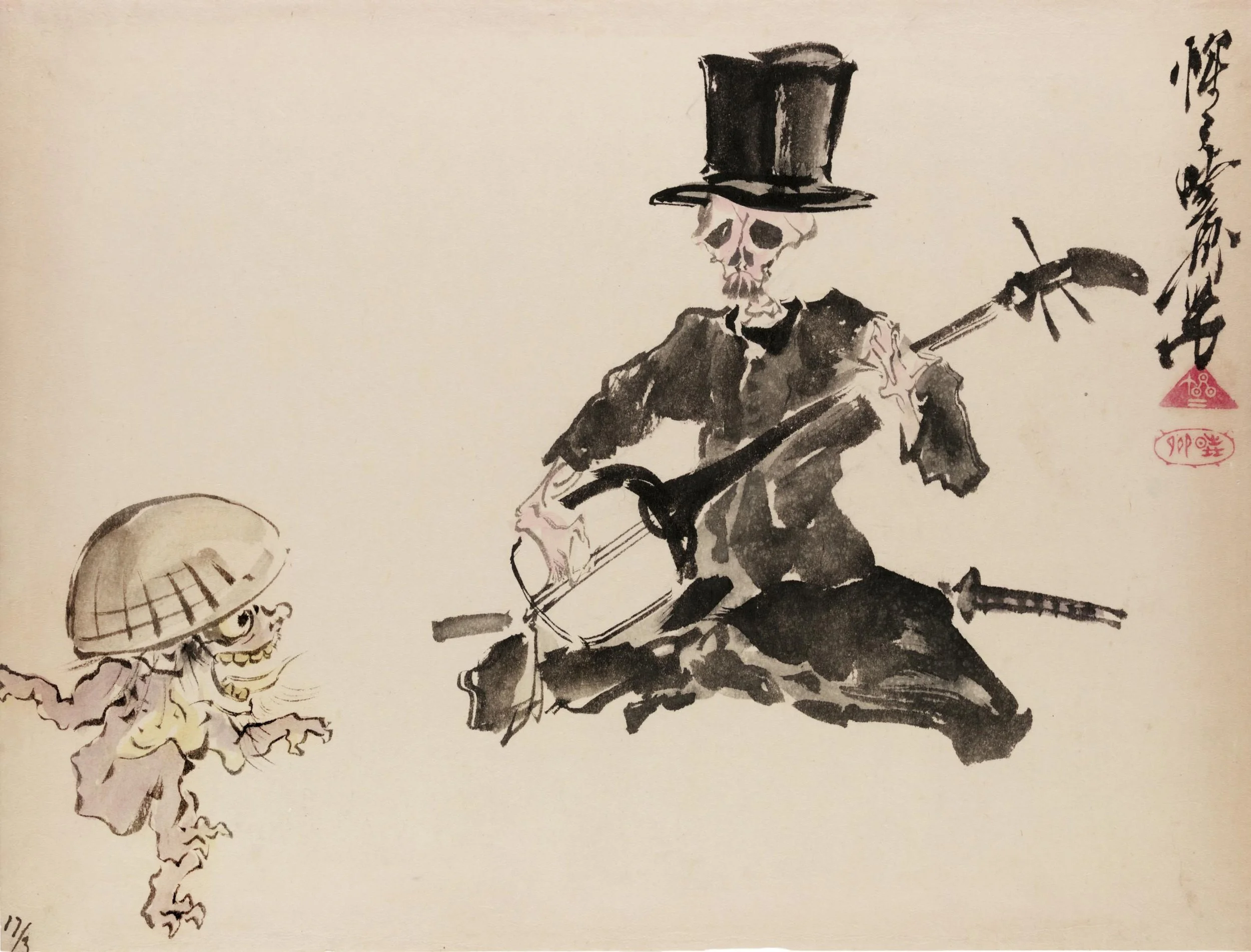
Skeleton Shamisen Player in Top Hat with Dancing Monster (1871-8) by Kawanabe Kyosai. Image courtesy of Israel Goldman.
In 1871, Kyosai swapped the first character of his name, replacing 狂 (“mad”) with 暁 (“dawn” or “enlightenment”). It sounds like a fresh start, but the man who signed the new name went on painting farting warriors and skeletons in top hats.
I keep coming back to that new name as I make my way out of the museum. Dawn suits him. Kyosai lived at the hinge between two Japans, the Edo world of shoguns and the Meiji world of top hats, and he painted both with the same brush.
He is often praised as Hokusai’s successor, but I think he was something more. He stood between worlds, carrying classical painting and ukiyo-e into something distinctly his own that would eventually resemble modern manga. In 1874, he co-created E-shinbun Nipponchi, one of Japan’s earliest manga magazines. Even in the 21st century, Kyosai’s strange little world still knows how to make us laugh.
Reference:
Sadamura, K. (2022). Kyōsai: The Israel Goldman collection. Royal Academy of Arts.
Kyōsai's World: The Israel Goldman Collection is running at the Kobe City Museum through September 23, 2026.