
Gripped by Ink: Kneading My Way Into Nara Sumi
Setting foot in the 150-year-old ink shop in Nara, I expected to get my hands dirty. Instead, I learned that my ink stick could outlive me by more than a thousand years.
Sense of Wander: ★★★★★
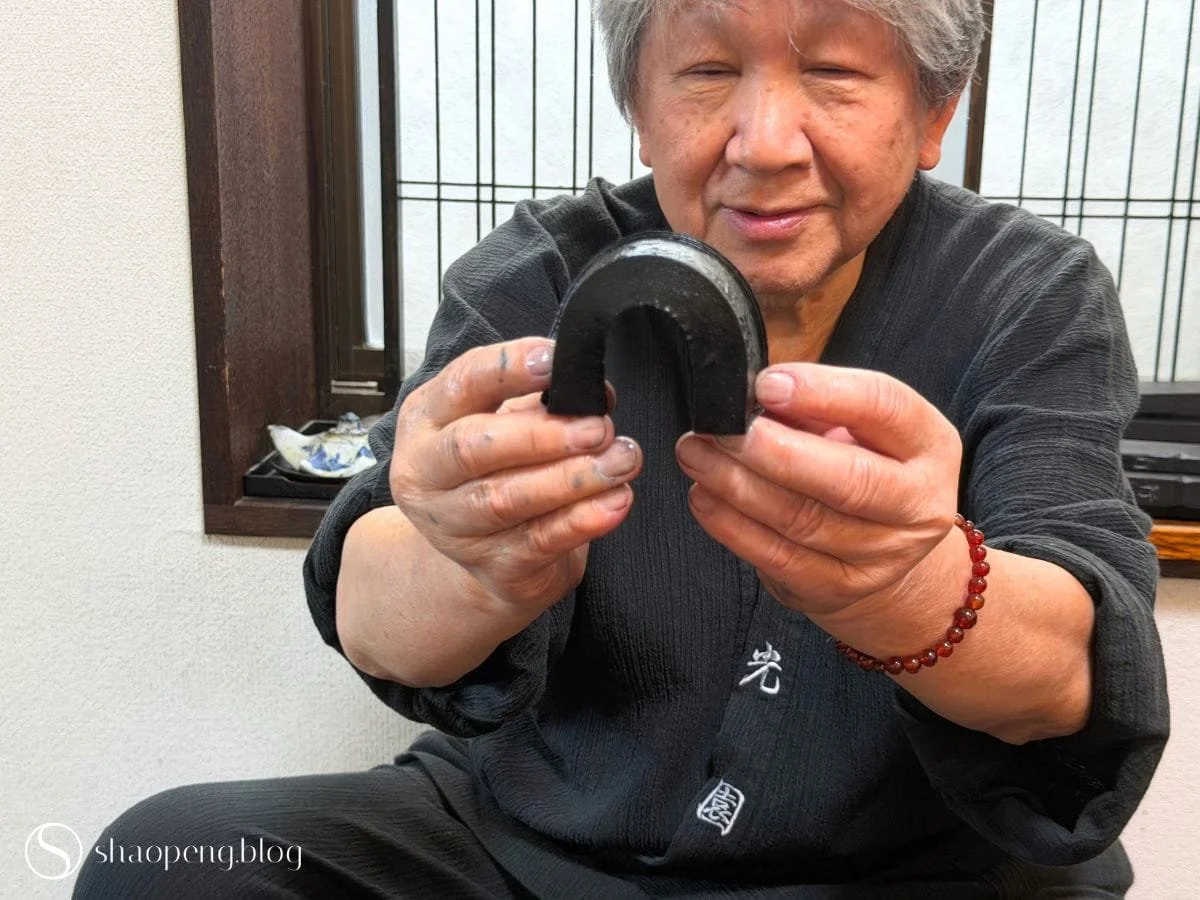
Yoshi demonstrates the surprising flexibility of a raw ink stick by bending and curling it.
NARA, Japan — I didn’t come to Nara for the deer. I came because somewhere in this city, artisans are still making ink the way it’s been made for over a thousand years. And especially after months of intense training in Chinese calligraphy, with the hope of exploring ways to express Arabic calligraphy, I wanted to understand more about the ink I use every day.
Nara, it turns out, is the perfect place. Its sumi — ink sticks, sometimes praised as “black gold” by people who take calligraphy seriously — has a reputation that stretches back to the Nara period (710–794). So, one early morning, I followed the blue dots on my map, traversing the lanes of Naramachi to a shop called Kinkoen, founded about 150 years ago.
Before I knew it, I found myself standing in front of a traditional machiya house, looking as though it had simply always been there. I rang the bell. A man opened the door and greeted me warmly. He is Nagano Bokuen, the sixth-generation owner of the Nagano family business. He told me I could just call him Yoshi.
I had signed up for the Gripped Sumi Experience, and I had imagined it to be a hands-on workshop, where I would be able to knead raw ink and shape it in my palm. And I did. But on top of that, Yoshi sat me down and walked me, with warmth and patience, through the entire history of Nara sumi: where it comes from, how it’s made, how its quality is assessed, and where the whole industry stands today. His willingness to share came in perfect step with my curiosity, prompting me to ask questions I didn’t know I’d been carrying. I ended up taking lots of notes, and am now writing this in the hope of passing it on. So here it goes.
A note before I begin: some of what follows comes directly from Yoshi, some from the shop’s website, and some I have excavated during my research on the subject from verified sources. I’ve found a few different versions of the story, because ink history, like ink itself, can be smudged.
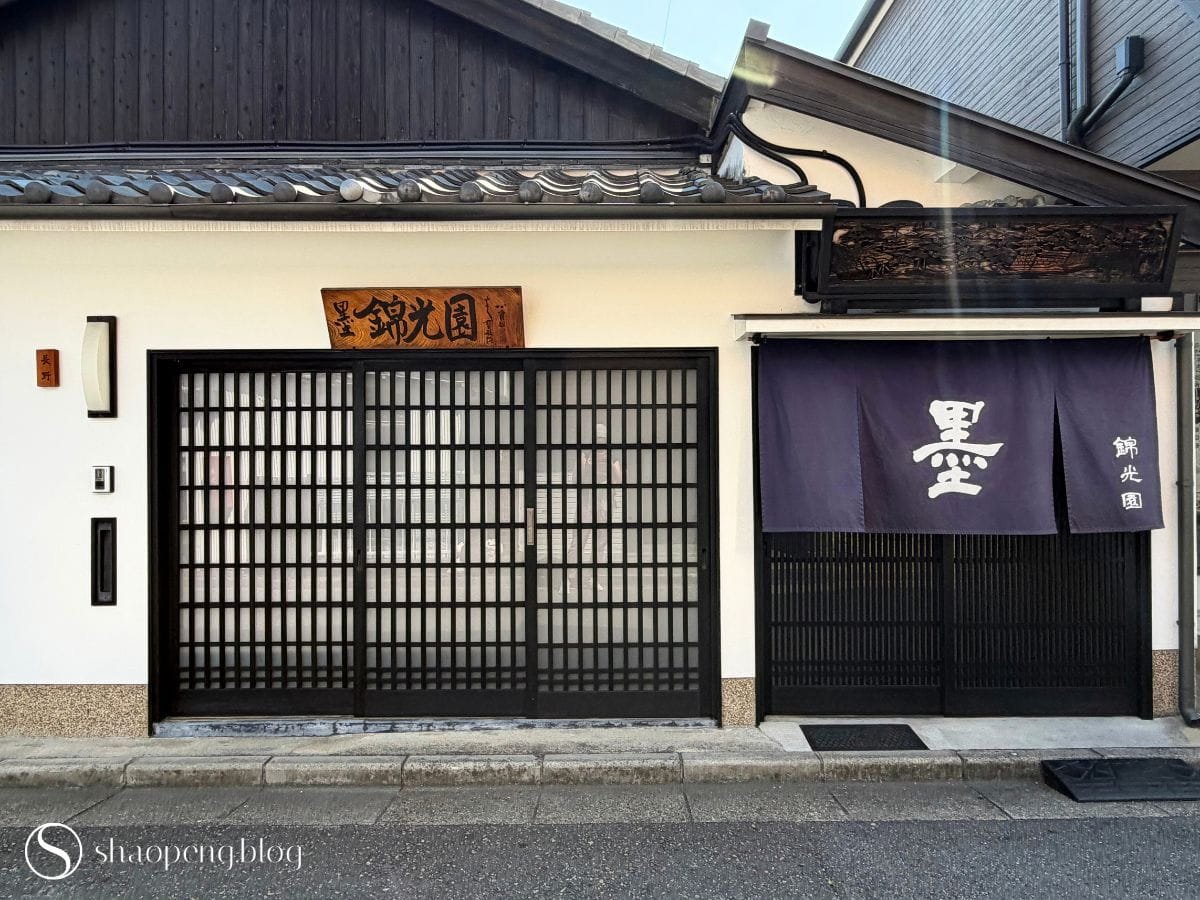
Kinkoen, an ink shop with around 150 years of history.
Its Sacred Beginnings
The story people tell about Nara ink usually starts with Buddhism. Sumi-making techniques are said to have reached Japan from China and Korea in 610, carried by a Korean monk known as Damjin, or Doncho. From there, demand for ink rose quickly: the imperial court and Nara’s Buddhist temples needed it constantly for copying sutras and keeping government records.
The monk Kukai enters the story too, credited by some accounts with bringing refined ink- and brush-making techniques back from Tang China (618–907) and setting up production at Kofukuji Temple, which is often considered the true beginning of Nara sumi. It’s a good story, but one that some consider to be more legend than fact. What’s less disputed is that Kofukuji became the centre of ink production over the following centuries.
For a long time, Japanese ink meant pine soot — shoenboku — made by burning resinous pine wood. The real technological leap came later, during the Muromachi period (1336–1573), and it happened almost by accident. Monks at Kofukuji kept oil lamps burning day and night in front of the Buddhist statues, and the ultra-fine soot that collected under the temple roofs turned out to be free, abundant, and an excellent raw material for sumi. That discovery gave Japan its first homegrown oil-soot ink, yuenboku, so it no longer had to rely on imported Chinese oil-soot ink.
Ink-making stayed largely in the hands of temples until the 16th-century civil wars loosened Buddhist institutions’ grip on the craft, pushing it out into the merchant economy. In 1577, Kobaien — still the oldest operating ink maker in Japan today — opened its doors. By the Edo period (1603–1868), more than forty specialised ink shops lined Nara’s streets, with around two hundred artisans at work, giving rise to the ornate sumi sticks made for the imperial court, samurai households, and scholars.
Today, only a handful of companies still make sumi sticks by hand in Nara, but together they still account for around 95% of the country’s sumi stick production. Most calligraphers now, myself included, reach for bottled industrial ink instead, often made from mineral soot sourced from petroleum.
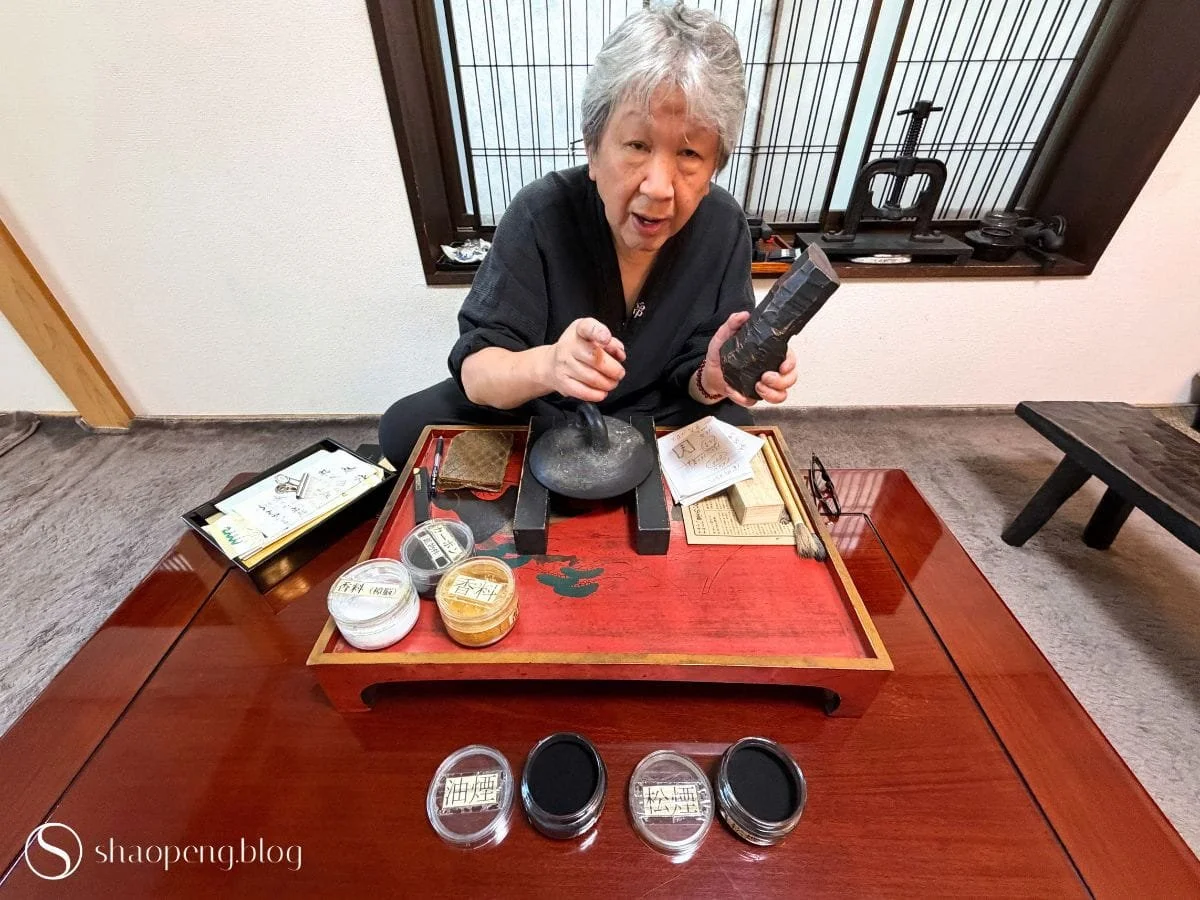
Yoshi explains how soot is made.
Soot, Glue, and Scent
In a nutshell, ink is composed of three things: soot, gelatin, and scent.
Pine soot is prized for its matte texture, and when premium pine soot is diluted with water, it can carry faint bluish undertones, making it good for expressive brushwork and landscape washes.
The process of collecting it is tedious: pine wood or branches, rich in resin, smolder inside a kiln for days while smoke rises and carbon soot clings to the inner walls near the vents. Once it cools, the soot is scraped off. In Japan, red pine, or akamatsu, is the preferred wood.
Oil soot is gentler in the making. Vegetable oil, usually sesame or rapeseed, burns slowly in an earthenware pot called a kawarake, and the soot gathers on a lid held above the flame. Yoshi told me the higher the lid is placed, the finer — and more valuable — the resulting particles. Oil soot tends to produce a deeper, glossier black than pine soot, which is part of why it became the ink of choice for transcribing delicate sutras and detailed paintings.
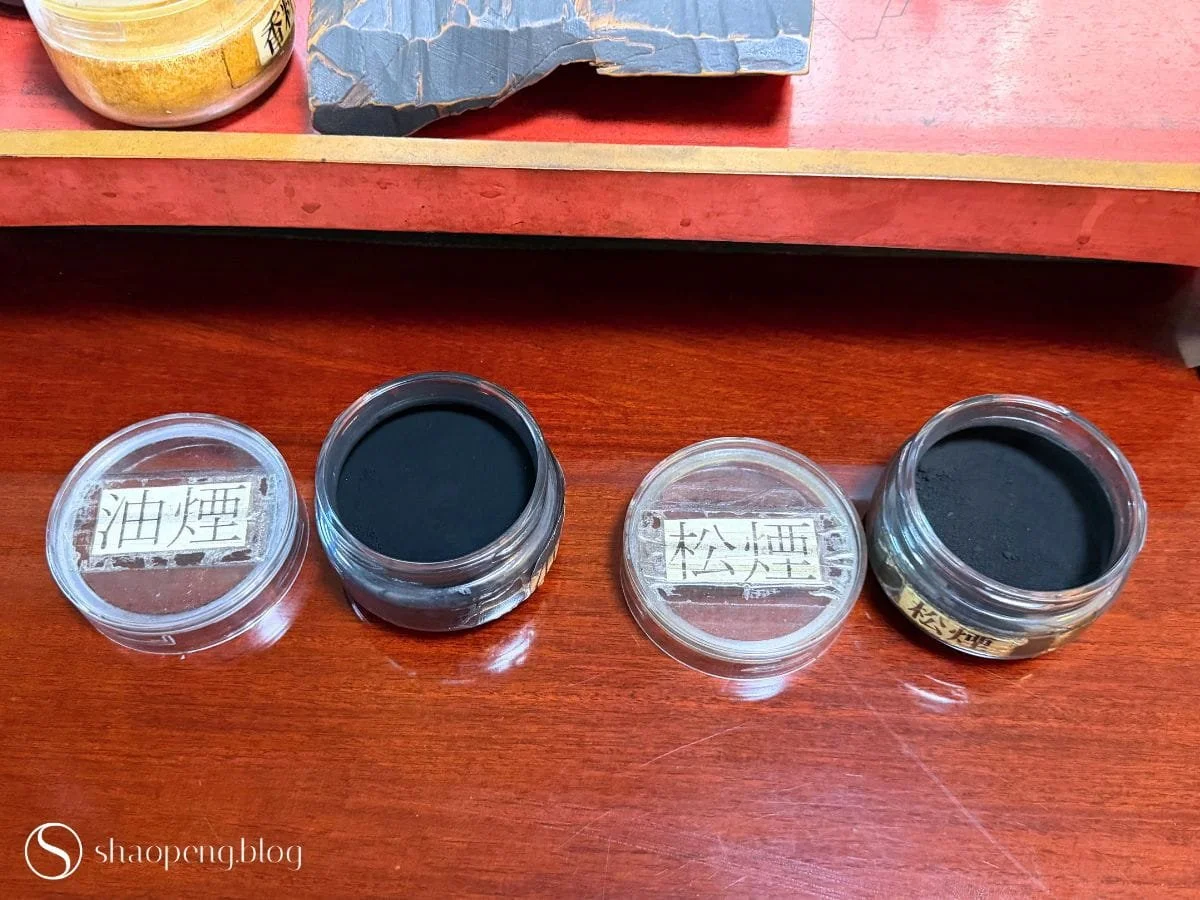
Oil soot (left) yields finer particles than pine soot (right).
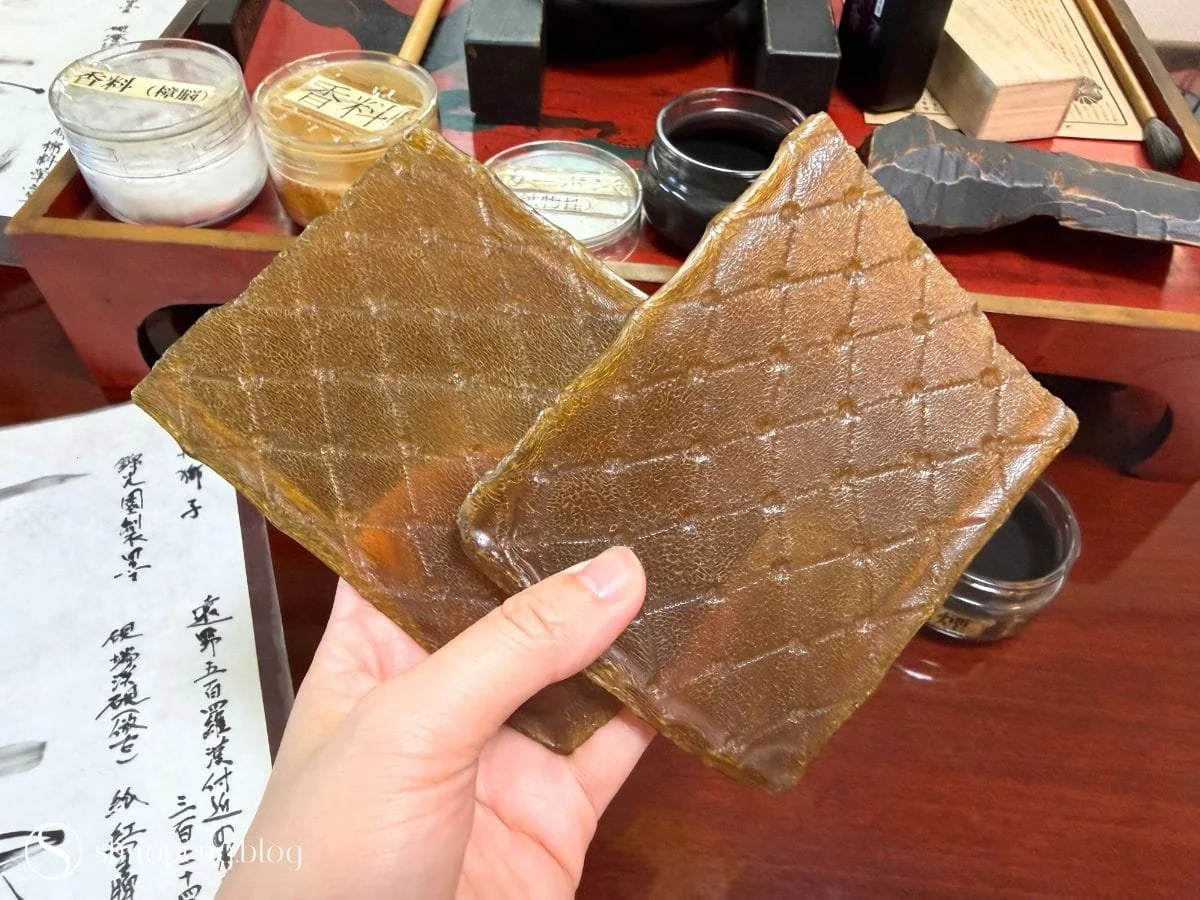
Gelatin used to make sumi sticks.
He also mentioned something I hadn’t considered before: the size of those soot particles, once mixed with water, directly shapes how the ink behaves on paper: how much it bleeds (nijimi), or how dry a stroke comes out (kasure). I haven’t tested that for myself, but I will.
Once the soot is collected, it’s blended with nikawa, a gelatin made by boiling water with collagen drawn from animal hides, skins, and bones. This is also what sets handmade sumi apart from bottled ink, which relies on synthetic glue.
The mixture then goes into a rice cooker for thirty to forty minutes before being kneaded with camphor (added as an insect repellent) and, for roughly the last fifty years, fragrance. Every ink house has its own scent signature; Kinkoen’s recipe includes musk and amber.
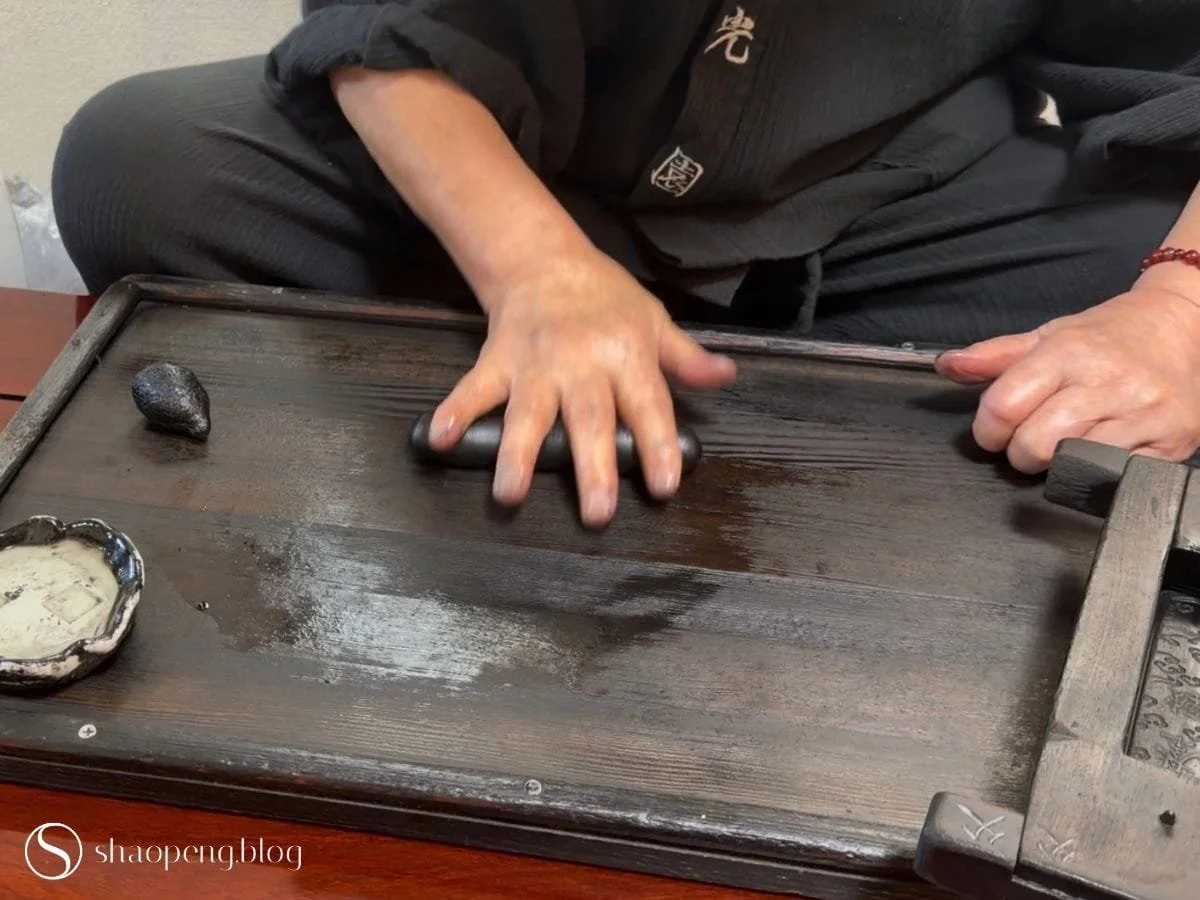
Kneading the ink dough.
Kneading My Own Sumi Stick
When the ink dough was ready, Yoshi rubbed vegetable oil into his hands and started working it like a baker. For a proper ink stick, the dough is weighed on a balance and pressed into a sumigata, a mould carved from pear wood. Each mould is hand-chiseled with a mirror-image design so the ink stick comes out with relief design, carrying calligraphy, motifs, or whatever the carver chose.
From what I know, there’s only one mold engraver still working in this tradition in Nara today — a woman named Natsuko Sato who, having learned her trade under the late master Gaho Nakamura, is now the eighth generation of the historic Katashu workshop, dating back to 1805.
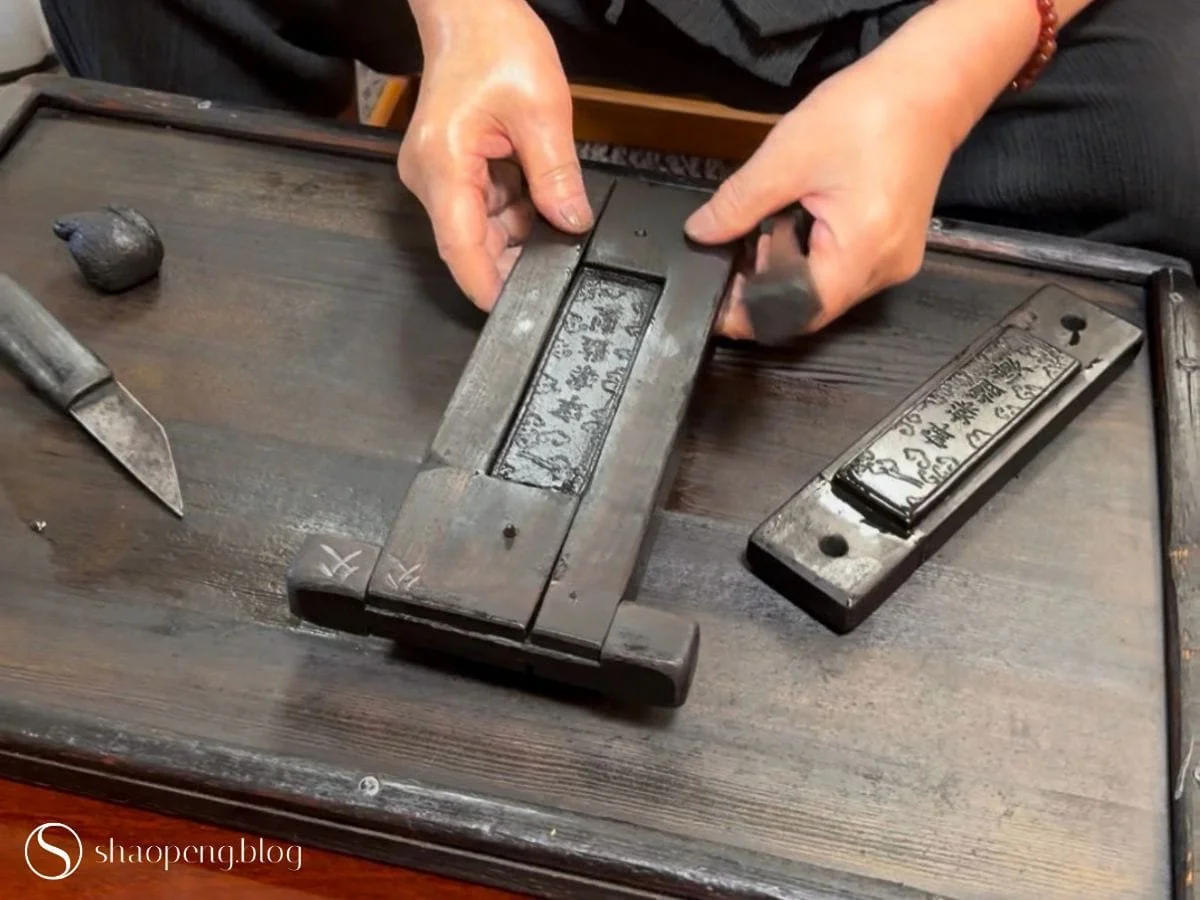
Ink dough pressed into a pear-wood mould.
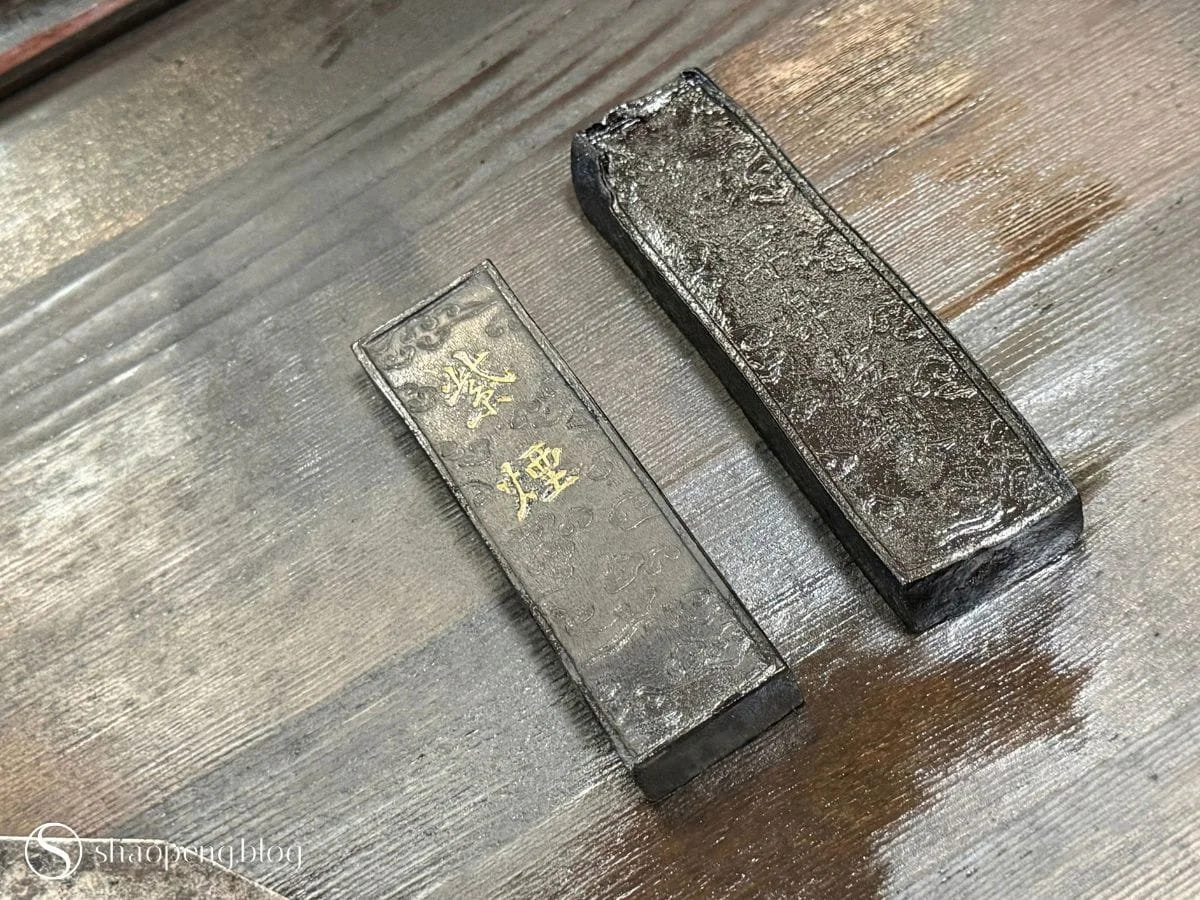
As moisture evaporates during drying, the ink stick shrinks in size (left).
I didn’t press my ink into a mould, though. I pressed it into my own fist, giving birth to my first nigiri-zumi, or “gripped ink.” And there it was: my first ink stick, still warm from my hand, which I’ll have to wait up to three months to dry.
Like wine, in the world of sumi sticks, older is better: those aged ten or twenty years — called kobu — are sought after by master calligraphers and painters, because time allows the glue to fully mature and the moisture to evaporate, unlocking a fuller range of tones.
If made properly, ink sticks can last for over a thousand years. The oldest surviving example is found in China, where a pine-soot ink stick was excavated from a 3rd-century BCE tomb in Hubei Province. Nara has its own ancient relic in the Shosoin repository: an ink stick dated to about 1,300 years ago. Either way, it’s humbling to think that something this fragile-looking can outlast empires.
The workshop took much longer than I had planned, but I walked out of Kinkoen knowing far more about ink than I’d expected to, and grateful for how generously Yoshi gave his time.
The search doesn’t end here, though. I’m tracking down the last handmade pine-soot ink workshops in Taiwan, and the Hui ink sticks of Huizhou in Anhui Province, where the ink-making tradition is inscribed on China’s Intangible Cultural Heritage list.
I hope to share what I discover on my ink journey with you very soon, especially when I finally get to unbox my gripped ink stick after three months, inshaAllah.
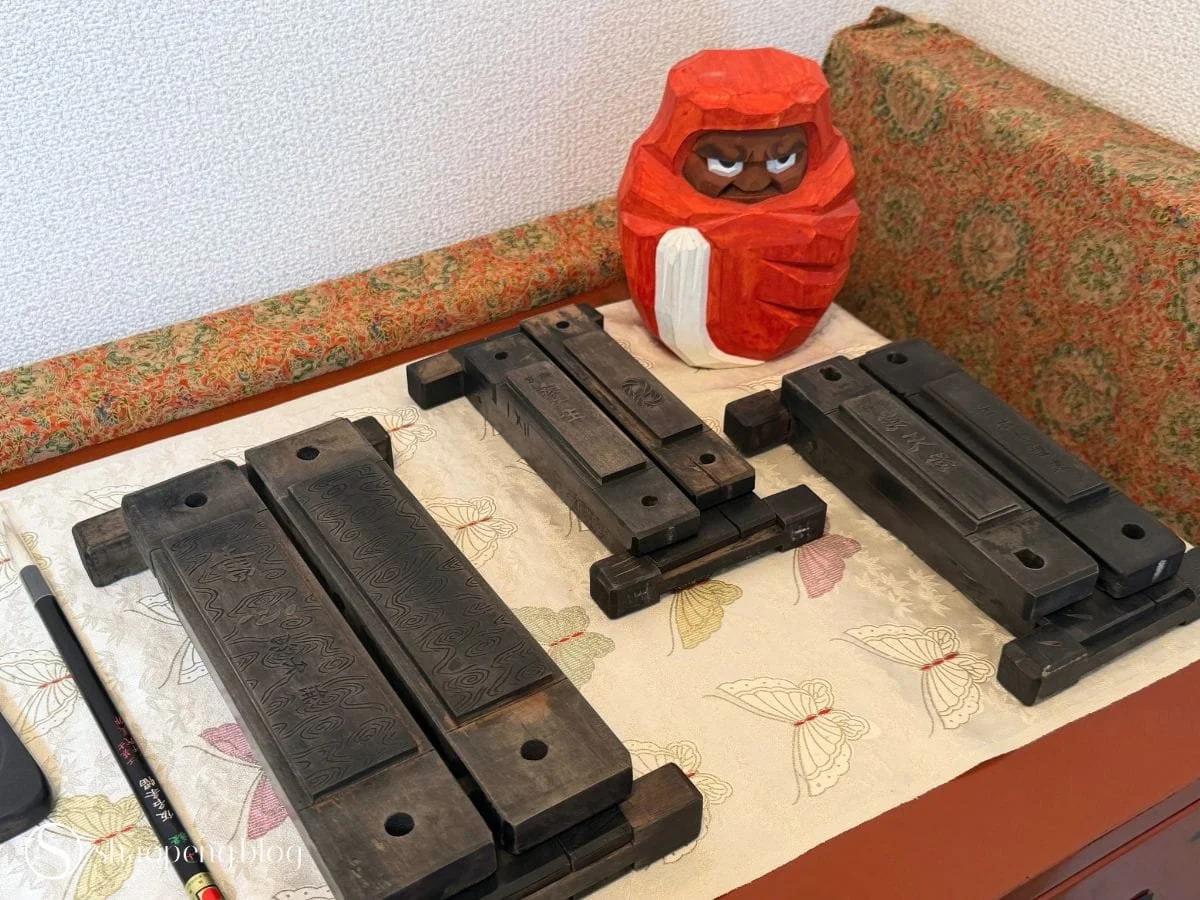
Examples of ink stick moulds carved with different designs.
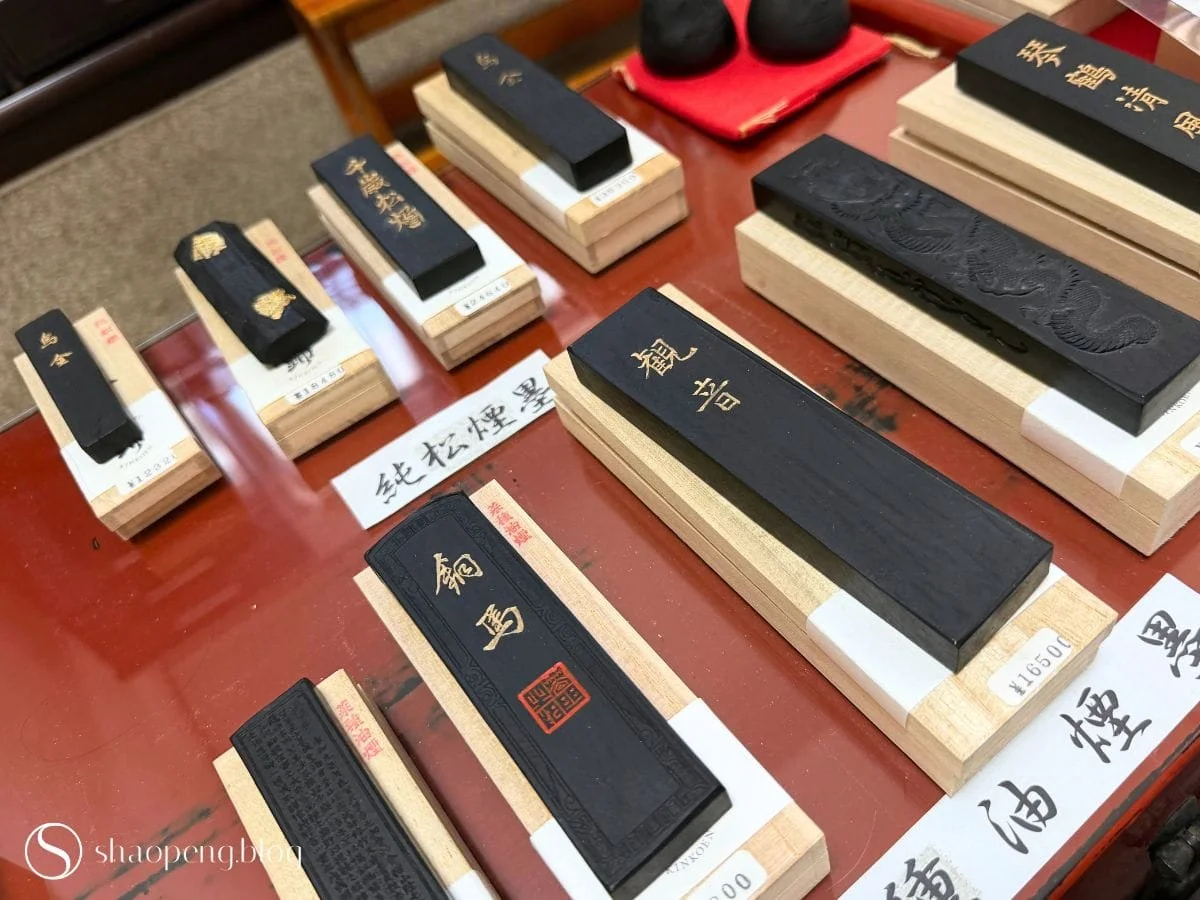
Kinkoen sells a variety of handcrafted sumi sticks made from both pine soot and oil soot.
Wanderer’s tip — For those wanting to learn more about Nara sumi or join a Gripped Sumi Experience workshop, visit Kinkoen.