
Finding Siddham: An Ancient Script Hidden in Japan’s Buddhist Temples
Born in India and travelled eastward with Buddhism, Siddham found an unexpected home in the temples of Japan, where this distinctive script has survived and continues to be practiced today.
Sense of Wander: ★★★★☆
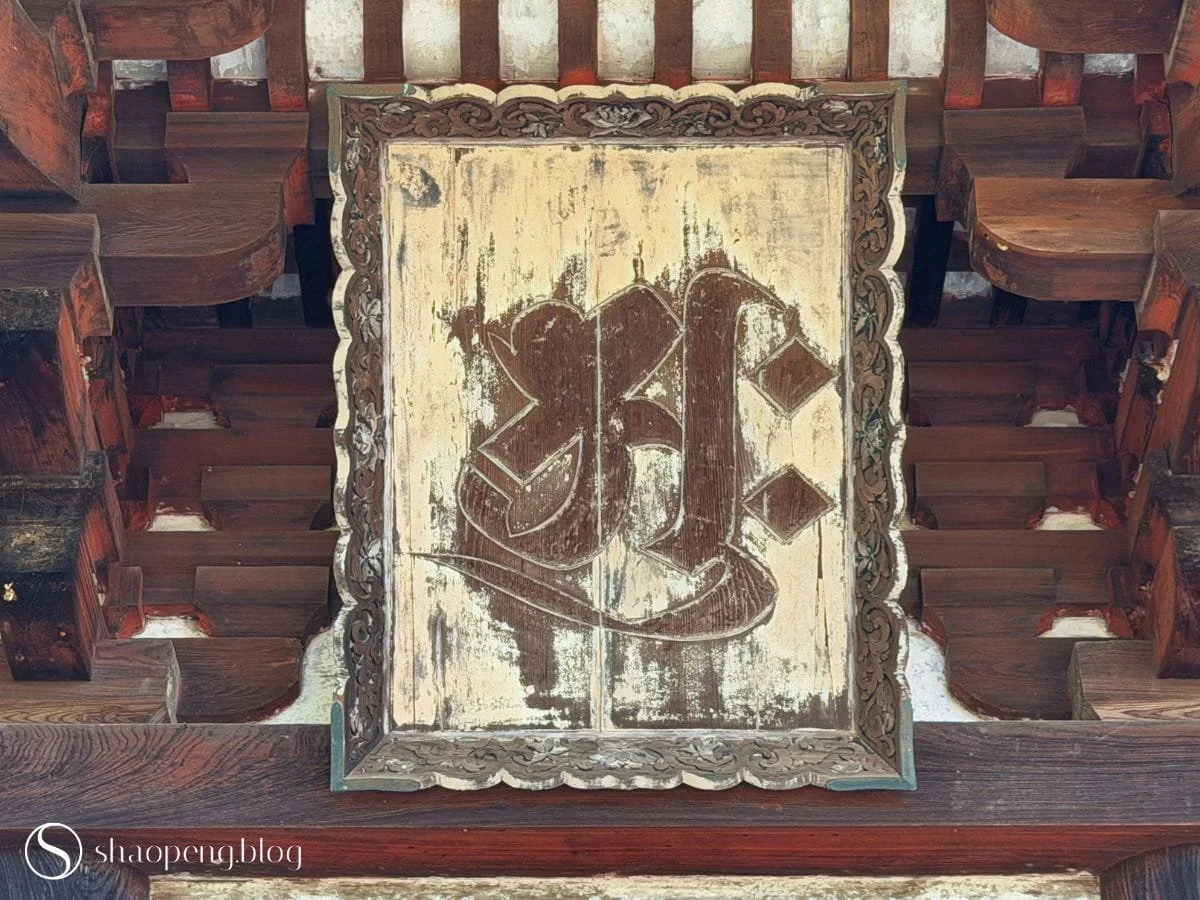
A seed syllable in Siddham script is inscribed at the entrance to Ninnaji’s five-storey pagoda.
KYOTO, Japan — I had told myself, before this trip, that I was done with Kyoto’s temples. I’ve seen enough Buddhist statues from bygone eras and collected an album full of goshuin over the years that the idea of adding one more to the list didn’t excite me. And then a dear friend mentioned that Ninnaji was showing something it had never presented to the public before: Siddham script.
That was enough to send me straight to Omuro, on the northwestern edge of the city.
Ninnaji has a founding story associated with the imperial family. It was Emperor Koko who first vowed, in 886, to build the temple. It was his son, Emperor Uda, who carried out that promise and completed it in 888, before retiring here himself and turning Ninnaji into a monastery for princes. The temple eventually came to be known as the Omuro Imperial Palace. None of the 9th-century buildings survive, but what stands now, rebuilt in the early 1600s with the Tokugawa shogunate’s backing, still carries that old imperial hush.
Most people come here for the Omuro cherry blossoms. I’m here for Reihokan, the temple’s treasure hall, and for a script that most visitors walk straight past without knowing what it is.
Siddham script is, simply, a script that left its home and became a naturalised citizen somewhere else. Originally a medieval Brahmic script used in India by Buddhist monks between the 6th and 13th centuries, it’s closely tied to Esoteric Buddhism, where the writing is reserved for mantras, dharanis, and seed syllables rather than everyday correspondence. From India, it moved east with Buddhism into Tang-dynasty China (618–907), where monks studied it not to speak Sanskrit fluently, but to get the sounds of sacred verses right.
It was in Tang China that the Japanese monk Kukai (774-835) encountered it. Kukai, who would later found the Shingon school back home, spent a couple of years there studying Sanskrit and Siddham, and carried the script back to Japan when he returned around 806. But he wasn’t the first to introduce Sanskrit to Japan.
A palm-leaf manuscript from Horyuji in Nara, long said to date from 609 but placed a little later by scholars, sometime in the 8th century, suggests that Sanskrit arrived in Japan as early as the Nara period (710–794), making it one of the oldest tangible traces of Sanskrit in Japan.
Once in Japan, Siddham kept evolving. Early on, it followed Chinese calligraphic conventions closely, but over the centuries it softened into something distinctly Japanese, especially when the Tokugawa shogunate began actively promoting Buddhism and calligraphers had every incentive to keep practicing it. And this is what gets me: while Siddham faded out of use in India and eventually in China too, it never stopped being written in Japan. Today, it survives nowhere else as a living script.
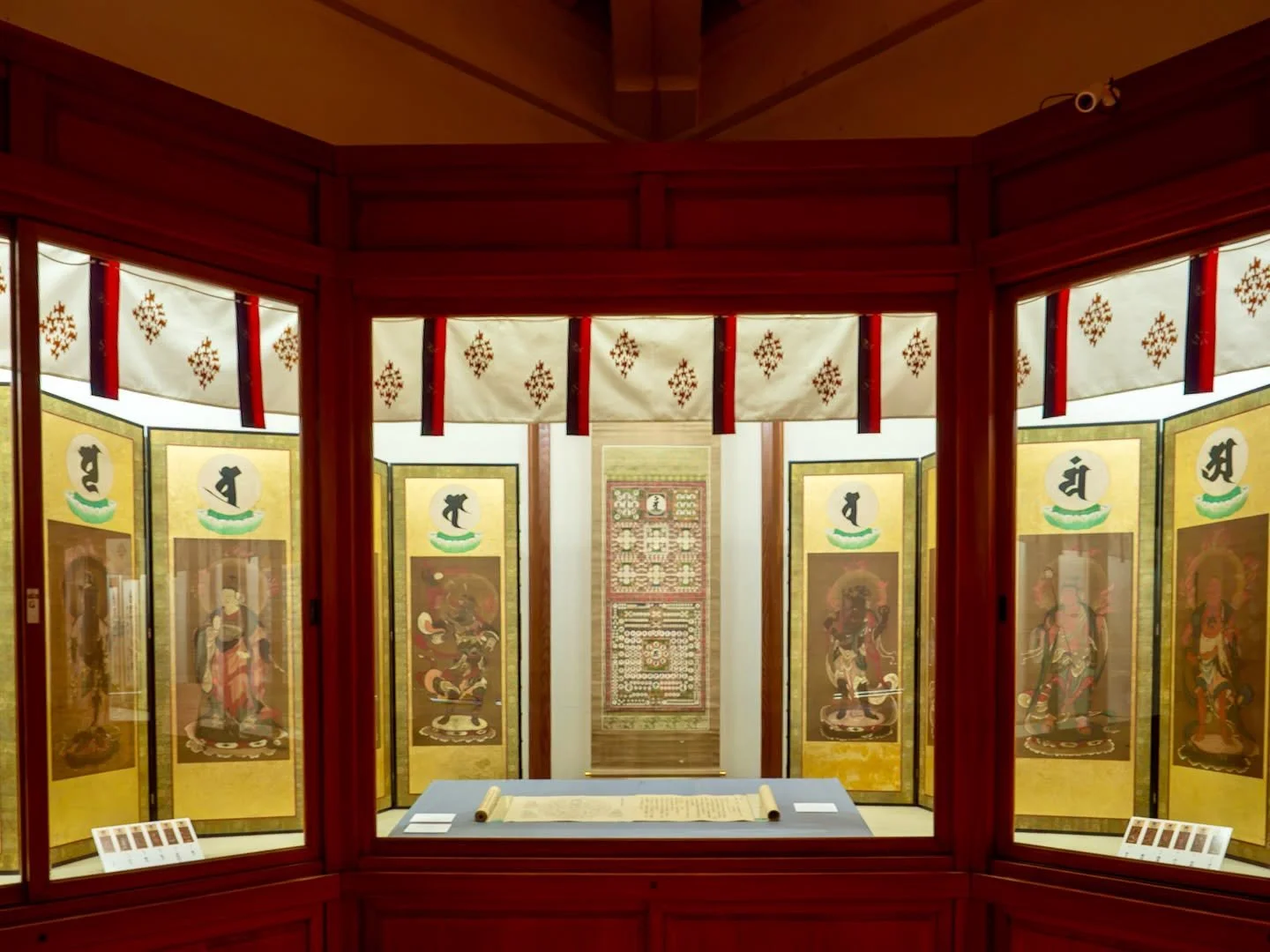
Inside The History and Present of Siddham Script. Image courtesy of Ninnaji.
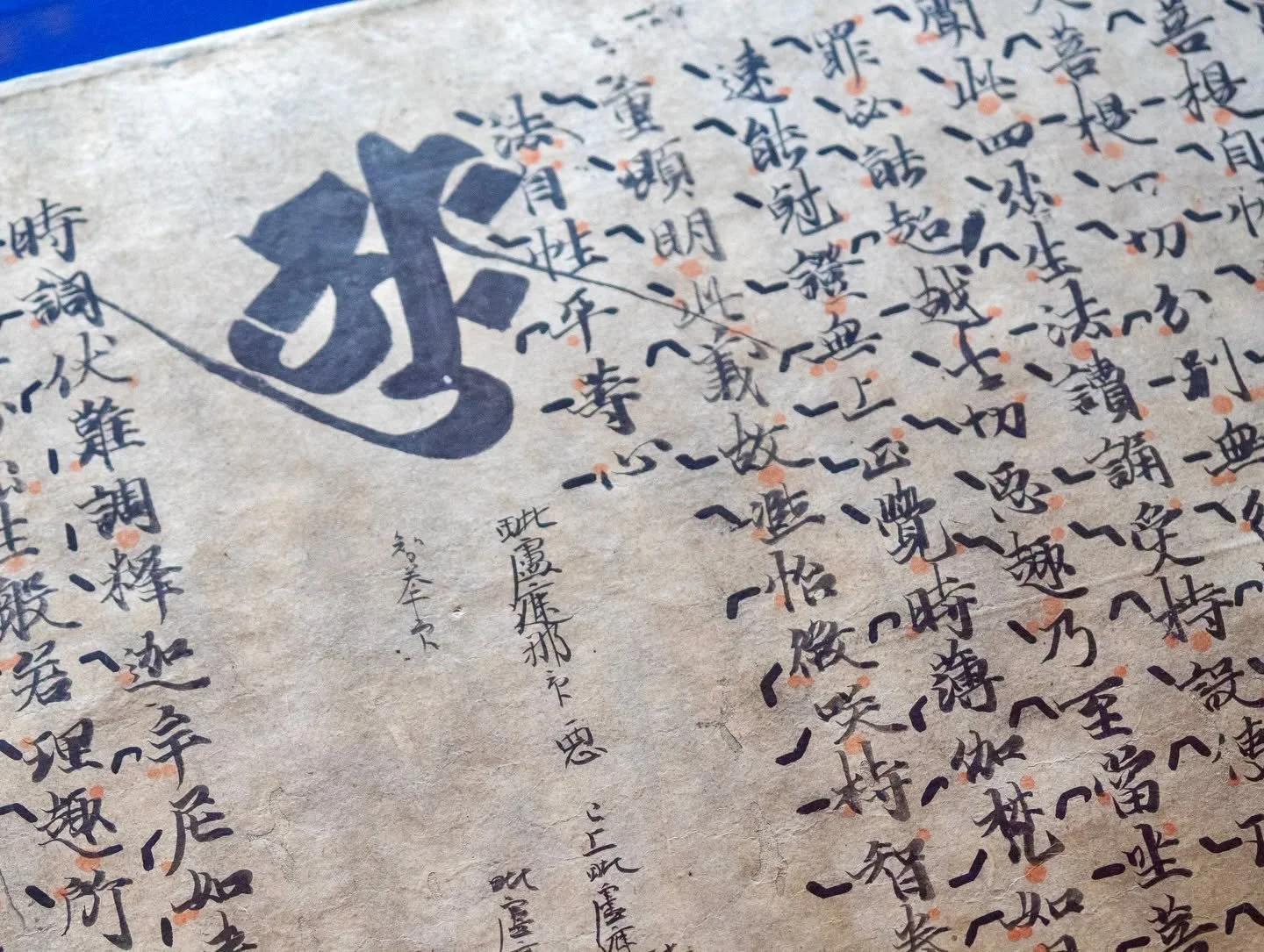
A Siddham seed syllable appears among Buddhist texts written in Chinese. Image courtesy of Ninnaji.
The exhibition, The History and Present of Siddham Script: Works by Kodama Yoshitaka, sits inside the Reihokan, showcasing monks’ old writing practices, hand-copied sutras, and mandalas constructed out of seed syllables rendered in Siddham. In Esoteric Buddhist tradition, each of those syllables isn’t just a letter standing in for a deity; it’s treated as a living vessel for that deity, with the character itself considered sacred.
Alongside the historic pieces, the exhibition features contemporary work by Kodama Yoshitaka (児玉 義隆), an ordained monk, scholar, and calligrapher who has spent years teaching Siddham at Ninnaji’s own training hall. His paired depictions of the two great mandalas of Shingon cosmology are, for me, the heart of the exhibition. The Womb Realm (Garbhadhātu) represents our physical world, centred on a lotus radiating divine light outward. The Diamond Realm (Vajradhātu) represents the opposite: a heavenly plane of ultimate wisdom, its nine-square grid mapping out stages toward enlightenment.
I can’t read more than a few Sanskrit characters, but it didn’t matter. Whether the ink was gold against black or plain black on white paper, the characters seem to pull my eyes in and just hold them there. There’s a strange tension in the script: it’s painted with a soft brush, following the aesthetics of Japanese calligraphy, but the letterforms themselves still carry the angularity of words written with a stiff bamboo pen.
If I had one complaint, it’s a small one: more explanatory labels would be useful, since most visitors (myself included) are new to the script.
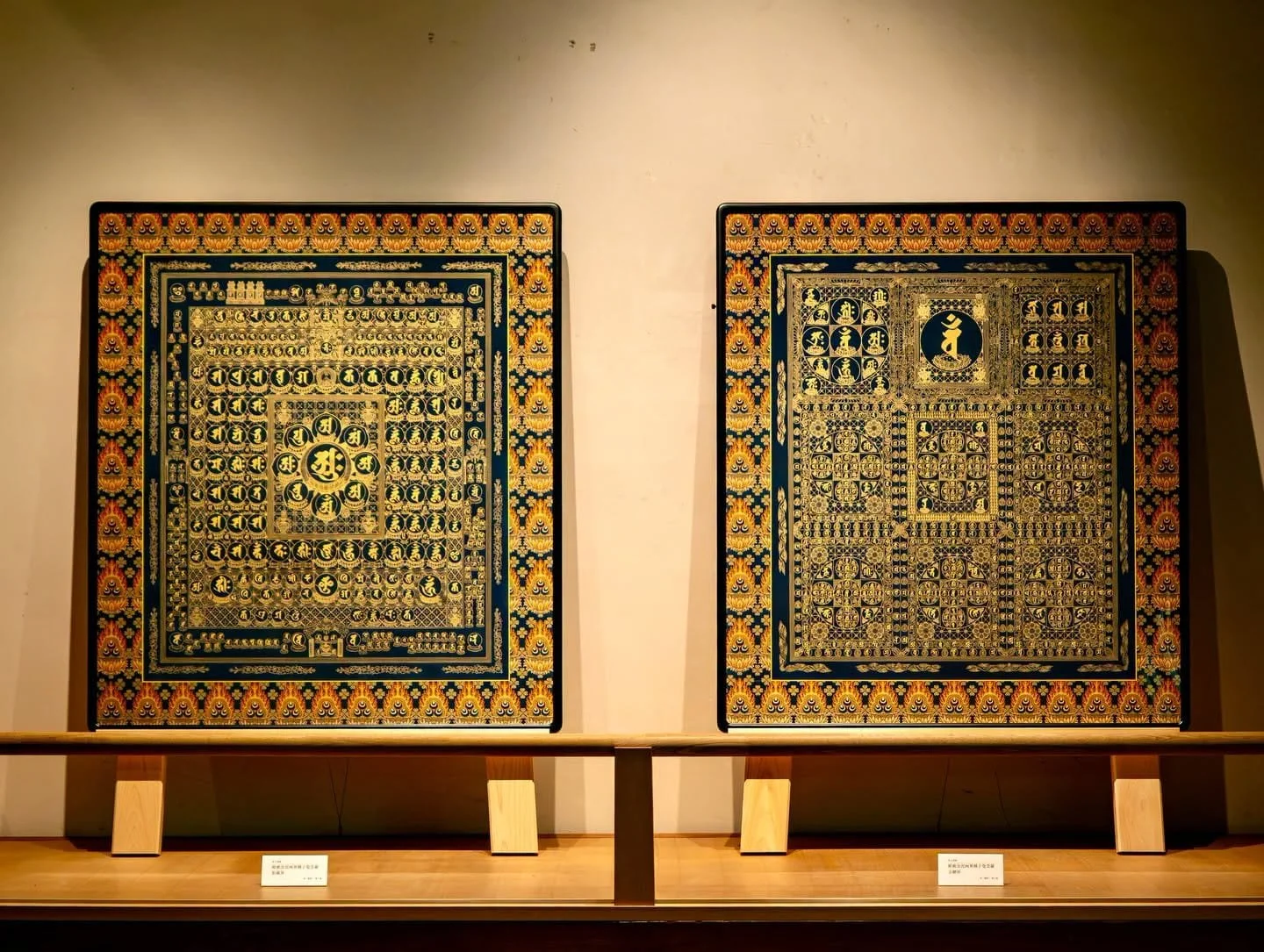
Garbhadhātu (left) and Vajradhātu (right) by Kodama Yoshitaka. Image courtesy of Ninnaji.
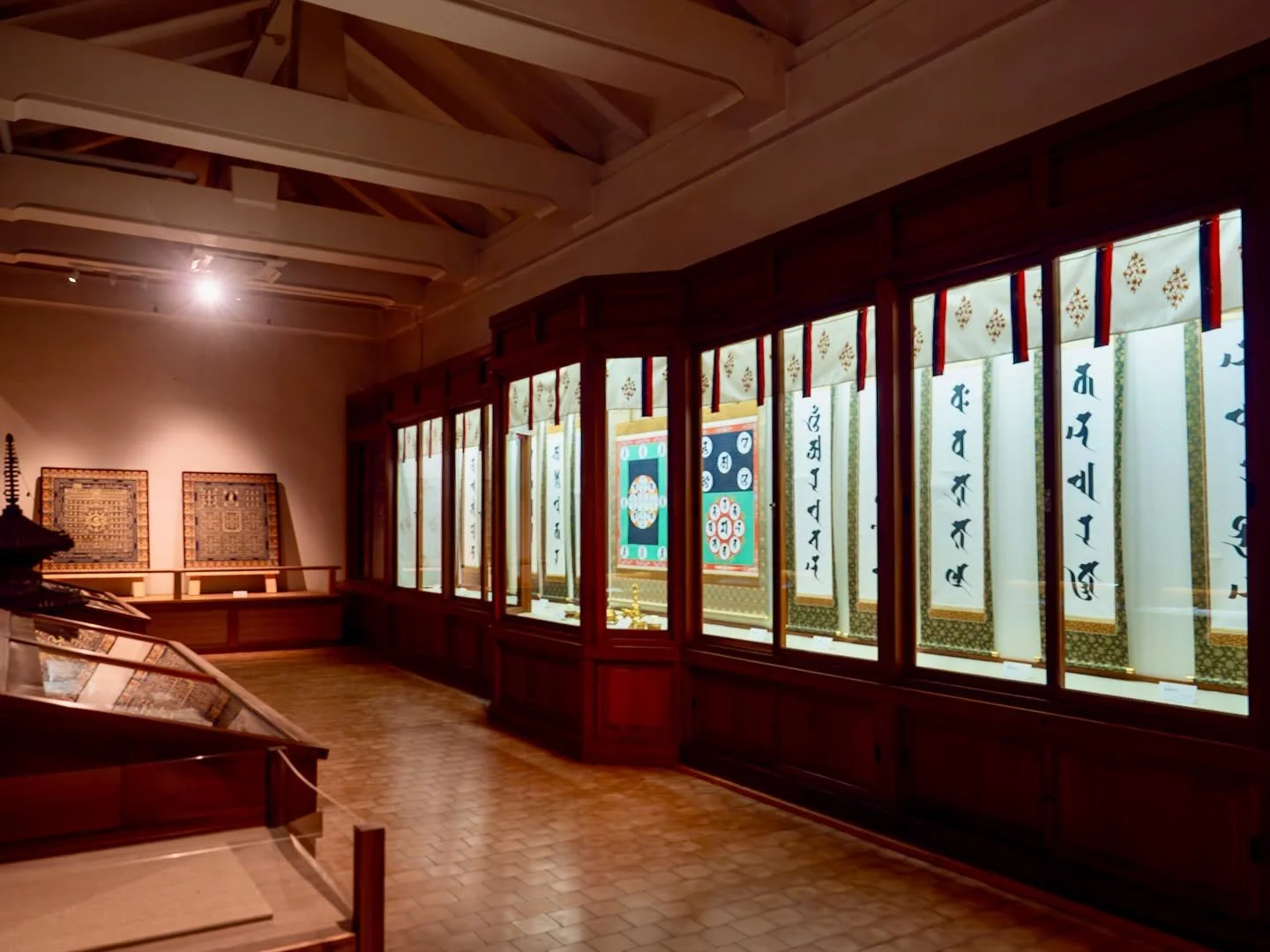
Inside The History and Present of Siddham Script. Image courtesy of Ninnaji.
Ninnaji is the head temple of the Omuro branch of the Shingon sect, so once you start looking for Siddham, you realise it was never confined to the exhibition hall; it’s hidden in plain sight among monuments across the temple grounds.
The exhibition period also comes with a stamp rally, sending visitors wandering to different corners of the complex to collect stamps at each site. Upon finishing, you’ll be gifted a souvenir card bearing a Siddham character. Mine turned out to be the seed syllable for Dainichi Nyorai (𑖀𑖯𑖾), the cosmic, primordial Buddha at the centre of the Shingon universe. This is exactly what I had wanted.
That same syllable, I later noticed, is inscribed on the wooden plaque above the entrance to the five-storey pagoda nearby. It’s easy to miss unless you tilt your head and look above.
Near the Main Hall is gorinto, a traditional stone stupa built to represent the five elements of Esoteric Buddhist cosmology, inscribed with five Siddham characters near its top. You could spend an entire afternoon at Ninnaji just hunting for these characters.
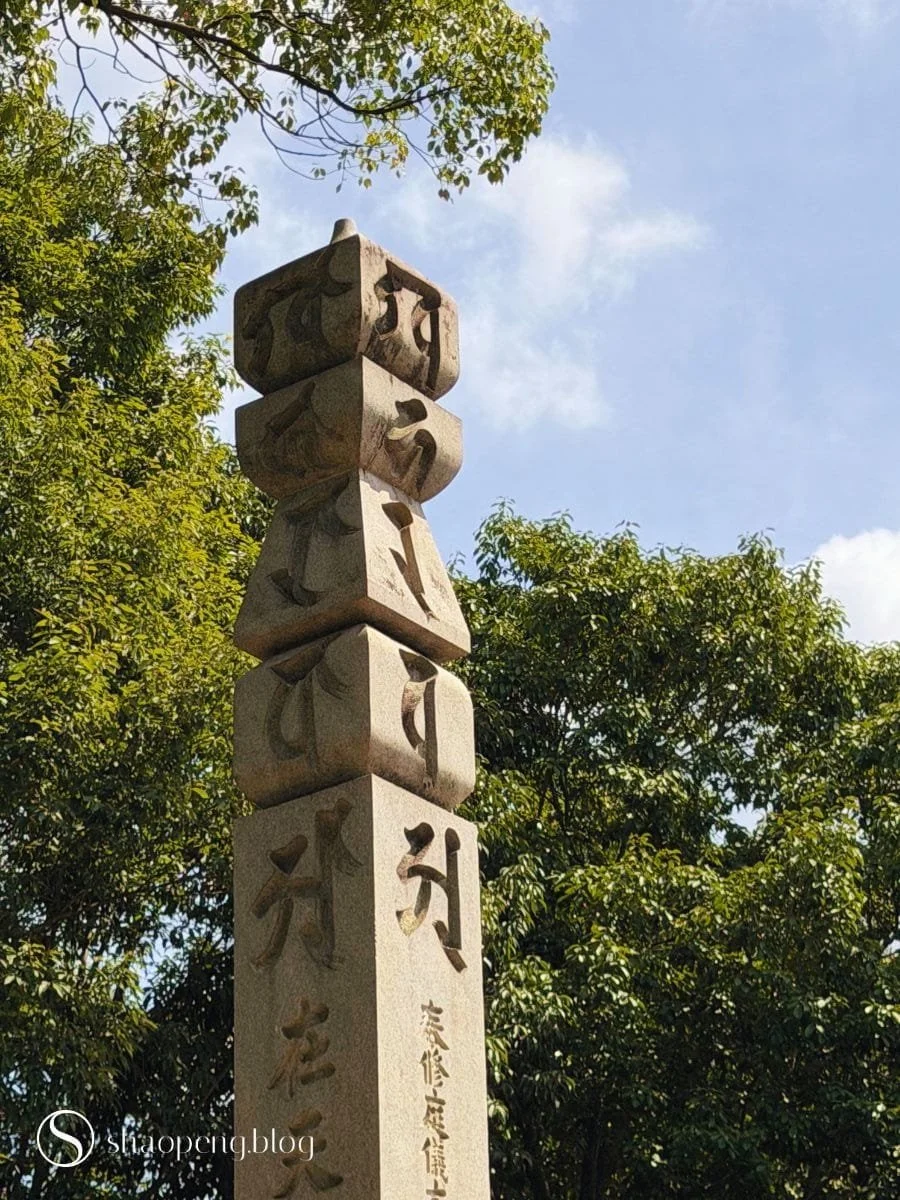
A stone gorinto at Ninnaji inscribed with Siddham script.
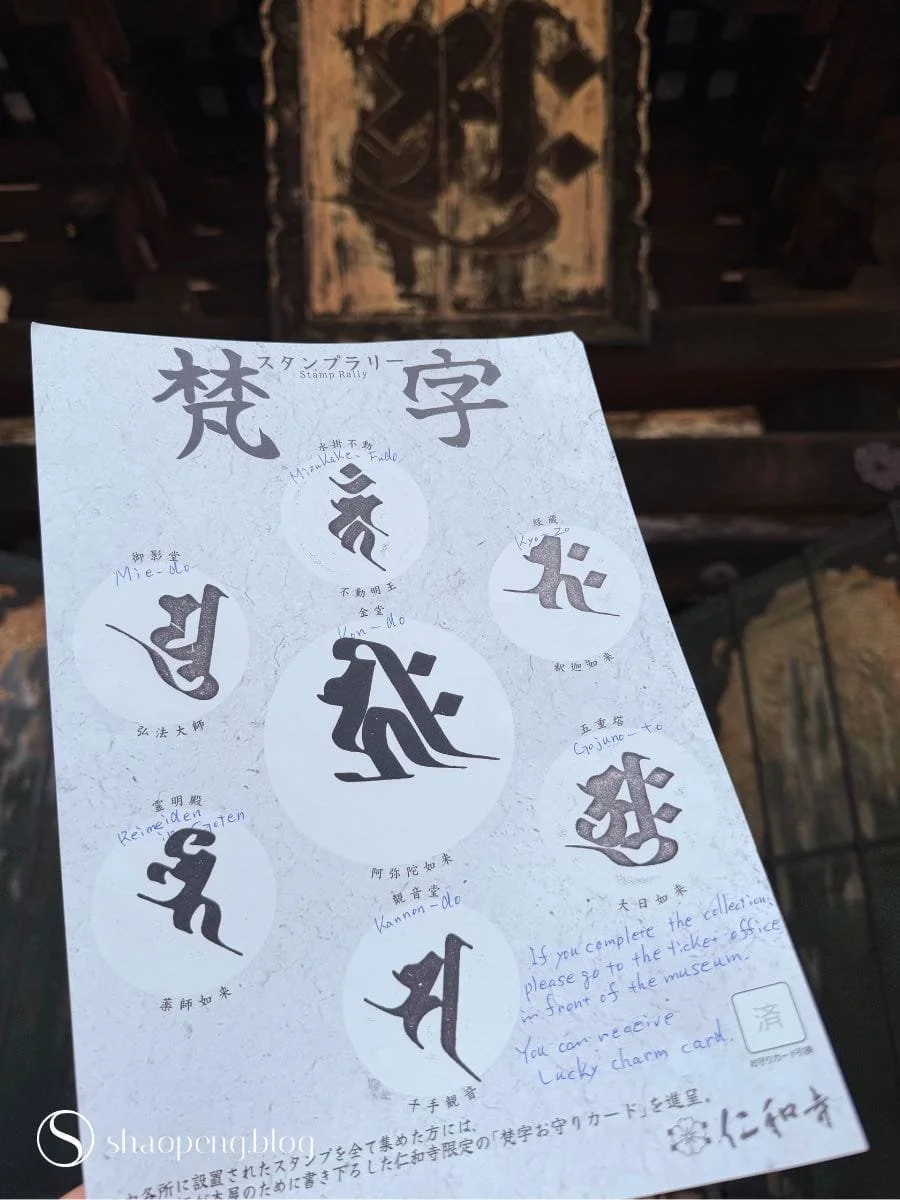
A Siddham script stamp rally invites visitors to explore Ninnaji Temple through the sacred script.
Somewhere in the middle of all this, I kept thinking about Ranjana, a script I was lucky enough to be taught years ago by Rinpoche Ugyen Tenzing. Ranjana and Siddham are siblings, both descended from the same ancestral Gupta Brahmi script and used to write Buddhist mantras in Sanskrit, and yet they look almost nothing alike.
Ranjana took shape in Nepal around the 11th century, considerably later than Siddham. Its ornate and geometric forms are written with a bamboo pen, producing crisp, deliberate strokes. While Ranjana is still written by Newar communities today, Siddham ended up in the hands of Japanese monks wielding soft brushes. Every stroke of the latter carries a flow and looseness that Ranjana never really allows itself.
Standing in the exhibition hall, I can’t help comparing the two scripts in my head. It’s fascinating how the same sacred sound can take on completely different lives, depending on where it landed and who is still willing, centuries later, to keep writing it.
Wanderer’s tip — To commemorate the completion of restoration works at Shiro-shoin in Ninnaji’s Imperial Palace Garden, a Sanskrit character exhibition will be held in the Southern Garden from October 3 to November 20, 2026, offering a rare peek into the world of Siddham script.
Reference:
Kodama, Y. (2002). Bonji de miru Mikkyō: Sono oshie, imi, kakikata [Esoteric Buddhism seen through Sanskrit characters: Its teachings, meanings, and writing methods]. Daihōrinkaku.
The History and Present of Siddham Script: Works by Kodama Yoshitaka was held at Ninnaji from June 20 to August 23, 2026.