
Sini: The Art of Writing Arabic in the Chinese Tradition
Arabic calligraphy took an unexpected turn in China, where millennia-old traditions of ink and brush gave it an entirely new face, and the Chinese brush began to speak Arabic.
Sense of Wander: ★★★★☆
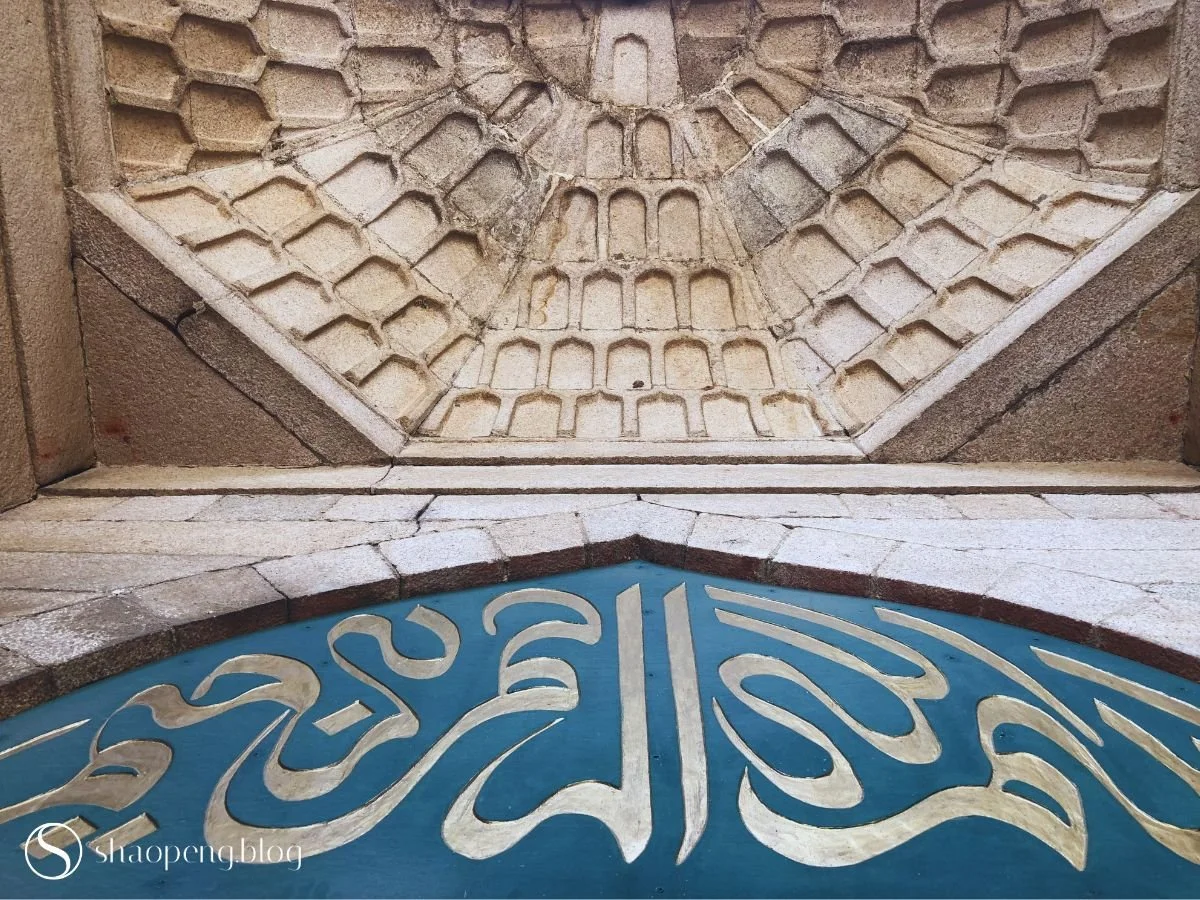
“Bismillah al-Rahman al-Rahim” (In the Name of Allah, the Most Gracious, the Most Merciful), rendered in a broad-stroke style, as seen at Qingjing Mosque in Quanzhou, China.
BEIJING, China — Arabic calligraphy has always been something close to my heart. I first met it in 2014 during my postgraduate studies in Islamic art, of all unlikely places. Its timeless curve and turn took hold of me before I could explain why. It led me to studying the Arabic language, then to the mosques of countries I travelled to, and finally to the art itself. I am now, in many ways, still wandering down that road.
In the vast visual language of Islam, calligraphy is held as its highest artistic expression. Arabesque may wander through the natural world, geometry may capture the cosmic order, but calligraphy comes closest to the divine.
The Quranic revelation, transmitted in Arabic, elevated the written word into a vessel of divine presence. To write beautifully was not merely an aesthetic choice, but an act of devotion, and a way to honour the word of God (Allah).
Like any living tradition, Arabic calligraphy did not stay where it began. It set out on the road, and like all things that travel far enough, picked up the dust of other lands, brushed shoulders with foreign hands, and took on a new face.
On the Road of Faith
Islam’s journey into China took place across centuries.
The earliest footprints lead back to the Tang dynasty (618–907), when envoys from the young Islamic caliphate first reached the Chinese court around 651 CE, sent under Caliph Uthman (644-656), the man credited with standardising the written text of the Quran.
In the centuries that followed, merchants, soldiers, and scholars journeyed along trade routes into China’s port cities and inland towns, where they settled, married, and built lives. Their numbers swelled during the Yuan dynasty (1271–1368), when Central Asian Muslims rose to prominent roles in administration and cultural life. They carried with them what could fit on a camel or in a ship’s hold. Among their belongings was the Quran, and with it, its script.
On Chinese soil, Arabic calligraphy met a tradition older than itself by more than a thousand years: Chinese calligraphy, whose roots reach back to the late Shang dynasty (circa 1250–1050 BCE), when characters were first carved into bones and shells for divination and communication with the spirits.
Here, two rivers, each carrying centuries of devotion in their currents, began to merge into a single course.
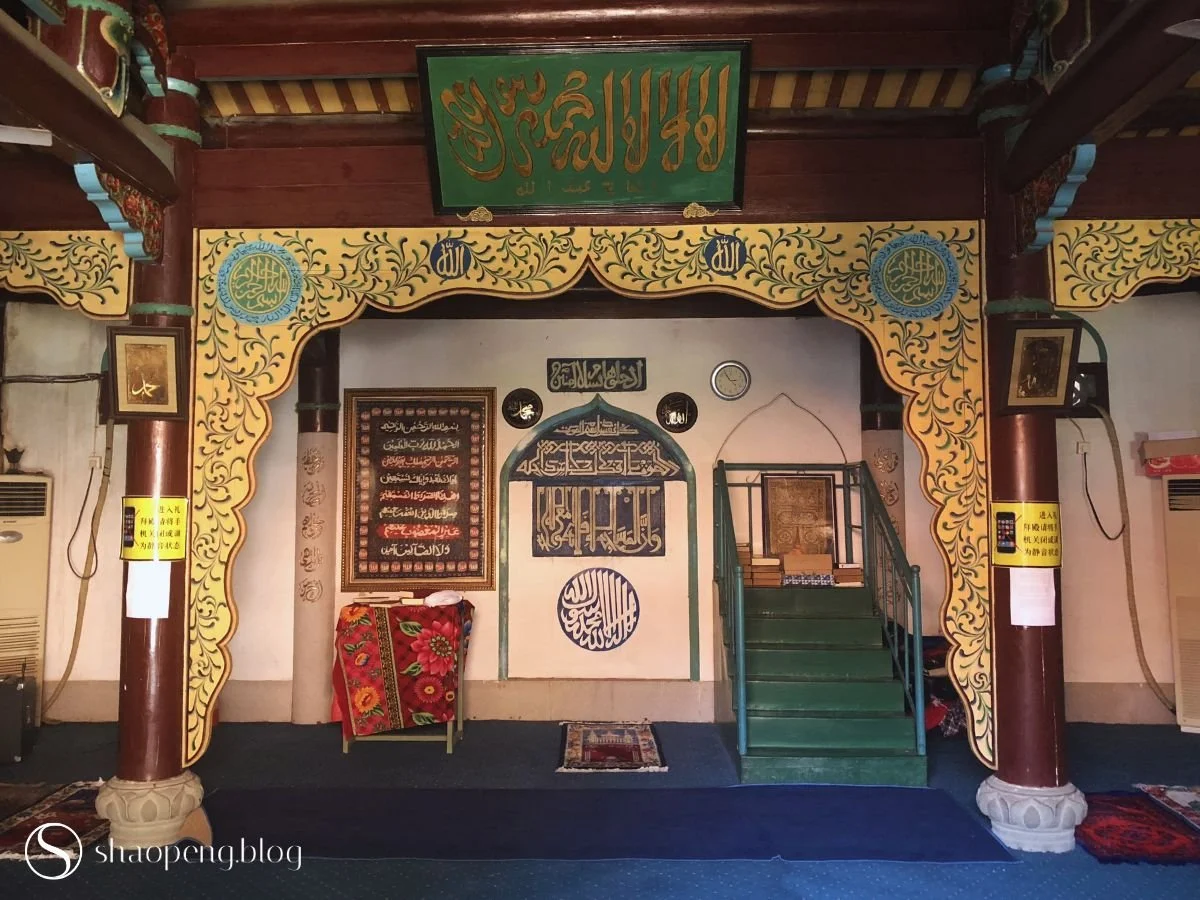
Inside the main prayer hall of Qingjing Mosque in Quanzhou, China, calligraphy in both Sini and other foreign styles can be found.
Sini: Where Chinese Brush Began to Speak Arabic
Within China’s Muslim communities, Arabic letters started to take on the qualities of the Chinese brush: its fluidity, modulation of pressure, and instinct for spatial balance. Over centuries, this encounter gave birth to what came to be known as “Sini script,” rooted in Arabic script tradition and shaped by Chinese calligraphic sensibility.
In China, calligraphy is called shufa — a discipline governed by balance and restraint. Its instrument is the brush, bundled from animal hair, sometimes stiff, sometimes soft, and sometimes a blend of both. Arabic calligraphy, by contrast, is written with a reed pen, or qalam.
In Sini script, the writing instrument shifts with the style. In the Mushaf style, a traditional reed or bamboo qalam is used on sized paper, its controlled tip allowing for clarity and restraint. In the broad-stroke style, however, the instrument changes slightly: calligraphers wrap fabric around a wooden pen, softening its edge so the ink can travel more freely across the xuan paper. In the brush style, it is the Chinese calligraphy brush that takes over.
Each instrument draws out a different face of the same script, as if Arabic letters, once they enter this foreign land, begin to adjust their expression to the tools that carry them.
What’s more, the surface where the ink meets the page reflects two entirely different philosophies.
Chinese calligraphers write on xuan paper (also referred to as “rice paper”), a soft and highly absorbent surface. The moment ink touches the paper, it is absorbed, fixed, and irrevocable. There is little room for correction, and none for hesitation. Every line demands decisiveness, and an instinct for knowing how brush, ink, and paper work together.
Arabic calligraphy, on the other hand, is traditionally carried out on parchment, parchment-like papers, and later surfaces burnished and sized with starch, built to resist absorption. Here, ink rests on the surface rather than sinking into it. The line stays sharp and forms can be repeated, refined, and controlled.
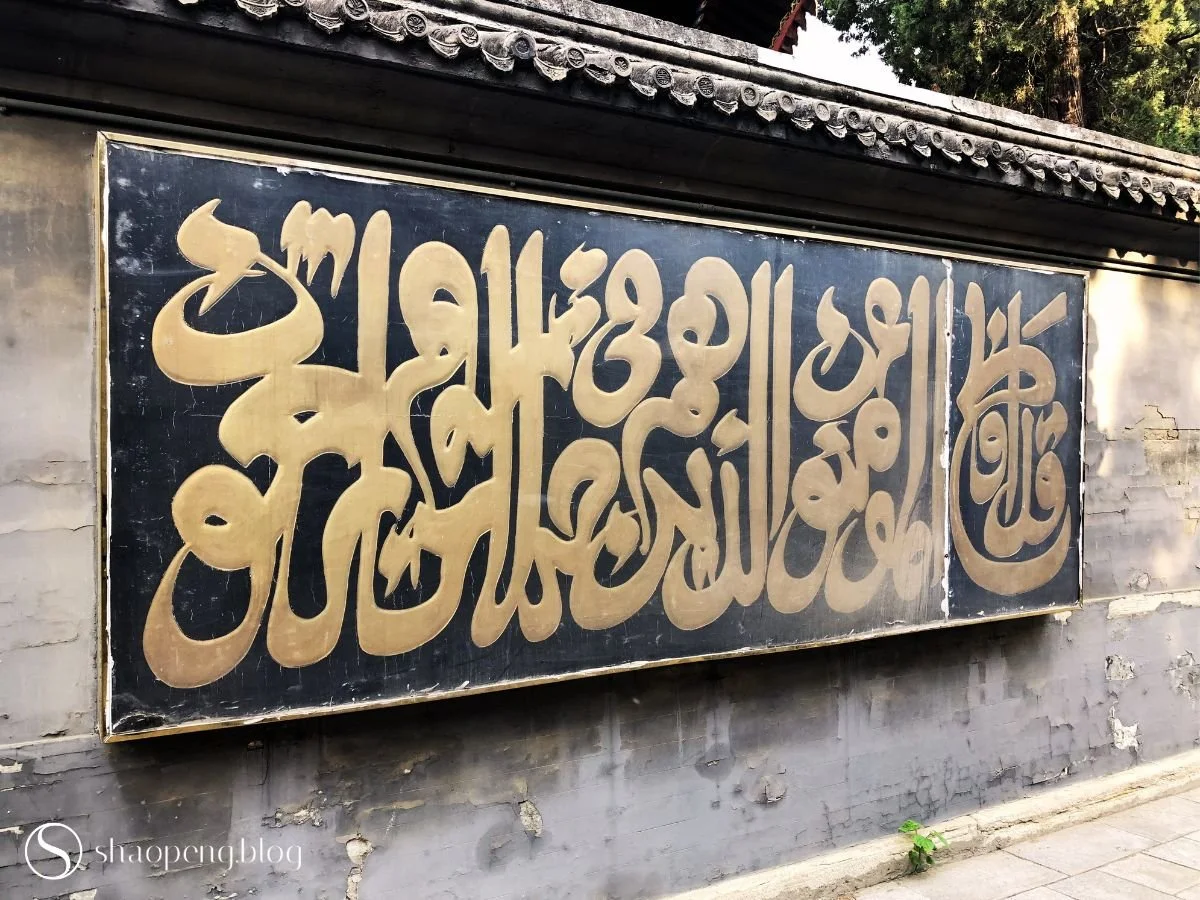
Quranic verse rendered in a broad-stroke style, inscribed on a plaque for public viewing inside Niujie Mosque in Beijing, China.
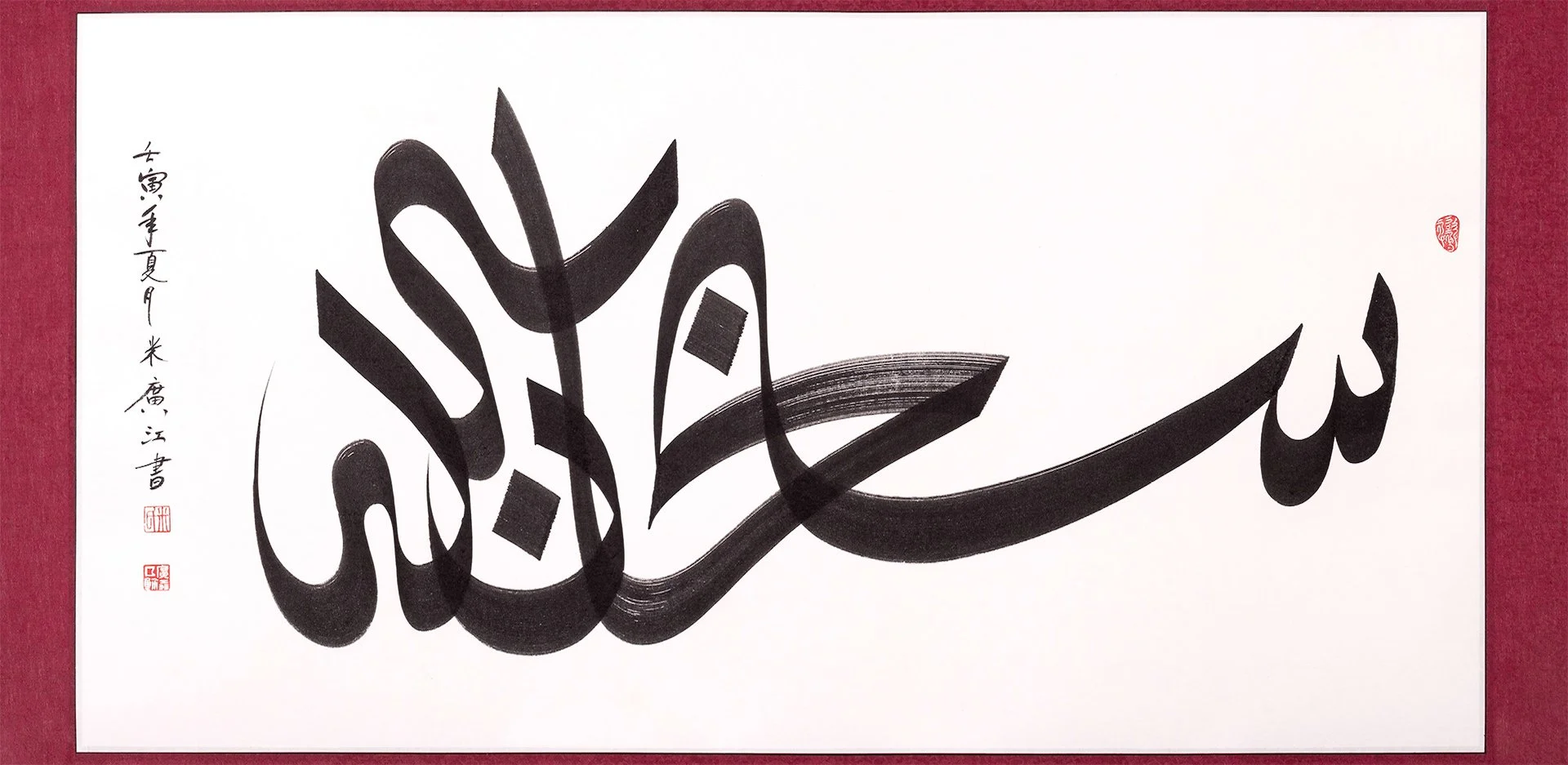
“Subhan Allah” (God is sublime) by Haji Noor Deen, written in broad-stroke style with ink on xuan paper. Image courtesy of Haji Noor Deen.
Faces of Sini Calligraphy
Like any tradition shaped by a long migration, Sini calligraphy did not settle into a single form. It branched, like an ocean dividing into rivers, carrying the same water toward different shores:
1. Mushaf style (穆蘇哈甫體): reserved for copying the Quran itself, this script is a blend of naskh, muhaqqaq, and rayhani that arrived in China during the Yuan dynasty and were gradually absorbed into local Muslim practice.
2. Religious book style (抄錄體): born in the lamplit corners of Chinese mosques, this script was used for devotion and study where imams hand-copied scripture and commentary using pens fashioned from bamboo or chopsticks.
3. Broad-stroke style (寬筆體): calligraphy scaled for public eyes, with letters expanding into monumental, almost architectural forms.
4. Script-Painting style (經字畫): where the boundary between word and image dissolves, and the script takes the shape of a vase, a flower, or other objects imbued with symbolic meaning.
5. Brush style (毛筆體): the clearest descendant of the Chinese brush tradition, adopted by Chinese Muslims from the late Yuan dynasty onward. Here, Arabic letters are rendered with a Chinese brush and arranged vertically from top to bottom, reflecting the conventions of traditional Chinese calligraphy.
6. Depictive style (描繪體): calligraphy that wanders fully into the territory of illustration, blurring the boundary between painting and writing while remaining rooted in the written form.
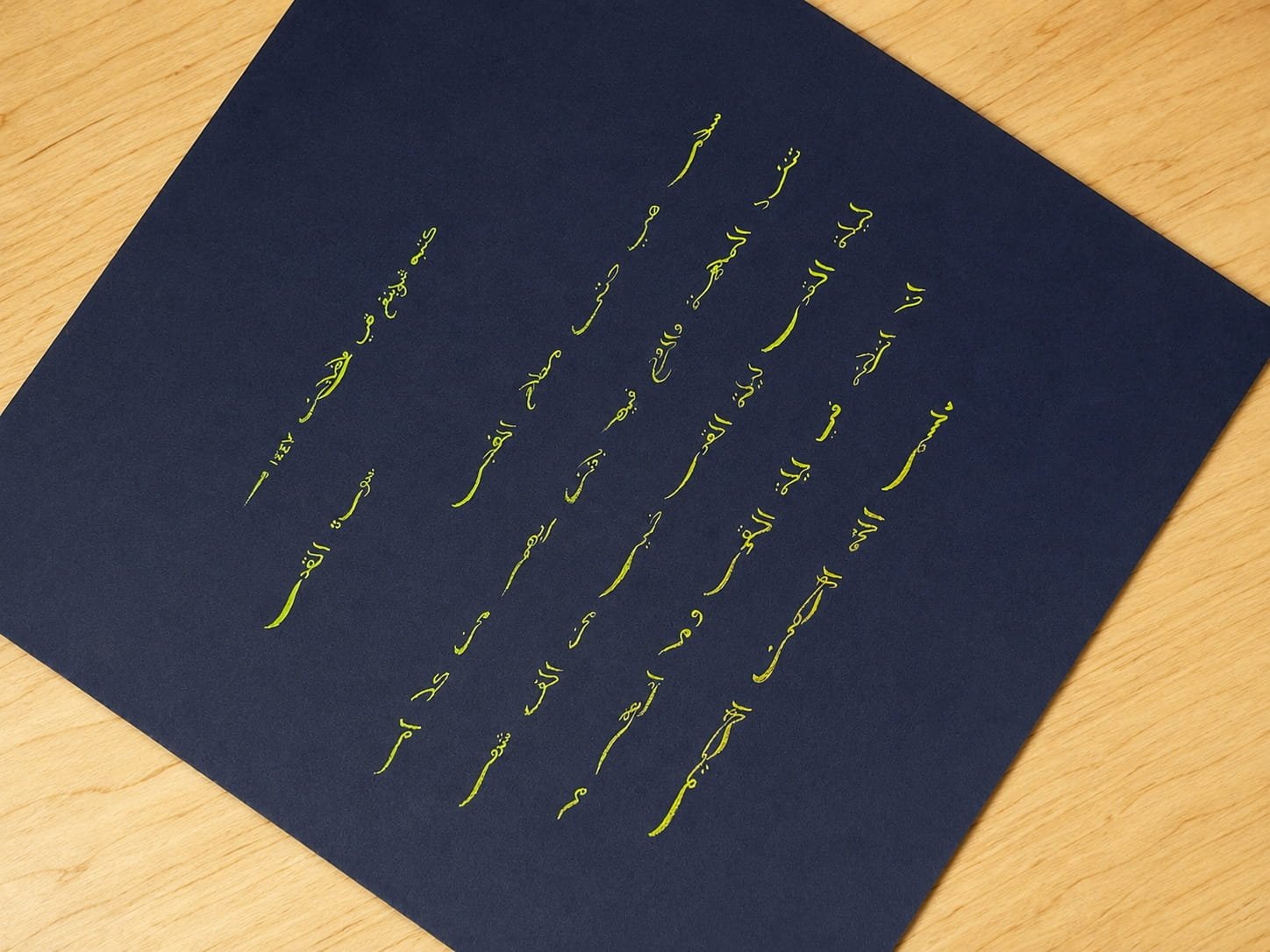
Surah Al-Qadr, rendered in gold on dark blue xuan paper in the Sini brush style, Ramadan 1447 AH (2026).
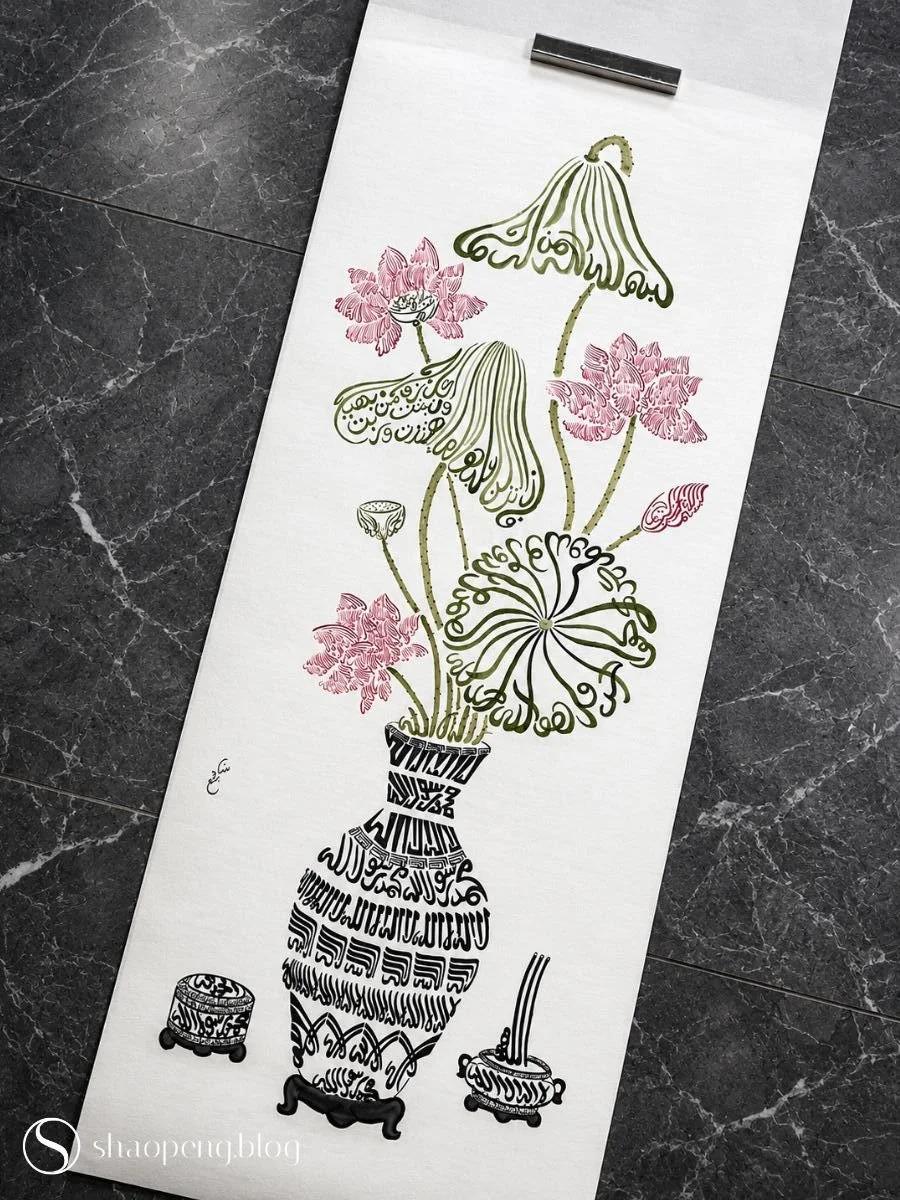
A piece in script-painting style, copied from a work by Haji Noor Deen as part of my submission in class.
Image © Shaopeng
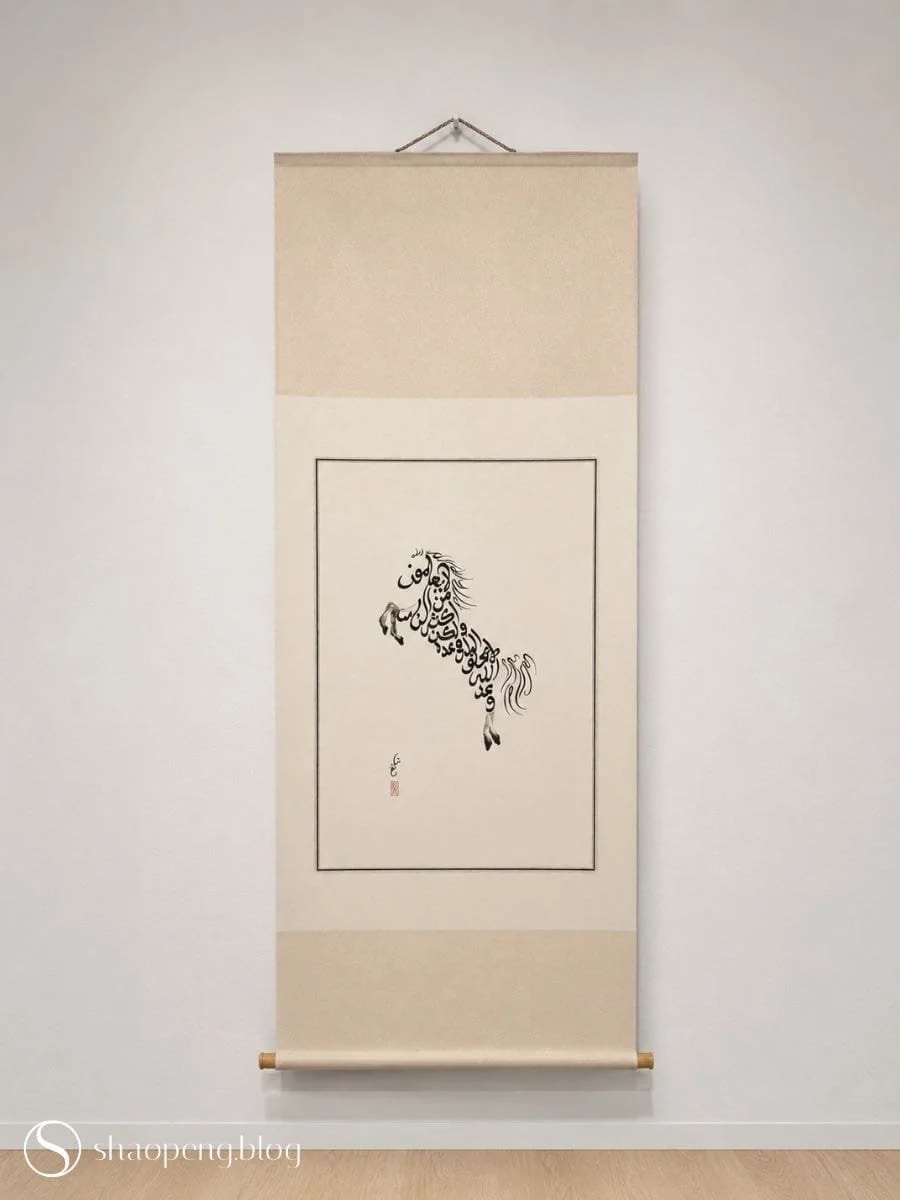
While pursuing my study of Sini script, I began creating works of my own, including this piece, in which I handled the calligraphy, framing, and mounting of the hanging scroll from start to finish.
Image © Shaopeng
Contemporary Sini Calligraphy
Every tradition needs someone to carry it forward, and in Sini calligraphy today, few are as celebrated as Haji Noor Deen (Mi Guangjiang). His works are collected by major museums around the world, and he remains active in the field, particularly within Arabic-speaking and global calligraphy communities.
I first encountered Haji Noor Deen’s work through his book, the only in-depth study of Sini calligraphy. When I eventually decided to pursue Arabic calligraphy more seriously, I went looking for teachers. At the time, I had no idea that Haji Noor Deen offered classes at all. Finding my way into his teaching felt like taking a path that had been there all along, waiting for me to notice it. Two years in, and I’m still very much a wanderer on the road.
The journey began with broad-stroke style. Controlling the ink — really controlling it — asks for a kind of patience I didn’t know I lacked until I sat down with a fabric-wrapped pen and watched my first strokes bleed and spread across xuan paper. Speed, too, becomes its own teacher. Move too slowly, and the ink pools where it shouldn’t. Move too quickly, and the stroke becomes too dry to hold its shape. There is no shortcut through this, but trial, and error, and trial again.
Script-painting, brush style, and the depictive style came more easily to me, perhaps because something in their logic resonated with an instinct I already carried from my artistic past.
Recently, I’ve been training my hands in the Mushaf style. And it feels, in some ways, like circling back to where this entire journey began: the Quran, the Word of God. Only now, that line carries the weight of two traditions instead of one.
Reference:
Mi, G. (2018). Zhongguo chuantong Alabowen shufa yishu yanjiu [The study of Arabic calligraphy in Chinese tradition]. Peking University Press.