
Wander in AlUla: Reading the Sky Like the Bedouins Do
Stargazing in the heart of the Gharameel Desert, I find myself connected to a distant past, shaped by generations of travellers whose imaginative tales remain scattered across the sands.
Sense of Wander: ★★★★★
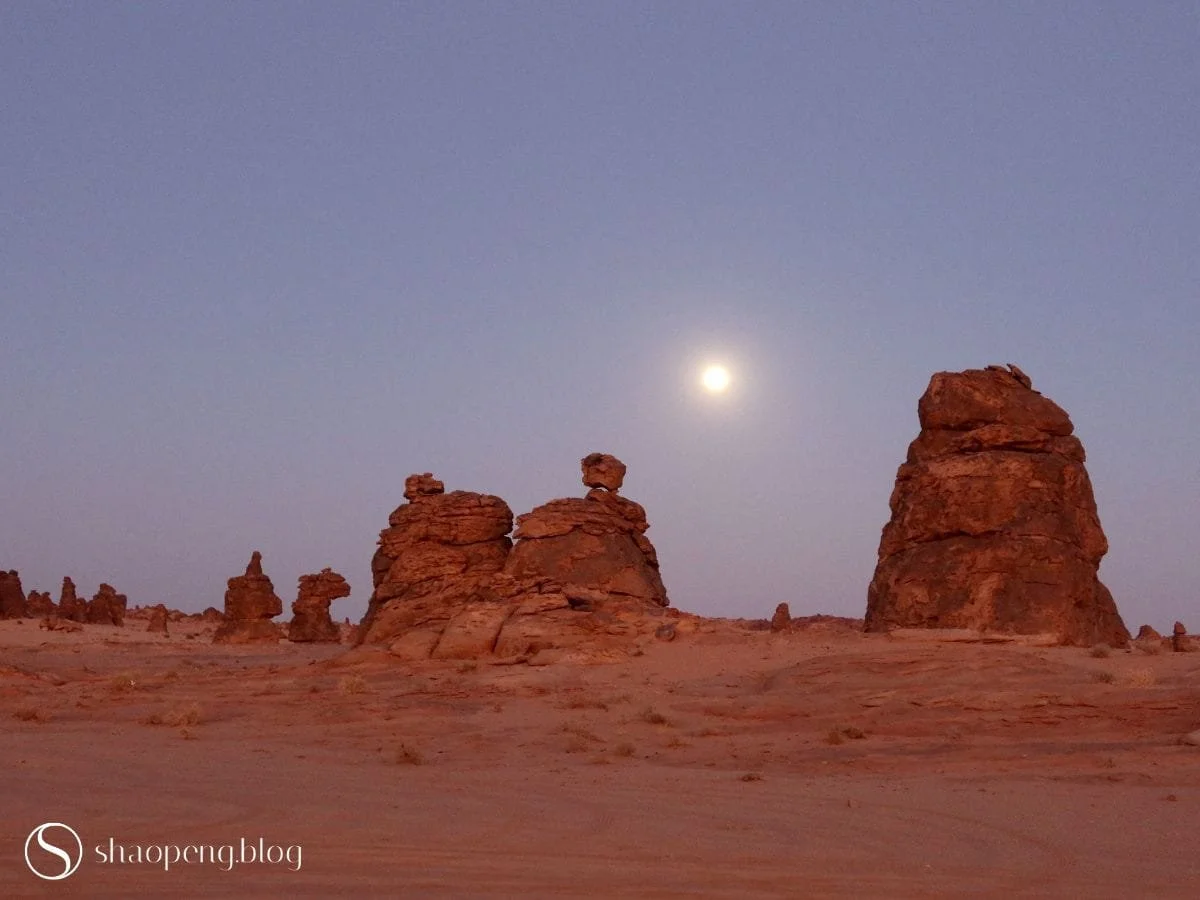
The Gharameel Desert illuminated by a near-full moon.
ALULA, Saudi Arabia — We pass Hegra as the light begins to fade, and it’s still more than an hour before our jeep leaves the paved road, winding its way through a landscape of rock formations that seem to have wandered in from another planet. For a moment, it genuinely feels like we’ve trespassed into somewhere not quite of this Earth.
The sun has already slipped below the horizon by the time we arrive, but there’s still enough light left in the sky to trace the silhouettes of the rock spires around us. Then the near-full moon takes over, illuminating the desert as if an enormous lamp has been switched on somewhere overhead.
After one last stretch of bumpy road, we roll to a stop in the middle of the Gharameel Desert. The sky is still pale enough for the first few hundred stars to emerge, winking down at us as though they’ve been waiting all along.
Your phone signal disappears somewhere out here, but you remain connected — not to people, but a whole world of stories carried by the stars, guiding travellers and caravans across this same desert for centuries. Perhaps even millennia.
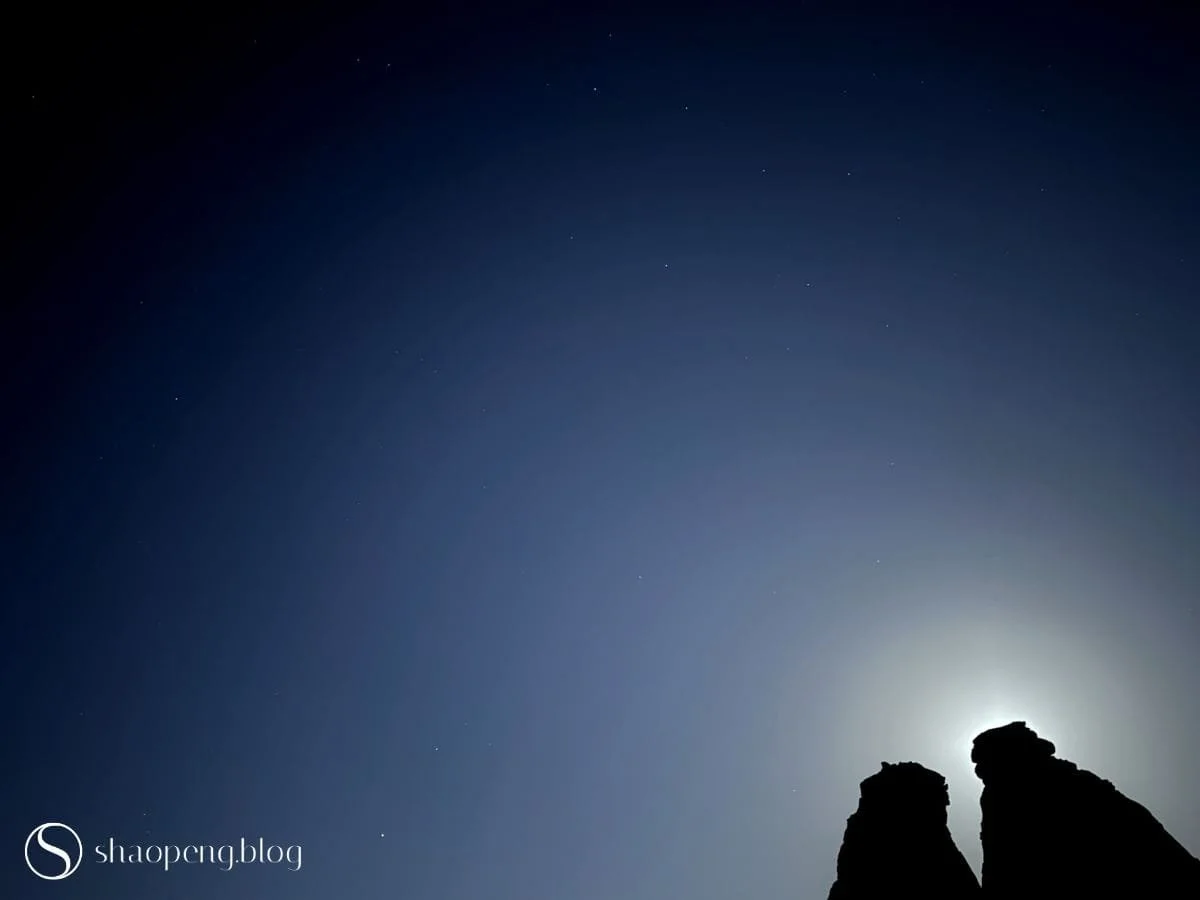
Stargazing in the heart of the Gharameel Desert.
Stargazing at Gharameel is the one thing I’ve been looking forward to since before the trip even begins. I’ve spent most of the last thirty-odd years in cities dense enough to swallow the night sky, so stars, for the most part, have remained something distant and foreign. This is going to be my first real stargazing experience — and in the Arabian Peninsula, of all places. It feels improbable enough that I keep half-expecting something to go wrong.
Nothing did.
As the sky darkens, the temperature drops quickly. My ultralight down jacket is no match for the desert cold, and I can feel my fingertips growing numb even tucked inside my pockets. Someone hands me a farwa, a heavy Bedouin coat traditionally made from camel fur and worn through the harsh desert winters. It isn’t a light thing to wear, but it works.
There are, it turns out, two ways to experience stargazing. You can simply lie back and let the sky reveal itself, or you can go with a guide. We have the latter: a Bedouin guide who brings the night sky to life through the stories behind the stars.
She begins by introducing the Arab contribution to our understanding of the heavens: roughly 80 percent of the star names used in modern astronomy trace their origins to Arabic. These names were not simply borrowed; many were preserved and transmitted through centuries of Arabic astronomical scholarship, often carrying forward knowledge from earlier traditions that might otherwise have been lost. Betelgeuse, Rigel, Deneb, Vega, Altair — all bear Arabic names.
She then guides us through the heavens star by star: the bent knee of Cassiopeia, the North Star with its two faithful companions, the familiar scoop of the Big Dipper. Then comes the story of two fainter stars near Orion: a woman named al-Jawza’, promised in marriage to a man called Suhayl. According to an old Arabian legend, something went wrong on their wedding night, and by morning al-Jawza’ was dead. Suhayl fled south in grief and fear, becoming, in the sky, the star we now call Canopus.
Then there is Al-Thurayya — the Pleiades — revered in Bedouin lore as the most beautiful of them all. And finally, Sirius, believed to be a gateway to heaven, the only star mentioned by name in the Quran. In one verse, its presence serves as a reminder that even the brightest light in the sky remains subject to something greater — a powerful statement in a land where Sirius had long inspired reverence among desert peoples.
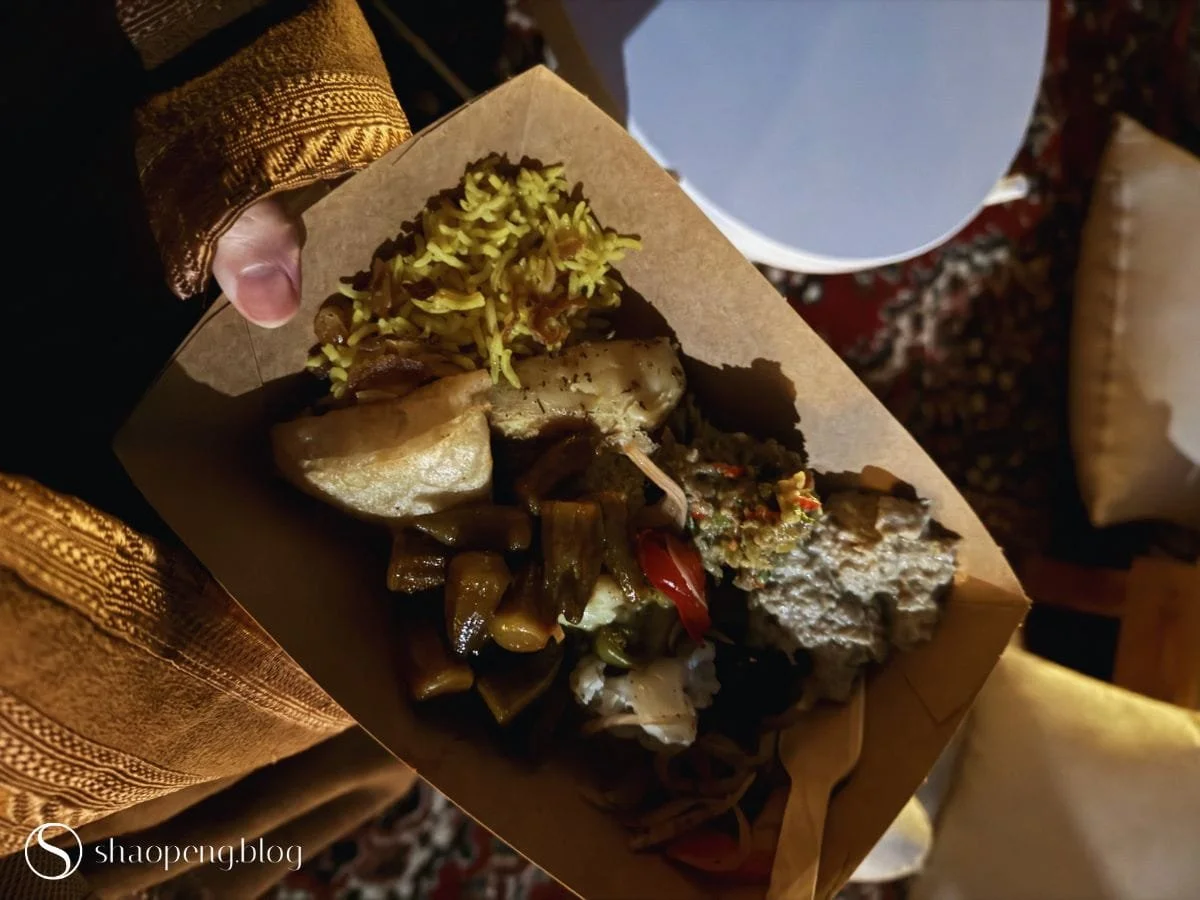
A farwa and a warm meal offer comfort against the chill of the desert night.
My eyes aren’t built for stargazing — astigmatism turns every point of light into a small smear against the darkness. But somewhere in the squinting, I come to realise something: stars are relational. You don’t find them one at a time; you find one, and it leads you to the next, revealing a celestial roadmap hidden in plain sight.
We also learn why planets shine with a steadier light: they are reflecting the sun’s glow, while stars flicker through the turbulence of their own restless gases. As I listen, I can’t help wishing astronomy had been taught this way when I was a child — beneath an actual sky, rather than confined to pages of text and diagrams.
Our guide moves effortlessly between Arabic and English, and I follow more than I expect. Perhaps 80 percent. For someone still finding my way through Arabic, it feels like a small but meaningful milestone.
I leave Gharameel knowing a little more about a tiny fraction of the stars above — the ones that, until then, had remained invisible to me my entire life.
Wanderer’s tip — The activity doesn’t run every night, so it’s worth booking ahead via Experience AlUla. And if it’s showing as unavailable online — the way it did for us — reach out to the tour operator Husaak Adventures instead.