
Follow the old caravan road through the Fergana Valley, where silk is woven by hand, potters guard a secret blue glaze, and a khan’s palace still stands.
Sense of Wander: ★★★★★
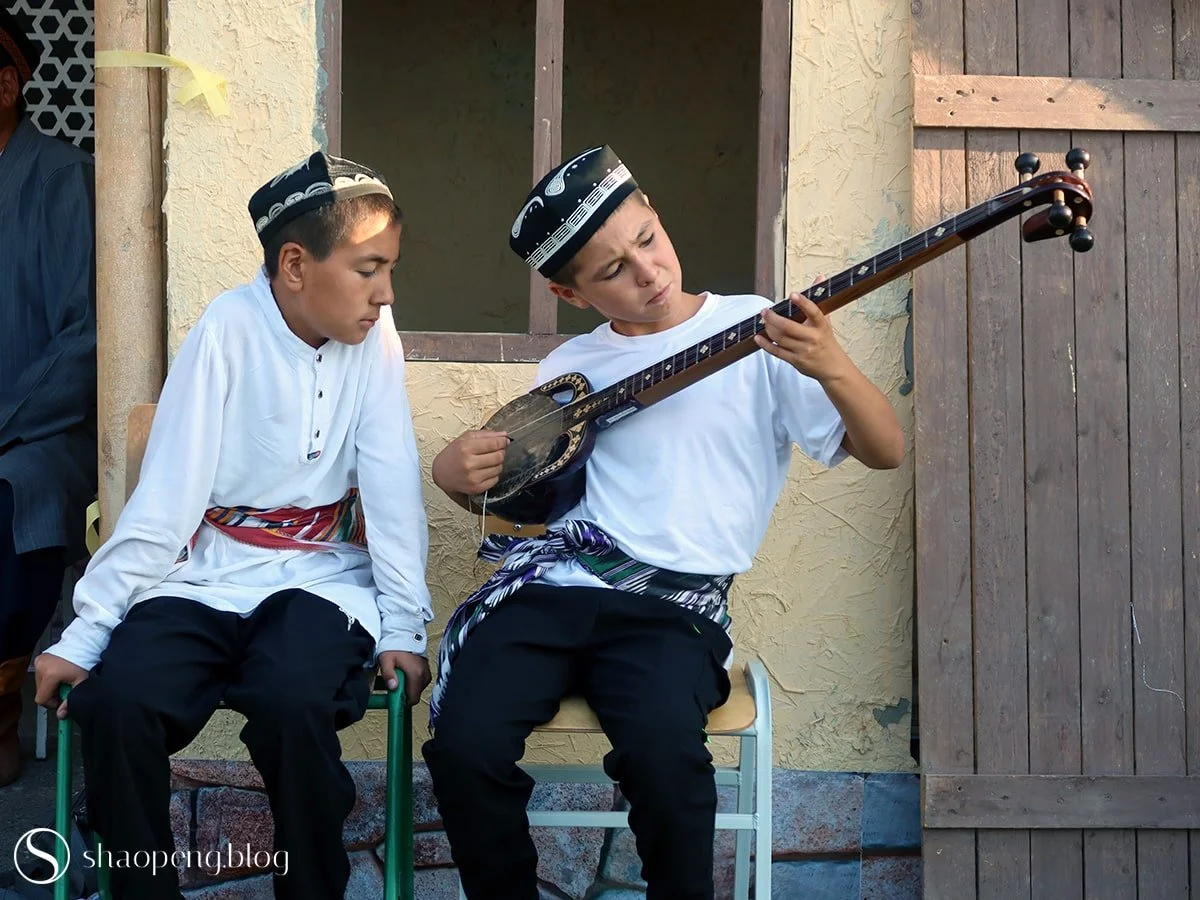
Two Uzbek boys absorbed by the rubab, a traditional plucked lute deeply rooted in Central Asian musical traditions.
FERGANA, Uzbekistan — After crossing the high passes from Kashgar, the envoys and caravans that first travelled this route would have found welcome relief in the fertile abundance of Fergana. Like a piece of jade set in the heart of Central Asia, the valley has long been a meeting point of worlds. It lay at the crossroads of several classical-era empires, and Chinese chroniclers likened its cities to those of Bactria and Parthia, urban centres of the Hellenistic and Persian worlds.
The story of Fergana, however, began long before the Silk Road. Ancient petroglyphs found in the region depict human figures alongside large-horned cattle, offering a window into prehistoric pastoral life and the way early inhabitants saw their world.
Written history came later. In 329 BCE, Alexander the Great founded Alexandria Eschate, meaning “The Furthest”, at the valley’s southwestern edge. Around 130 BCE, the Chinese explorer Zhang Qian recorded an account of the region, known in Chinese as Dayuan. He described people who ploughed their fields, grew rice and wheat, and made wine from grapes. The valley was also renowned for its “heavenly horses”, prized in Han China (206 BCE-220 CE), which waged war against Dayuan and forced its rulers into submission in 101 BCE.
The valley’s strategic position along trade routes brought Persian, Turkic, and Arab influences into its culture, while successive waves of conquest shaped its history and identity. Han Chinese, Kushans, Sassanid Persians, Arab caliphates, Mongols, and eventually Timur’s empire all held sway over the region at different points in history.
And you can still see what drew them here. The Naryn and Kara Darya rivers nourish the valley’s fertile land, creating an agricultural haven in an otherwise arid part of Central Asia. Fergana is known for its pomegranates, figs, and distinctive grape varieties, while its orchards also yield apricots and melons. Then there is devzira, a reddish-brown rice prized for the distinctive colour and flavour it gives plov. It absorbs the oil and juices in the cooking cauldron while retaining its texture, making it ideal for this Central Asian staple.
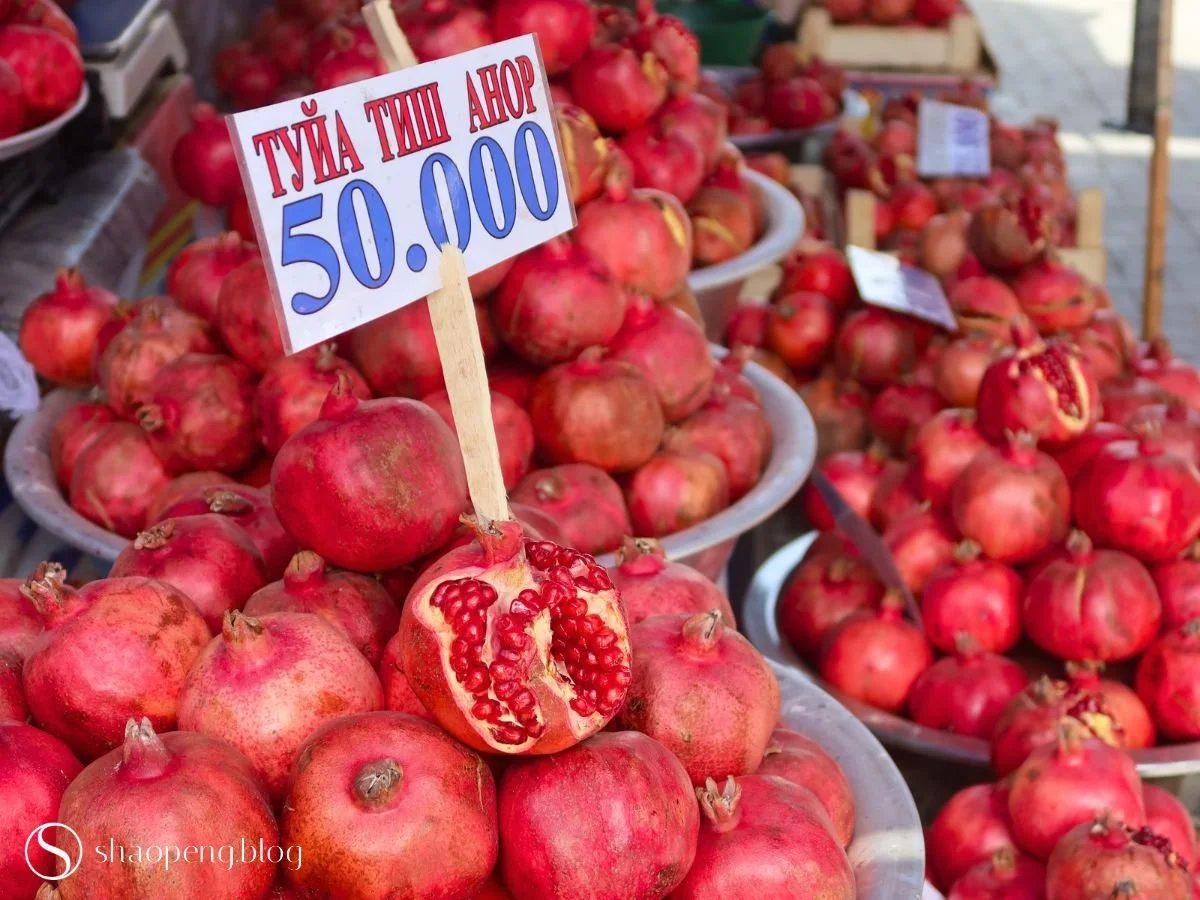
Different grades of pomegranates for sale at Fergana’s central bazaar.
Later chapters belong to the valley’s own rulers. Babur (1483–1530), founder of the Mughal dynasty (1526–1857), was born here, linking Fergana to Afghanistan and India. The Kokand Khanate, founded in 1709, later made Kokand the capital of a vast territory.
At the end of the 19th century, the Russian Empire conquered the valley, and Russians came to play prominent roles in its administration, commerce, and industry. Yet the valley’s ethnic diversity long predates Russian rule. Uzbeks, Tajiks, and Kyrgyz have lived alongside one another for centuries, together with other communities, such as Kashgarians, Kipchaks, Bukharan Jews, and Romani.
The modern political map, however, tells a more complicated story. In the 1920s, the Soviet Union divided the valley among three republics, and with the collapse of the USSR in 1991, these internal boundaries became international borders. But the communities on either side remain closely intertwined, with their shared cultural ties extending beyond national boundaries. This interconnected heritage is reflected in the region’s crafts and in its bazaars, where Uzbek traders work alongside Korean and Russian vendors selling homemade specialities.
Now, join me on a journey from east to west, tracing the route taken by Chinese caravans from Kashgar. We’ll begin in Fergana, a relatively young garrison city whose museum and park, named after a medieval astronomer, set the scene. From there, we’ll continue to Margilan, where silk is still drawn, dyed, and woven by hand. Next comes Rishtan, where red earth and a closely guarded blue glaze have shaped the region’s pottery for centuries. We’ll conclude in Kokand, the former khanate capital, where palaces and a mosque-turned-craft museum bring our journey to a close before we set off on another.
Fergana: A Young City in An Ancient Valley
Sense of Wander: ★★★☆☆
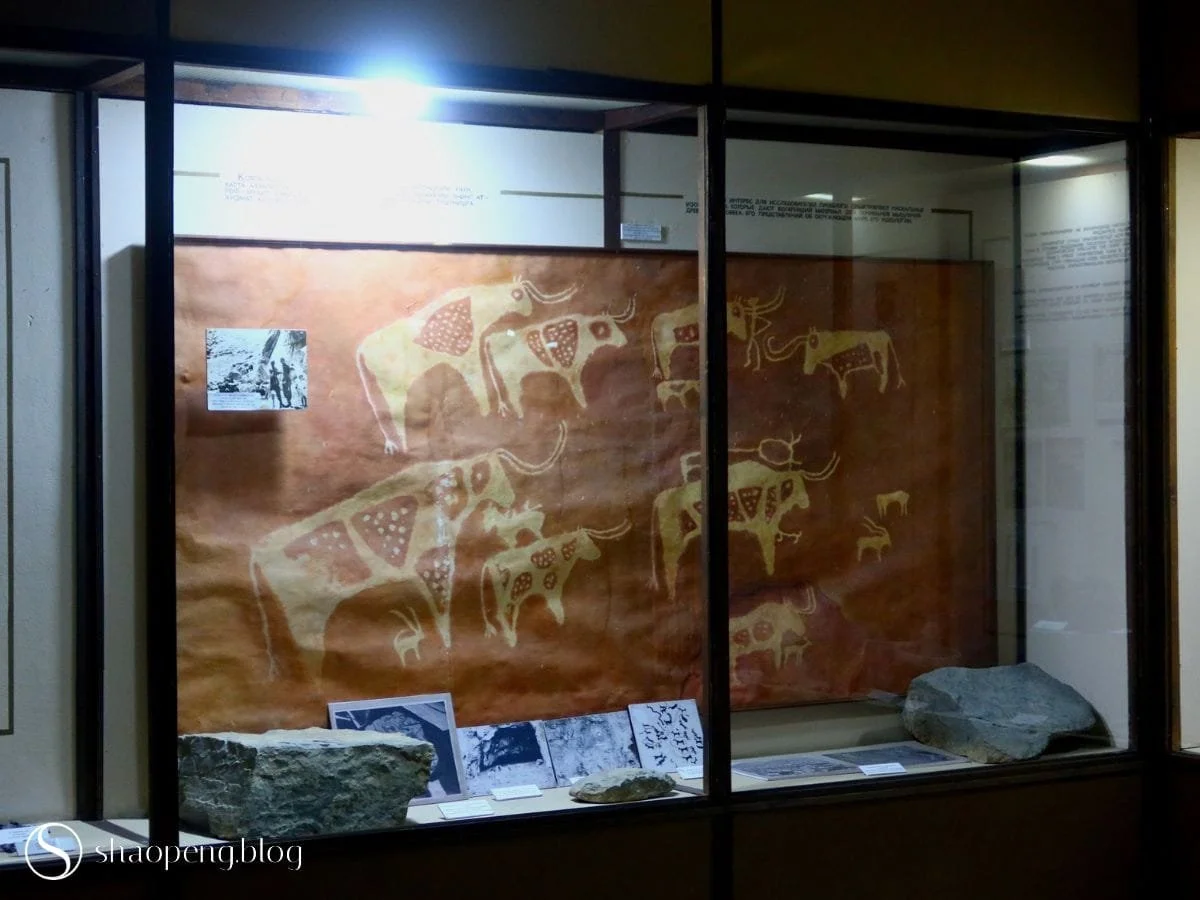
Examples of ancient petroglyphs on display at the Fergana Regional Museum of Local Lore.
Fergana comes as a surprise: a city in the heart of the Silk Road region whose main urban centre is barely 150 years old. Founded in 1876 as a military-administrative centre following the abolition of the Kokand Khanate, it was initially named New Margilan. In 1907, it was renamed Skobelev, before taking its present name in 1924.
The city’s layout gives away its relative youth. Traditional Central Asian cities often grew organically around their bazaars, with winding alleys, mud-brick walls, and densely-packed houses. Fergana, by contrast, was laid out on a Western-inspired radial plan with concentric rings. Today, you can wander its streets beneath the shade of century-old trees rather than lose yourself in a labyrinth of narrow lanes.
There are few ancient monuments, so to understand the region’s past, start at the Fergana Regional Museum of Local Lore, also known as the State Museum of History and Culture of the Fergana Region
The museum opened on 26 May 1899, the centenary of Alexander Pushkin’s birth, which makes it one of Uzbekistan’s oldest. Walk through the valley’s story, from Stone Age artefacts to the end of the medieval period. Look for the Kokand Khanate coins, a Quran that belonged to Khudayar Khan, and manuscripts by the poets Navoi and Hafiz.
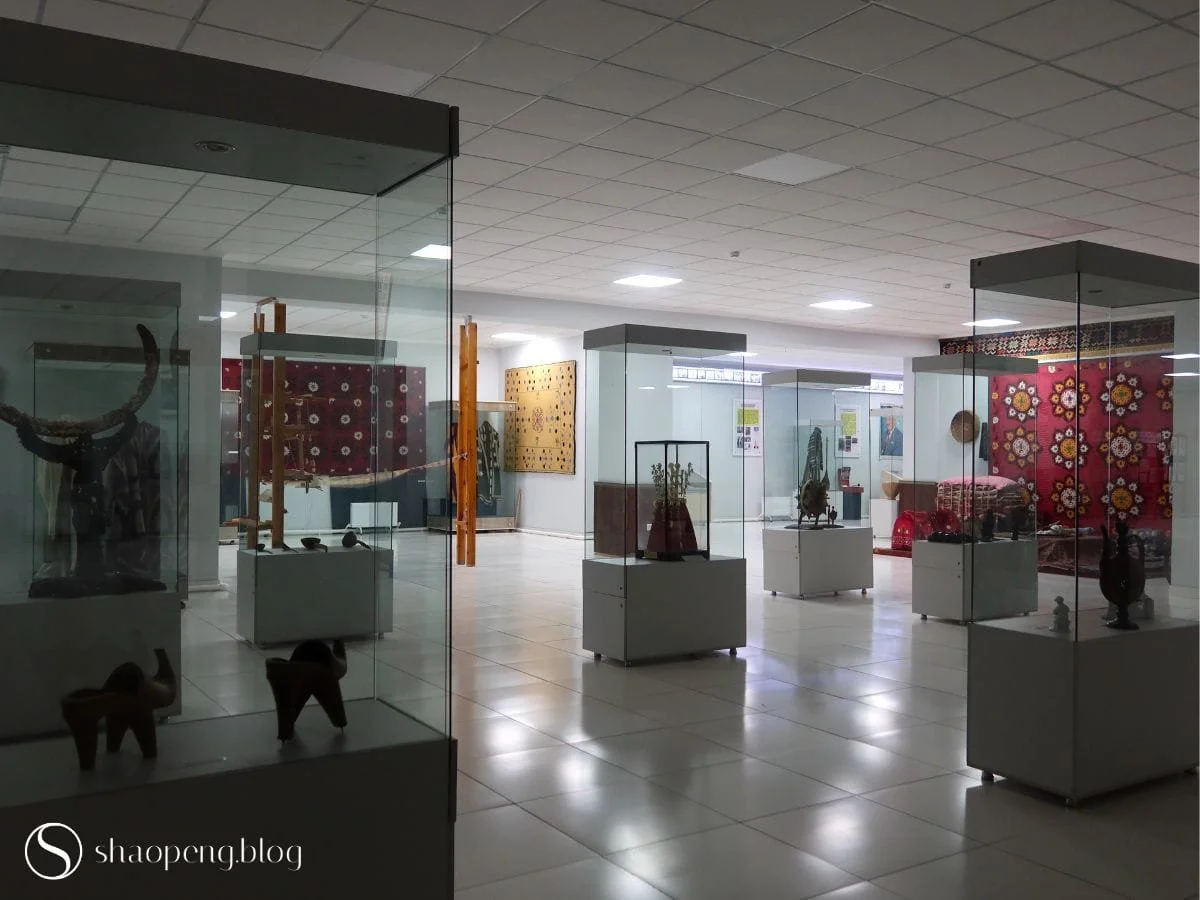
A selection of local arts and crafts on display at the Fergana Regional Museum of Local Lore.
An entire floor is devoted to the region’s crafts, from pottery and ceramics to woodwork, silk, embroidery, metalwork, and jewellery. In one corner, you’ll find askiya, an Uzbek art of improvised verbal duelling inscribed on UNESCO’s Representative List of the Intangible Cultural Heritage of Humanity in 2014. Believed to have originated in the Fergana Valley, it may remind you of Chinese xiangsheng, or crosstalk, with its quick-fire banter between performers.
Fergana has fewer arts venues than some other Uzbek cities, but its central bazaar makes up for it. As the heart of the city’s commercial life, the bazaar stretches across several blocks north of the centre, with stalls piled high with fresh fruit, vegetables, nuts, and spices from the fertile valley. Look out for the dried apricots, raisins, and almonds for which the region is known. I left with my hands full of fresh pomegranates, having learned that their price depends not only on the fruit’s size but also on the size of its seeds.
Wanderer’s tip — Foodies should venture beyond the city centre to try kosa samosa, a local speciality of the Fergana Valley.
Margilan: Cocoon to Cloth
Sense of Wander: ★★★★☆
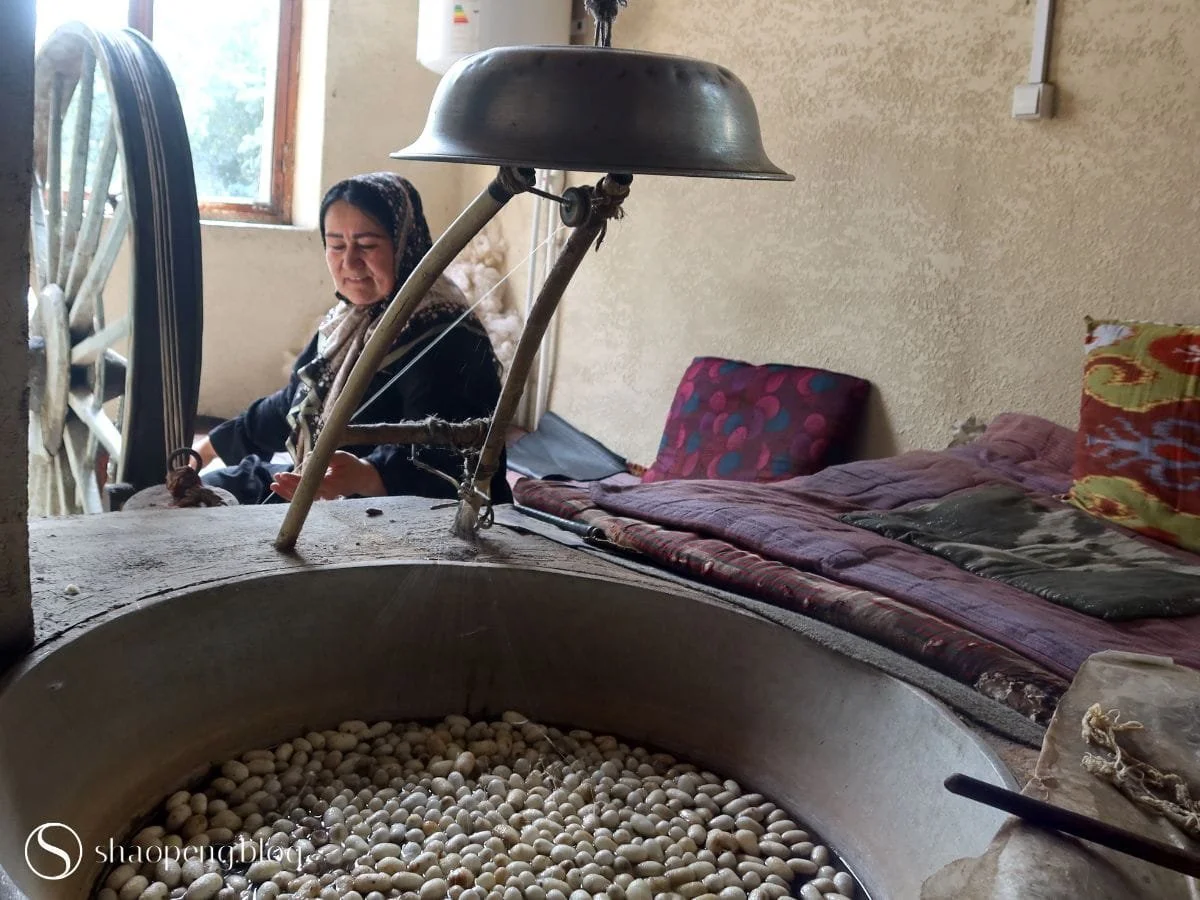
An artisan at Yodgorlik Silk Factory drawing and spinning silk thread from boiled cocoons.
You’ll encounter Margilan’s silk in bazaars across Uzbekistan long before you reach the town itself. Head north from Fergana for about half an hour by car, and you’ll find its source.
Arab chronicles from the 10th century mention the city as “Marginon,” and Margilan has been renowned for its silk goods ever since.
The best part of visiting Margilan is being able to follow silk from cocoon to cloth in a single visit. At Yodgorlik Silk Factory, Uzbekistan’s largest traditional silk factory, you can watch the process from start to finish, with much of the work still done by hand. Artisans weave khan-atlas, the “royal silk,” and ikat, whose softly blurred patterns emerge from threads tied and dyed before they reach the loom. Nearby, a smaller workshop offers a live tie-dye demonstration that feels almost magical.
Continue to the Crafts Development Centre, housed in the 19th-century Said Ahmad-Khoja Madrasa. The madrasa operated for only a short time before closing in the early Soviet period. In 2007, local people founded the centre to revive and safeguard traditional crafts at risk of disappearing. Its programme for atlas and adras production was selected by UNESCO for its Register of Good Safeguarding Practices in 2017. Look out for the block-printing studio dedicated to chitgarlik, a traditional Uzbek craft now practised by only a handful of artisans.
When you’re ready for a break from silk, wander through the town’s older quarter. The Pir Siddiq complex, known locally as “Kaptarlik” (“Pigeon”), commemorates the miraculous rescue of a saint. Since then, pigeons have held a special place in local tradition. Nearby, the 18th-century Khoja Magiz Mausoleum has a rare octagonal inner chamber beneath its dome.
For a taste of local produce, make your way to Central Dehkan Bazaar, just a block from Yodgorlik Silk Factory. Babur, who was born in nearby Andijan, praised Margilan in his memoirs as a fine town blessed with an abundance of good things. Among them were its apricots and pomegranates, including a variety known as “Great Seed,” as well as dried apricots stuffed with almonds.
Wanderer’s tip — Margilan makes an easy half-day or full-day trip from Fergana.
Rishtan: Red Earth, Secret Blue
Sense of Wander: ★★★☆☆
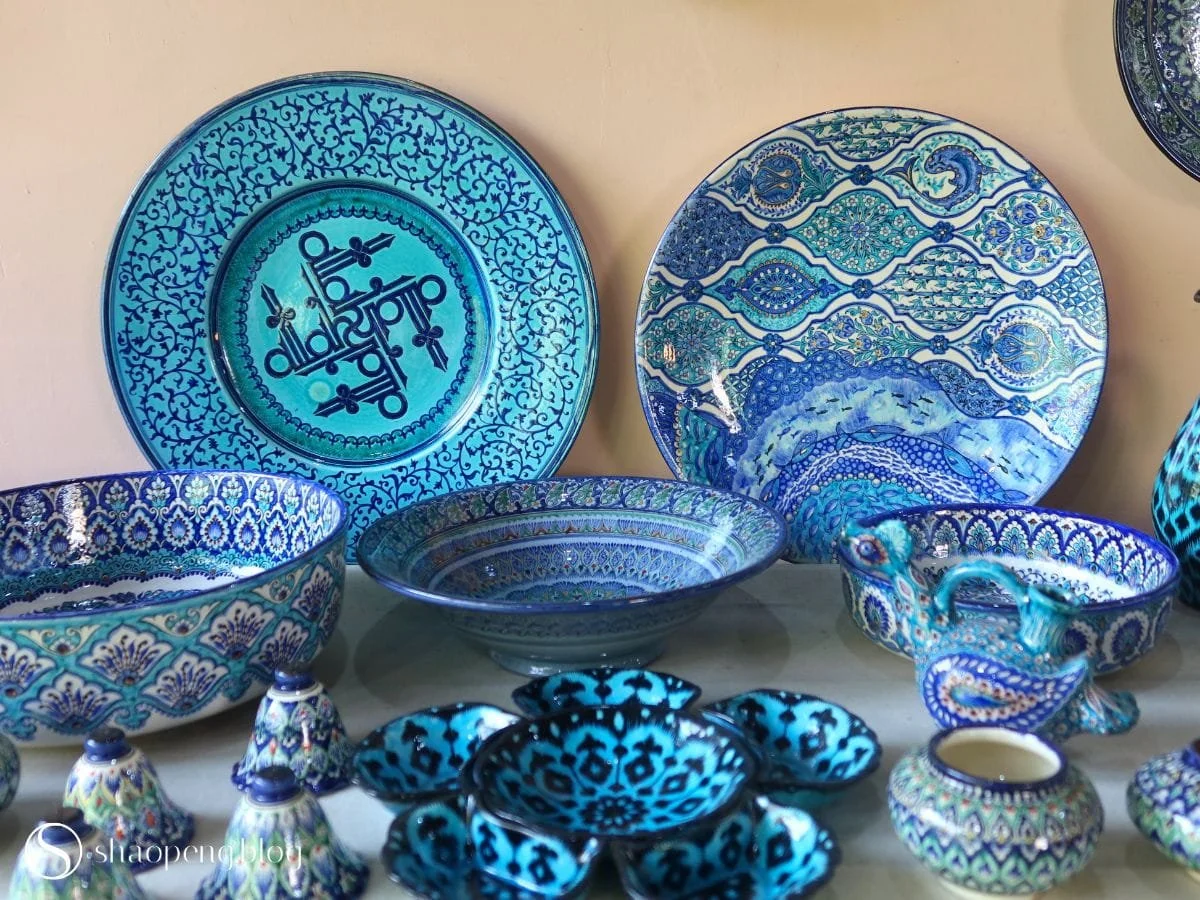
Ishkor-glazed ceramics for sale at Rustam Usmanov’s workshop in Rishtan.
Wander further west, and the road leads to Rishtan, one of Central Asia’s great pottery towns. The name is thought to derive from the Sogdian word “Rosh,” meaning “red earth,” a fitting reference to the iron-rich red clay beneath your feet. Archaeological excavations have uncovered potters’ quarters with kilns dating to the 2nd–1st century BCE.
Rishtan’s signature is ishkor, a glaze that gives its ceramics their distinctive shades of deep blue, turquoise, and green. It is made from the ash of a desert plant called qyrq bogan, meaning “forty branches.” The ash forms the basis of the glaze, while metal oxides add colour: cobalt for blues and copper for greens. The recipe is closely guarded, with master potters often keeping their ingredients, proportions, and techniques to themselves.
This tradition came close to disappearing. By the mid-20th century, the technique behind Rishtan’s famous blue ceramics had fallen into neglect and was only revived in 1974. The town itself has had its own twists and turns: renamed Kuibyshevo in 1934, it regained its historical name in 1977.
Wander between the studios, and you’ll meet very different masters. Rustam Usmanov, after being laid off from a factory, opened his own workshop to revive traditional Rishtan ceramic techniques. Today, his son Damir works alongside him. Watch a potter turn a lump of clay into a vessel on the wheel in just minutes, then see an artisan decorate it with a brush fine enough to draw the most delicate lines.
Alisher Nazirov’s studio offers a different atmosphere, with a more poetic touch. Born in 1958, he is a first-generation potter who established his own workshop and artistic tradition. In 1994, he completed an internship in Japan, creating more than 80 works at the studio of ceramic artist Isokichi Asakura. Since then, he has devoted himself to reviving the ancient ishkor glaze.
Near the exit of Nazirov’s workshop, you’ll stumble upon a memorial shrine in the Japanese style. It honours the potter’s friendship with Osaki Shigekatsu, a Japanese businessman who came to Rishtan to establish a car factory and sought out Nazirov because of his connections with Japan. It’s an unexpected piece of Silk Road history, linking this pottery town with a country at the far end of the route.
If you love ceramics, time your visit for the International Pottery Forum. It’s held every two years as part of the International Festival of Handicrafts in Kokand. At the most recent one, in 2025, Rishtan opened its Traditional Pottery Museum, and the World Crafts Council granted the district the title of “World Craft City.”
Kokand: Capital of Khans and Craftsmen
Sense of Wander: ★★★★☆

Khudayar Khan’s Palace, where history meets artistry in Kokand.
Say the name out loud and you’ll see why it lured me. Its prefix may come from an Iranian word for “good,” which would make Kokand the “good city,” though the etymology is debated. Another popular interpretation is “City of Winds.”
The city has existed since at least the 10th century and appears frequently in travellers’ accounts of the caravan routes. In 1709, Shahrukh declared independence and built a citadel here. The Kokand Khanate that followed made the city the capital of a large territory until the Russians absorbed it in 1876. Poets, scholars, and musicians gathered at its court, and the city still wears that ambition proudly.
Start at Khudayar Khan’s Palace, where the last khan projected his power through turquoise and cobalt tiles. Built in the early 1870s, it was the last in a series of seven palaces. Its original scale is hard to imagine: it had seven courtyards and 119 rooms, but only two courtyards and 19 rooms survive today. Inside, look for carved wooden columns and delicate plasterwork known as ganch. The palace has housed a museum since 1925.
Then wander toward the Jami Mosque, built in the early 19th century. Its hundred-metre-long ayvan is supported by 98 columns and topped with a colourfully painted ceiling. The surprise lies inside: working studios where you can watch weavers, potters, jewellers, and knife-makers at work under the same roof where people pray, as part of the Museum of Applied Arts.
The old city’s less-visited corners offer a counterpoint to all that splendour. The 18th-century Norbutabiy Madrasa was once the city’s largest religious centre. Beside it, the Modari Khan Mausoelum, built in 1825 for Umar Khan’s mother, features unusual red, green, yellow, and blue tilework. The site is also associated with a poet: Nodira played a key role in promoting architecture in Kokand and helped shape the city’s cultural golden age.
What makes Kokand different is that it’s a craft city living in Bukhara’s shadow. It earned World Craft City status in 2019 and hosts a biennial International Festival of Handicrafts that turns its streets into an open-air gallery.
Wanderer’s tips — Kokand sees few visitors, so take your time.