
Step into Rishtan, a town of potters, where red earth and a glaze made from wild shrub ash become Uzbekistan’s famous ishkor ceramics.
Sense of Wander: ★★★★☆

Ceramics by Rishtan potter Alisher Nazirov.
RISHTAN, Uzbekistan — I’ve never been a fan of ceramics. So when I found myself in the Fergana Valley with some time to spare, I almost talked myself out of visiting Rishtan. Located roughly halfway between Fergana and Kokand, about 40 kilometres from the latter, it seemed easy to skip. But I’m glad I didn’t.
Let’s start from the ground up. Rishtan’s clay, known locally as qizil tuproq, is red and rich in iron, and potters still dig it from underground deposits today. Scholars trace the town’s name to a Sogdian word for “red earth,” meaning the place is named after its raw material.
Potters have worked here for centuries. Excavations have uncovered craftsmen’s quarters with kilns dating to the 2nd–1st century BCE. The famous blue, however, is much younger. Locals will tell you it goes back at least 800 years, though no one I met could pin down an exact date.
The Silk Road likely played a part, with trade routes running north through the Fergana Valley. The ishkor glazing technique is said to have arrived from Iran and Samarkand, and Rishtan’s potters spent a while imitating Chinese porcelain. By the late 19th century, their blue ware was winning over the Russian market.
The Blue Nobody Will Fully Explain
Ishkor is at the heart of Rishtan’s pottery. Made from the ash of a wild shrub of the same name, this alkaline glaze influences how mineral oxides develop their colours, yielding shades ranging from deep and pale blue to turquoise and, sometimes, green.
The patterns have a vocabulary of their own. There’s chorbarg, the quatrefoil, and anorgul, featuring pomegranate flowers and fruit. Then there’s bodomgul, the almond blossom, alongside barg, the leaf, and islimi, a form of vegetal ornament better known as arabesque.
The 20th century nearly brought this tradition to a halt. Production of the ultramarine ware stopped in the 1930s, and the glaze wasn’t revived until the 1970s. Today, more than a hundred masters work in Rishtan, and the craft is still finding its place in the modern world.
I had the chance to visit two workshops in Rishtan, and each offered a very different answer to what that future might look like.
Rustam Usmanov: A Master of Tradition
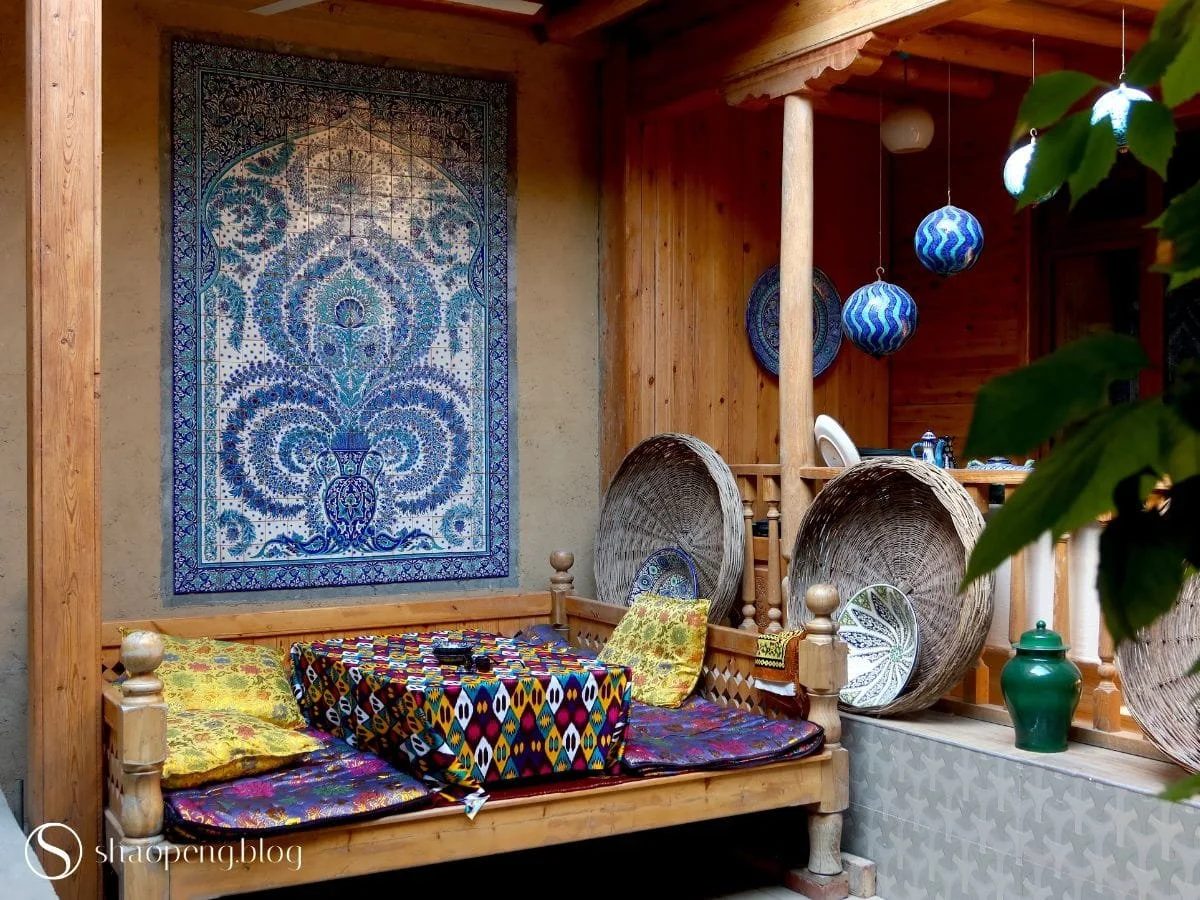
Inside Rustam Usmanov’s workshop in Rishtan.
You know you’ve found Rustam Usmanov’s workshop before anyone opens the door. The carved wooden panels are inlaid with turquoise-coloured ceramic tiles arranged to form multi-pointed stars. Beneath the house number, a ceramic panel made up of more than two hundred coloured tiles features a mihrab-like design adorned by arabesques in the region’s signature cobalt and turquoise blues.
Inside, the courtyard is bathed in morning sun, and almost everything seems to be made of clay. Bowls, plates, and jars fill the space, while glazed baubles hang in the air like decorations at a Christmas market that has wandered into Central Asia.
Usmanov was born in Rishtan in 1954 and trained as an artist at the Tashkent Theatre and Art Institute. He later became chief artist at the town’s ceramic factory. When the factory fell into decline, he set up a workshop at home to keep traditional techniques alive. Today, his son Damir works alongside him, specialising in the ishkor technique.
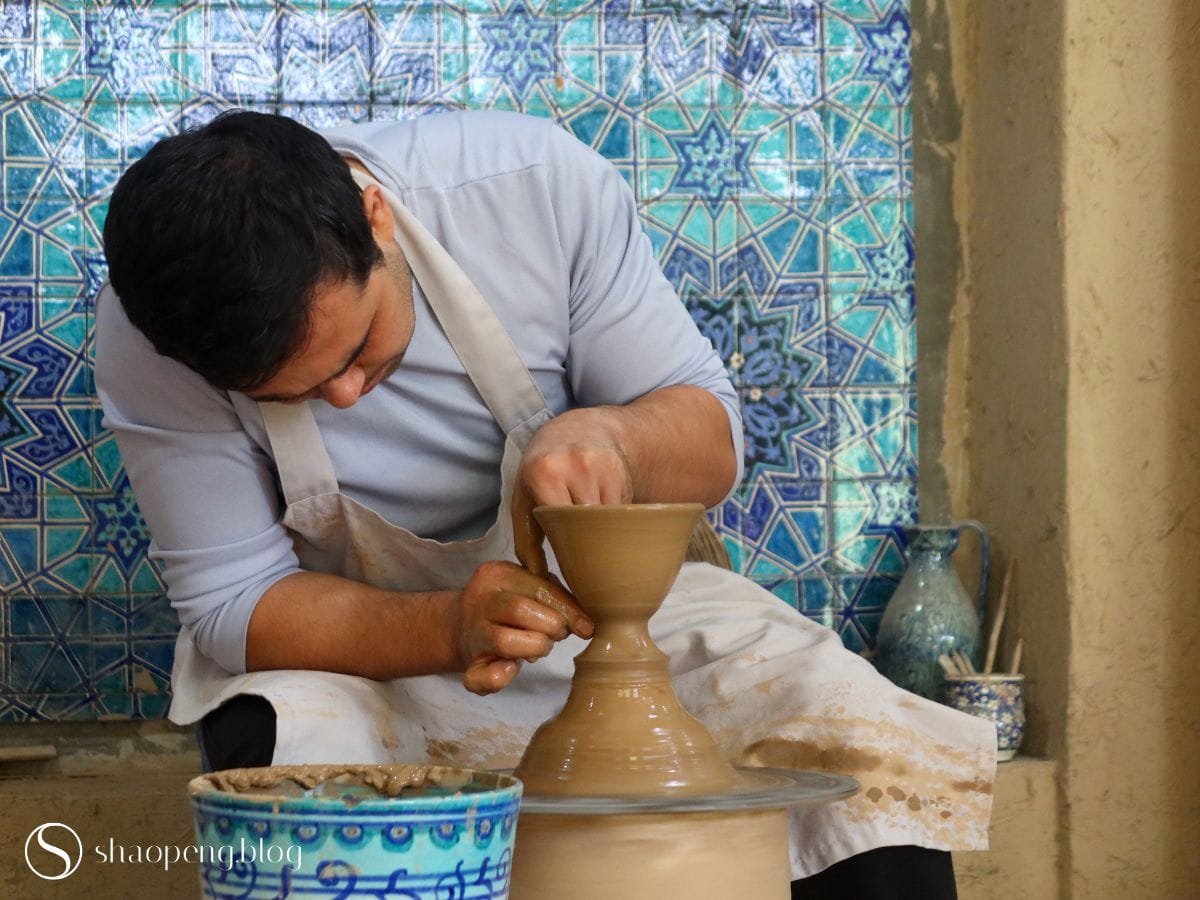
A potter at work on the wheel inside Rustam Usmanov’s workshop.
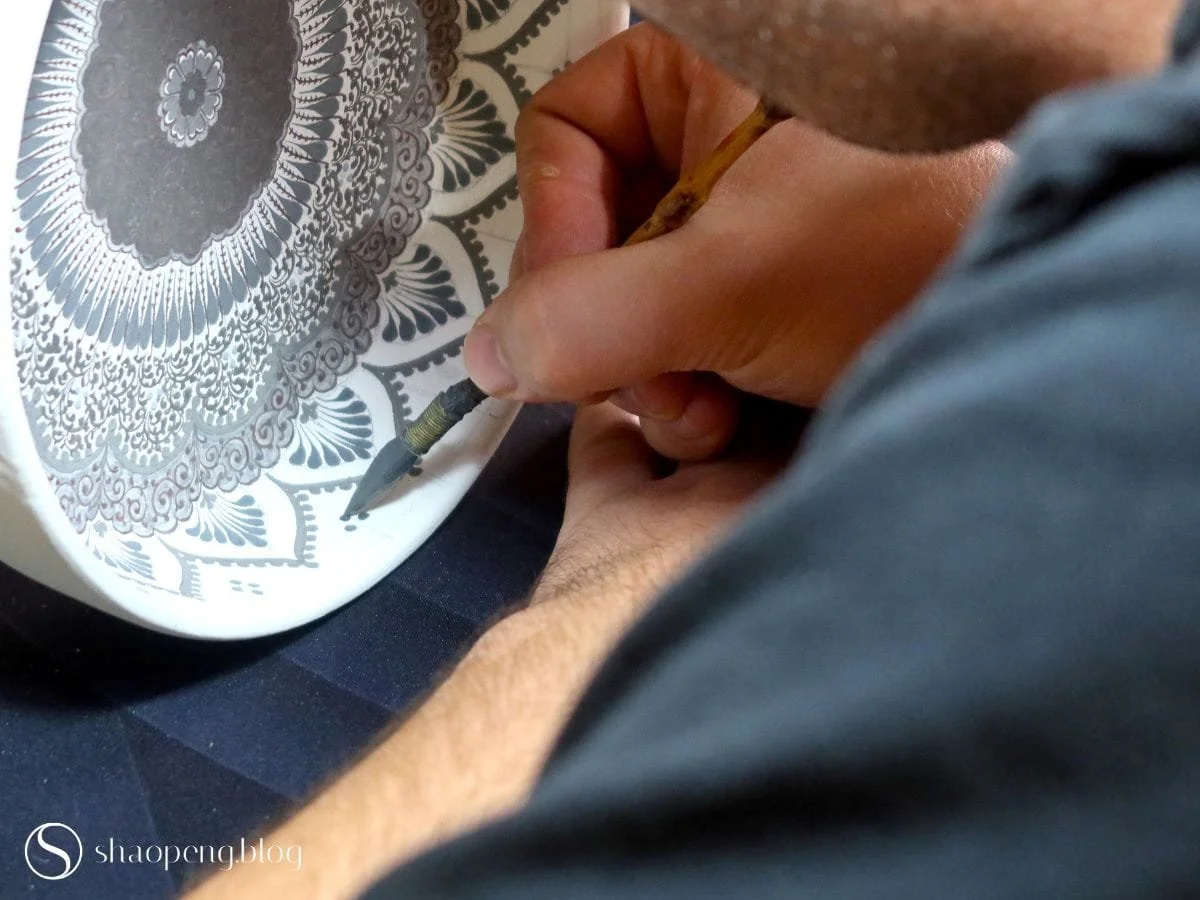
An artisan carefully painting patterns onto the surface of a vessel.
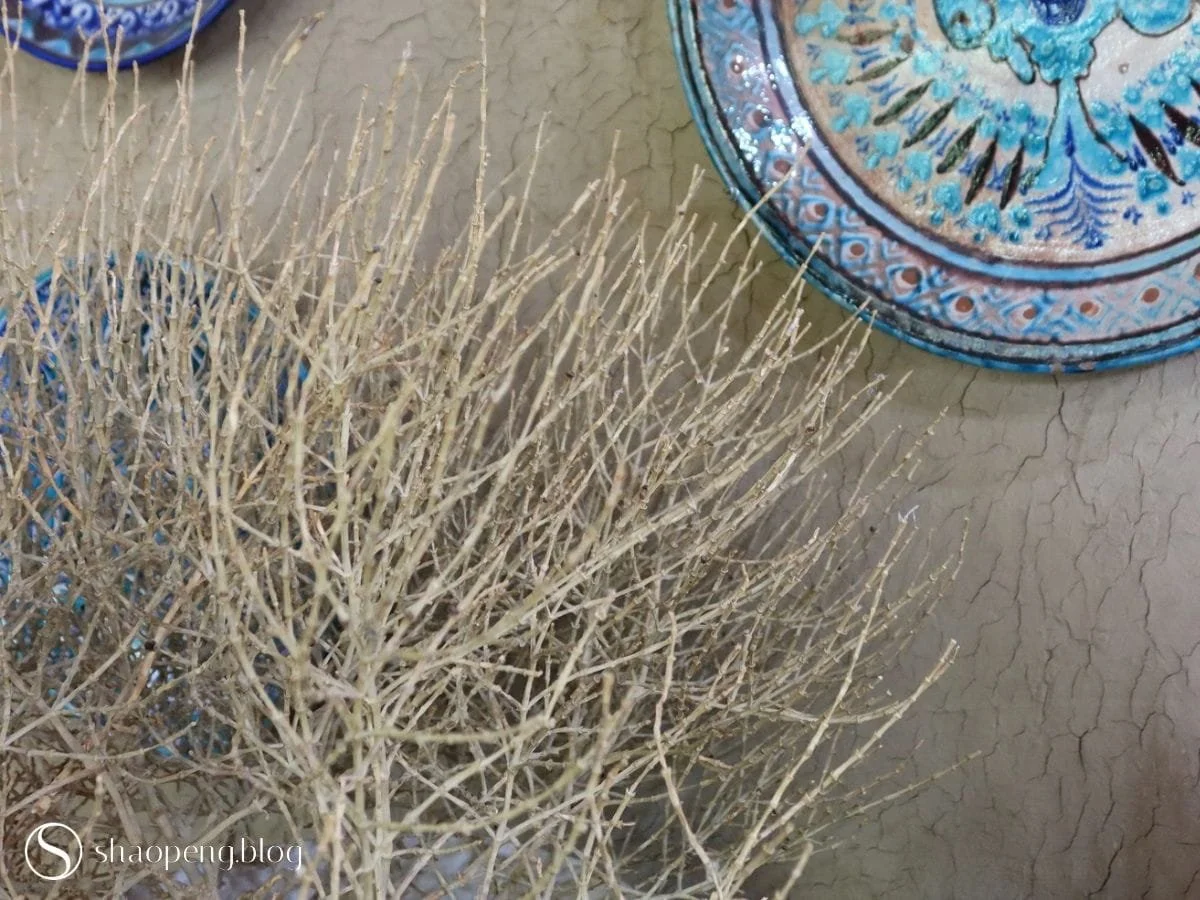
The ishkor shrub, whose ashes are used to make the traditional glaze.
The glaze is central to the entire process. The shrub from which it is made is known as ishkor, or qyrq bogan, meaning “forty branches.” It is harvested only in late September, then dried and burned to produce ash rich in natural alkaline salts. The ash is then grounded into a fine powder and mixed with crushed quartz. Mineral oxides are added to create different colours: copper for turquoise and green, and cobalt for deep blues. Together, they produce Rishtan’s signature palette.
Inside the workshop, you’ll come across artisans working at different stages of the process. One throws clay on the wheel, shaping a vessel from a lump in just minutes. Having taken ceramic classes back in high school, I know how difficult this is. I find myself wondering how many vessels he has made, and how many have failed, to reach this level of skill. Nearby, other artisans focus on painting, their heads bent so low they almost touch the tabletop as they work with super-fine brushes, laying down line after line.
The only part I miss is the firing.
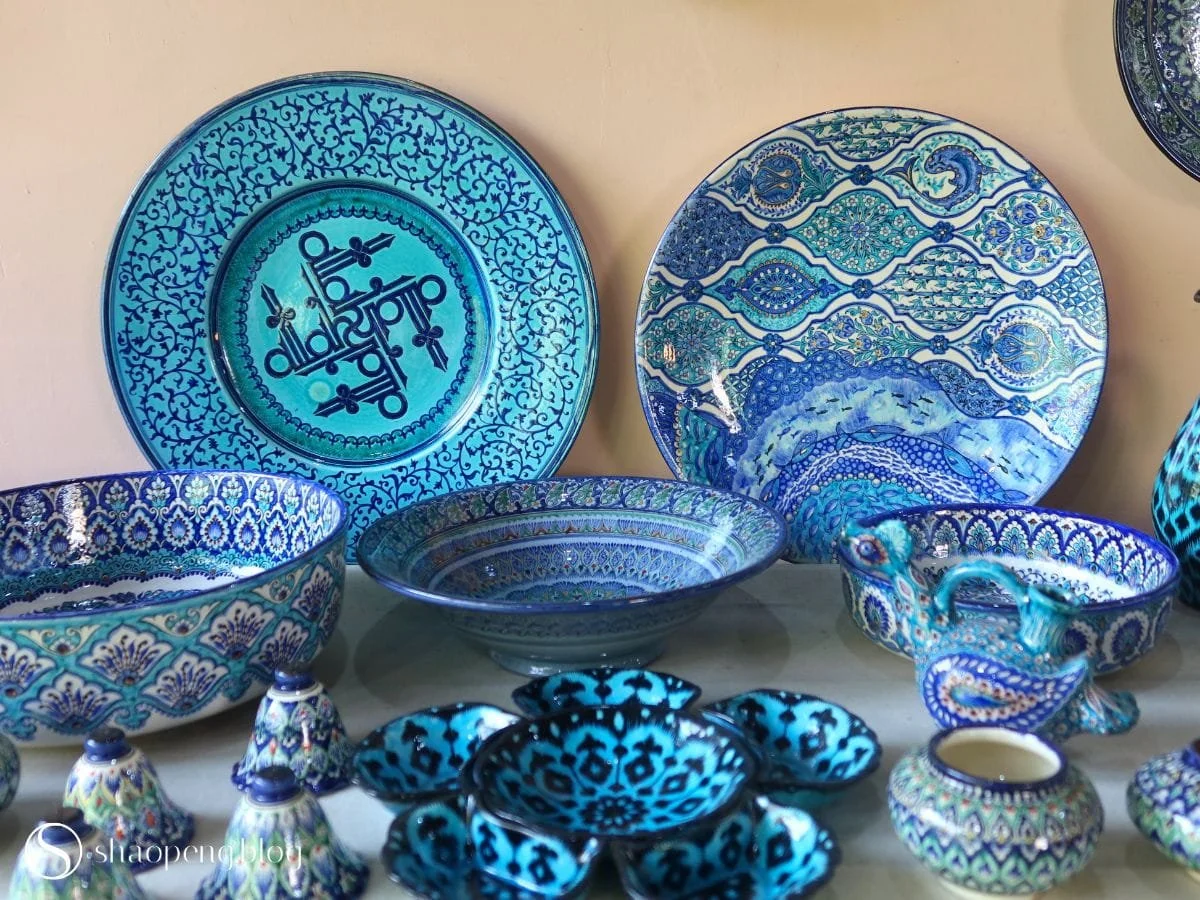
Classic ishkor-glazed wares for sale at Rustam Usmanov’s workshop.
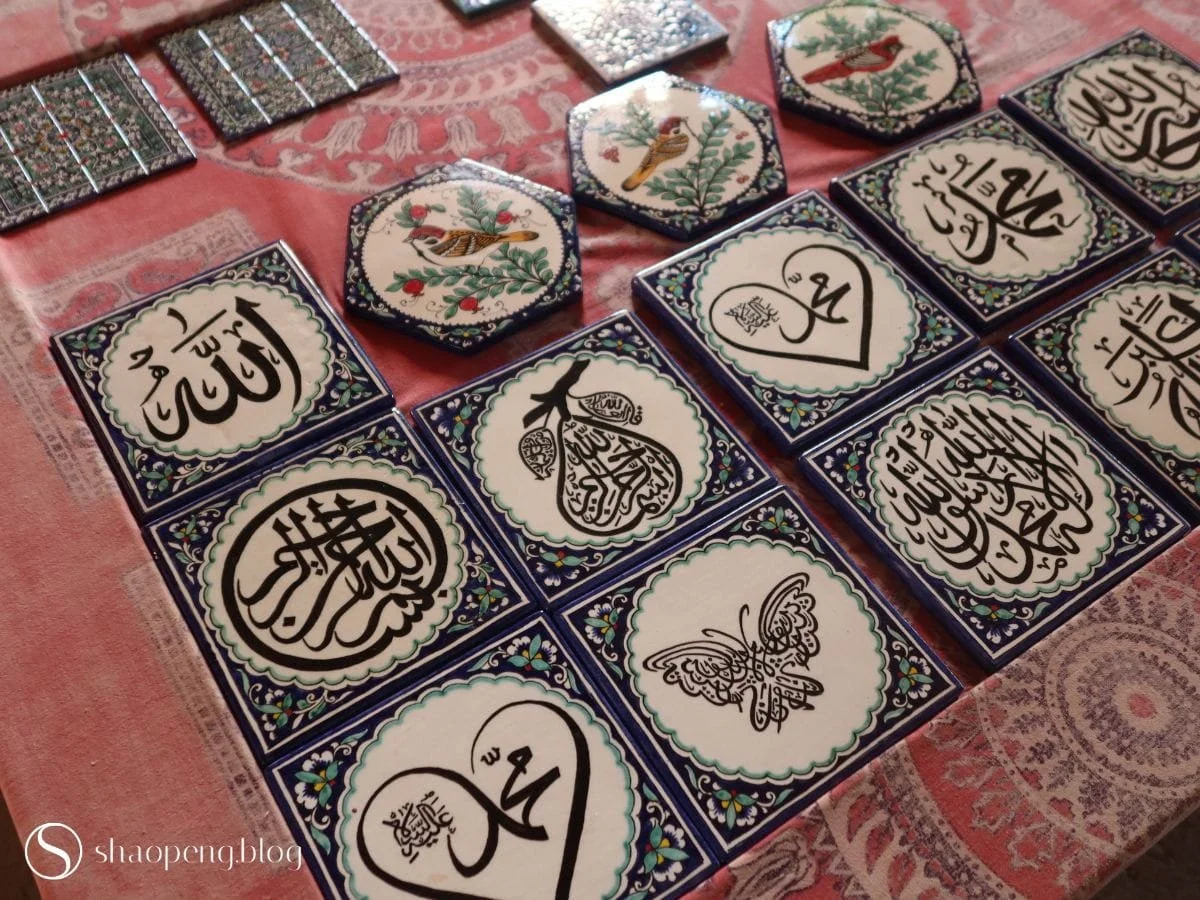
A selection of ceramic tiles featuring Islamic calligraphy.
Alisher Nazirov: The Potter Who Went East
Alisher Nazirov’s workshop feels like stepping into another world. Born in 1958, Nazirov is also a first-generation potter. He began learning the craft at twelve under local masters. While Usmanov’s workshop draws on the classical repertoire, Nazirov’s ceramics feel more artistic and poetic.
First, you enter through a dim corridor lined on both sides with ceramics, a kind of Uzbek wunderkammer, or cabinet of curiosities. Each piece seems shrouded in mist, as if the glaze were murmuring a secret.
Part of Nazirov’s style comes from the ground beneath his feet. He studied patterns found on archaeological pieces and drew on them to revive Rishtan’s ancient forms. The rest comes from further afield. In 1994, he received training in Japan, producing more than eighty pieces in the workshop of Isokichi Asakura, a master of the Kutani school. His work is now held in several museums, including the Asakura-san Ceramics Museum in Komatsu.
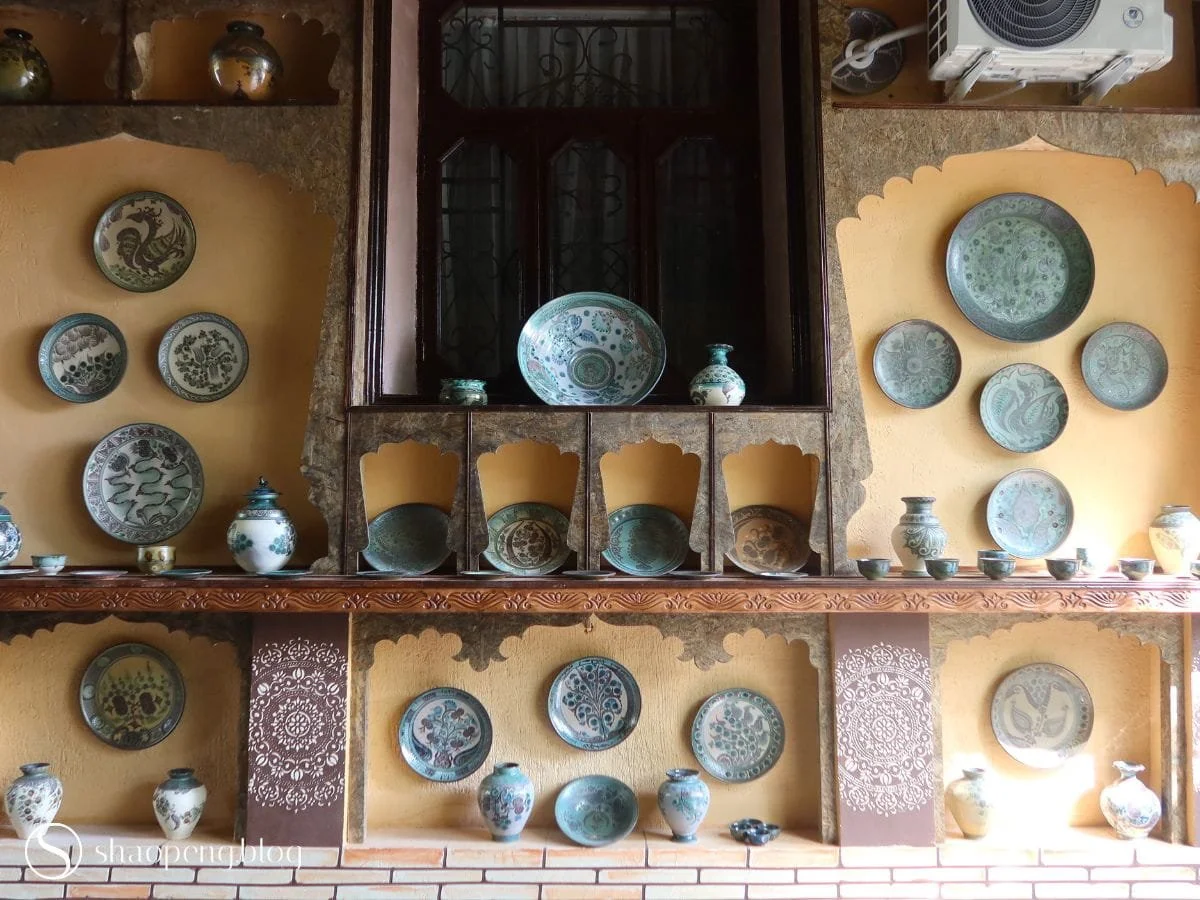
Ceramics displayed along the walls of Alisher Nazirov’s workshop in Rishtan.
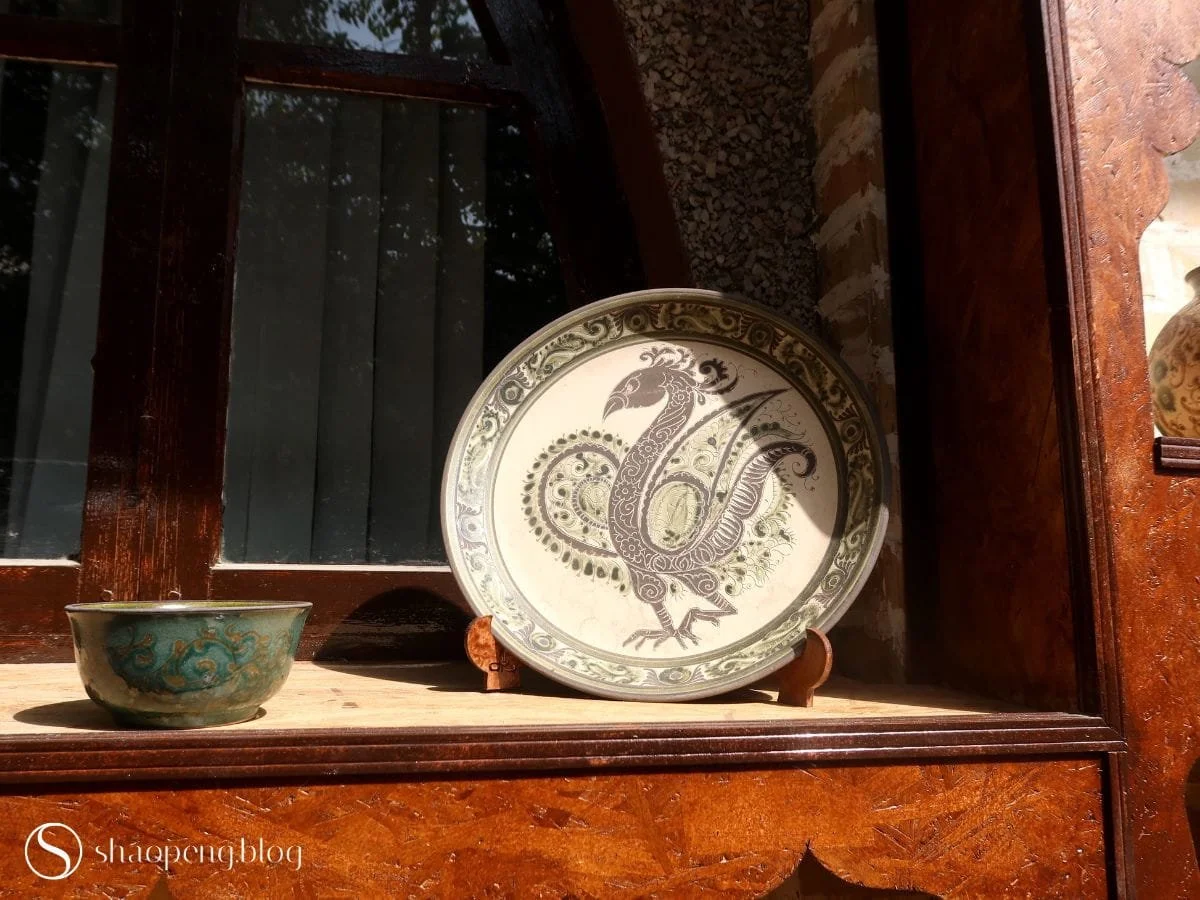
Inside Alisher Nazirov’s workshop, a plate depicting a phoenix basking in the morning sun.
At the heart of the workshop lies an open courtyard, where a potter works at the wheel. Nearby, a tapchan — a raised wooden platform where Uzbeks gather to eat, drink tea, and rest — sits amid lush greenery. Clusters of jade-coloured grapes hang overhead, adding to the distinctly Uzbek atmosphere. There’s a wooden staircase that leads to an upper floor, where more traditional ishkor-glazed wares are on display.
On your way out, you may notice a memorial near the gate. It honours Osaki Shigekatsu (1938–2005), a Japanese engineer who came to Uzbekistan to help establish a car factory. A lover of ceramics, he became friends with Nazirov. After his death, Nazirov built the shrine in his memory.
Behind a pot decorated with swirling blue-green designs rises an austere black monument. Inscribed on it in white is the Japanese character kokoro, meaning “heart” or “spirit.” A single strand of Shigekatsu’s hair is buried here, recalling Muslim traditions of saint veneration.
Japan is often described as the eastern end of the Silk Road. Standing before that shrine, I realise that the road never really ended. Its connections continue to take new forms, and one of them brought Japan to Rishtan.
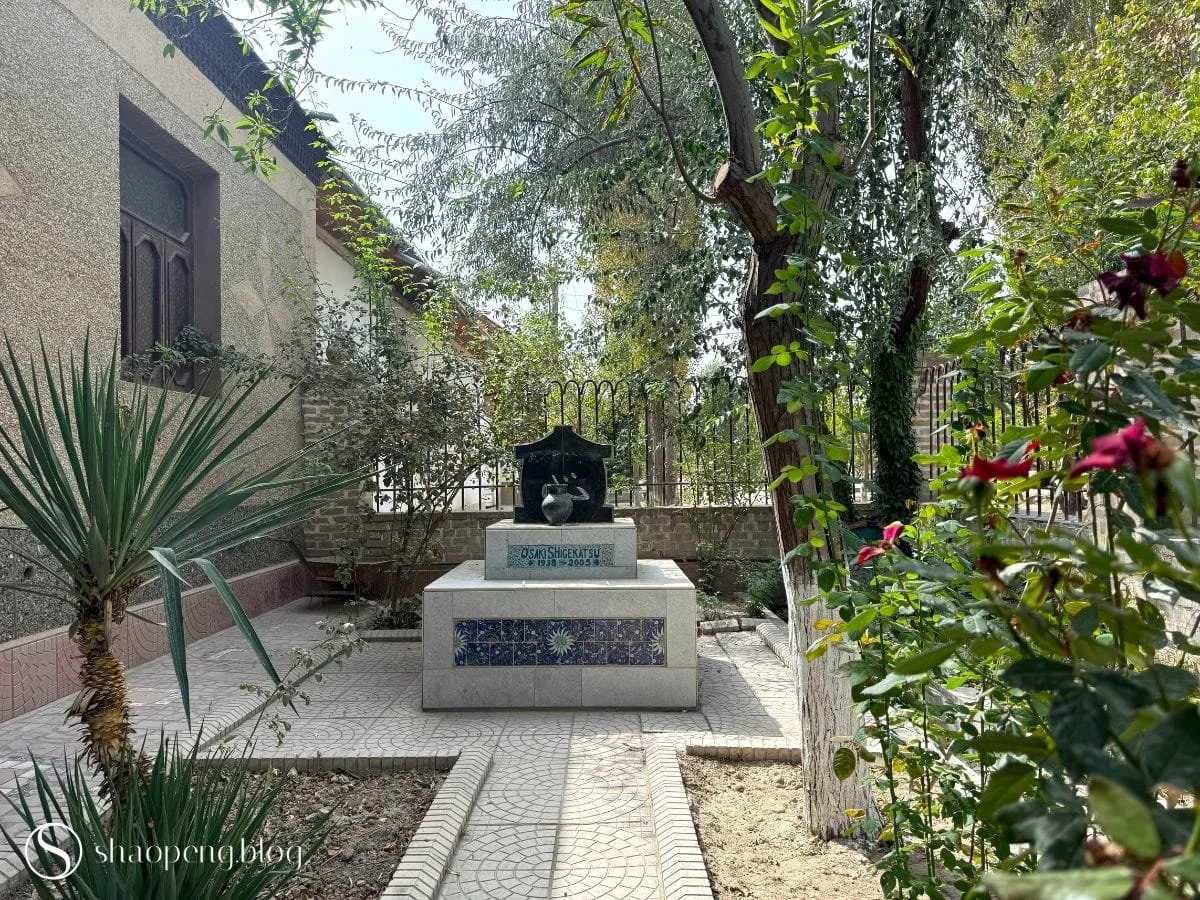
A memorial shrine dedicated to Osaki Shigekatsu (1938–2005).
Reference:
Murray, K. (2019, September 10). Alisher Nazirov: Gifts of skill connect Uzbekistan and Japan. Garland Magazine. https://garlandmag.com/article/alisher-nazirov/