
In Margilan, silk begins as cocoons and is transformed into “royal silk” through generations of craftsmanship. Come meet the artisans behind the shimmering fabrics you see in bazaars across Uzbekistan.
Sense of Wander: ★★★★☆
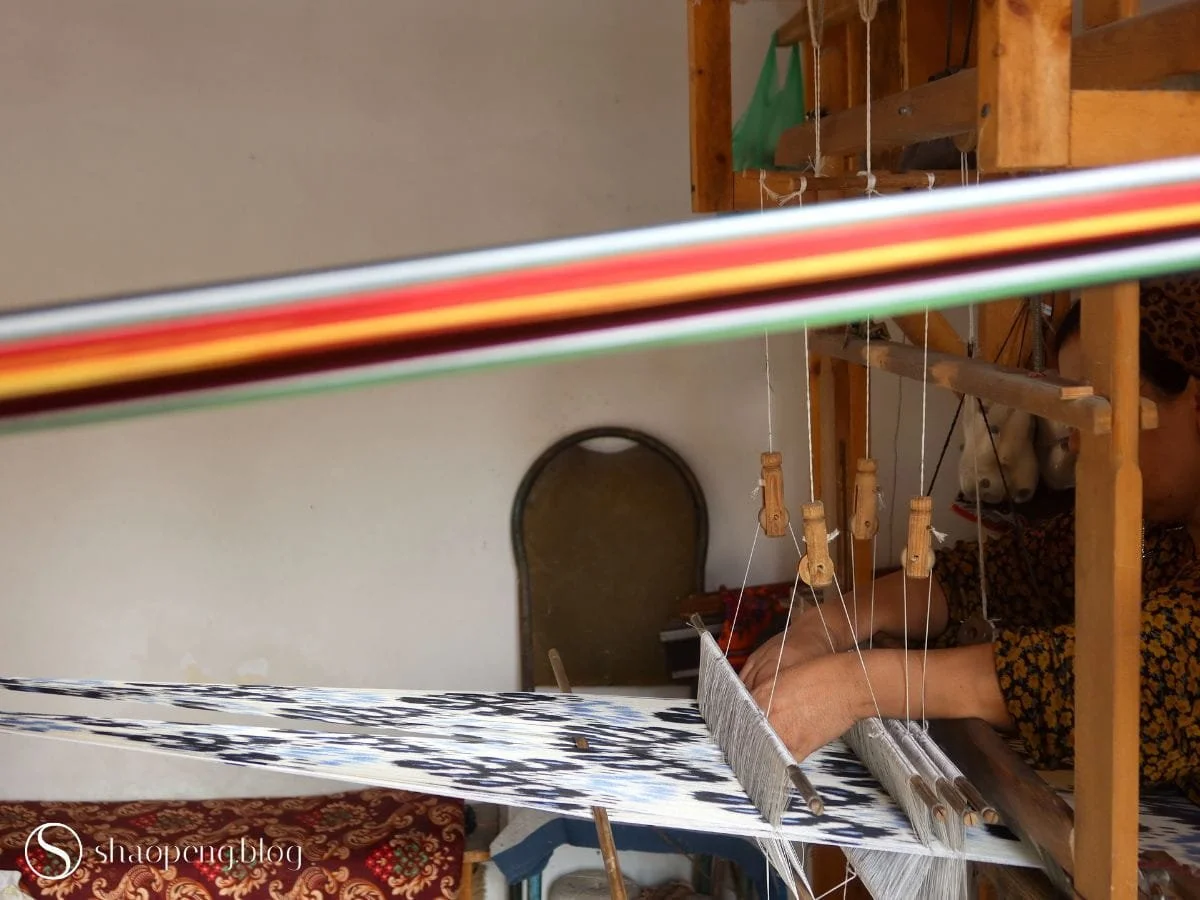
An artisan working at the loom at Margilan Crafts Development Centre.
MARGILAN, Uzbekistan — You’ll come across Margilan’s silk without ever setting foot in the town itself. It appears in the bazaars of Bukhara and Samarkand, where bolts of shimmering fabric in kaleidoscopic colours spill across the stalls. Follow these silk threads, and you might be surprised to find that many lead back to a small town in the southern Fergana Valley, about 75 kilometres by road from Kokand.
In Margilan, silk is a way of life. Much of the weaving still takes place in small family workshops, where you can watch the process from start to finish: cocoons boiled in water, delicate filaments drawn into thread, fibres dyed with natural ingredients, and patterns woven on traditional looms.
Before you know it, you’re following a trail that began long before the Silk Road acquired its name. The term itself is relatively recent: German geographer Ferdinand von Richthofen coined Seidenstraße in 1877. By then, Margilan had long been a crossroads for caravans travelling between East and West, whose trade helped shape the town’s crafts and commerce.
Those caravans carried a secret, too. Silk originated in China, where the techniques of its production were closely guarded. According to legend, the secret escaped when a Chinese princess concealed silkworm eggs out in her headdress on her way to Khotan, an ancient kingdom in what is now southwestern Xinjiang, along the southern branch of the Silk Road.
Exactly when silk reached the Fergana Valley remains uncertain, but Margilan has been renowned for its silk since at least the 10th century. Its weavers developed a signature fabric, khan-atlas, or “royal silk”, and mastered the art of ikat, in which threads are tied and dyed before weaving. The resulting patterns are known for their softly blurred edges.
The scale of the trade was once staggering. In 1910, according to historical accounts, 911 of the Fergana region’s 1,387 silk-weaving workshops were in Margilan. Today, traditional craftsmanship continues alongside modern production, though only a few hundred artisans are said to retain the skills of master weavers.
Visit some of the town’s key silk workshops and craft centres, and you’ll find out why Margilan is often called Uzbekistan’s silk capital:
Yodgorlik Silk Factory
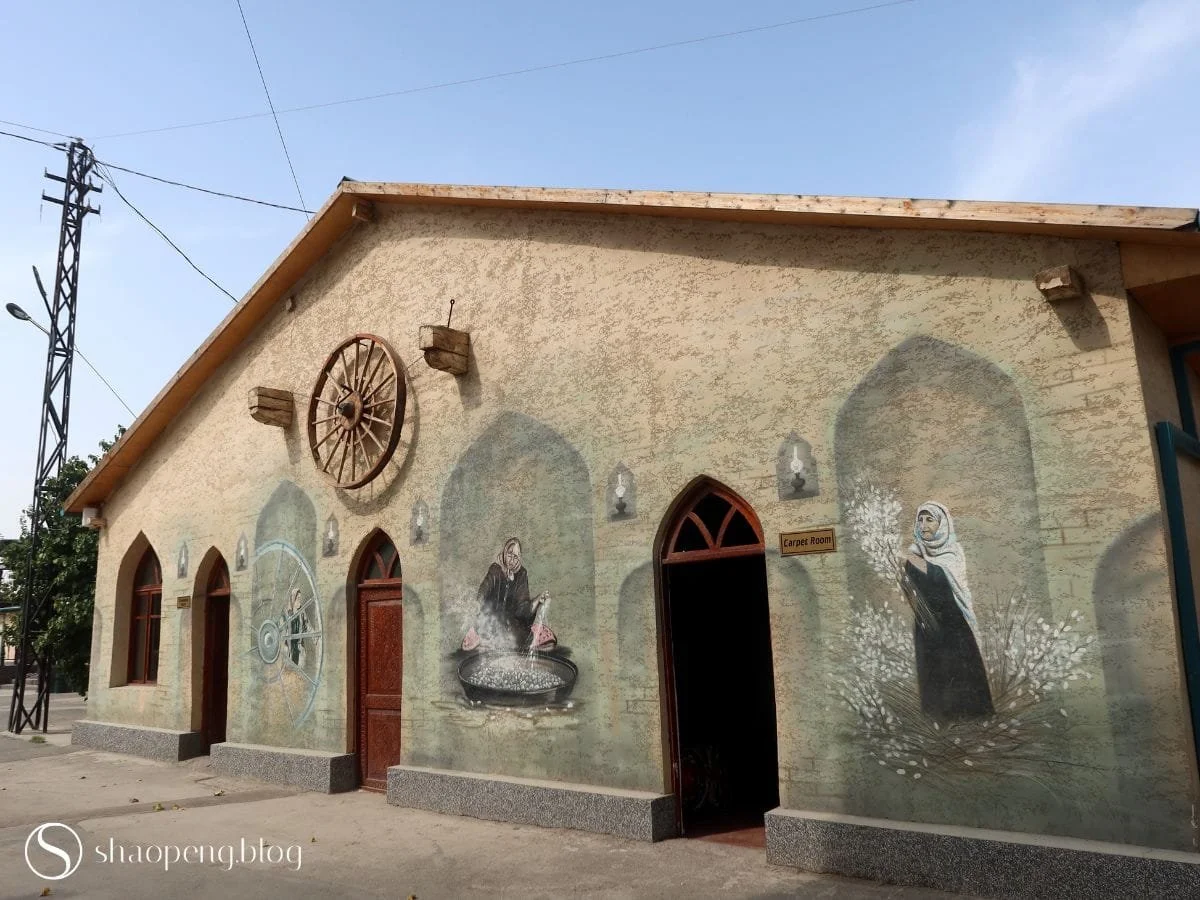
Inside Yodgorlik Silk Factory in Margilan, Uzbekistan.
Yodgorlik is usually the first stop for visitors to Margilan, and its owner calls it a “factory museum”. It’s the largest traditional silk factory in Uzbekistan, with around 200 employees as of 2020, and nearly every stage of the journey from cocoon to garment takes place under its roofs.
As soon as you enter, you’ll be greeted by an enormous mulberry tree that has stood here for well over a century. Every silk thread here begins with leaves like these, which silkworms eat before spinning their cocoons.
Each room is devoted to a different stage of the process, and visitors can wander freely. In one room, an artisan draws thread from boiled cocoons, so fine it seems as though it could snap at any moment. In another, the thread is spun into skeins.
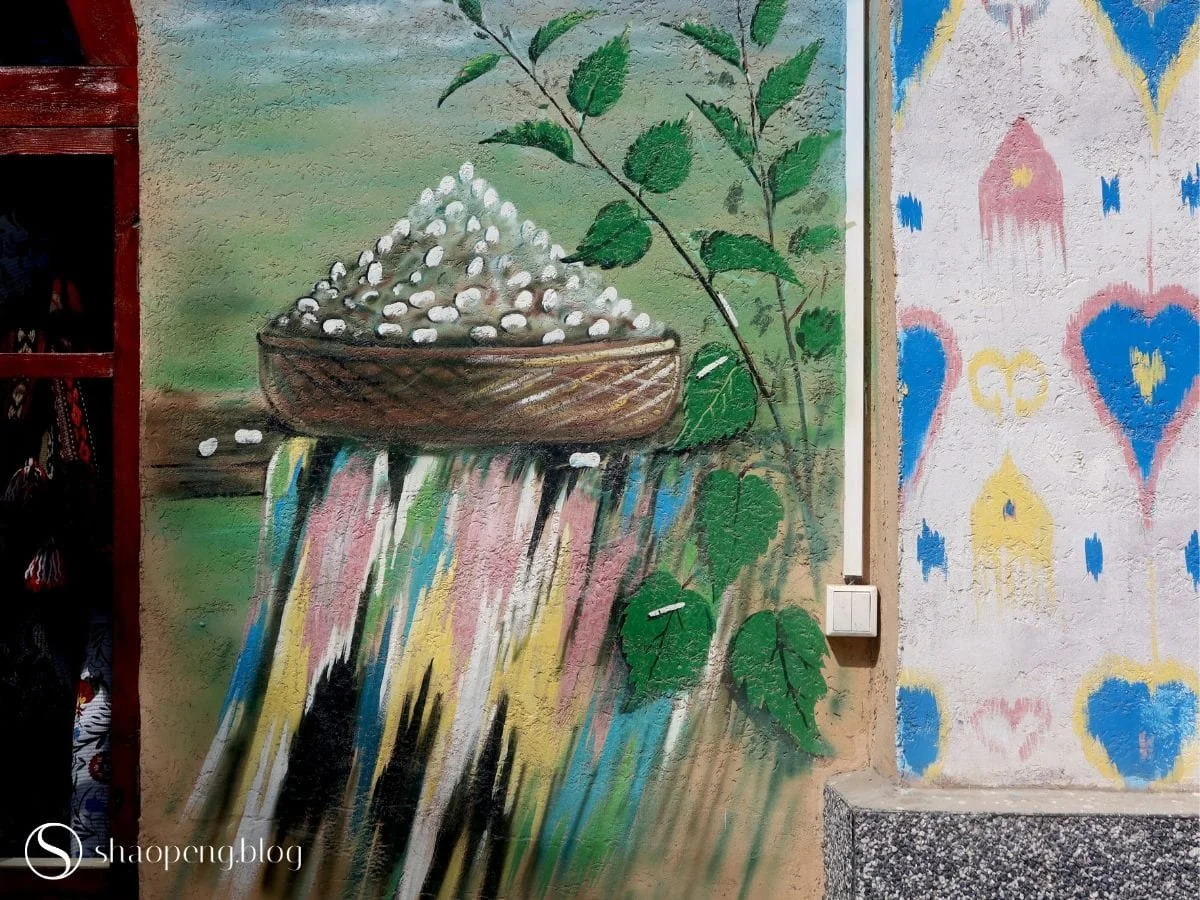
A mural depicting a basket piled high with cocoons.
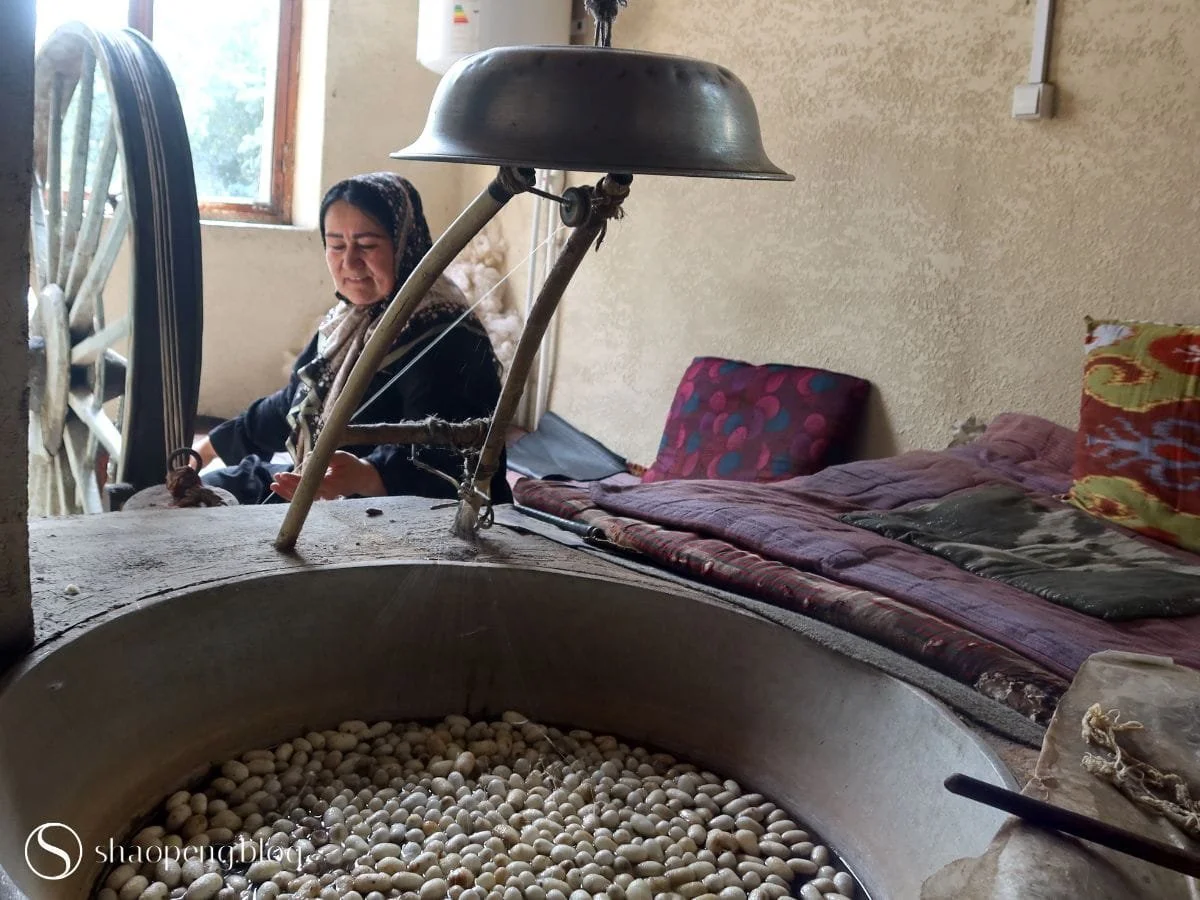
A local artisan drawing and spinning silk thread from boiled cocoons.
Raw silk is ivory or off-white, so colour comes from the dye room, where the air is thick with a faintly pungent smell. Cauldrons bubble with pomegranate, onion skins, walnut shells and the roots of local plants, all used to produce natural dyes.
My favourite is the Abr Band Room. Inside, an abrbandchi sketches the pattern onto warp threads stretched across a frame, then tightly binds sections to resist the dye. Abr means “cloud”, and the soft-edged designs do look like clouds. The technique’s more internationally recognised name, ikat, comes from a Malay-Indonesian verb meaning “to tie”. I’ve seen ikat all over Uzbekistan, but this is my first time watching how its colours are created.

The reflection of abr band on the surface of the dye bath recalls the legend of its origins.
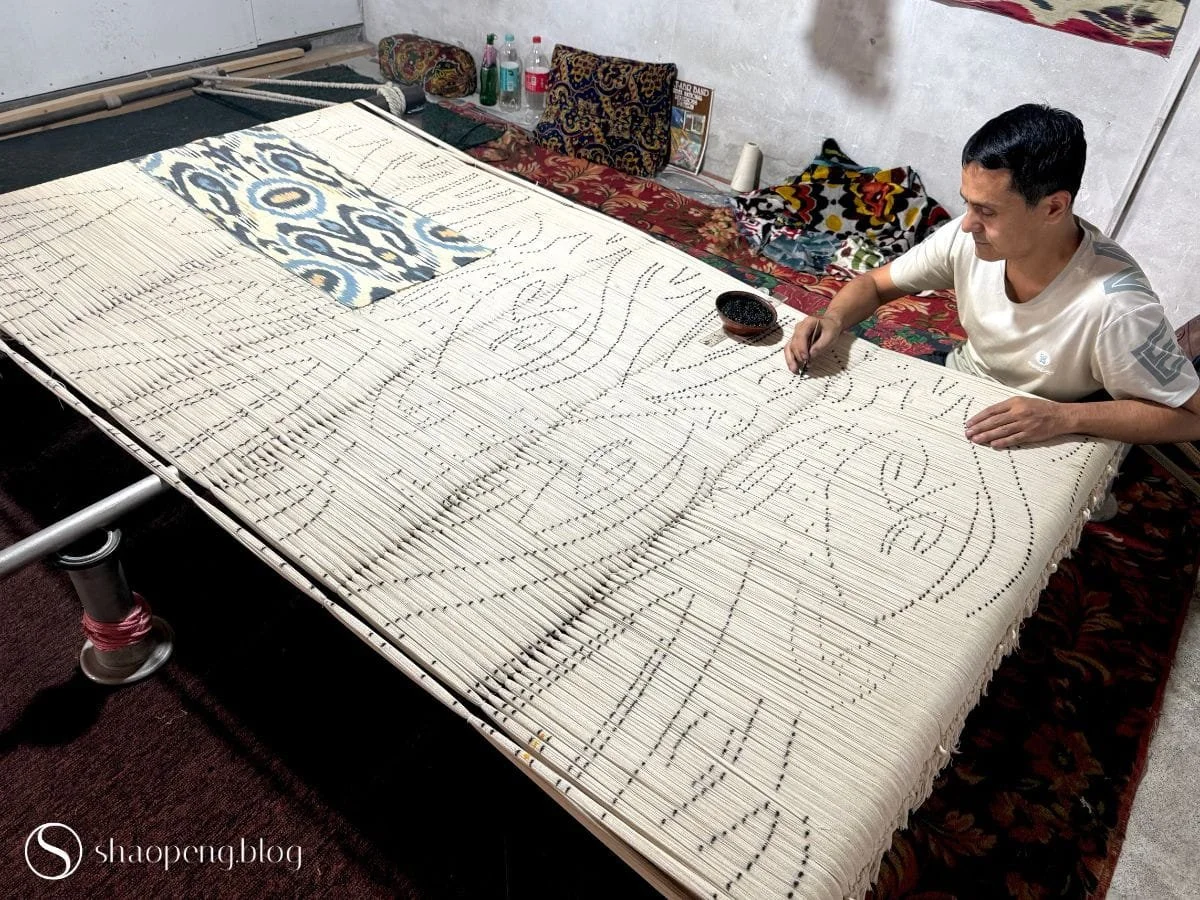
An abrbandchi outlines the pattern on silk warps using charcoal.
In its Weaving Room, the rhythmic clack of wooden looms fills the air. The weavers, many of them women, are absorbed in their work, repeating the same gestures with practised ease. Silk warps stretch across the frames as shuttles carry the weft through.
You’ll hear two words constantly when shopping for ikat in Uzbekistan: atlas and adras. Atlas is made from pure silk, while adras combines a silk warp with a cotton weft, often in roughly equal proportions. The cotton gives it a more muted appearance and a slightly ribbed texture, though the proportions of silk and cotton can vary.
Wanderer’s tip — Come early, when the looms are busiest, and leave time to browse the shop, where you can buy directly from the makers.
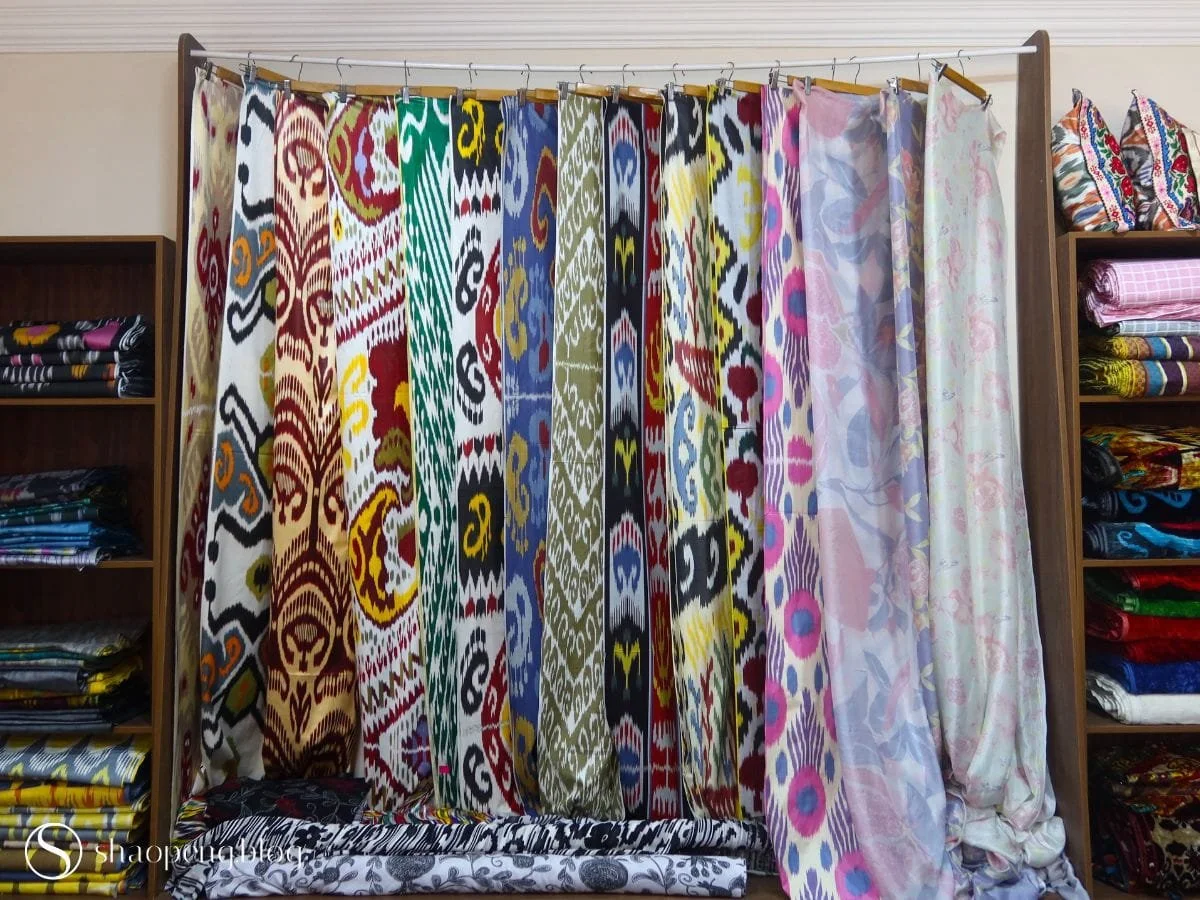
A showcase of ikat fabrics in the shop at Yodgorlik Silk Factory.
Silk Factory
A short walk from Yodgorlik, you’ll come across a smaller workshop that is nonetheless complete in every detail.
Simply called “Silk Factory” (map), it has its own cocoon-boiling and spinning area near the entrance, along with rooms dedicated to abr band and traditional weaving.
The highlight is a live tie-dye demonstration. A scarf is tied seemingly at random and dipped into different dye baths. Before you know it, a patterned silk scarf emerges before your eyes. During my visit, I get to watch five or six rounds, thanks to a French tour group that happens to be there. Seeing the silk emerge from the dye baths transformed each time is a little magical in its own way.
Wanderer’s tip — The factory’s dedicated shop is about a minute’s walk away. Ask the staff to walk you there.
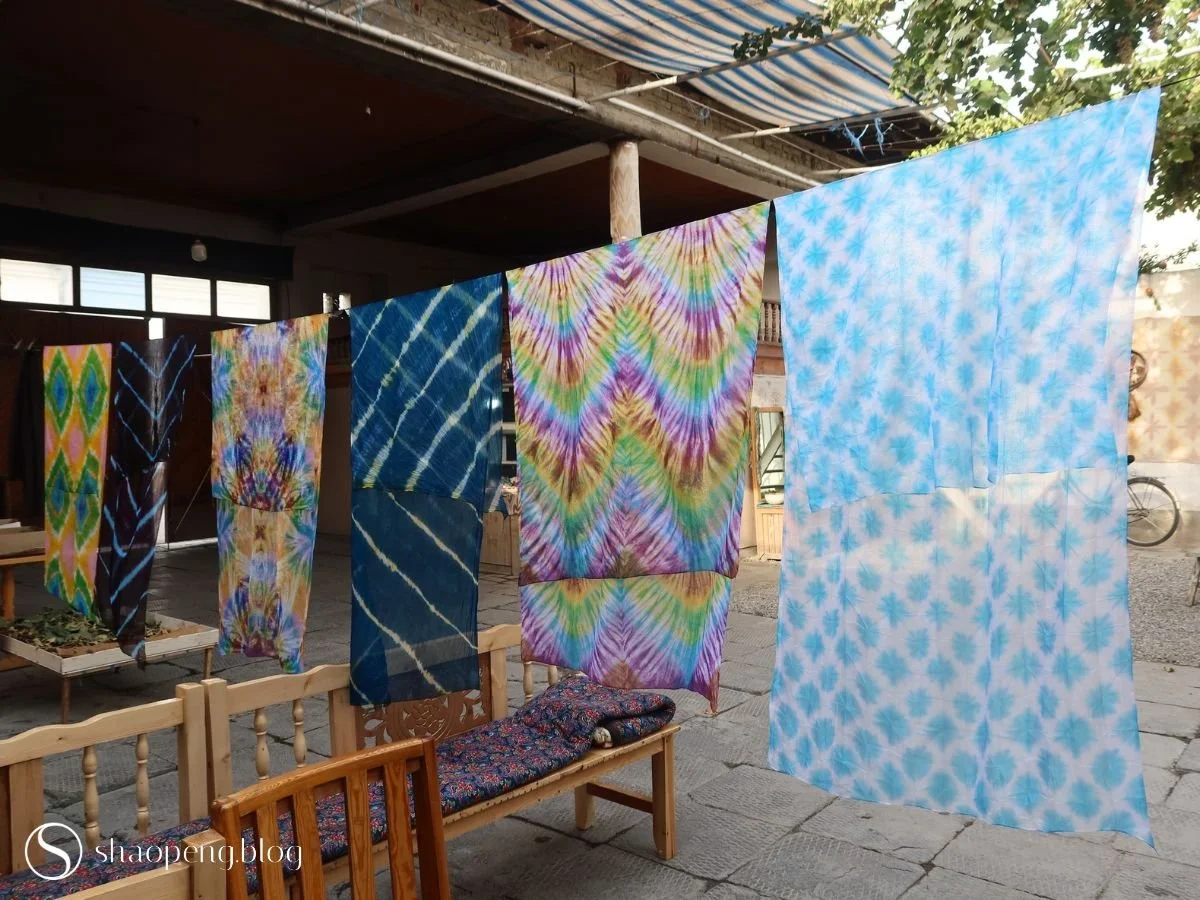
Tie-dyed silk scarves at Silk Factory.
Margilan Crafts Development Centre
If the silk factories show you how an ikat is made, the Crafts Development Centre reveals what else Margilan’s artisans can do.
It’s housed in the restored 19th-century Said Ahmad-Khoja Madrasah, which closed soon after the Soviet era began and reopened after 1991 as a hub for traditional crafts. Its courtyard houses a weaving studio alongside workshops for pottery, block printing and metalwork.
Weaving remains at the heart of the centre. Founded by local artisans in 2007, it aims to safeguard traditional atlas and adras making through training, exhibitions and festivals. In 2017, UNESCO added it to its Register of Good Safeguarding Practices.
My favourite corner, though, is devoted to chitgarlik, or block printing. Inside, you’ll find wooden blocks in all shapes and sizes, carved with floral and geometric designs. Artisans use these blocks to stamp patterns onto cloth by hand, using natural dyes. The process reminds me of the block-printed textiles I saw in Jaipur, India, where the craft also has a long-standing tradition.
The craft has dwindled to just a handful of practitioners across the country, and Margilan is one of the few places where you can still see it practiced today.
Wanderer’s tip — During my visit, the centre was quiet, and several workshops stood empty. Check opening times locally before you go.
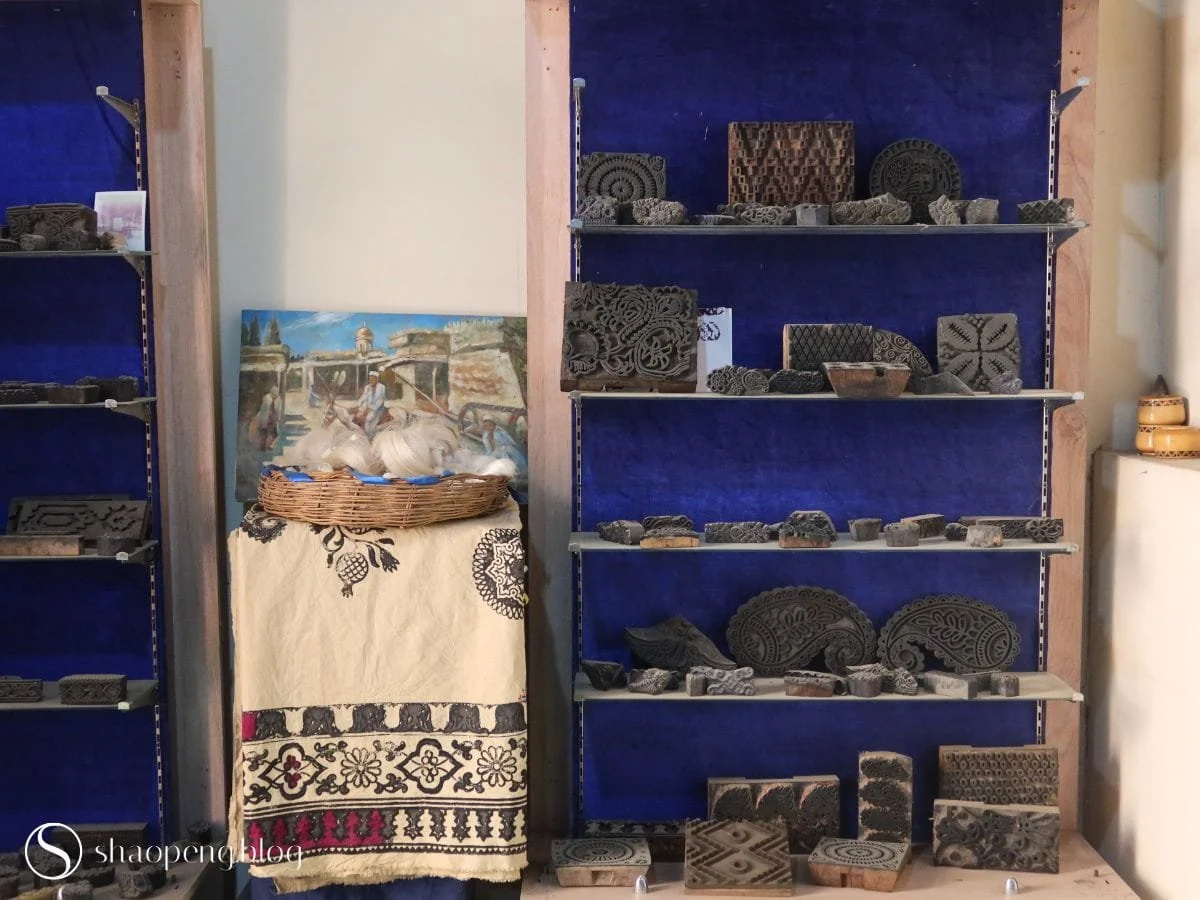
Carved wooden blocks used in the traditional art of block printing, locally known as chitgarlik.
Reference:
Eurasianet. (2020, January 24). Uzbekistan’s industry in silk threatens artisanal heritage. Eurasianet. https://eurasianet.org/uzbekistans-industry-in-silk-threatens-artisanal-heritage