
Follow the clatter of looms, the tapping of chisels against copper, and the pounding of mulberry bark into paper, and you’ll find the artisans keeping Uzbekistan’s traditional crafts alive.
Sense of Wander: ★★★★★

Vintage carpets reimagined as unique home decor by Bukhara artisans.
TASHKENT, Uzbekistan — As I travel through Uzbekistan, I’m surprised to find how traditional crafts remain a living part of everyday life, rather than relics of the past. Perhaps this is why a handful of its cities have been recognised as World Craft Cities.
Where and how you encounter artisans and their crafts varies from city to city. In some places, craftsmen and women gather under one roof, in a caravanserai or madrasa whose cells have been converted into workshops and shops, or in a crafts centre where silk weaving, ceramics and woodcarving sit side by side. Step inside and you’ll hear the tap of a chisel on copper, the soft clatter of a loom, and the held breath of a miniature painter laying a delicate line on paper.
Then there’s Bukhara, where craft is something you keep running into. Its trading domes have been hubs of commerce since the 16th century. Here, the best plan is often no plan: wander the lanes between the domes and let the crafts find you. My own search for the Artisan Development Centre turned into a small adventure, as it wasn’t even listed on Google Maps when I first visited in 2024.
Timing can change what you find, too. Held every two years in September, Kokand’s International Festival of Handicrafts fills the city with exhibitions, master classes and cultural programmes. You’ll find crafts from lesser-known regions such as Karakalpakstan, Jizzax and Surxondaryo, each with a design language of its own. Seeing their work added a few more destinations to my list.
As someone who sees traditional crafts as a doorway to understanding a culture, I’ve put together this guide as an invitation to discover each city at your own pace. I hope to let it grow organically over the years, with more cities to come!
Tashkent: The Capital's Craft Side
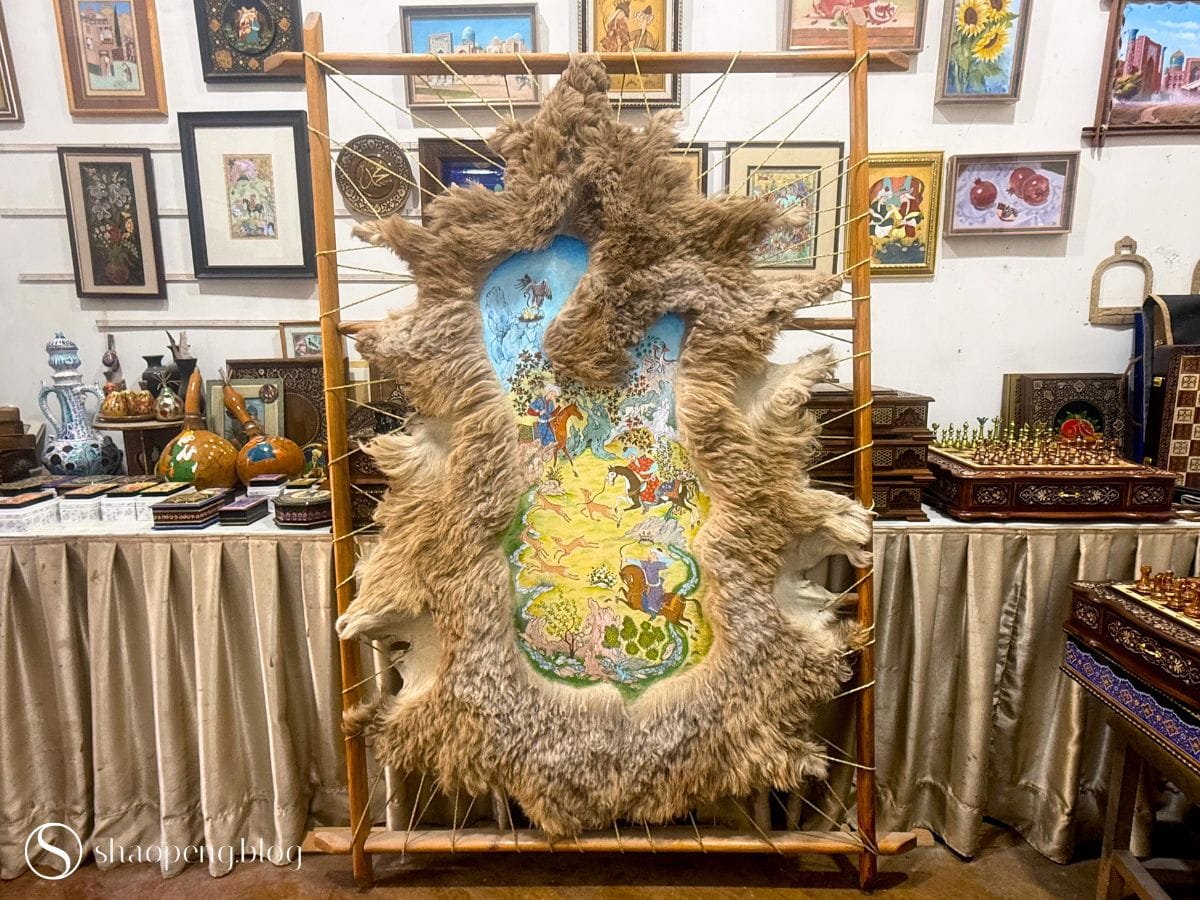
A Persian-inspired painting on treated sheepskin, displayed in a studio-shop at Tashkent’s Centre of Applied Arts.
Most visitors treat Tashkent as a gateway, a city to pass through on the way to Samarkand or Bukhara. Give it a day or two, though, and you’ll find that the capital has a craft scene of its own.
Start with the State Museum of Applied Arts of Uzbekistan, which offers the most comprehensive overview of the country’s traditional crafts under one roof. It houses more than 7,000 items of folk applied art, from embroidery and skullcaps to jewellery, carpets, ceramics, chased metalwork and knives, with pieces dating from the first half of the 19th century to the present day. The variety is dazzling, with nearly the whole country on display: knives from Chust, ceramics from Rishtan, ikat from Margilan, and gold embroidery from Bukhara. Think of it as a preview of the cities to come, or a recap if you’re passing through on your way home.
The museum building deserves a closer look. Traditional crafts are everywhere, from the exterior to the interior, with woodcarving, ganch (carved plaster), and ceramic tiles crafted by masters from different regions.
The building was once the mansion of Alexander Polovtsev, a Russian diplomat, orientalist and collector who arrived in Tashkent in 1896. In 1927, it hosted an exhibition of outstanding works by Uzbek craftsmen. The exhibition was reorganised into the Handicrafts Museum in 1937, and in 1997, the institution was renamed the State Museum of Applied Arts.
To meet artisans at work, head to Abul Kasim Madrasa, the city’s Centre of Applied Arts. Built in the mid-19th century and surrounded by lush greenery, its modest entrance makes it easy to miss. The cells around the courtyard have been converted into studio shops, each specialising in a different craft.
In one of them, I met Komoliddin Siddiqov, a local artisan who showed me a Persian-inspired painting by his father on treated sheepskin, with the fur serving as a natural frame. It’s the kind of piece you’d expect to find only in a museum, and a hopeful reminder that tradition keeps finding new surfaces in the hands of today’s artisans.
Wanderer’s tips — Visit the museum first, then the madrasa, so you’ll have a better sense of what you’re seeing when you meet the artisans.
Bukhara: City of Artisans

Stepping into the Bukhara Artisan Development Centre feels like entering a hidden treasure trove.
Bukhara has been a city of makers for as long as it has been a city of traders. At its height, more than two hundred crafts flourished here, and even in the 20th century, over a hundred were still practiced.
The city lies in the Zarafshan oasis, and the river’s Persian name is often translated as “spreader of gold”, a fitting association for a city famous for its gold embroidery and jewellery. In 2022, Bukhara was officially designated a World Craft City.
Merchants once traded beneath domed bazaars known as toqi, built at the busiest street crossings. At its peak, Bukhara had five grand bazaars; three survive today. Every mahalla (neighbourhood) was associated with a trade. Skills were closely guarded and passed from grandfather to grandson. Today, you can still follow the city’s old trading routes on foot, ducking into workshops along its cobblestone alleys.
Start with gold embroidery, a craft that has long defined Bukhara. Near the southern entrance to Toqi Zargaron, master embroiderer Baxshullo Jumayev, a sixth-generation artisan with nearly six decades of experience at the needle, works in a studio filled with museum-worthy pieces. He speaks English, so strike up a conversation. The craft has deep roots here. It is said that Bukhara was the only centre in Central Asia where gold embroidery survived into the 20th century, and before 1917, its workshops answered directly to the Emir.
Metal is where Bukhara gets playful. Around Toqi Sarrafon, blacksmiths hammer out the city’s signature stork-shaped scissors. The fifth-generation smith I met proudly showed me the male and female versions side by side. The stork is a symbol of resilience and renewal in Bukhara, returning to the same rooftop nests year after year, making these scissors a fitting souvenir to bring home.
At the Bukhara Artisan Development Centre, the Silk & Heritage workshop invites you to watch weavers bring ikat to life on the loom. Next door, embroiderer Bashkir stitches pomegranate suzani in naturally dyed silk, offering a minimalist take on the heavily embroidered versions found in the city’s markets.
Then there are the often-overlooked crafts. Just off Lyabi-Hauz Square, the Puppet Museum doubles as a working studio, where each puppet is built from ten to twelve layers of papier-mâché, sometimes recycled from Soviet-era books. The studio produces as many as 120 different character types.
Craft here is not simply preserved; it continues to evolve. That spirit made it a natural part of the inaugural Bukhara Biennale. The city also hosts the International Festival of Gold Embroidery and Jewellery Art, which returned in May 2026.
Wanderer’s tips — For more on Bukhara’s crafts, read my longer pieces in the Wander in Bukhara series.
Samarkand: Crafts Behind Its Famous Facades
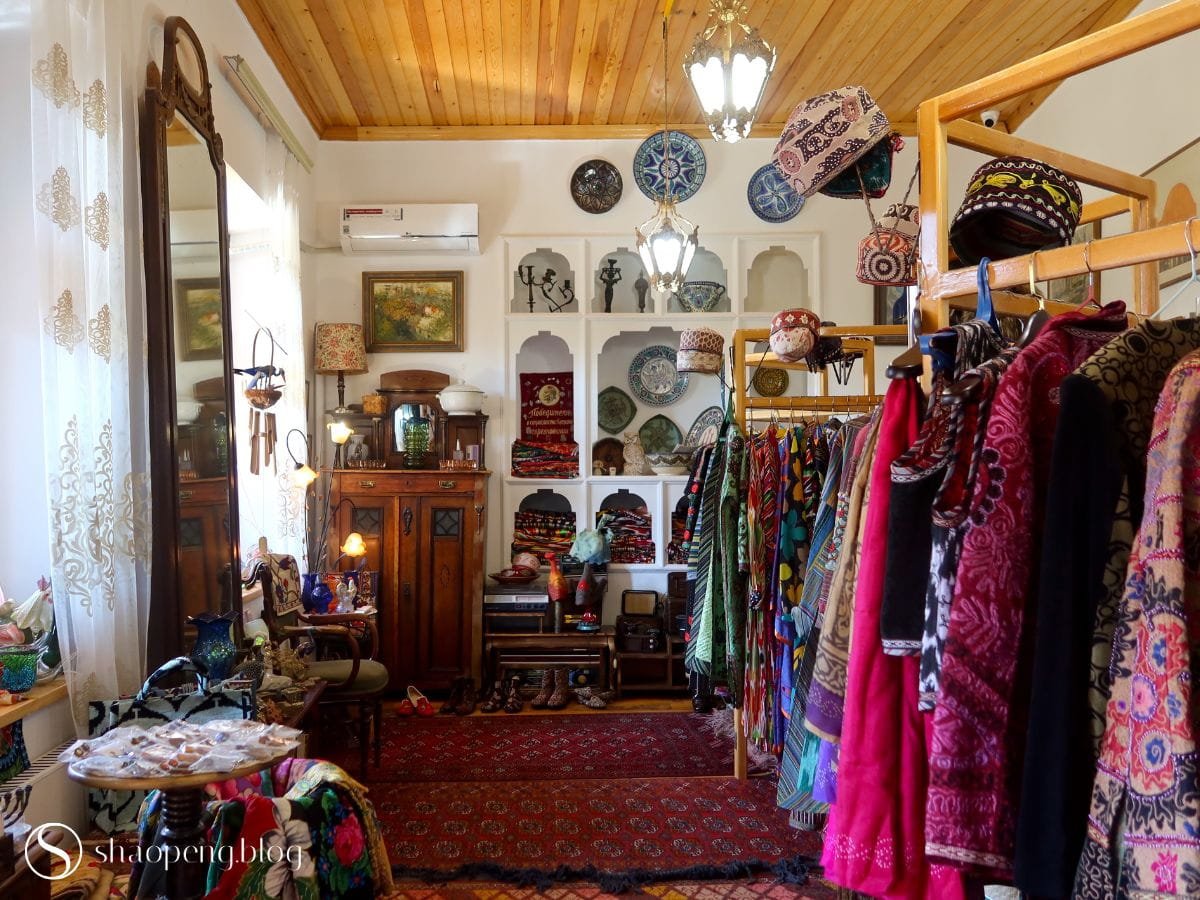
A shop inside Samarkand’s Handicraft Centre selling locally made garments and crafts.
Samarkand’s monuments often make the headlines for their facades, but some of the city’s best discoveries lie behind the tilework.
Of the three madrasas on Registan Square, Ulugh Beg Madrasa is the one to visit if you’re hunting for traditional crafts. It’s also the oldest, built between 1417 and 1420 by the Timurid ruler and astronomer Ulugh Beg. The stars in the tilework above its portal are a nod to his fascination with the night sky.
In its day, the madrasa was a university of sorts, where geometry, astronomy, logic and philosophy were taught alongside religious sciences. Today, most of its cells are occupied by artisans selling woodcarving, ikat, ceramics and hand-painted miniatures. I particularly enjoy the studio of calligrapher Abdujalil Ergashev, whose shop is filled with handwritten Arabic script and Quranic verses.
Just off Registan Square, the Handicraft Centre offers another cluster of workshops. Part of the Rukhabad Architectural Complex, it’s a hub for local craftsmanship, with shops selling oil paintings, ceramics, jewellery and woodwork.
For silk carpets, hop in a taxi to the Samarkand-Bukhara Silk Carpets Factory. A guided tour lets you see how the carpets are woven by hand on traditional looms. You’ll also learn to distinguish Samarkand carpet motifs from those of Bukhara, which turned into a fun guessing game for me.
My favourite destination is the Konigil Meros Paper Factory, a short drive from the centre, where traditional mulberry paper is made by hand. For more than a thousand years, Samarkand was one of the world’s major centres of paper production. By the 19th century, however, the craft had disappeared from Uzbekistan, until the Mukhtarov brothers revived it in the 1990s.
The paper is often called “silk paper”, but there’s no silk in it. The name evokes the smooth, silk-like sheen of the finished paper and its journey along the Silk Road. The mulberry tree has another connection to silk, too; its leaves feed silkworms, which spin silk fibres to form their cocoons. Here, you can watch the entire process, from pounding the bark to drying the sheets, and even try your hand at burnishing a sheet yourself.
Wanderer’s tips — Allow half a day for Konigil, and bring cash for the paper.
Kokand: A Crossroads of Makers
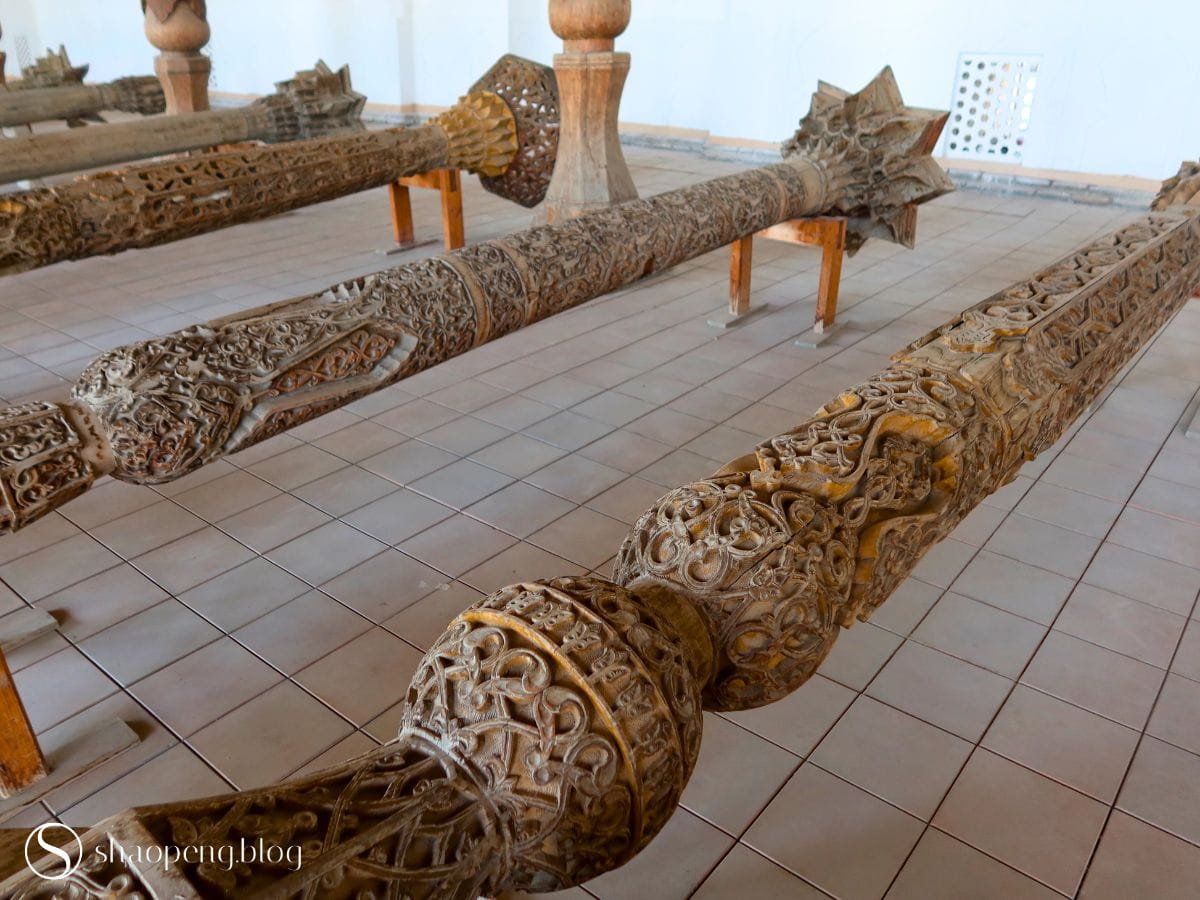
20th-century wooden pillars carved by master woodcarver Oodirion Haydarov, on display at the Museum of Applied Arts in Kokand.
Kokand is easy to overlook, but for craft lovers, it’s a detour worth taking. Once the capital of the Kokand Khanate (1710–1867), the city still displays traces of its former glory at Khudayar Khan’s Palace, its facade covered in tiles of turquoise, cobalt, mustard and olive. Artisans from nearby Rishtan also contributed to the palace’s finishing work, bringing their ceramic craftsmanship to its ornate decoration. Step inside, and the wonder continues. Towering wooden columns stand beneath painted ceilings, while delicate ganch (carved plaster) adorns the walls with floral and botanical motifs.
For a closer look at local craftsmanship, head to the Jami Mosque, just off Chorsu Square. Rebuilt under Umar Khan, its ayvan is lined with nearly one hundred carved wooden columns beneath a painted ceiling. Inside, the Museum of Applied Arts houses working studios dedicated to weaving, ceramics, knife-making, jewellery and carpentry, where artisans carry on traditions passed down through generations of families. You can watch them at work and buy directly from the makers. Besides these crafts, Kokand is also known for its paper, leather goods and even horse-drawn carriages.
Woodcarving, however, is what put Kokand on the world craft map. In 2019, on the eve of the first International Festival of Handicrafts, the World Crafts Council welcomed Kokand into its World Craft City network in recognition of its woodcarving tradition. Some fine examples are on display at the Museum of Applied Arts. Among the city’s best-known woodcarvers is Kadyrjan Khaidarov, who helped restore the columns, ceilings, doors and gates of Khudayar Khan’s Palace while introducing innovations of his own to the Kokand style.
The festival is perhaps the best reason to plan a trip. Held every two years in September, it transforms the streets south of the palace into an open-air craft market, bringing together makers from across Uzbekistan, Central Asia and beyond. What I love most is that many artisans demonstrate their skills on-site.
Wanderer’s tips — If you can, visit in September for the festival, but check the dates and allow time for the full event rather than just a day. Keep in mind that the studios at the Museum of Applied Arts are usually quiet while the artisans are away at the fair.
Margilan: Following the Silk Threads Home
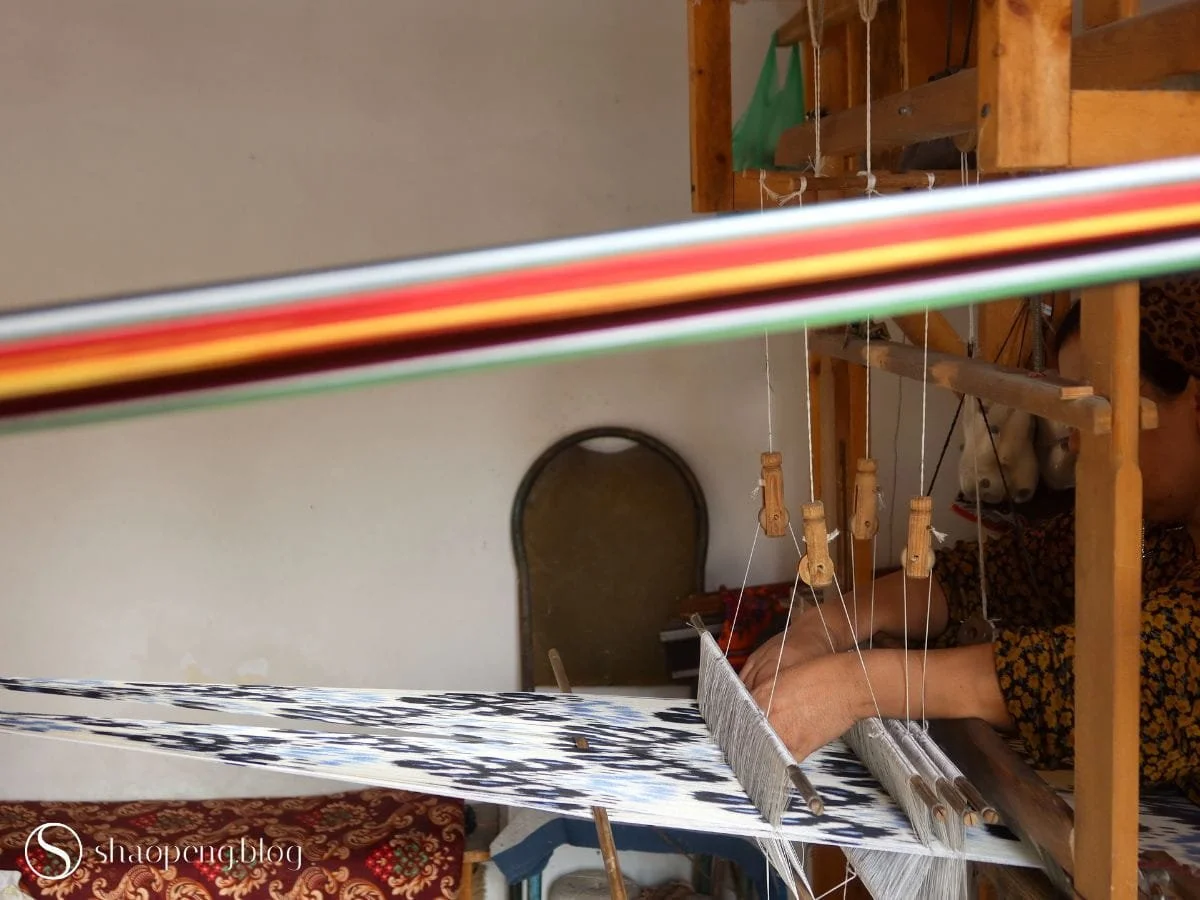
An artisan weaving an ikat at Margilan Crafts Development Centre.
Those visiting Margilan are likely drawn by its famous silk, whose name they may already recognise from bazaars across Bukhara and Samarkand. But is this small town, tucked away in the southern Fergana Valley and often overlooked in favour of Uzbekistan’s more popular tourist destinations, worth a visit? I’d say yes.
Margilan has been renowned for silk since at least the 10th century. Its weavers developed khan-atlas, or “royal silk”, and mastered ikat, a technique in which threads are tied and dyed before weaving, creating patterns with softly blurred edges.
For a closer look at Margilan’s silk traditions, begin at Yodgorlik Silk Factory. As Uzbekistan’s largest traditional silk factory, it lets you wander through nearly every stage of silk production: from cocoons to cloth. A short walk away, the smaller Silk Factory offers a live tie-dye demonstration, in which a scarf is tied and dipped before being unwrapped to show its patterns. The reveal never ceases to surprise.
Before you shop, learn two words: atlas refers to pure silk, while adras combines a silk warp with a cotton weft, giving the fabric a more muted appearance and slightly ribbed texture.
The Margilan Crafts Development Centre reveals another side of the town’s craftsmanship. Housed in the restored 19th-century Said Ahmad-Khoja Madrasa, its courtyard is home to workshops specialising in weaving, pottery, metalwork and block printing. For more, read my longer piece: Wander in Margilan: Uzbekistan’s Silk Capital.
Wanderer’s tips — If your dates are flexible, time your visit with the Atlas Bayrami Festival, held in Margilan since 2015 with UNESCO support. Kumtepa Bazaar, one of the oldest and busiest markets in the Fergana Valley, is also worth a visit.
Rishtan: A Ceramics Heartland
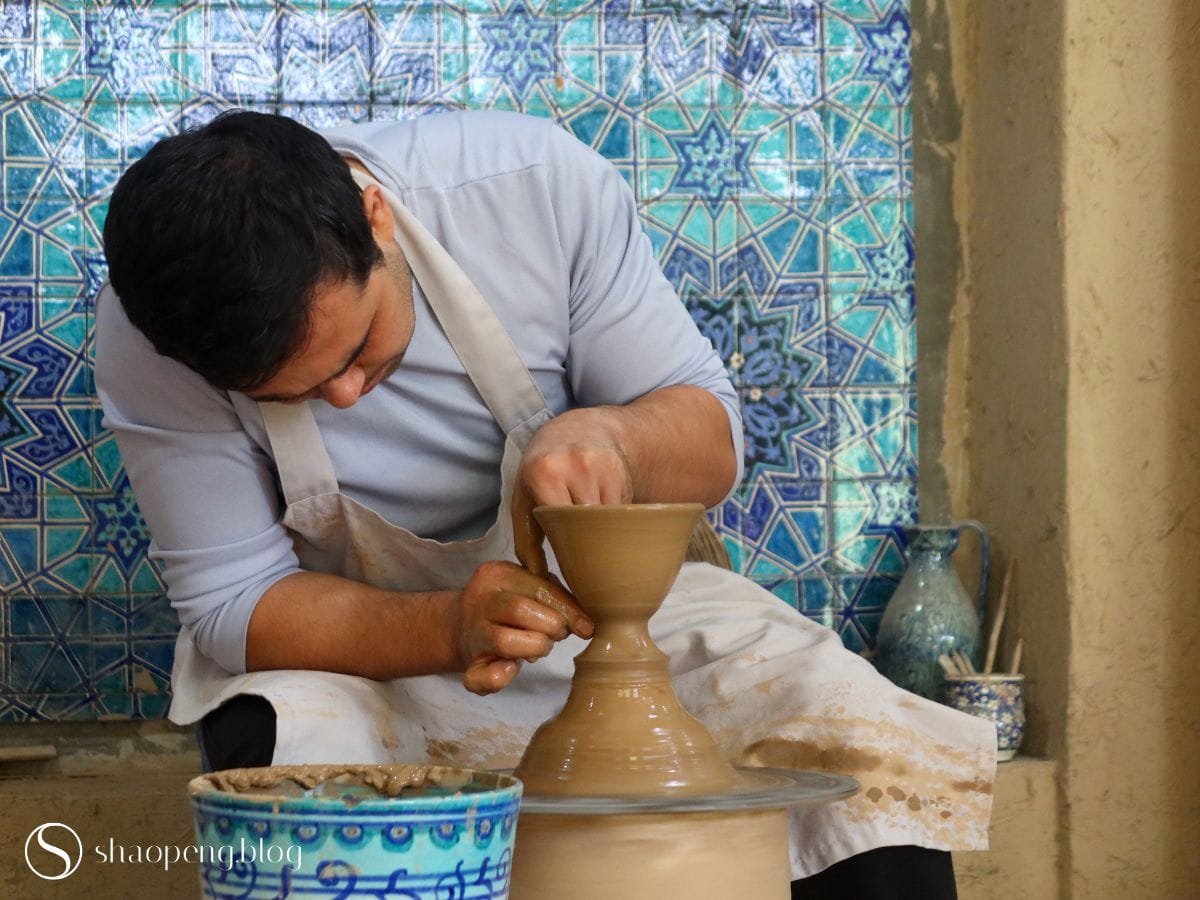
Nestled in the Fergana Valley between Fergana and Kokand, Rishtan is Uzbekistan’s go-to town for ceramics, and one of its oldest pottery centres. Its name is said to derive from a Sogdian word meaning “red earth,” and the clay beneath your feet is just that.
What sets Rishtan apart is its ishkor glaze, which begins with fire. Made from the ash of a desert plant that is gathered and burnt, the glaze turns to glass in the kiln. Mineral oxides add colour, producing the blues, turquoises and greens that define Rishtan ware. Painters work freehand, decorating vessels with motifs such as the pomegranate (anorgul), almond blossom (bodomgul), the quatrefoil (chorbarg), and winding leaves and shoots.
The best way to discover Rishtan ceramics is to step inside its workshops. Start at Rustam Usmanov‘s workshop. Housed in a traditional family home, it offers a chance to watch a vessel take shape on the potter’s wheel, followed by a painter laying down line after delicate line with an ultra-fine brush. Usmanov established his own workshop to revive traditional techniques, with ishkor glaze at the heart of his practice.
Next, head to Alisher Nazirov’s studio, where the style is more subtle and poetic. Drawing on archaeological finds, he has revived ancient forms and trained in Japan under master potter Isokichi Asakura. A small memorial in his garden commemorates a friendship that crossed borders.
To put these workshops into context, finish at the Museum of the History of Traditional Rishtan Ceramics, opened in 2025 to document, preserve and pass on the town’s ceramic heritage.
Wanderer’s tips — For the full story of these two workshops, and how a glaze made from burnt plants came to define a town, read my longer piece: Wander in Rishtan: The Glaze That Rose from Ash.