
Where the Sun Rises: A Wander Through the Okayama Orient Museum
More than 8,000 kilometres from Mesopotamia, in a city famous for its peaches, stands a fortress-like museum housing one of Japan’s most remarkable collections of ancient Oriental artefacts.
Sense of Wander: ★★★★☆
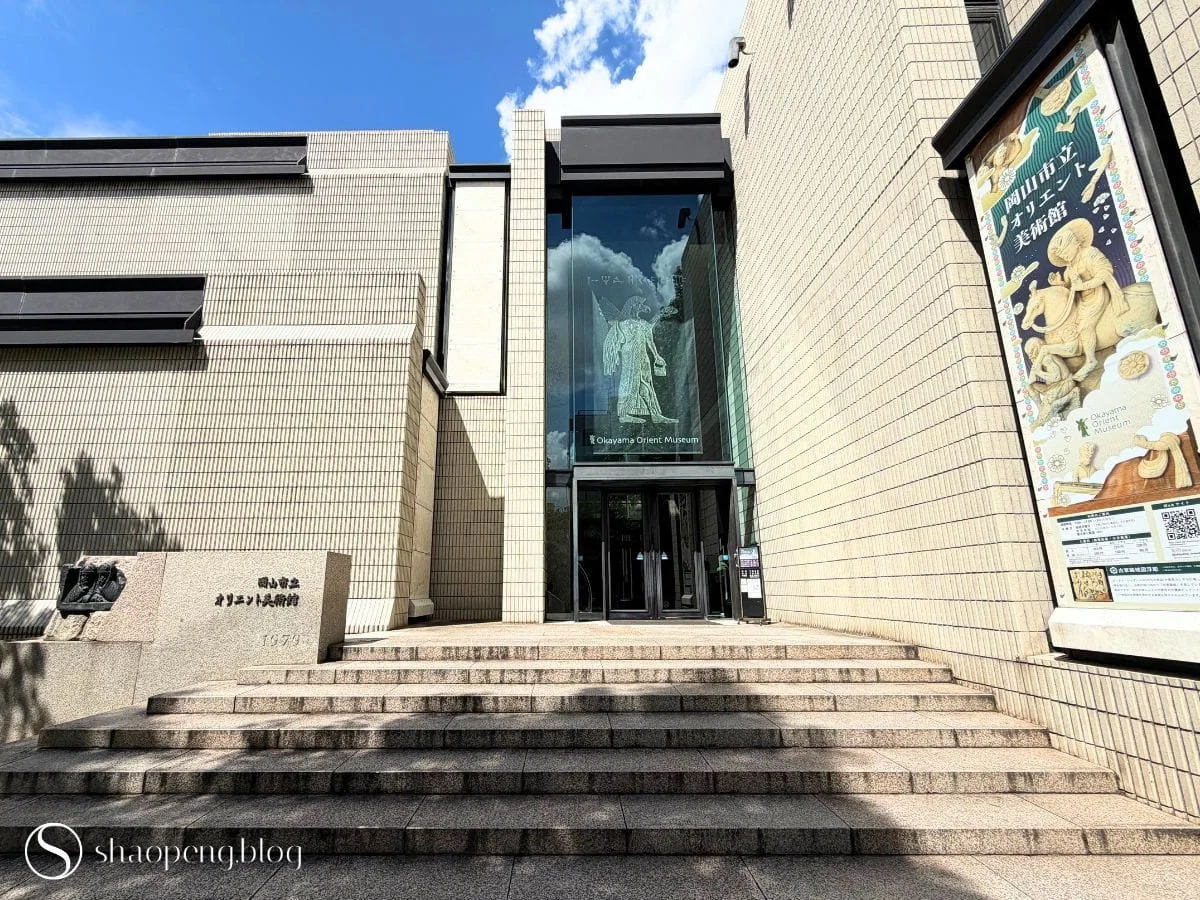
Entrance to the Okayama Orient Museum.
OKAYAMA, Japan — Less than an hour by bullet train from Osaka, Okayama has plenty to keep visitors busy. There is Korakuen, one of Japan’s celebrated landscape gardens, and there is Momotaro, the folktale boy born from a giant peach who sets out to defeat a band of demons. I came here for something that has nothing to do with Okayama itself, though. I came for the remnants of bygone civilisations, some from more than 8,000 kilometres away.
I was surprised when I first heard the Okayama Orient Museum, and even more curious when I learnt it opened in 1979. Why would a Japanese city known for its garden and its peaches build a museum devoted to Mesopotamia and its neighbours, and do it so long ago?
The answer begins at the door. The building, designed by architect Okada Shin’ichi, is a stack of sand-coloured boxes that recalls a Mesopotamian temple. It looks like a guarded fortress amid the modern streets around it, as if suggesting that crossing the threshold means stepping into a different world.
The Okayama Orient Museum is the only public museum in Japan devoted to the ancient “Orient”. Its collection of roughly 5,000 objects spans the vast region between China and Europe. The word comes from the Latin for “rising”, referring to the direction of the sunrise, and the ancient Greeks and Romans used it for the lands to their east. Here, it refers to a region with Mesopotamia (present-day Iraq) at its heart. It stretches west to Egypt and North Africa, north to Anatolia (present-day Turkey), south to the Arabian Peninsula, and east to Afghanistan.
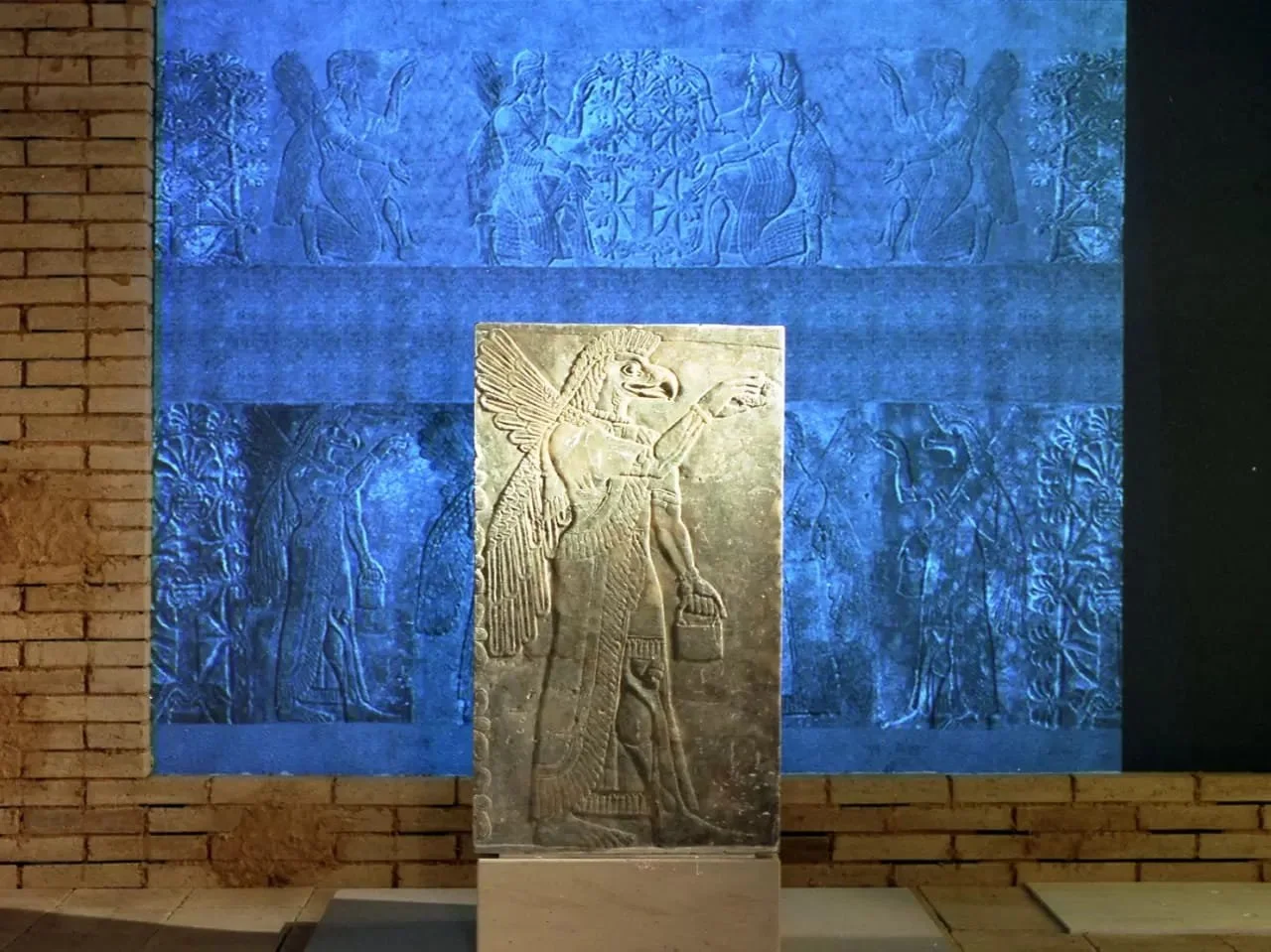
Relief of Protective Spirit, Apukallu. Image courtesy of Okayama Prefecture Tourism Federation.
Inside, the light drops. The galleries are shrouded in darkness, with gentle illumination glowing from the display cases. Early exhibits include tools handcrafted from stone and bone, followed by the arrival of pottery in the Neolithic period, around 6,000 BCE in West Asia, when clay vessels began to be used for holding, cooking and serving food. It’s easy to walk past these humble pots, but they mark a revolution. People were settling down, storing surplus and eating together.
What makes the museum special is how it lets you hop between civilisations in a matter of seconds. Mesopotamia is at its heart, the cradle of writing, cities and law. Here are fragments of cuneiform clay tablets and tiny cylinder seals that capture daily life in miniature, among the earliest records of human existence.
The showpiece is a gypsum alabaster relief of an Apkallu, a winged guardian spirit, carved in low relief in the 9th century BCE. The figure has a human body, the head of an eagle and great wings. It once adorned the Northwest Palace of King Ashurnasirpal II at Nimrud, ancient Kalhu, the Assyrian capital located a few dozen kilometres south of Mosul in Iraq. The museum bought it in 2004 for its 25th anniversary, with the help of public donations. It also appears on the entrance ticket.
Keep wandering and the depth of the collection starts to show, especially in the objects from the Iranian plateau. There is painted prehistoric pottery, glassware, metalwork and more. The museum holds ancient three-bladed bronze arrowheads (sanyaku-zoku) from Persepolis, long associated with Achaemenid military equipment.
One of my favourites is a pottery bowl from Tepe Hissar in northern Iran, dated to roughly 3,500–3,000 BCE. Its earthy surface carries the painted silhouette of an animal. It reminds me of the markhor, the corkscrew-horned wild goat that I’ve seen Tajik craftsmen turn into awe-inspiring works of art at the International Festival of Handicrafts in Kokand, Uzbekistan. Five thousand years have passed, but the brushwork is still confident and startlingly alive. Someone looked at an animal, loved it, and painted it on their bowl.
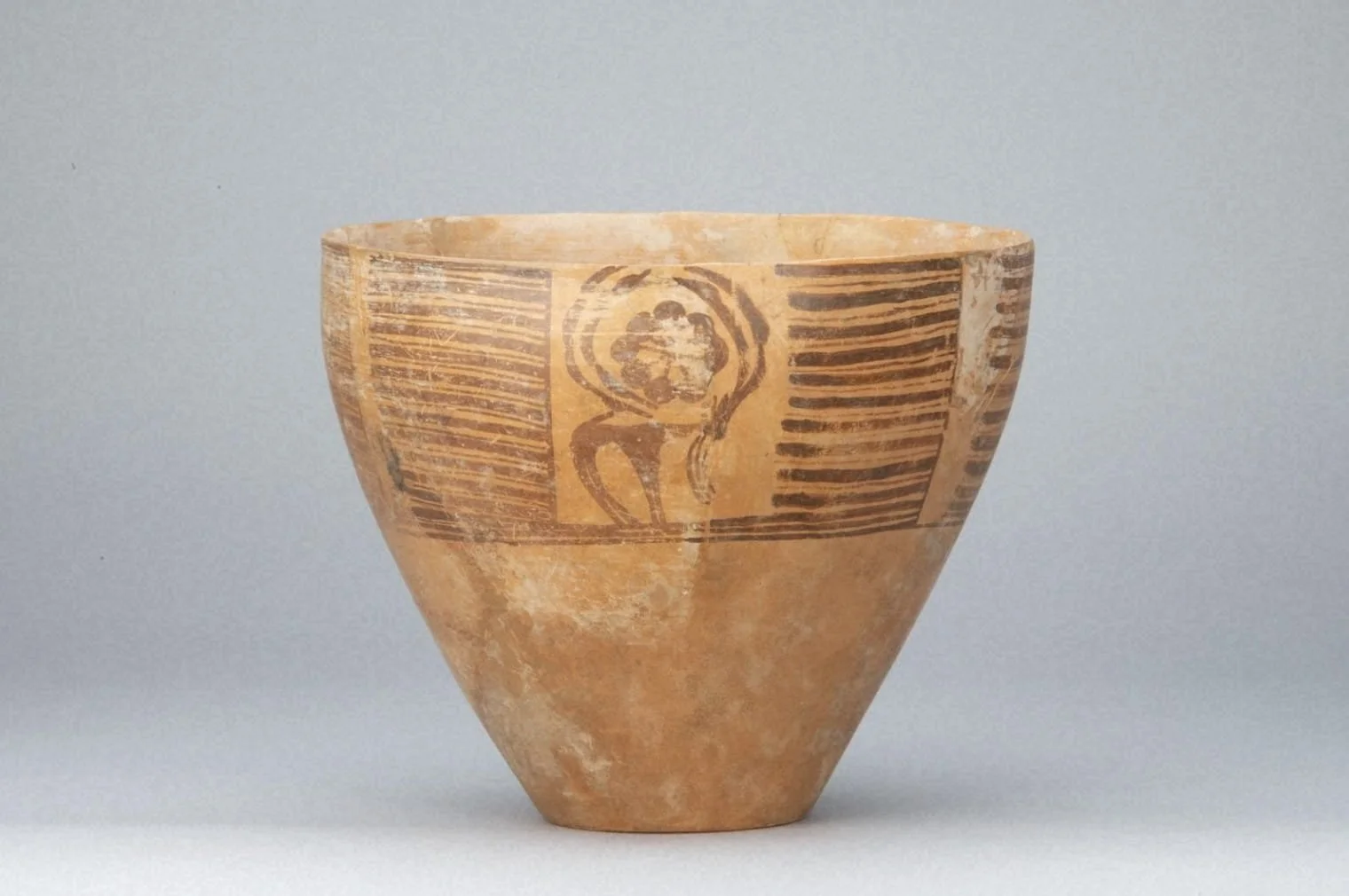
Deep bowl with painting of a makhor. Image courtesy of Okayama Orient Museum.
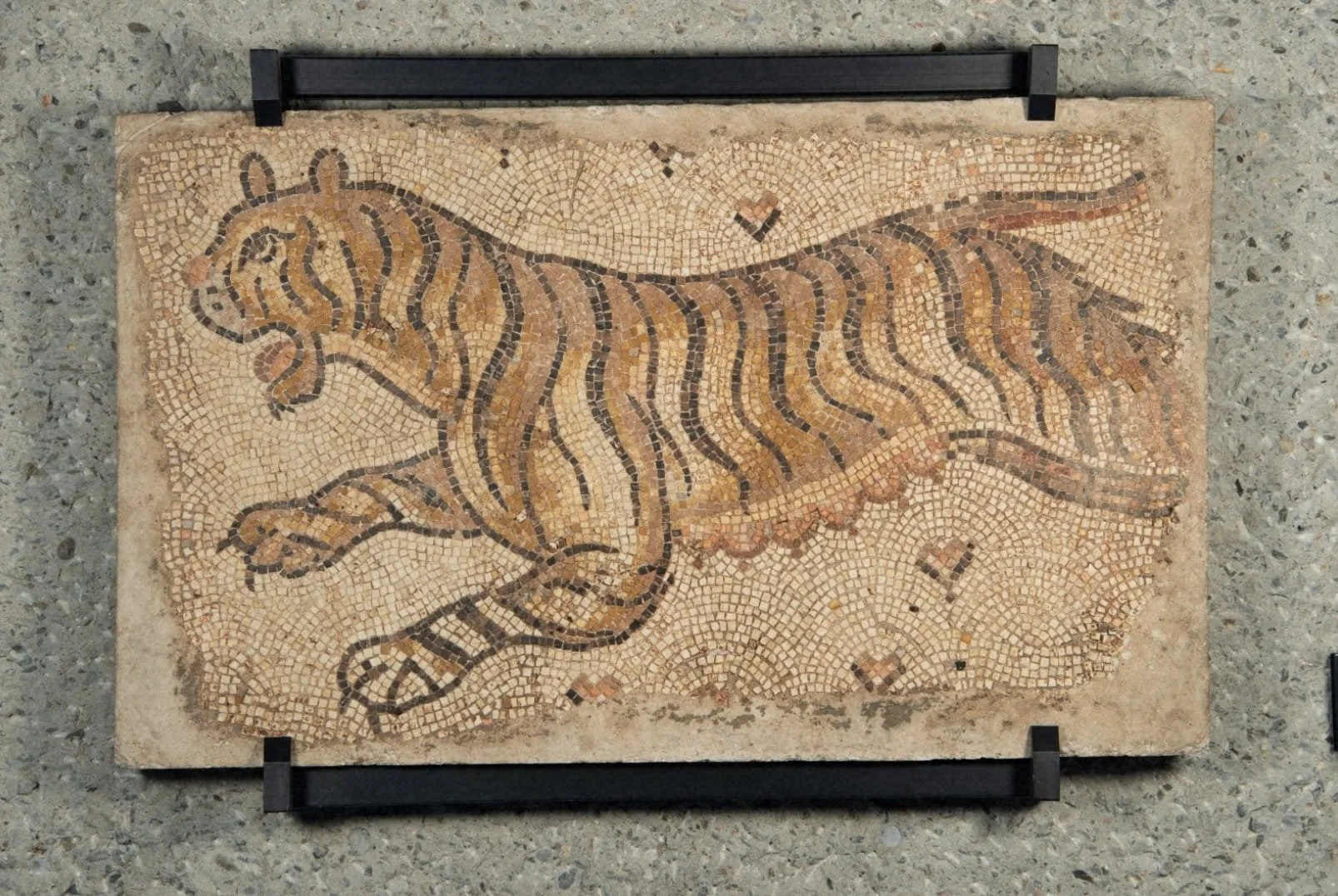
Mosaic of a tigress. Image courtesy of Okayama Orient Museum.
Then you step into the central hall, perhaps the brightest room in the museum, thanks to the daylight pouring through its atrium. Here, you come face to face with mosaics that took me back to the Villa Romana del Casale in Sicily. One is a fragment of a 5th-century pavement from Syria showing a tigress.
She is caught mid-stride, built from tiny tesserae in many colours that give her volume, expression and life. Look closely at her belly and you’ll count six teats, a charming detail from an anonymous craftsman who clearly watched the living world.
It also says something about Syria. At that time, the region sat between the Mediterranean and Mesopotamia, between the Roman and Byzantine worlds and Persia. It was a crossroads where goods, styles and ideas passed constantly, and a mosaic like this one, made for a church or public building, is a trace of that traffic.
Ancient Egypt is the familiar part of the story, with funerary objects, amulets and figurines. Further west, you reach the Mediterranean end of the journey, where the Orient meets the classical world. The objects range from black-figure pottery from ancient Greece to a 4th-century BCE silver coin bearing the face of Alexander the Great.
What lights me up is the section devoted to the Islamic world. There are vessels painted with calligraphic inscriptions, some legible and others rendered in purely decorative pseudo-script. The legible examples include Samanid ware, made between the 9th and 11th centuries across Central Asia and northeastern Iran. It is one of the most visually striking periods in Islamic ceramics, and a favourite of mine, with its austere palette of black Kufic script on a white ground. There are also a few pieces of lustreware from 13th-century Iran.
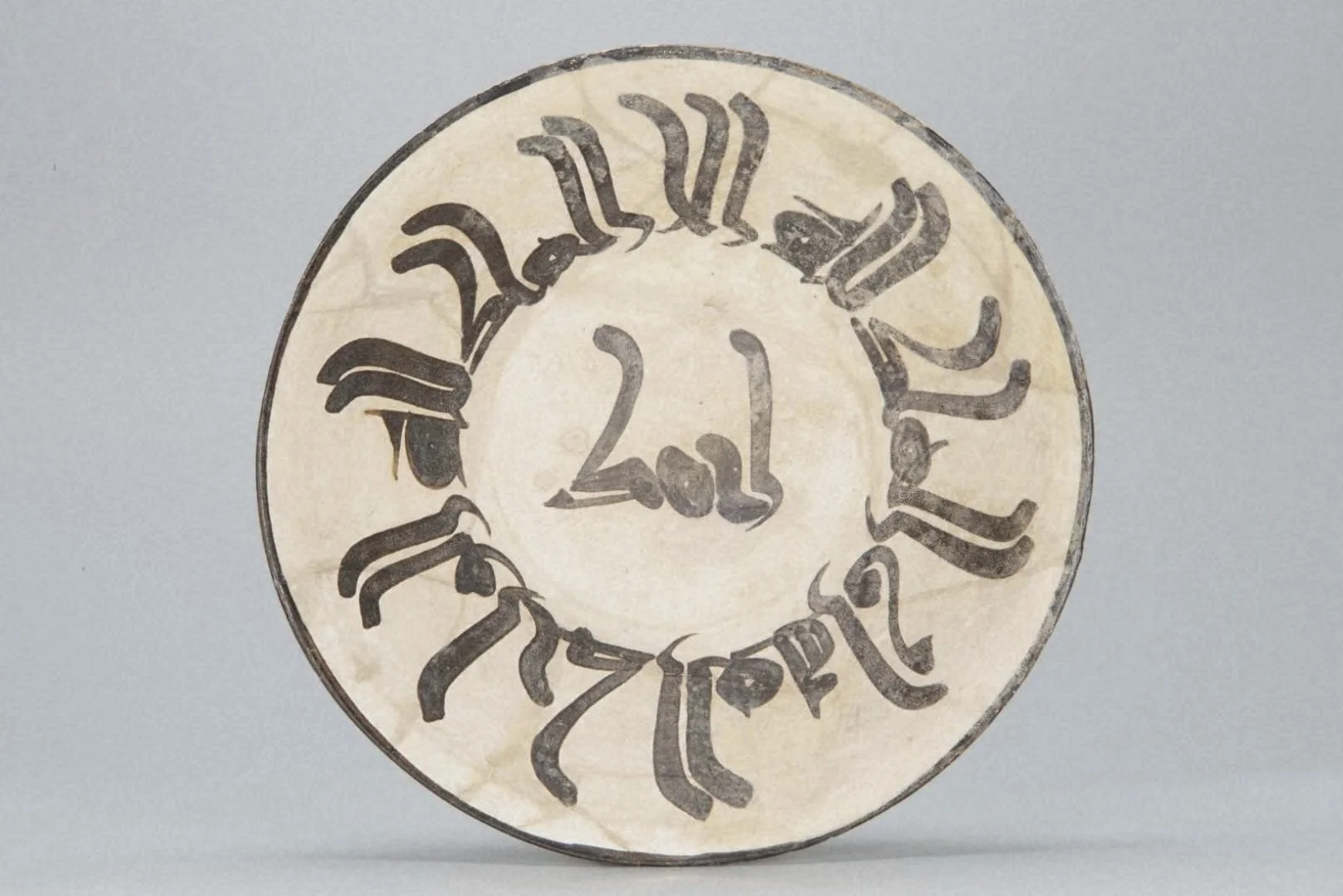
Samanid bowl bearing an inscription, from 10th-century Iran. Image courtesy of Okayama Orient Museum.
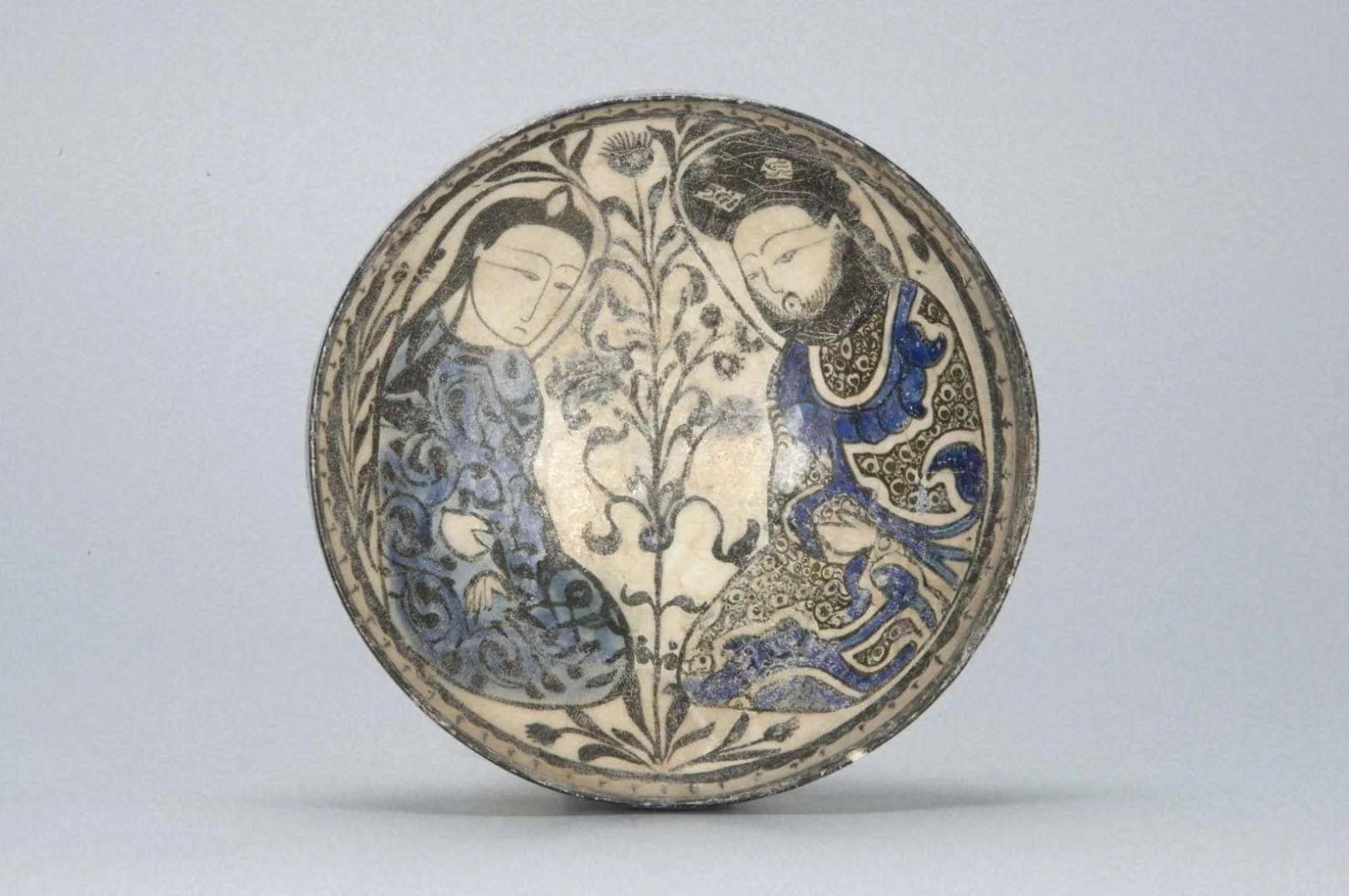
Cobalt- and black-painted bowl with a figure, from 13th-century Iran. Image courtesy of Okayama Orient Museum.
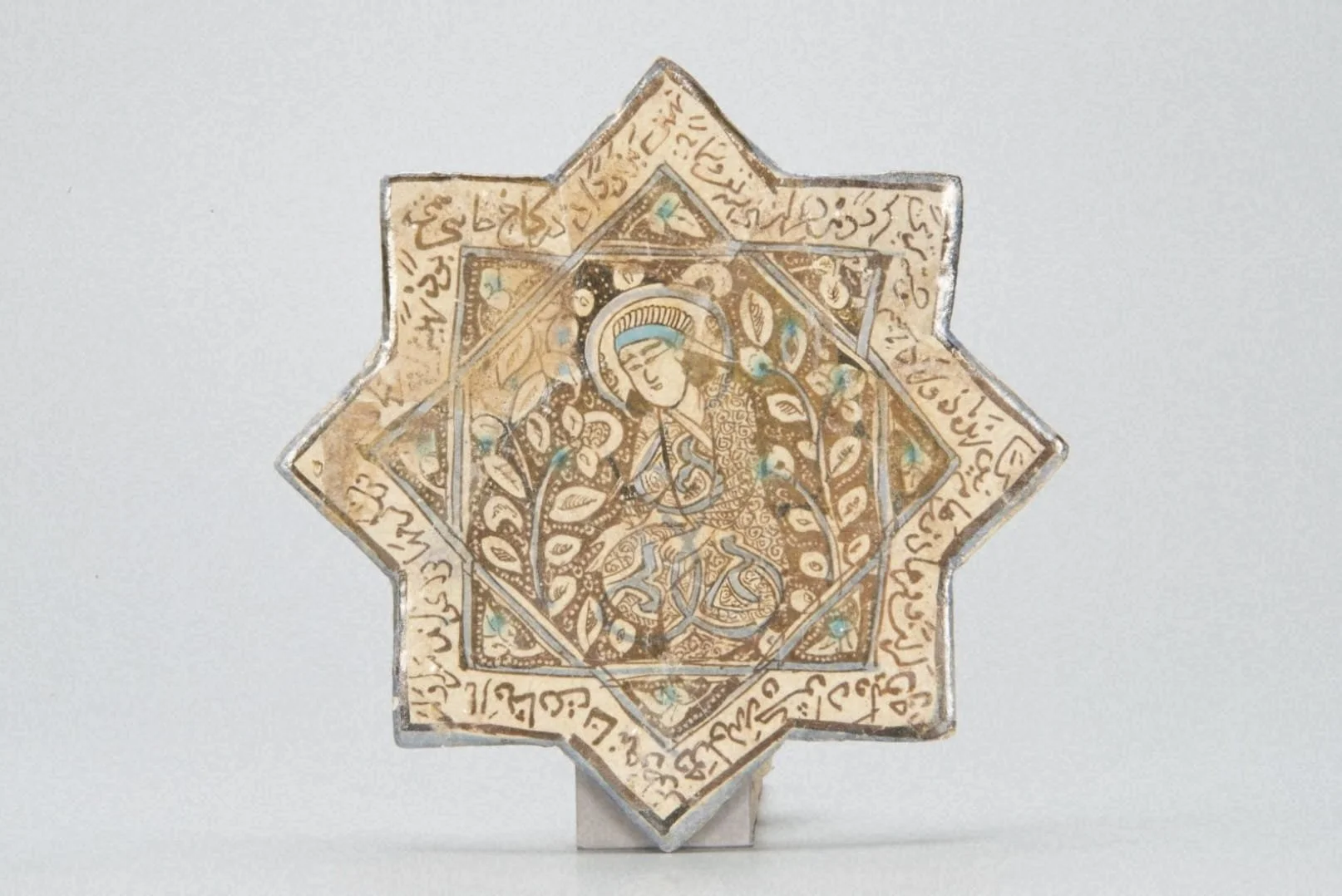
Lustre-painted star tile with a figure, from 13th-century Iran. Image courtesy of Okayama Orient Museum.
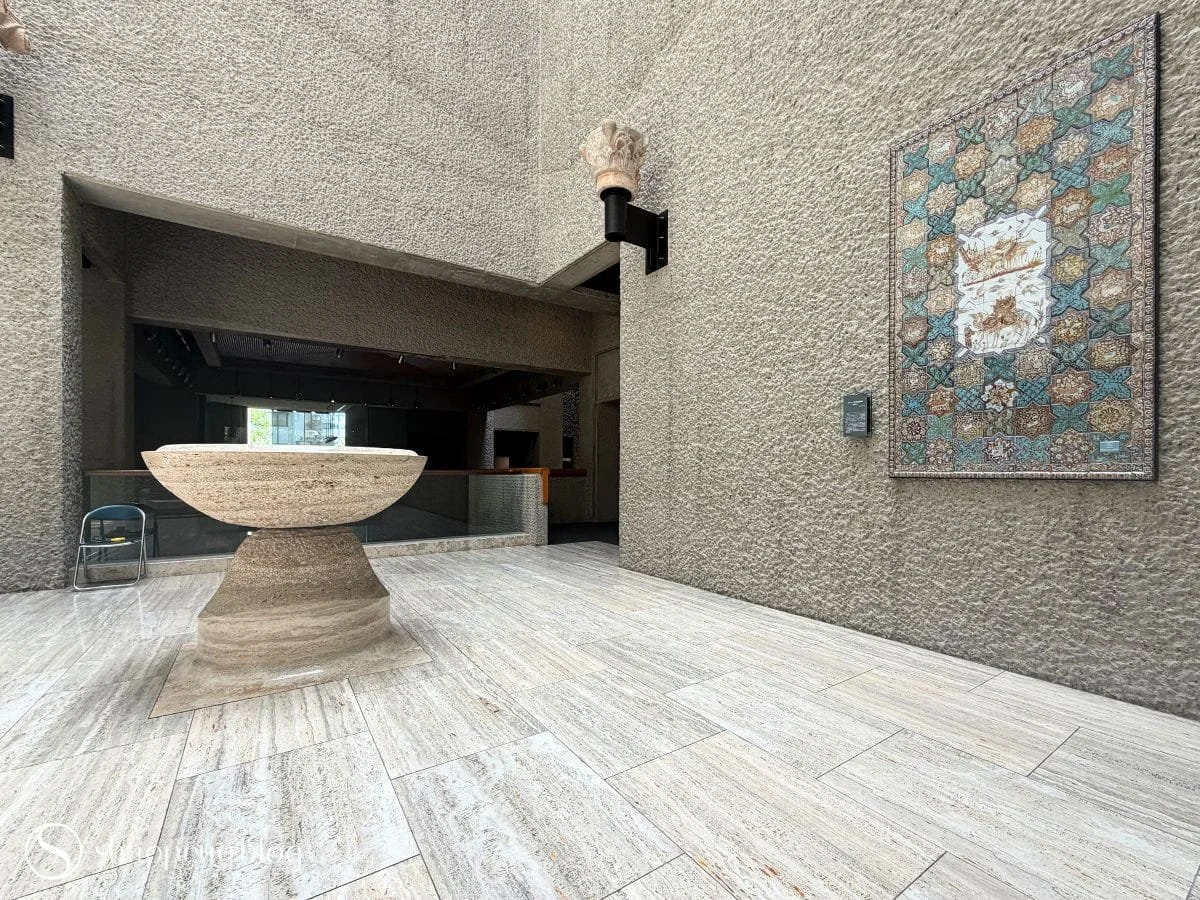
Kato Takuo’s Shokou on the museum’s upper floor.
The museum also holds a wonderful dialogue between old and new. In the light court on the upper floor is Shokou (“dawn” in Japanese), a mural assembled from star-shaped and cross-shaped tiles by Kato Takuo (加藤 卓男). Kato spent decades researching lost Middle Eastern ceramic techniques, and the mural revives medieval Persian lustre glazing. He gave it to the museum to mark its opening in 1979. In 1995, he was designated a Living National Treasure.
A few surprises await at the eastern edge of the story, in South Asia. There are gold coins from the Kushan Empire (2nd century CE) and Gandhara Buddhist sculptures from what is now northwestern Pakistan and eastern Afghanistan.
One schist fragment shows a seated Buddha in the centre, flanked by Brahman students. Gandhara art blended Greek and Buddhist traditions, a thread that ran along the Silk Road and eventually reached Japan itself. In these rooms, you journey from east to west and back again, across some 8,000 kilometres and several thousand years, without leaving Okayama.
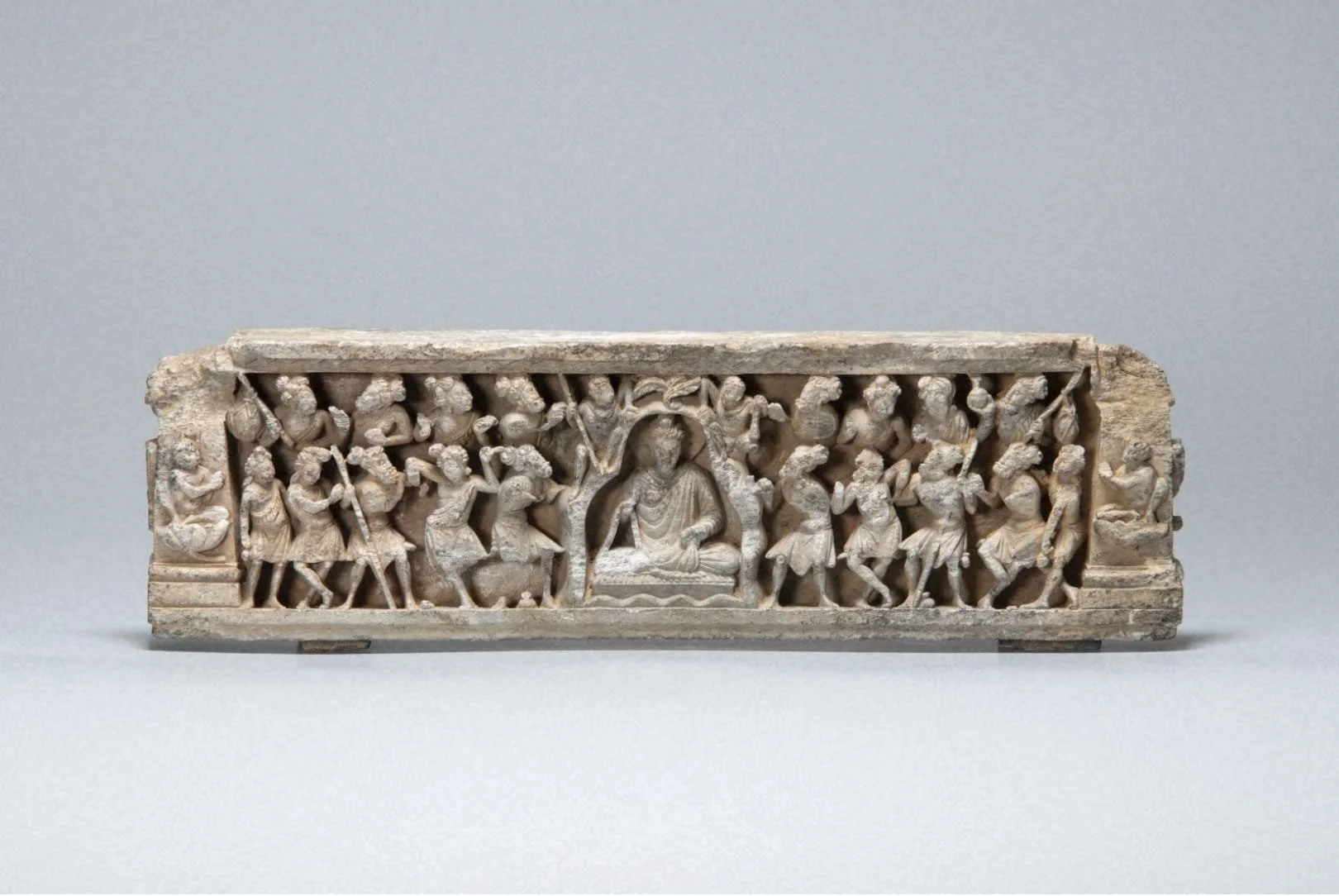
Buddha and 16 Brahman Students from 2nd–3rd century Gandhara. Image courtesy of Okayama Orient Museum.
You might wonder who had the vision to start all this. The founding collection came from Yasuhara Shinjiro, a local businessman and head of the Okayama Gakuen educational foundation. After encountering Mesopotamian art, he began collecting seriously, advised by scholars of the ancient Orient. In 1973, he donated nearly 2,000 objects to the city, which committed to building a museum. Prince Mikasa Takahito, an Orientalist, was involved from the early planning stages.
That curiosity still runs through the place, in the permanent collection and in the rotating special exhibitions. It even reaches the washroom, where a hand basin glazed in Persian-style lustre was crafted by Kato Kobei VII, the son of Kato Takuo.
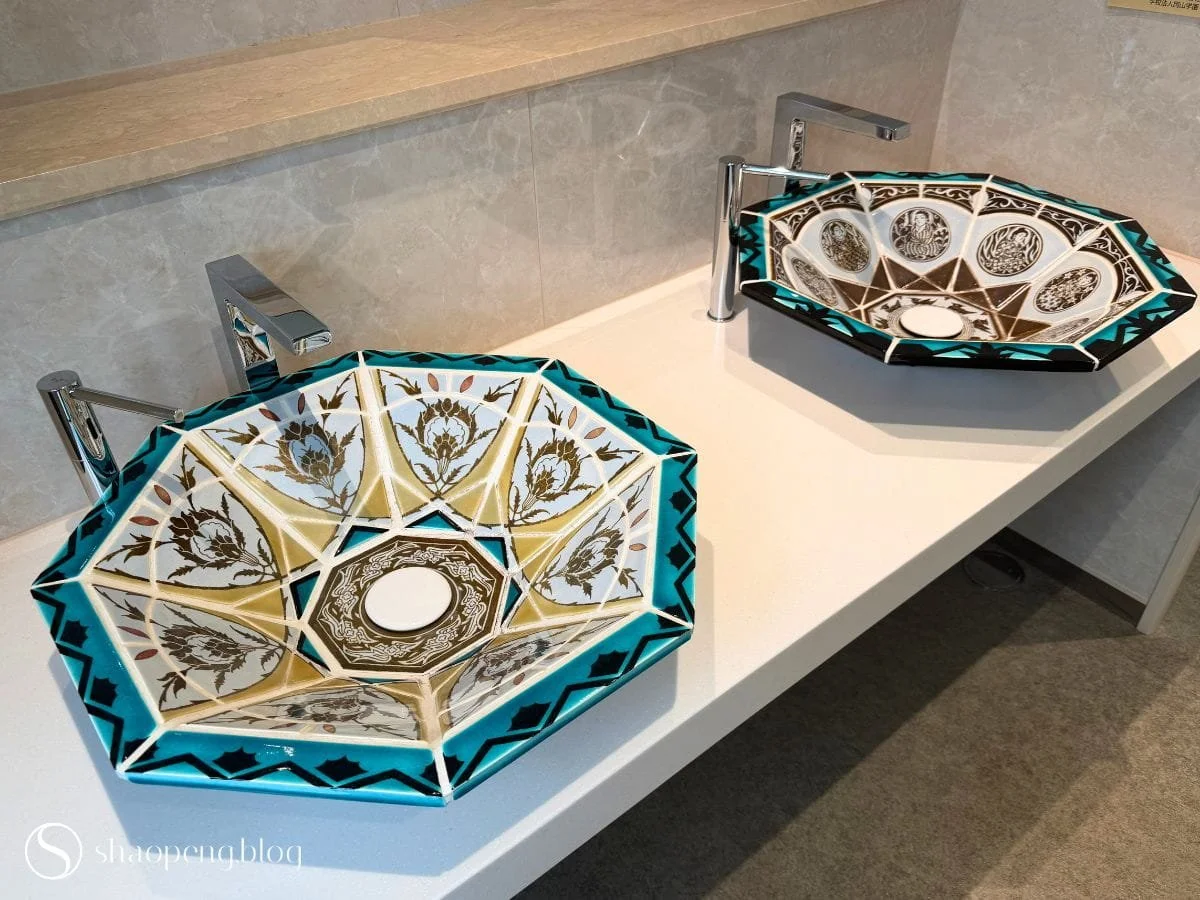
Washbasin in the women’s restroom at the Okayama Orient Museum.
You may also be interested in:
Reference:
Okayama Orient Museum. (1992). Guidebook of Okayama Orient Museum.