
Wander in Nara: Making My Own Calligraphy Brush
I came to Nara to buy calligraphy brushes but ended up learning to make one, and discovered that Japan’s brush-making craft is said to have begun here, with a monk and a tuft of hair.
Sense of Wander: ★★★☆☆
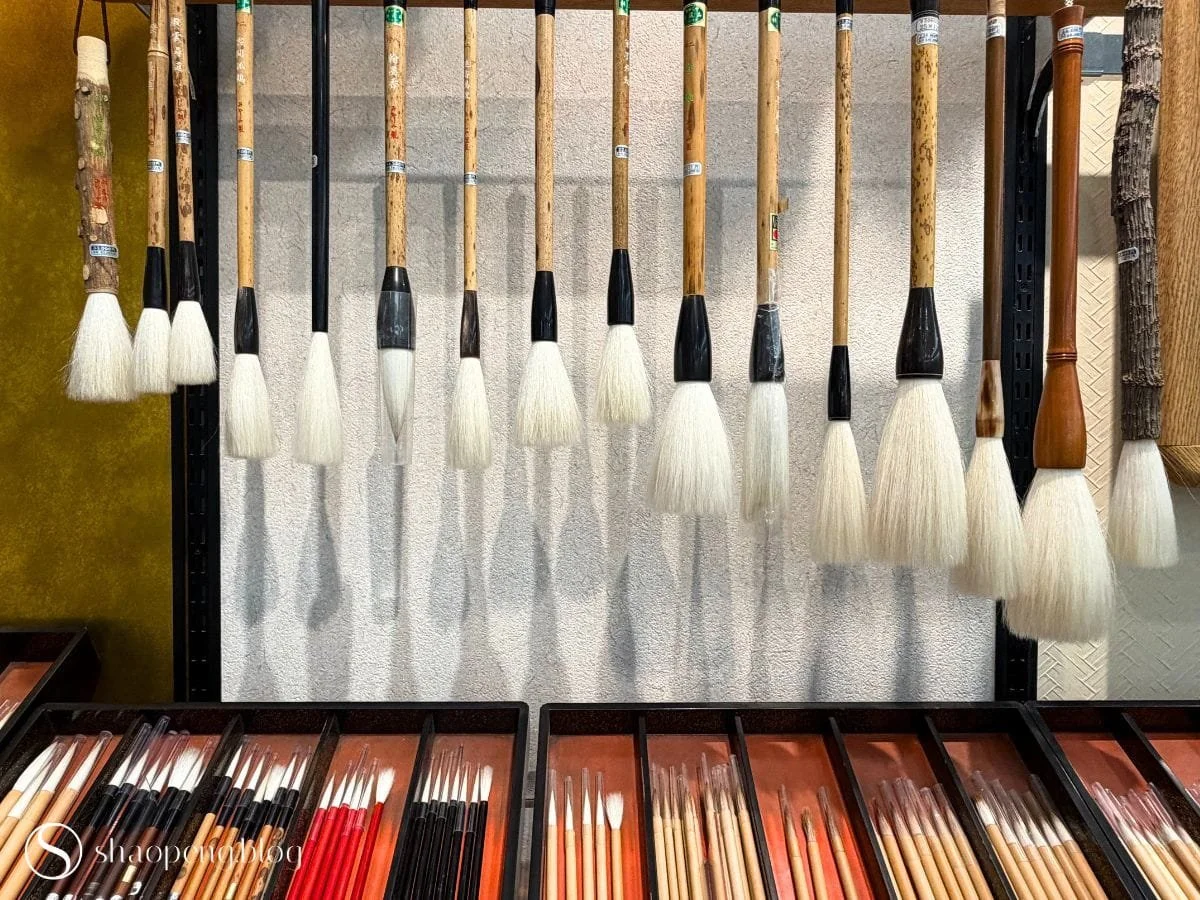
A selection of handcrafted calligraphy brushes from Nara.
NARA, Japan — It’s easy to wander through Nara without giving much thought to writing. From the deer to the temples, the city seems to be made of wood, stone and the echoes of Buddhist life. Yet much of what we know about Nara today was made possible by ink and brush. Monks needed both to copy sutras, and over time, a craft grew around them.
Having visited Nara many times, I’ve come this time with a modest plan: see an exhibition and pick up a couple of calligraphy brushes while I’m at it. I’ve been using brushes made in Taiwan and China for years, but I’ve never tried brushes made in Japan.
I certainly had no idea that Nara is home to one of Japan’s oldest brush-making traditions, alongside its better-known sumi ink. Nara produces roughly nine in ten of Japan’s ink sticks, a craft whose origins and development I’ve already explored in Gripped by Ink: Kneading My Way Into Nara Sumi.
The Brush That Found Nara and Made It Home
Like Nara sumi, Nara’s brush-making tradition traces its origins to China, where ancient brushes have been unearthed from tombs dating to the Warring States period (c. 475–221 BCE). One was found near Changsha, while another, from Xinyang in Henan, is also among the earliest surviving examples.
Legend credits the Qin general Meng Tian (c. 250-210 BCE) with inventing the brush, but archaeological finds show that brushes were already in use long before his time. The brush travelled to Japan alongside Chinese writing and Buddhism, part of a wider body of knowledge that Japan would spend centuries absorbing and shaping its own.
Nara became one of the earliest centres of brush-making in Japan, with a history stretching back more than 1,200 years. In the 8th century, the imperial court was based here, running a Chinese-style state through written records and brushwork, while temples such as Todaiji and Kofukuji relied on scribes to copy Buddhist scriptures. Some of their tools have survived. The Shosoin, Todaiji’s treasure repository, preserves seventeen Tenpyo brushes from Emperor Shomu’s collection.
According to a more detailed account, the monk Kukai (774–835) returned from Tang China in 806 with knowledge of brush-making and passed it on to a craftsman named Kiyokawa Sakanai. It is a founding legend, but one that has endured. Kiyokawa’s descendants first practiced the craft in Imai, but the centre of brush-making later shifted to Nara, where ink was already being produced in large quantities and the city’s Buddhist temples and Shinto shrines had a high demand for brushes.
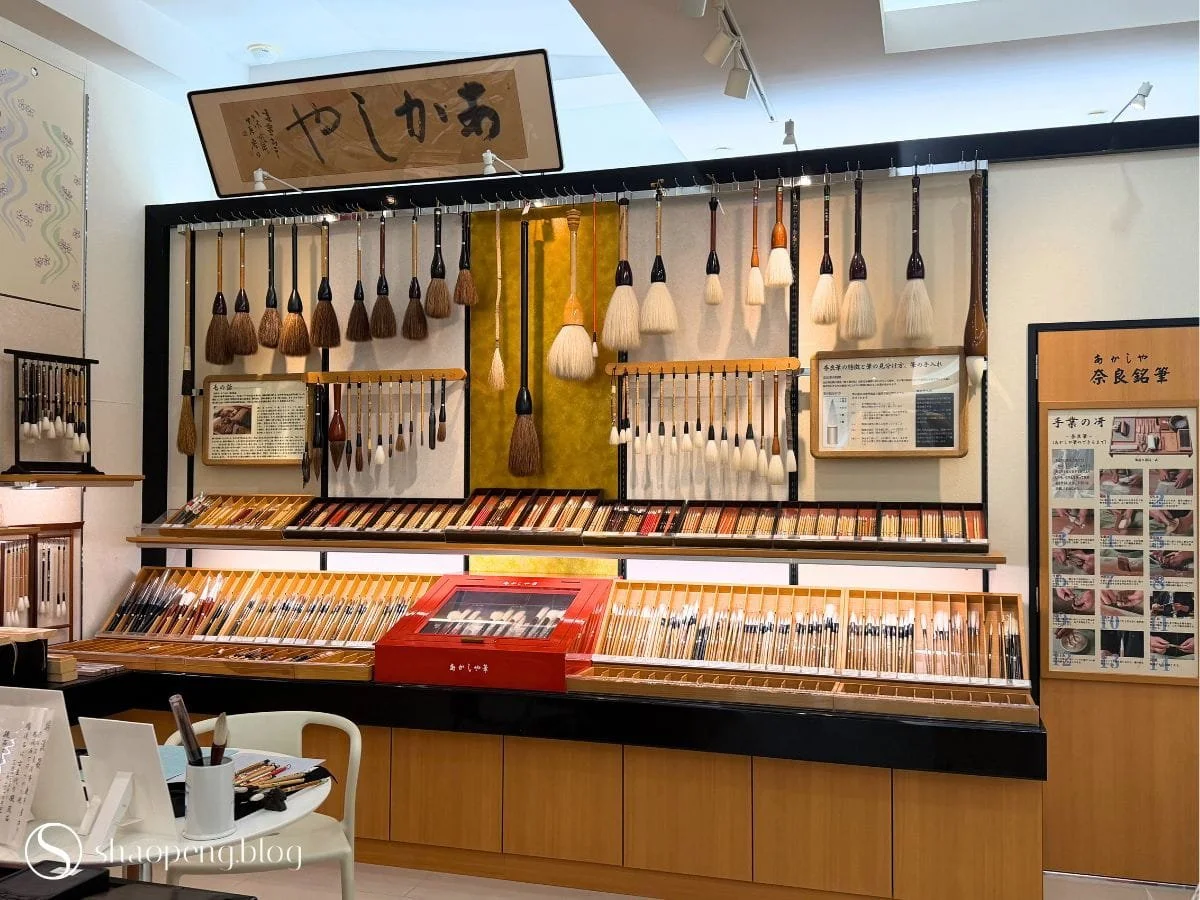
A wide selection of calligraphy brushes in various sizes, all handcrafted in Nara.
The craft eventually spread beyond Nara. When school education expanded during the Meiji era (1868–1912), demand for quality brushes grew far beyond religious institutions. Kumano, in Hiroshima Prefecture, initially bought and sold brushes and ink from Nara before developing its own brush-making industry.
Today, Kumano is Japan’s largest brush-producing town, accounting for roughly 80 per cent of the country’s output. In Japanese, a calligraphy brush is called a fude. Kumano fude were designated a national traditional craft in 1975, followed by Nara fude in October 1977. Alongside Kumano, Kawajiri and Toyohashi, Nara is now one of Japan’s four officially recognised brush-making regions.
However, Nara has never competed on volume. Instead, it has preserved its reputation for craftsmanship, particularly through a technique known as nerimaze-ho. This involves blending ten or more types of animal hair, including sheep, horse, deer, tanuki and weasel, according to their length and springiness. The aim is to create a brush that combines firmness with the ability to hold plenty of ink. Today, Nara fude are prized by calligraphers and ink painters across Japan for their artisanal quality.
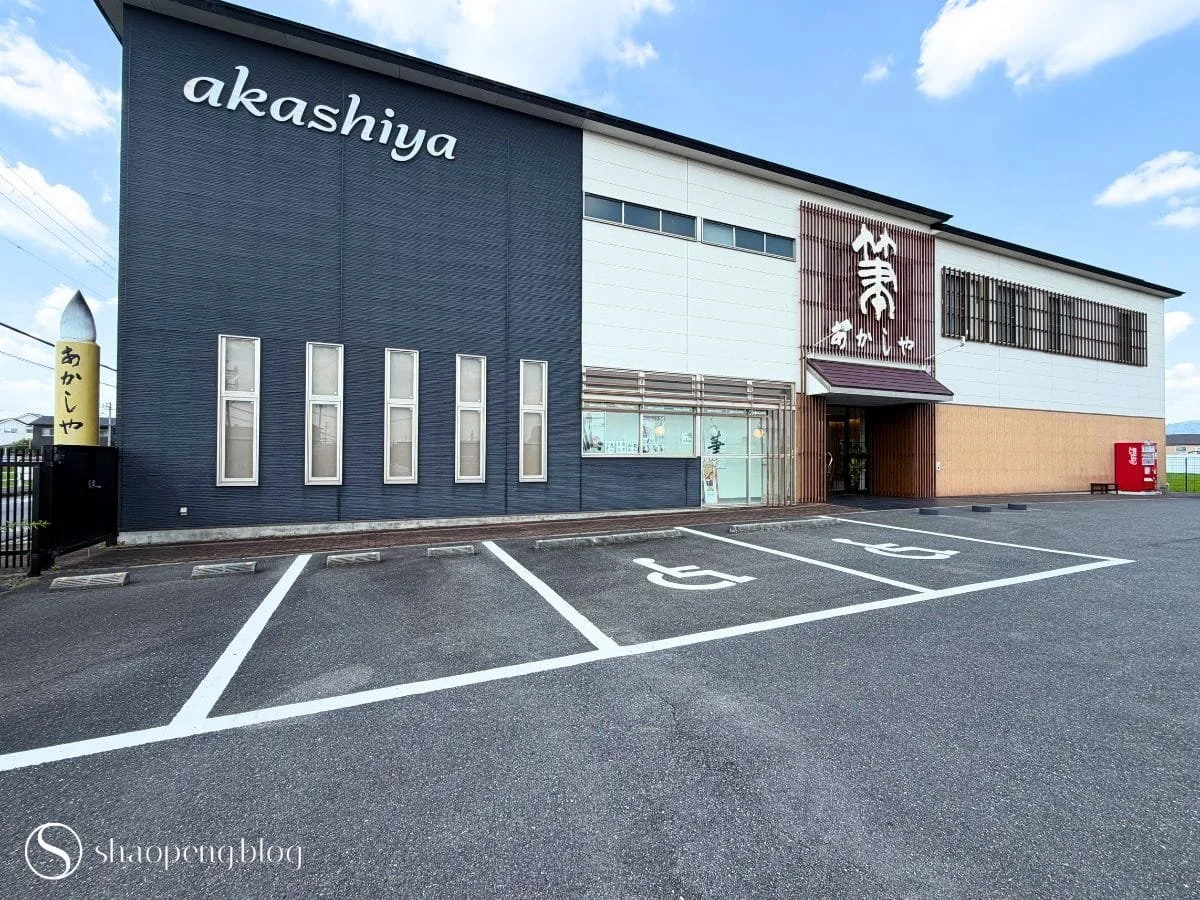
Akashiya is a brush manufacturer in Nara with more than four centuries of history.
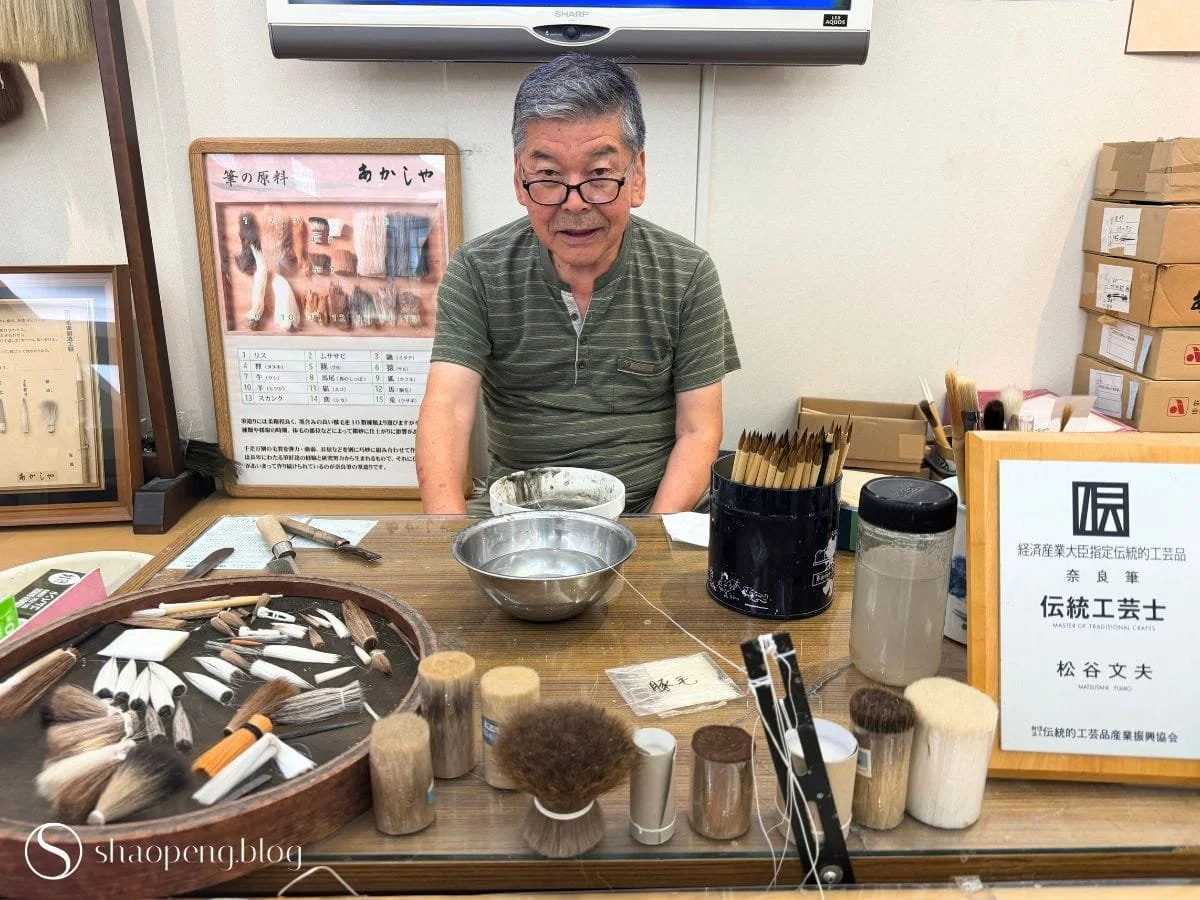
Matsutani Fumio is a certified Master of Traditional Craftsman specialising in Nara fude.
Learning to Make My Nara Fude
At Akashiya, a Nara brush-maker founded in 1624, I had the opportunity to try my hand at making a calligraphy brush. The company has a history spanning more than four centuries and continues to make brushes by hand, without machines. Guiding me through the process was Matsutani Fumio (松谷 文夫), a certified Master of Traditional Craftsman in brush-making.
The workshop occupies a corner of the Akashiya shop, where the master and his apprentice sit quietly, absorbed in their work.
Almost everything in brush-making revolves around the hair. First, it is combed out and spread across a board for blending. For a premium brush, the soft, fuzzy undercoat is removed because it can make ink flow unevenly and weaken the brush’s spring. The hair is then rubbed with rice-husk ash and warmed over charcoal to draw out its natural oils and straighten bent strands.
Next comes the meticulous work of the fingertips. The maker plucks out individual hairs to refine the tip, trims away inferior strands with a blade, and sorts the remaining hair by length into the core, intermediate layers and outer covering.
These layers are blended and folded together repeatedly to prevent any one type of hair from clumping. A machine cannot replicate this process with the same precision, as every strand has its own characteristics.
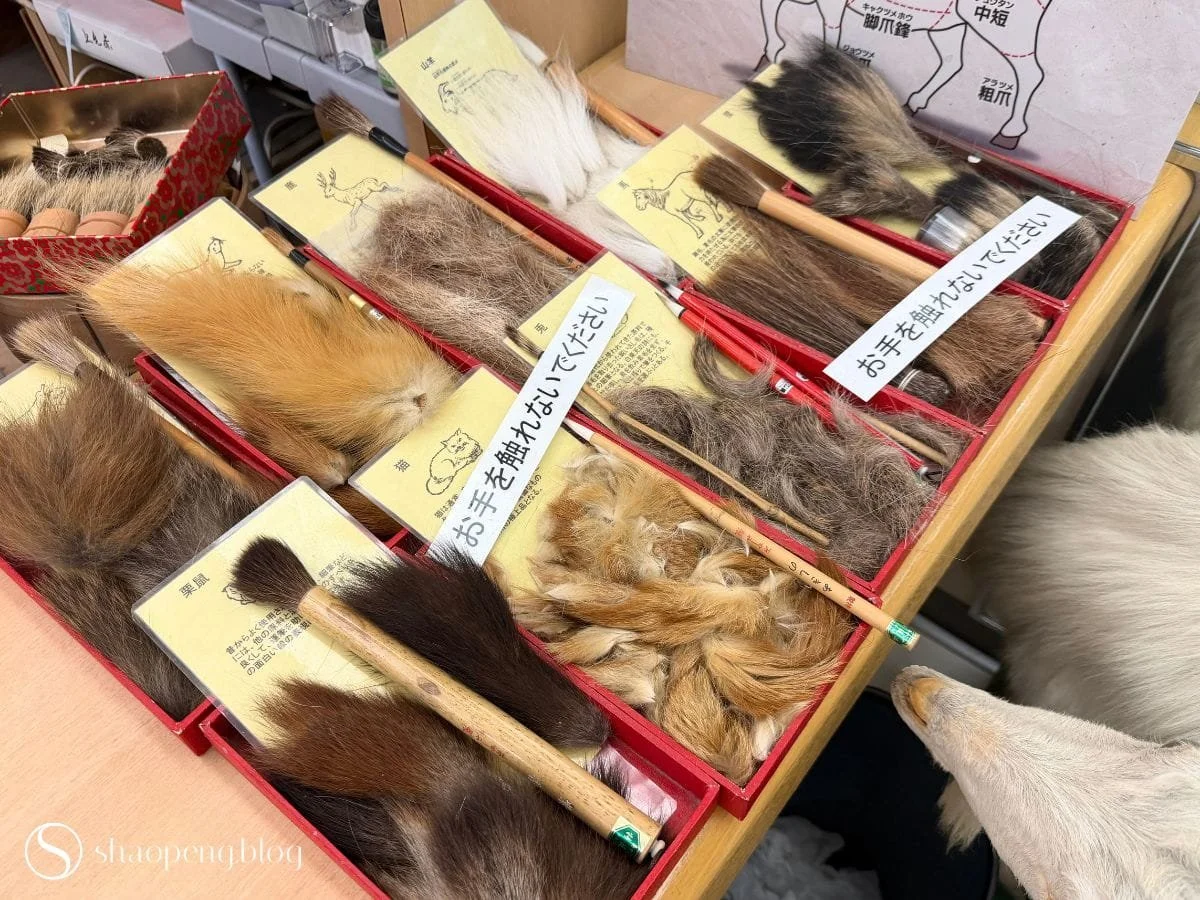
A variety of animal hairs are used to make Nara fude.
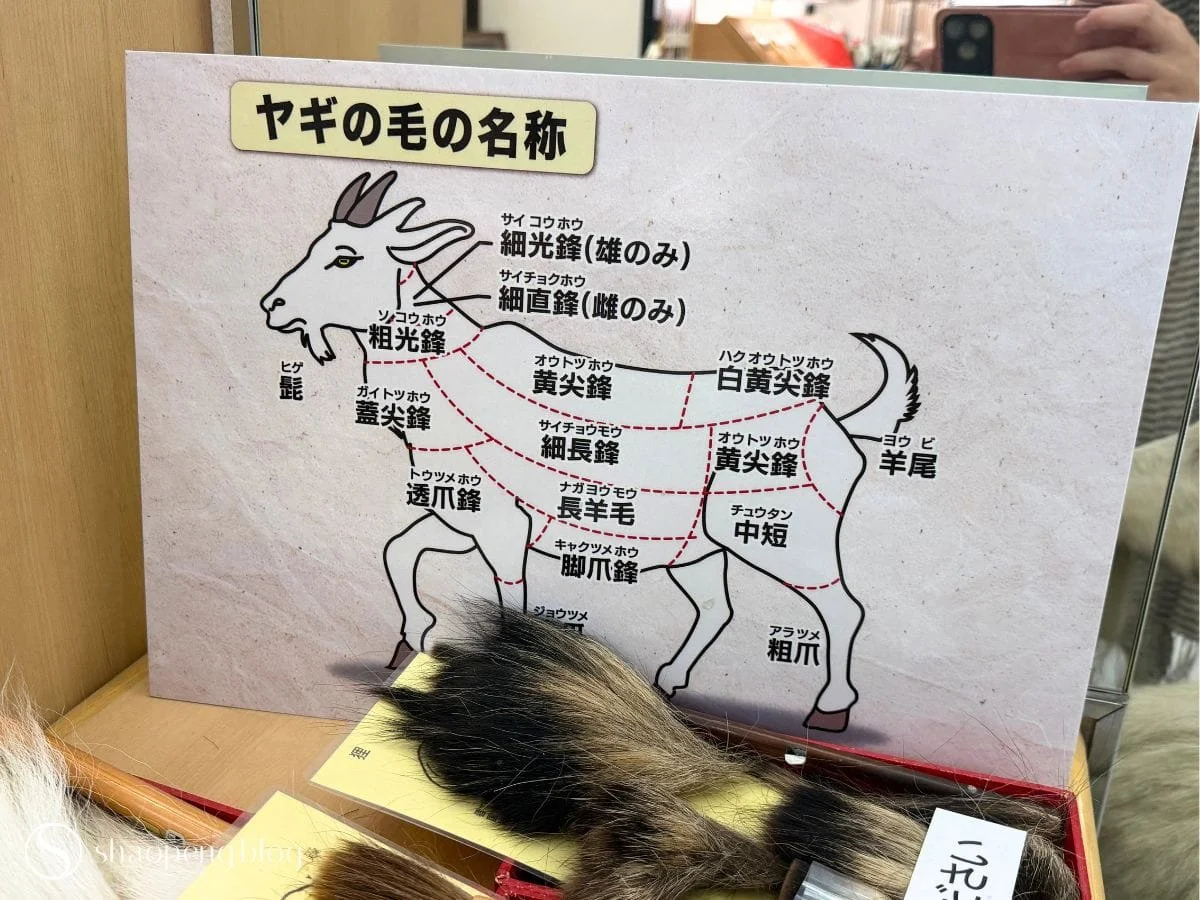
Different parts of a goat’s hair are used to make different types of brushes.
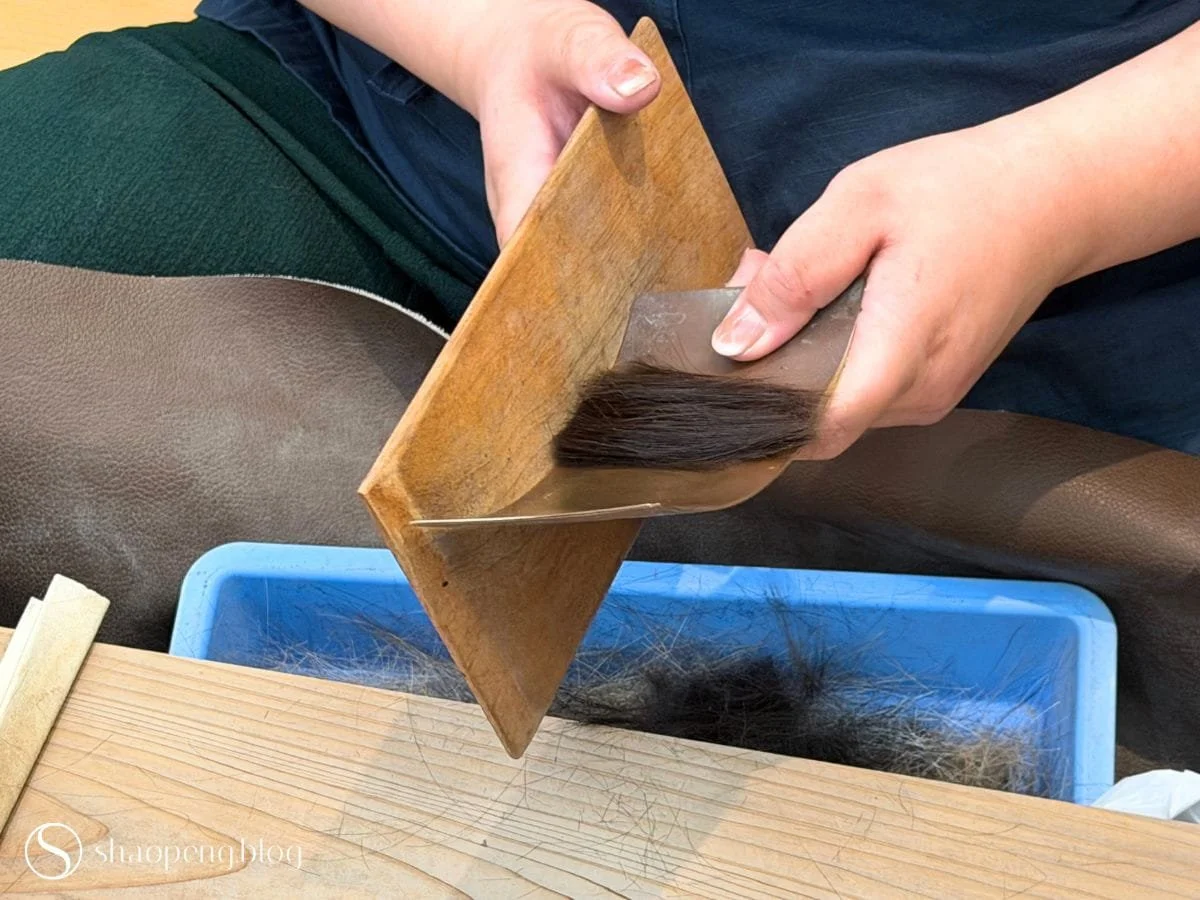
The hair is combed out and spread across a board, ready for blending.
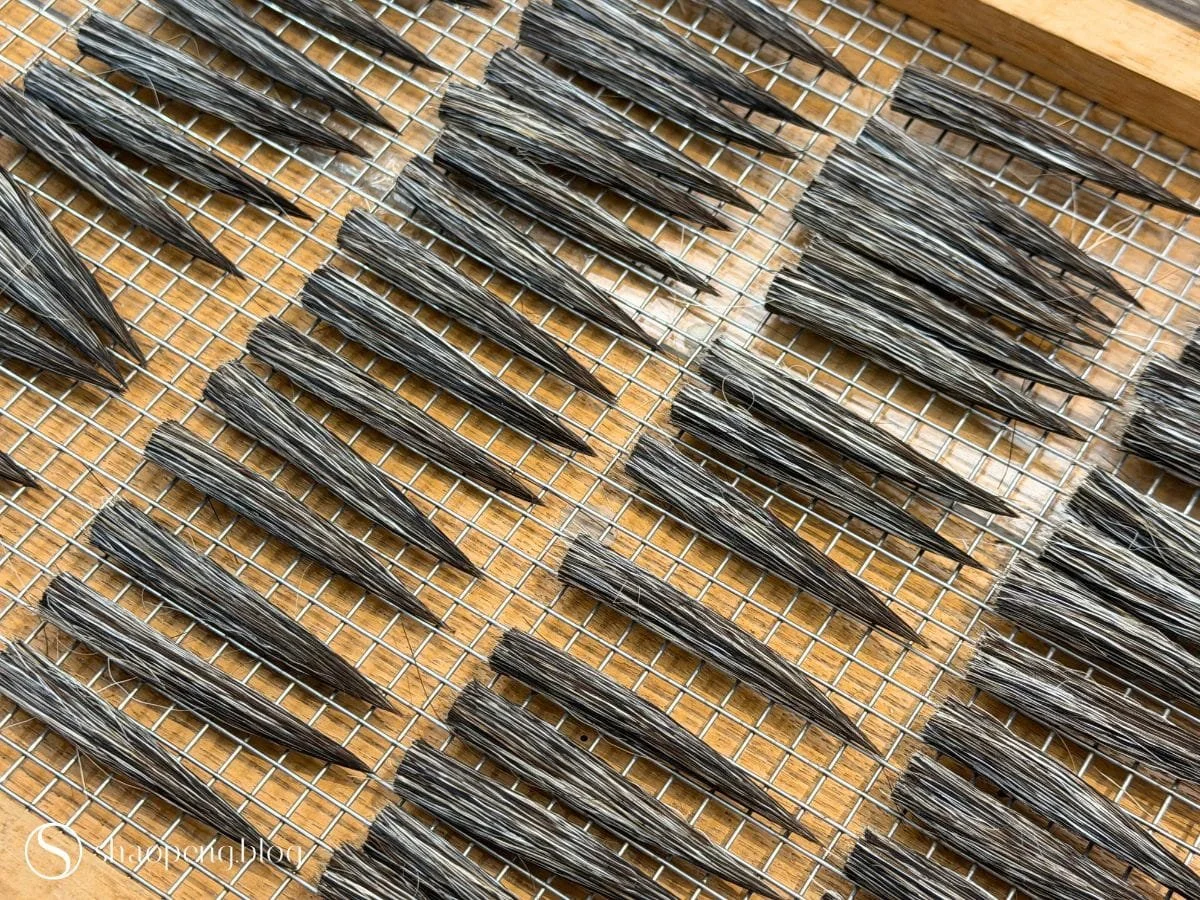
Bundles of animal hair for brush-making.
The blended core is then pushed through a koma, a small ring selected according to the desired brush thickness, before being wrapped in a fine outer layer. The base is bound with hemp thread, and the finished bundle is secured inside a bamboo handle.
My turn comes at the very end. Under the master’s guidance, I dip the brush head into funori, a seaweed-based glue, repeatedly until it is thoroughly soaked through to the core. I then use a long cotton thread to squeeze out the excess, turning the brush as I shape its pointed tip. After two or three rounds, my brush is finished.
Although I haven’t been involved in the entire process, I’ve completed the final steps with my own hands. Now that I understand how a brush is made from start to finish, I find myself approaching calligraphy differently.
I used to think of my brush simply as a writing instrument. Now, I see it as the result of an artisan’s many decisions, from selecting individual hairs to shaping the tip. I also see it as part of a craft that began in temples and continues to be passed down from one pair of hands to another.
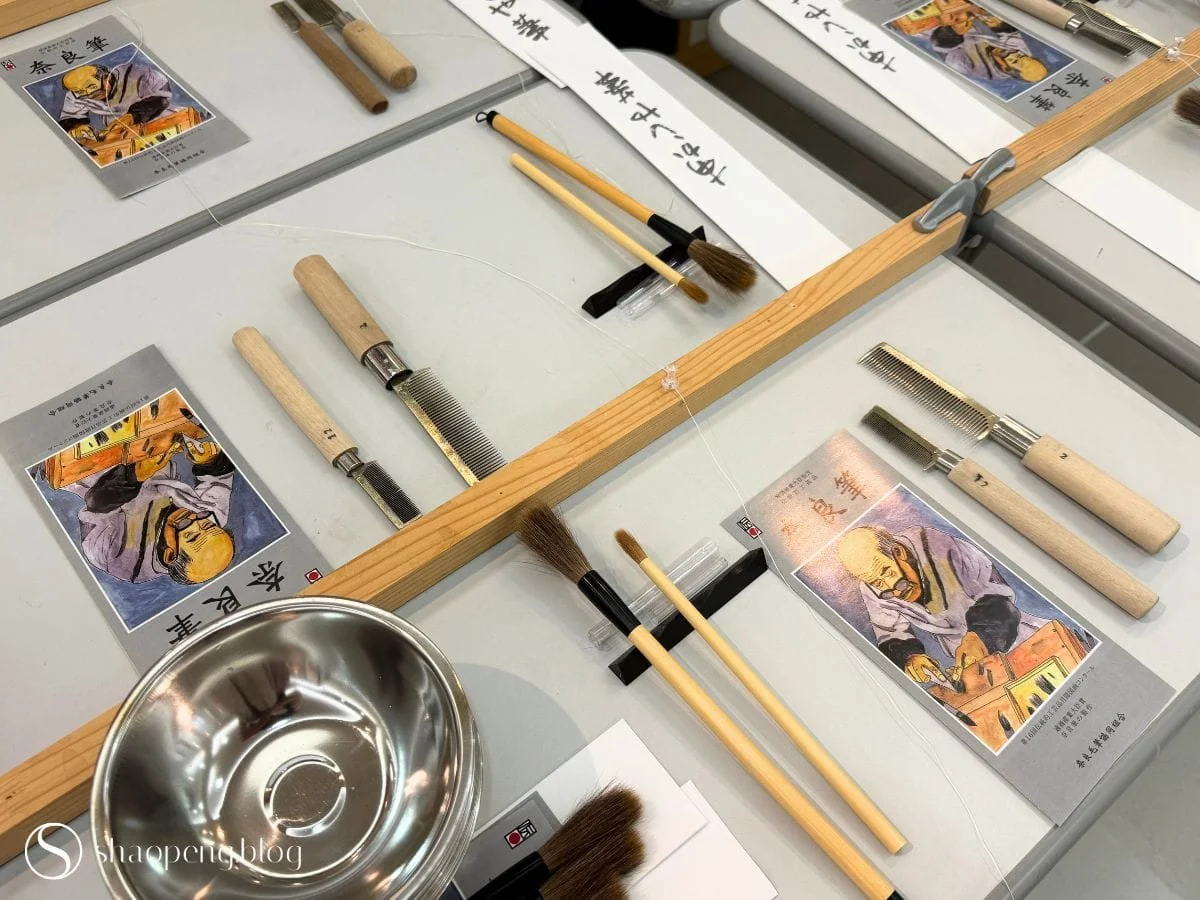
Calligraphy brush-making workshop at Akashiya, Nara.
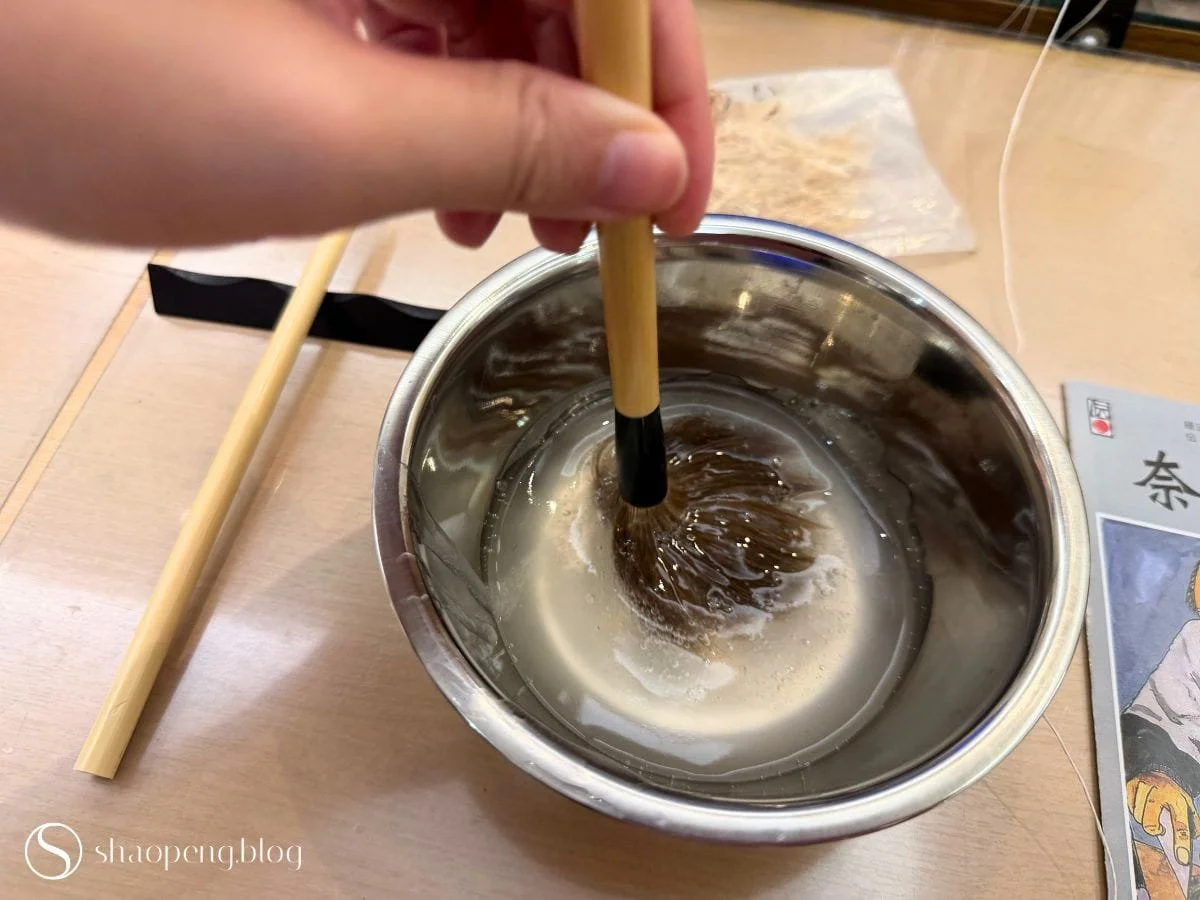
Dipping the brush head into funori, a seaweed-based glue.
Brush for Blessings
Akashiya also makes a type of brush called Shika no Makifude, which can be translated as “Sacred Deer Roll Brush.” I first spotted one at the Nara Craft Museum.
Historically made for exclusive use at a shrine, the brush has a core of deer hair wrapped in an outer layer dyed in five colours and shaped to resemble a gohei, a sacred wooden wand used in Shinto rituals. Over time, this sacred object has also become a popular gift and a symbol of good fortune.
The word maki in its name carries a history that reaches further back than Nara’s sacred deer. Early Japanese brushes are described as rolled brushes, with a core tightly wrapped in paper and then covered with hair, a construction that connects to Chinese brush-making traditions. More than a thousand years later, here is a brush dressed in five colours. It feels as though the craft has travelled a long way, only to return to its beginnings.
The deer roaming Nara’s streets are believed to be the divine messengers of the Kasuga deity, and I’ve spent much of my trip wandering among them. Shika no Makifude feels like a fitting souvenir: a brush with the deer of Nara at its heart. While most brushes are made to be used, this one will probably find a home in my drawer, beside the brush I made with my own hands. One for blessing, the other for writing.
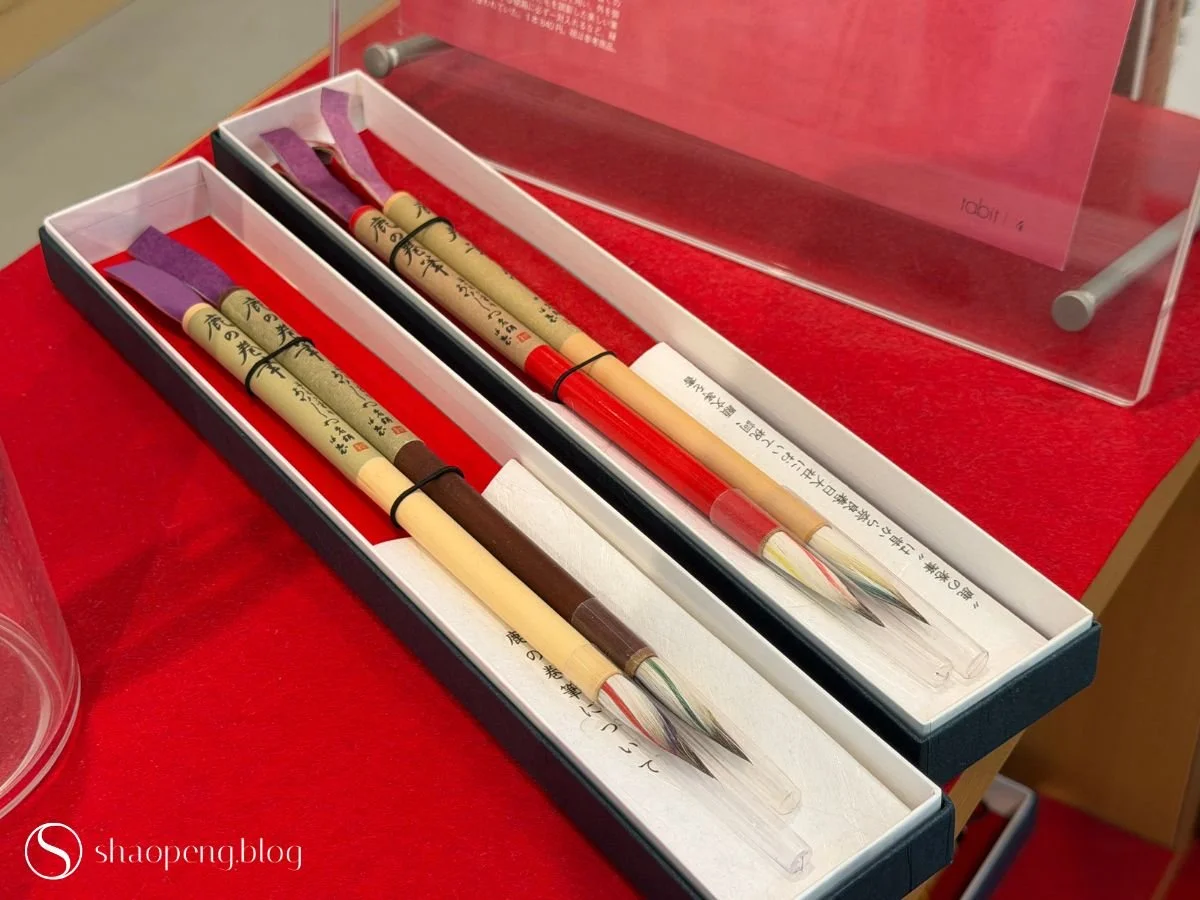
Shika no Makifude by Akashiya.
Wanderer’s tip — Although Akashiya is outside the city centre, it’s easy to reach by bus, followed by a short walk. If you’d like to try your hand at making a calligraphy brush, visit Akashiya’s website for workshop information. If you can’t make it out to Akashiya, the museum shop at Nara Craft Museum in the city centre is another place to find brushes made by local artisans.
You may also be interested in: