
Beneath Sharjah’s golden dome lies a constellation of wonders that opens onto the vast universe of the Islamic world.
Sense of Wander: ★★★★★
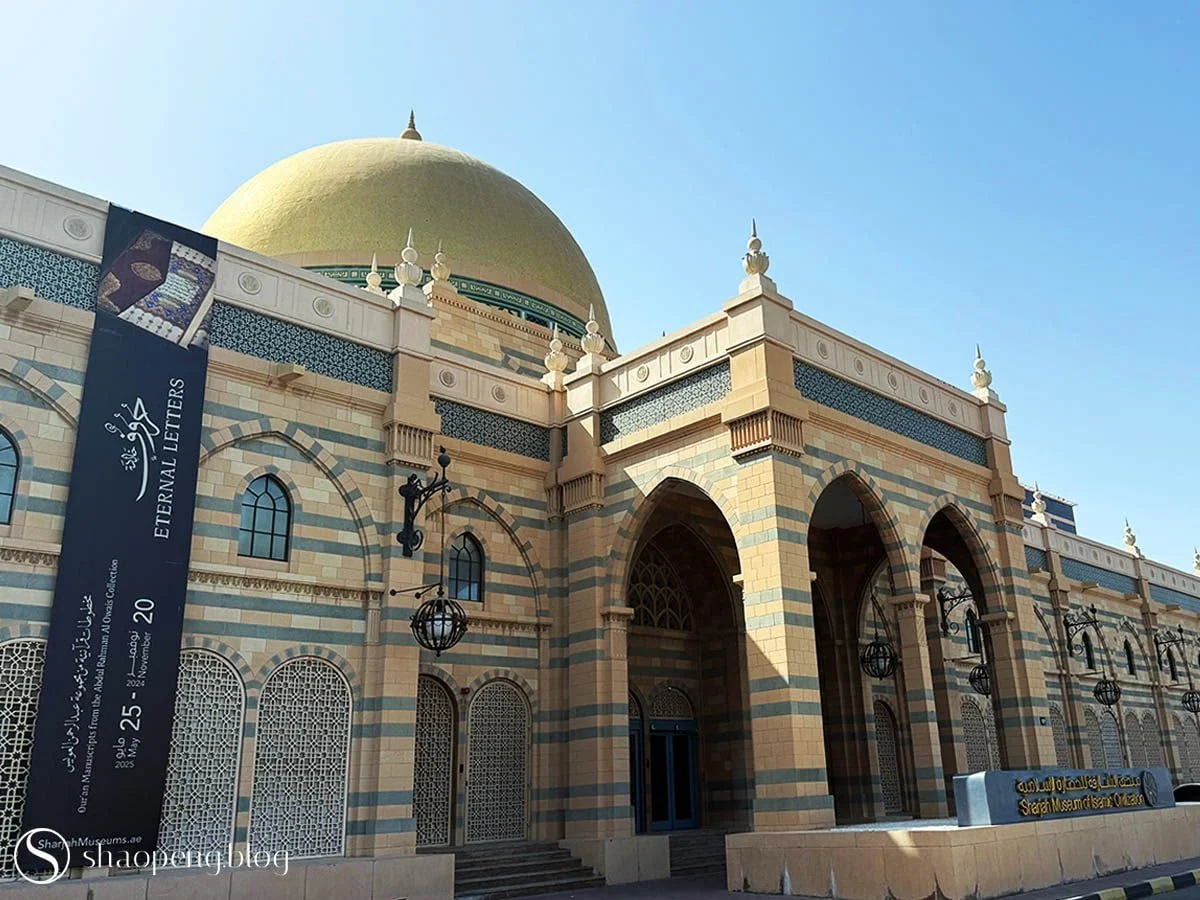
Entrance to the Sharjah Museum of Islamic Civilisation.
SHARJAH, UAE — Standing amidst Sharjah’s skyline is a golden dome that, at first sight, reminds me of the Dome of the Rock in Jerusalem, the oldest surviving monument of Islamic architecture. So, on my first trip to the cultural capital of the Arab world, I asked my taxi driver to take me beyond the city’s historic centre to the Sharjah Museum of Islamic Civilisation — the only museum of its kind in the UAE.
The Sharjah Museum of Islamic Civilisation is home to more than 5,000 objects spanning over 1,400 years. The journey begins on the ground floor in the Abu Bakr Gallery of Islamic Faith, which first orients visitors toward belief. Here, a green atlas silk bag once used to hold the key to the Kaaba bears Quranic verses embroidered in gold thread.
From there, visitors are led along the path of knowledge in the Ibn Al-Haytham Gallery of Science and Technology, which traces the often-overlooked contributions that Arab scientists and scholars made to the modern world.
Yet it is the museum’s permanent collection upstairs, spread across four galleries devoted to Islamic art, where I lose track of time.
Arranged chronologically yet grouped by material, the exhibits illustrate how Islamic faith and ways of life are embodied across a rich spectrum of material culture. From ceramics and glass to metalwork, jewellery, manuscripts, woodwork, textiles, and armour, each object seems designed to carry faith rather than just depict it.
In Gallery 1, a map sketches the vast geographical reach of the Islamic world, stretching from northwestern Africa and southern Spain across Turkey, Iraq, Iran, Central Asia, and India, all the way to Southeast Asia. Among the treasures are ceramic bowls and plates from Nishapur and Samarkand, many inscribed in Kufic script with blessings, proverbs, and gentle moral reminders, making them feel like postcards sent across the centuries.
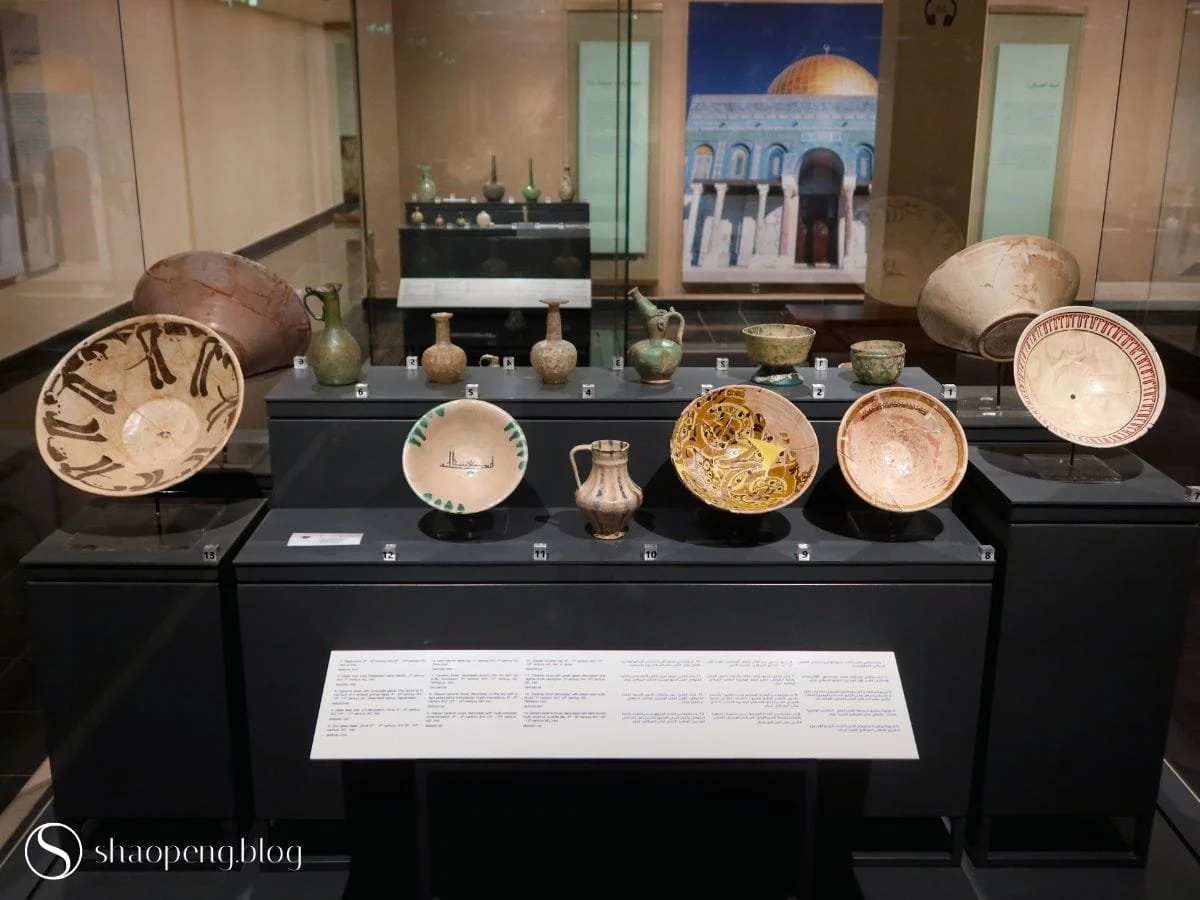
Ceramic bowls and glass vessels from the early period of Islamic civilisation.
In the Islamic world, calligraphy is a form of devotion. It was born from the desire to transmit the word of God (Allah), and for that reason has long been regarded as the highest form of artistic expression. The museum holds several Quran manuscripts from different eras, including a folio from the celebrated Blue Quran bearing verses from Surah Al-Nisa.
But writing does not remain confined to parchment or paper. It extends onto stone, metal, woodwork, and textiles, among other surfaces. Funerary fragments from Syria and Egypt bear Kufic inscriptions so richly ornamented that the boundary between script and decoration begins to dissolve. Even the jewellery case, filled with silver rings whose stones are engraved with Arabic letters, seems to whisper more than it glitters.
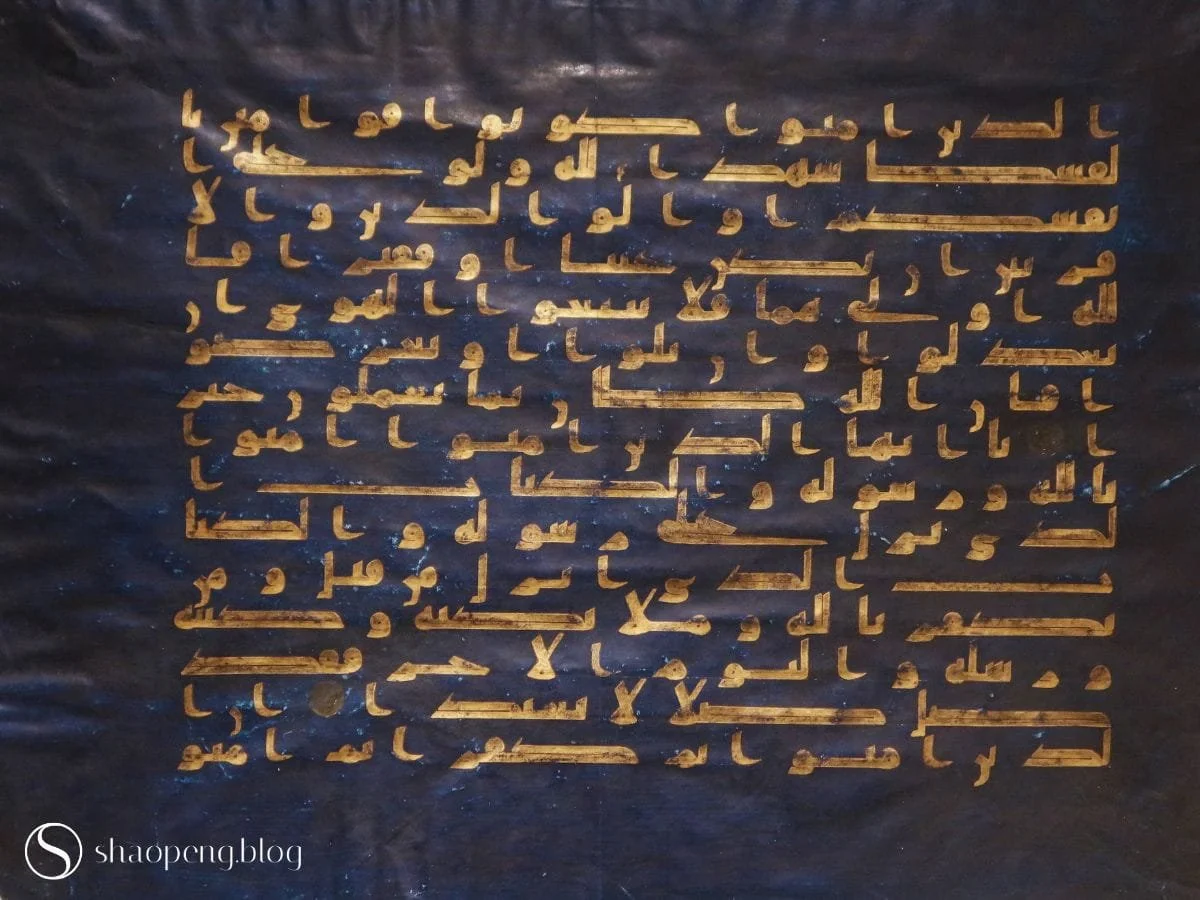
A folio from the Blue Quran featuring verses from Surah Al-Nisa.
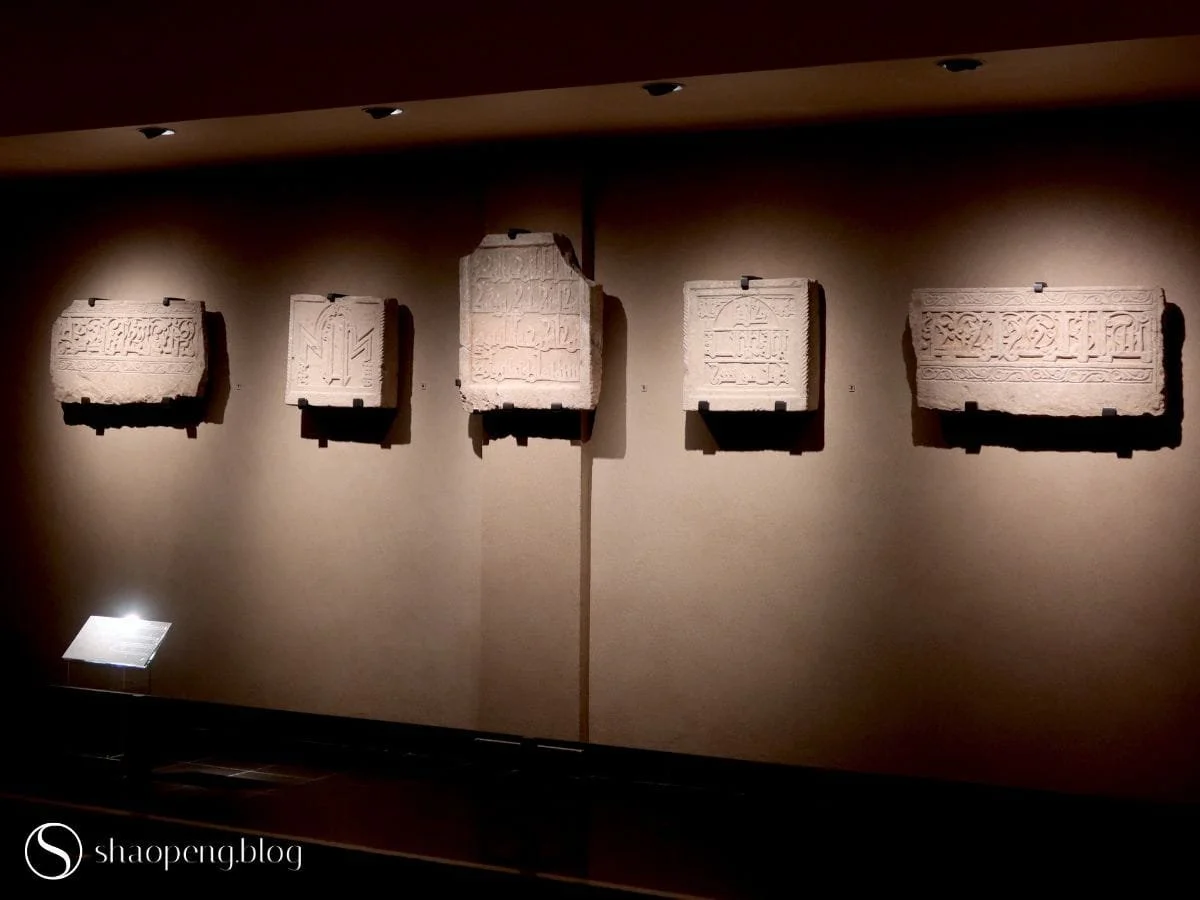
A selection of stone plaques from Syria and Egypt, dated to the 10th–11th centuries, bearing calligraphic inscriptions.
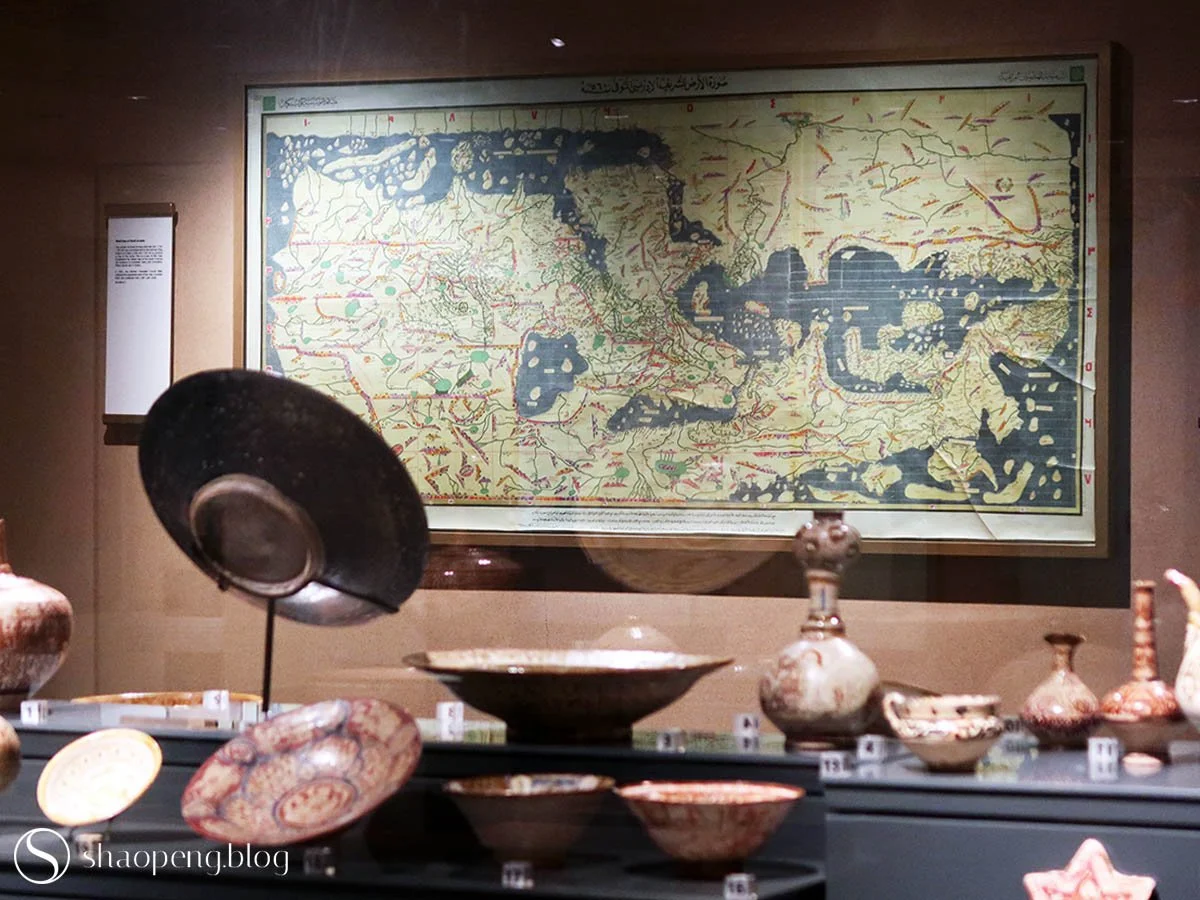
Al-Idrisi’s map provides a fitting backdrop for the artefacts on display
Then you find yourself standing before what is known as the oldest surviving world map, drawn by Muhammad Al-Idrisi (1100-1164) for the Norman King Roger II (1130-1154) of Sicily, its place names inscribed in Arabic. I had seen fragments of this map before in books, but nothing prepares you for the experience of seeing it fill an entire wall.
Poetry, too, found its way onto everyday objects. In the pottery of Kashan, in western Iran, during the 12th and 13th centuries, verses of love and longing curl around painted figures of young men and women, as if heartbreak needed somewhere ordinary to live.
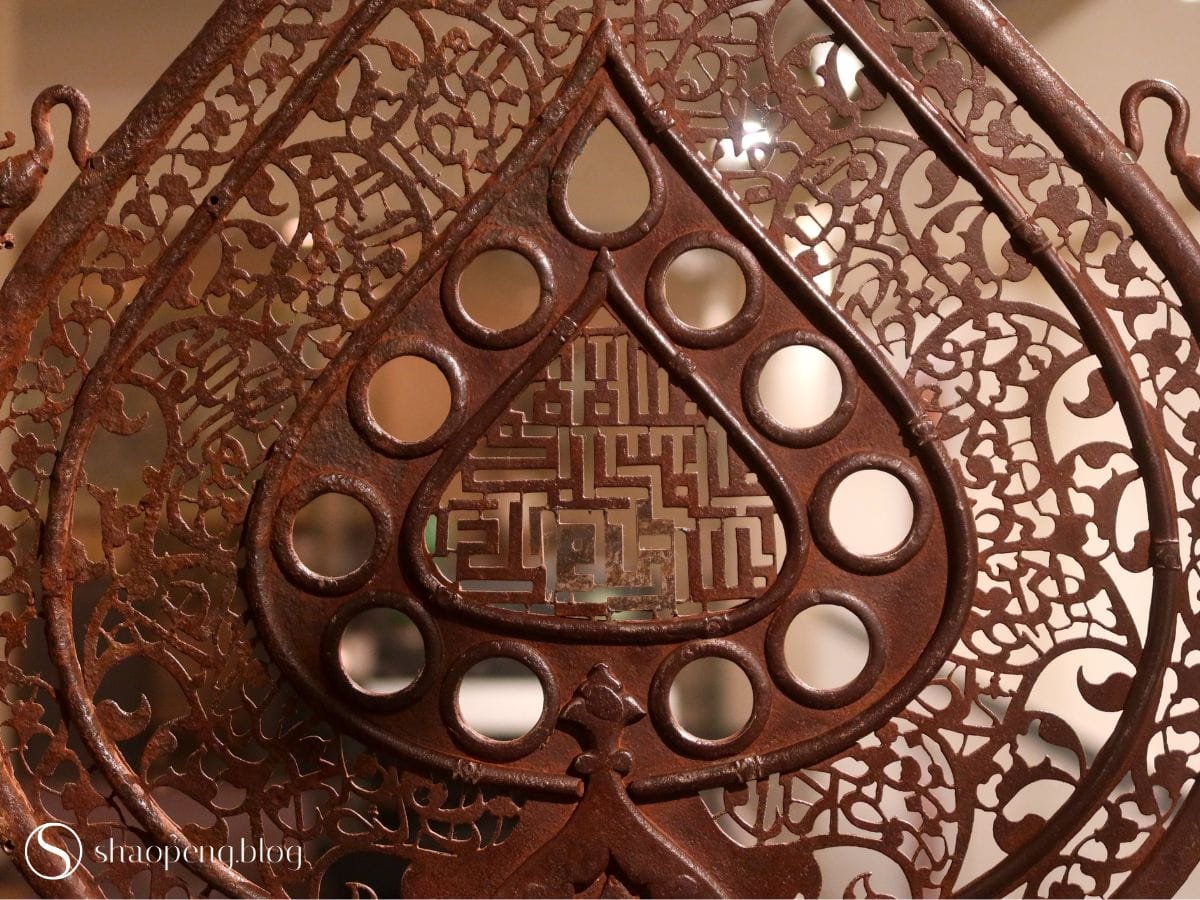
Detail of a processional stand from 17th-century Isfahan, featuring pierced decoration with Kufic calligraphy.
Gallery 2 explores three of the greatest Islamic empires — the Ottomans, Safavids, and Mughals — who were also rivals at the time. Each is known for a remarkable flourishing of artistic and cultural production, shaped by its own distinct visual language.
While calligraphy, arabesque, and geometry remain the holy trinity of Islamic art, artisans were by no means confined to abstraction; realism, too, had its place. An ivory sword handle carved in the shape of a mythical creature, dating to the 17th or 18th century, sits among the crafts and weaponry in Galleries 3 and 4. This is a reminder that fantasy and craftsmanship have long moved in close company.
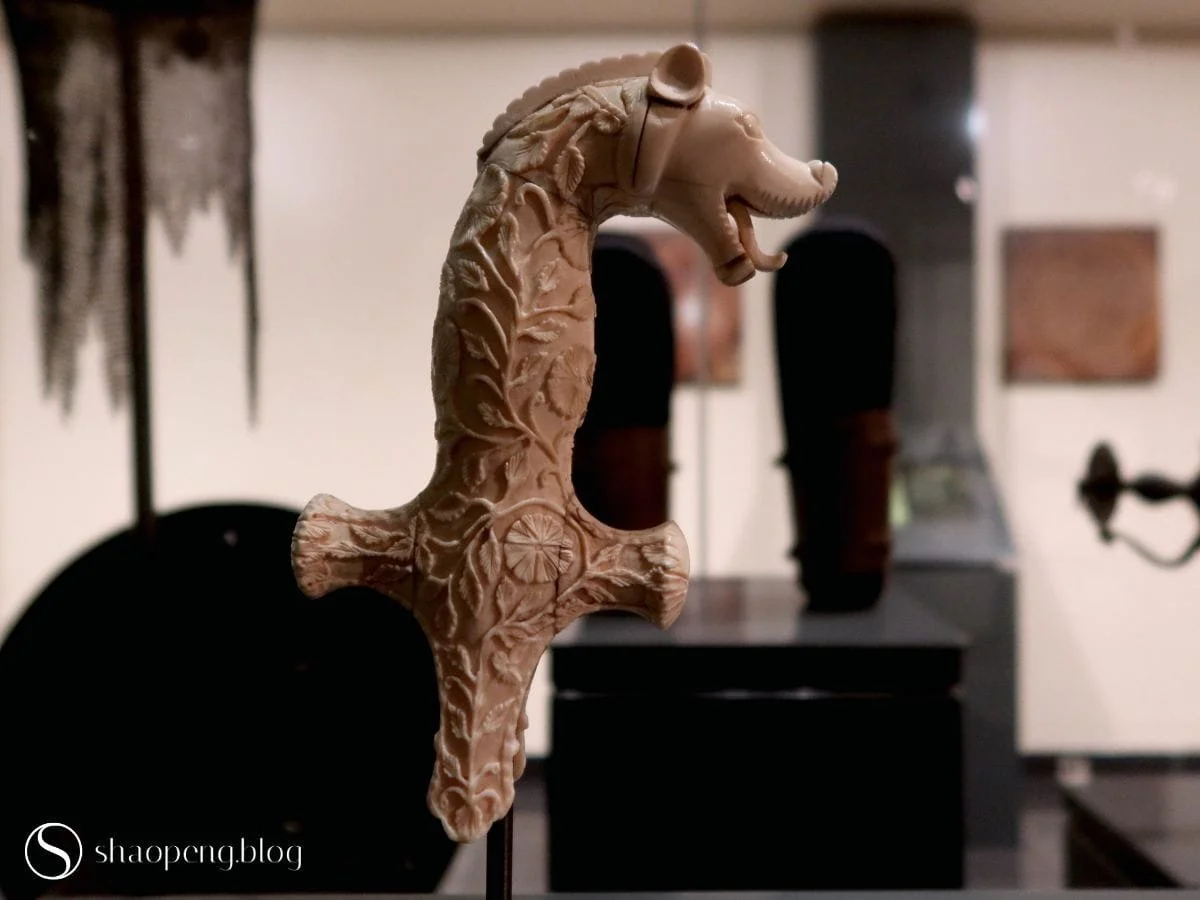
This ivory sword handle is intricately carved in the form of a mythical creature, its body adorned with vegetal motifs.
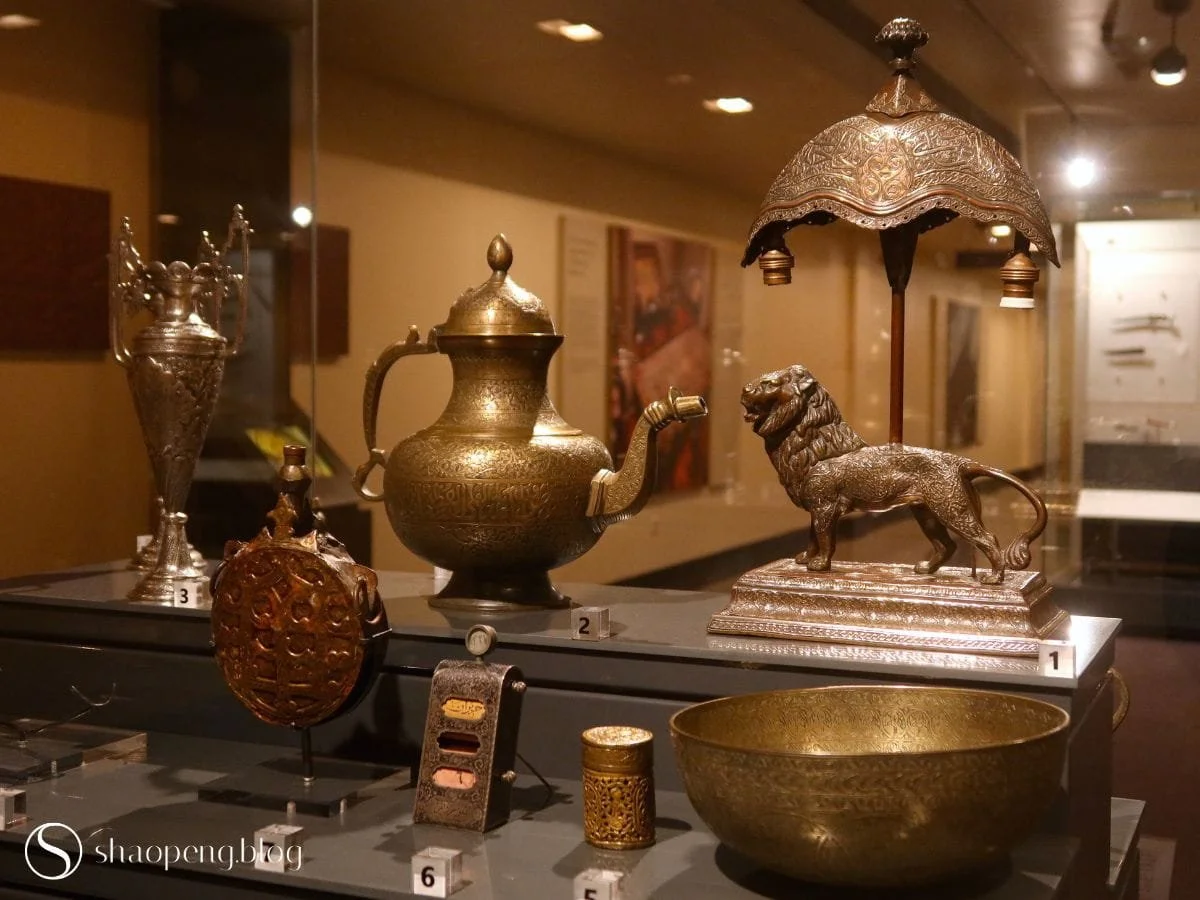
An electric lamp, dated to the 19th–20th century, is among the objects likely made in the Islamic world for European markets.
The 19th century brought European collectors into this world — among them Frederick Lord Leighton, who built his own “Arab Hall” inside his London home, now open to the public as Leighton House.
Here the museum’s tone turns slightly wistful: an electric table lamp featuring a sculpted lion base underneath a canopy, likely made for a European collector enchanted by Islamic aesthetics; beneath it, a 1860s Ottoman paper calendar tucked into a nielloed silver case, caught somewhere between East and West, old world and new technology.
I almost miss the best part. On the way out, a staircase leads you to the central atrium where, beneath the golden dome, a celestial mosaic hovers overhead. It depicts the twelve zodiac constellations with small ceramic pieces and 24-carat gold accents.
Seen from below, the work feels like a fitting distillation of what the Sharjah Museum of Islamic Civilisation offers: faith, science, art, and the history of empires presented here as only a small constellation within a far vaster universe of the Islamic world.
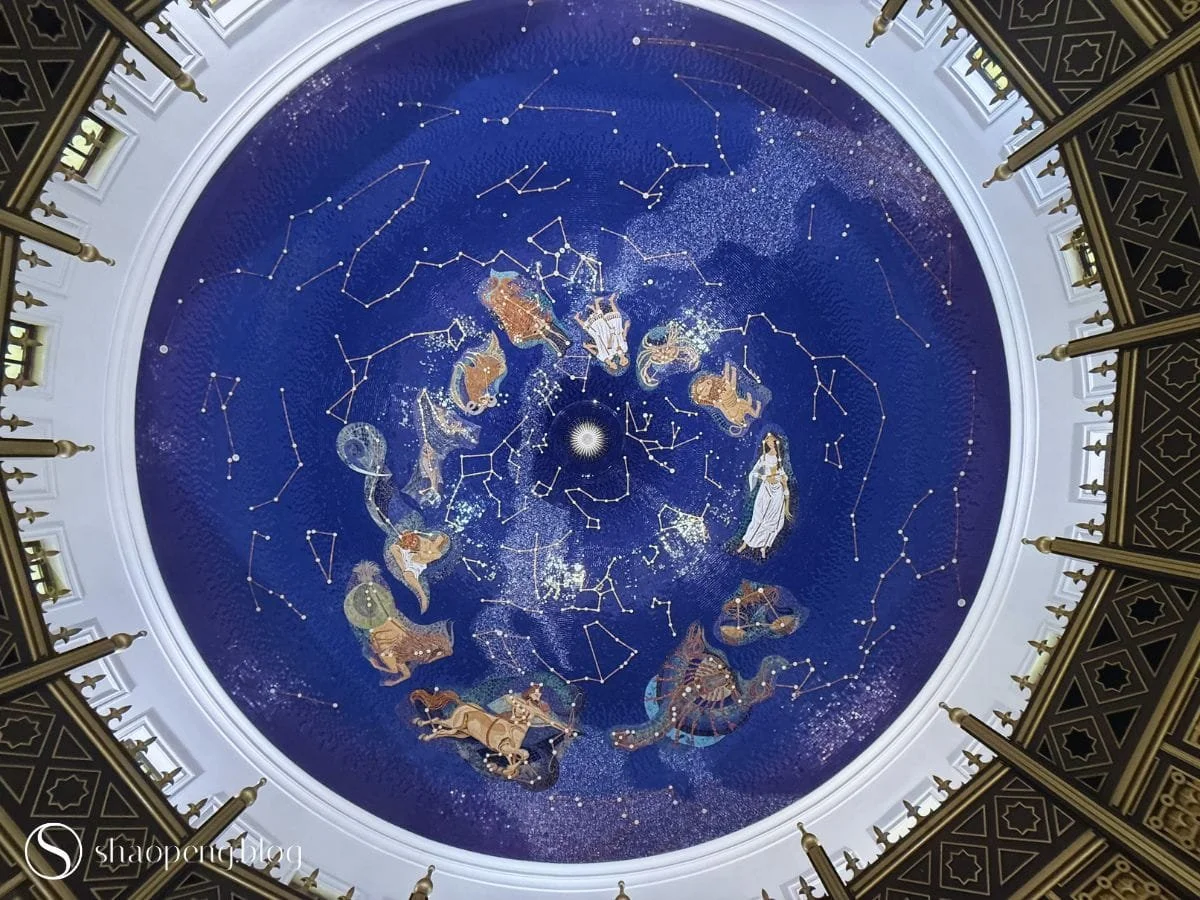
The celestial mosaic on the interior of the central dome at the Sharjah Museum of Islamic Civilisation.