
Wander in Dubai: Expo City, After the World Moved On
Most visitors to Dubai never make it to the end of the Red Line, but those who do find something the city doesn’t advertise: the remains of a world’s fair where three pavilions still stand to make their case for the future.
Sense of Wander: ★★★★☆
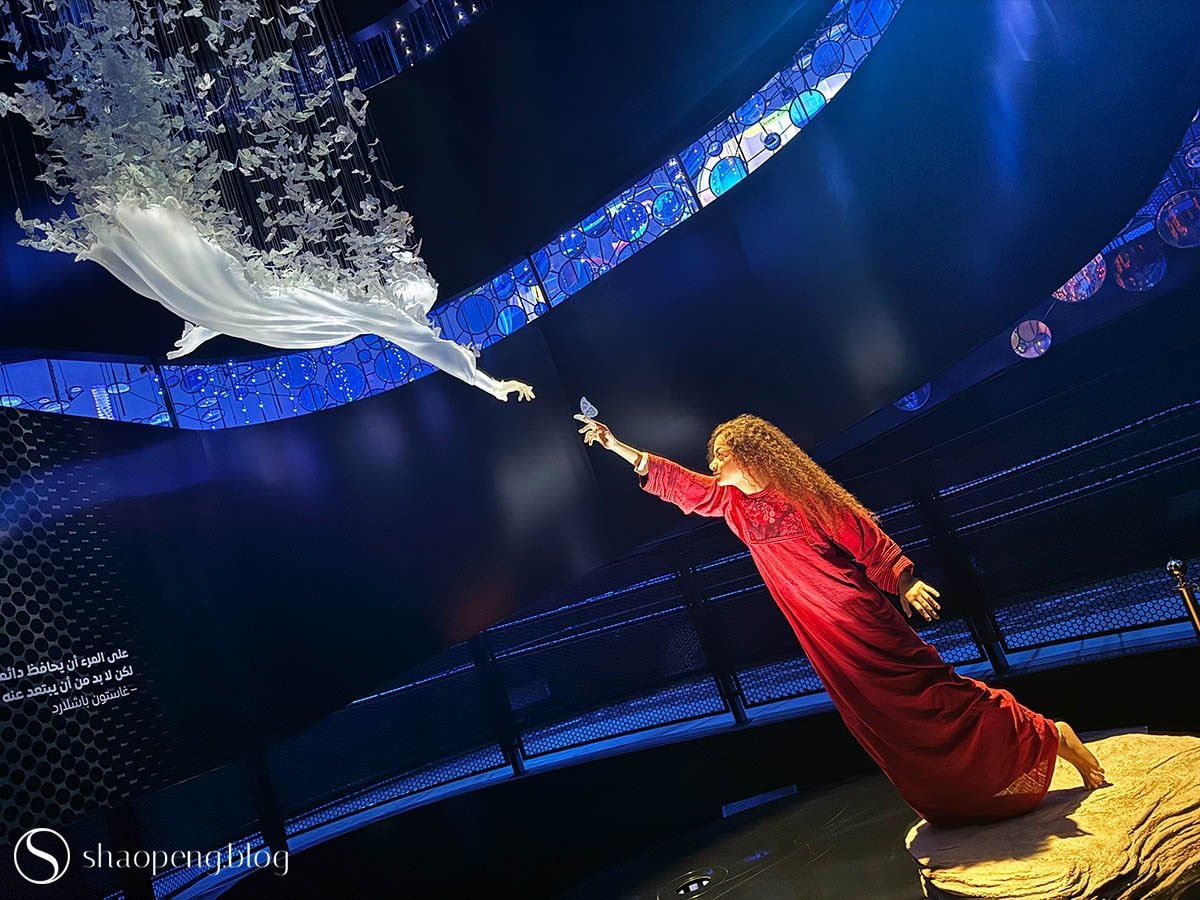
This installation offers a contemplative closing to the Alif exhibition.
DUBAI, UAE — My visit to Expo 2025 in Osaka had settled something within me, allowing me to see what a World Expo could offer. So when I learned that Dubai had hosted the previous edition in 2020, my curiosity - as it tends to do - made the decision for me: I would ride the Red Line to its southernmost point and find out what a world’s fair looks like after the world has moved on.
The heat hits me as soon as I step out of the metro station. Nearly 40 degrees, and I’m already second-guessing my decision to walk. Thankfully, a taxi driver appears, almost as if he had been expecting me. Five dirhams, he says, and he’ll take me anywhere within the grounds. With the blazing sun and oppressive heat, I hop onto the buggy without hesitation.
Expo City Dubai at noon in summer is nothing but stillness. The wide boulevards are empty, the plazas unoccupied, the grand pavilions standing in the heat like monuments to a party that ended years ago. The only movement comes from the occasional buggy drifting past in the distance — ours and theirs exchanging a kind of wordless acknowledgment across the silence. But emptiness, I’ve learned, strips a place down to its core, and what remains here is worth seeing.
Much of the temporary city that was built for Expo 2020 has since been dismantled or repurposed, but three pavilions remain open:
Vision
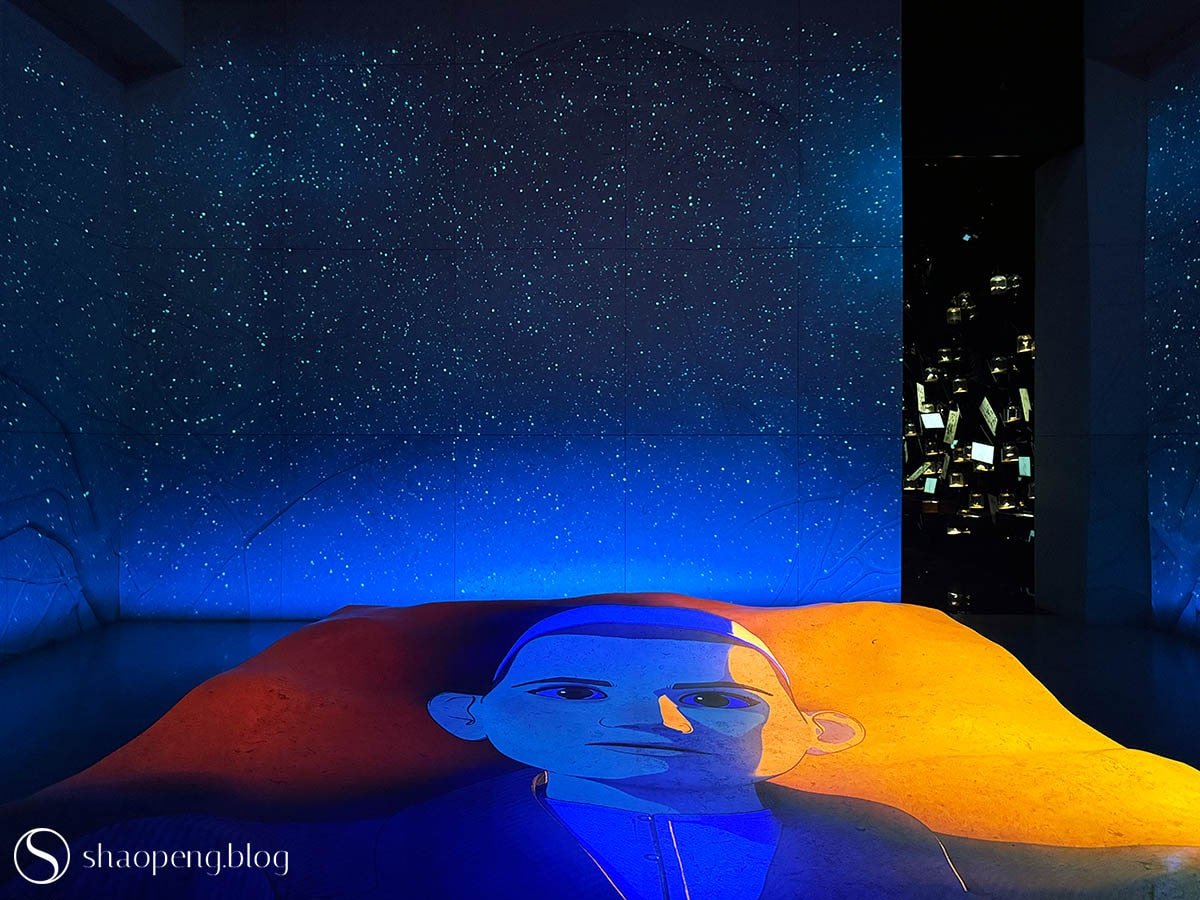
Vision begins with an animation tracing Sheikh Mohammed bin Rashid Al Maktoum’s experience in the desert.
The Vision Pavilion is unlike the others. It doesn’t speak of the world at large or the planet’s uncertain future, but dedicates itself to one man: Sheikh Mohammed bin Rashid Al Maktoum, Vice President and Prime Minister of the UAE and Ruler of Dubai.
The first thing that greets you at the entrance is a phrase attributed to him:
“وفقني الله وإياكم لخدمة البلاد والعباد”
"May God grant me and you the ability to serve the nation and its people."
This sets the tone for everything that follows.
The exhibition draws from My Story, a collection of personal anecdotes published to mark the Sheikh’s 50 years in public service. As it happens, I had picked up a copy at Kinokuniya a few days before, though I had not yet had the chance to read it through. Walking through the pavilion felt, in some ways, like reading the chapters I hadn’t gotten to yet.
The first room is an immersive theatre that brings the third chapter of My Story, “Sleeping with Scorpions,” to life. It traces the Sheikh’s footsteps as a young boy, sent into the desert in the company of Humaid Bin Amhi, a member of the Manasir tribe. There, he learned the desert’s way of living: how to hunt, how to read the land, and how to survive poisonous scorpion bites. The room doesn’t romanticise the hardship but lets it speak for itself, offering a peek into the formative experiences that shaped the leader Dubai would come to know.
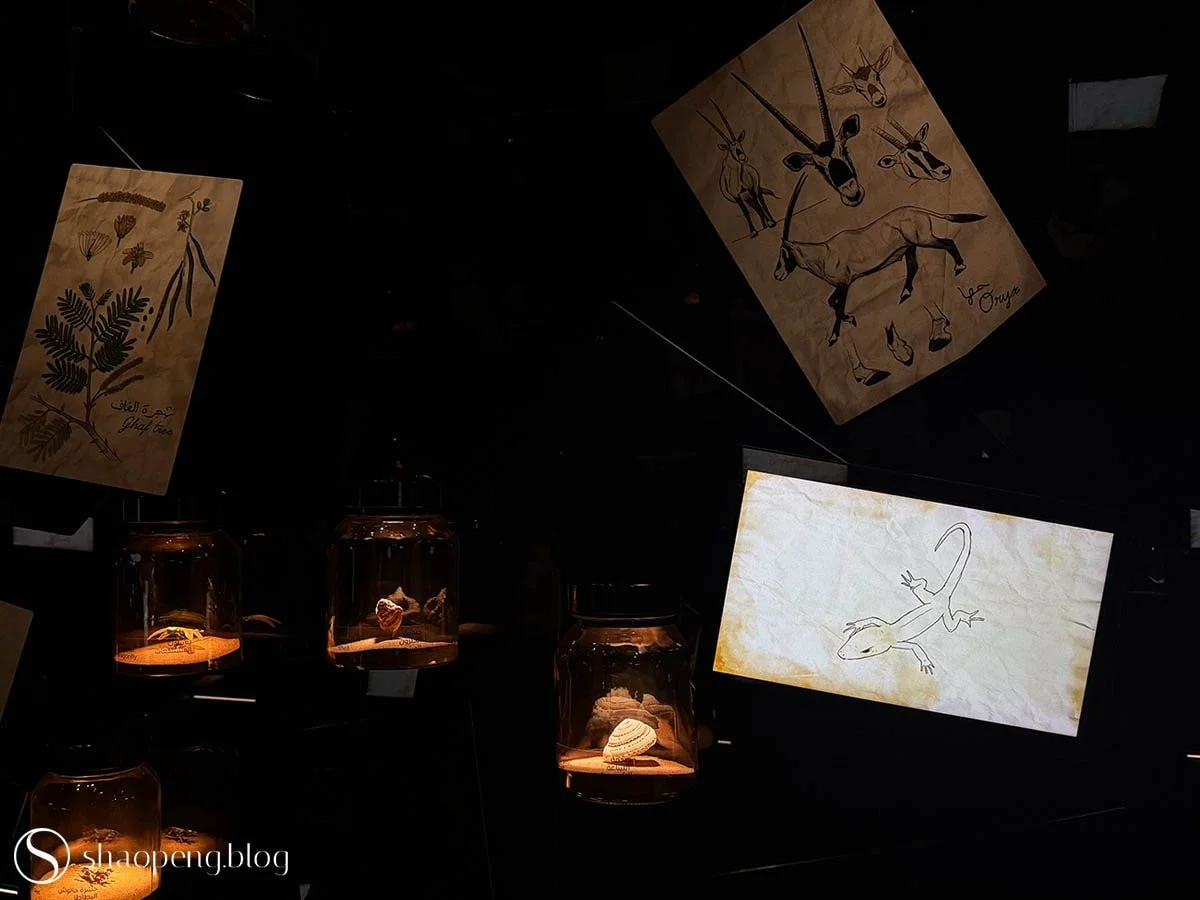
This room of curiosities illuminates the Sheikh’s fascination with the natural world.
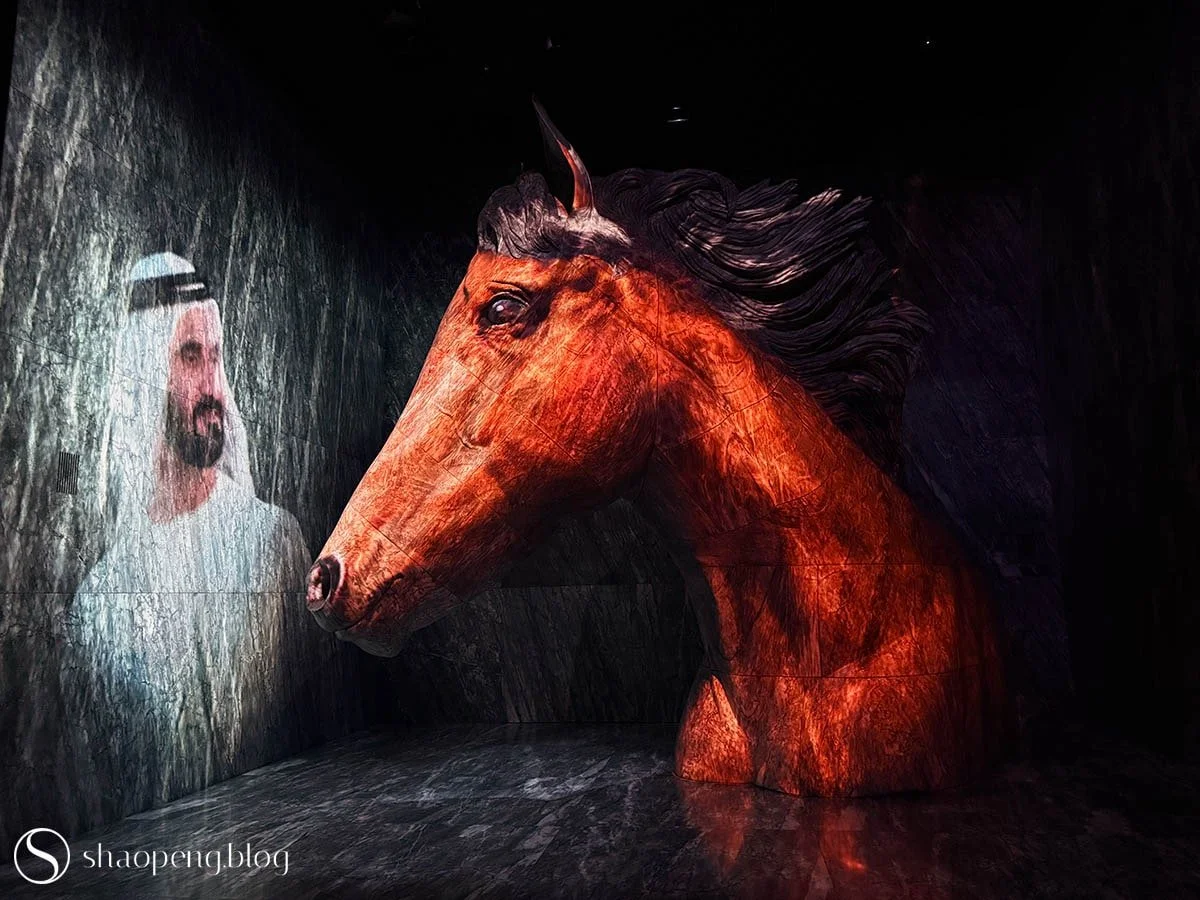
The Sheikh’s passion for horses and poetry is brought to life through an immersive display.
The second room is akin to a cabinet of curiosity, arranged in such a way that it makes you feel like a child who has wandered into someone else’s study uninvited and doesn’t want to leave. Specimens, sketches, toys, books, and relics fill the space, each one a window into the Sheikh’s lifelong fascination with the natural world and the thrill of discovery. Among the display cases sits a collection of replica artefacts from Saruq Al Hadid, an archaeological site the Sheikh reportedly spotted from a helicopter.
Further on, rooms are dedicated to the Sheikh’s passions for horses and poetry, and the centuries-old pearl diving industry that brought wealth to the region, particularly in the 18th and 19th centuries.
The Sheikh spent summers on local pearling boats as a young man, and the particular toughness of life at sea convinced him that Dubai could not afford to rest its future on any single industry. That conviction, more than any grand policy, is perhaps what set the emirate on its course toward the economic diversity it is known for today.
The overhead display in the pearling section — an unusual perspective that asks visitors to look up and see the pearl diver collecting oyster shells from below — is the one that stays with me the most.
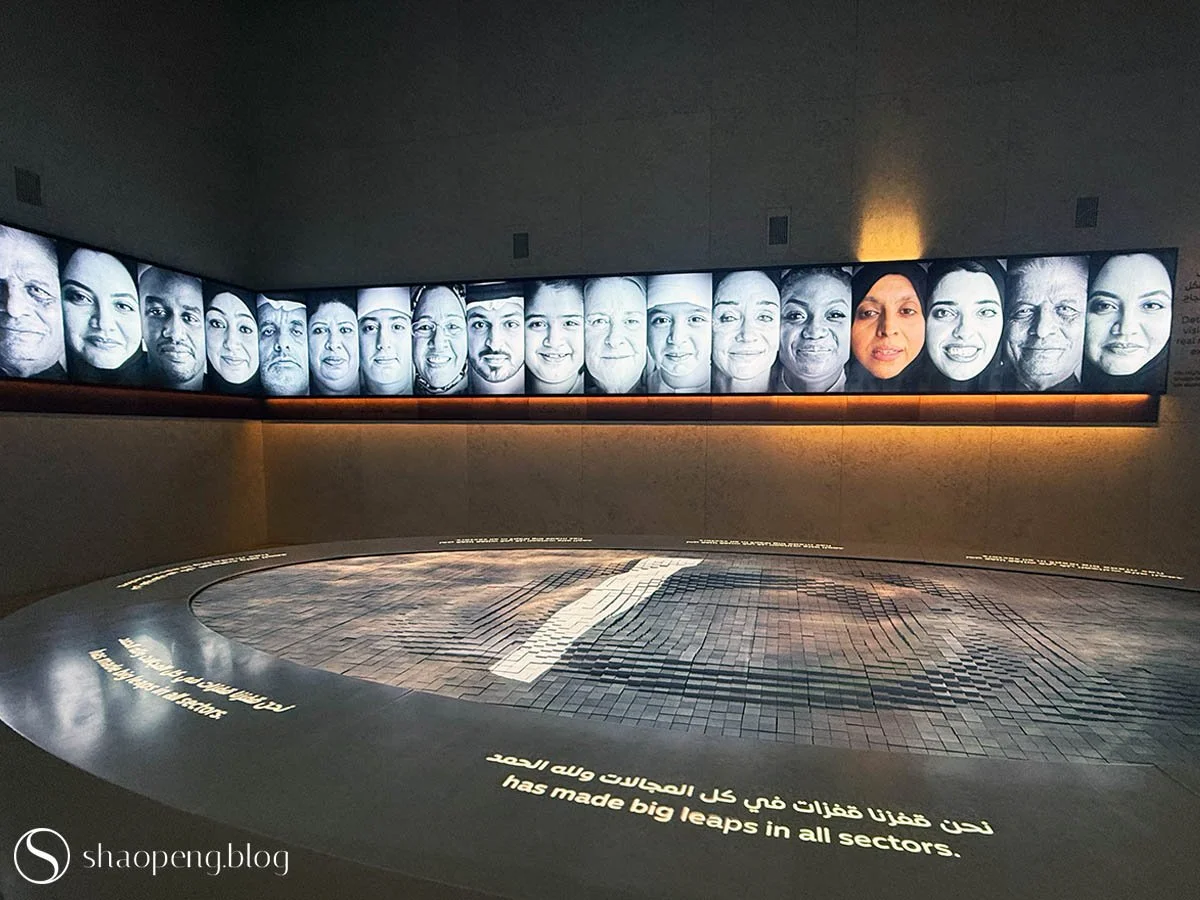
The exhibition at Vision draws to a close with the voices of Dubai’s citizens.
Sheikh Mohammed’s vision for Dubai, inherited from that of his father and grandfather, led Dubai’s exponential growth from a small village to an international metropolis.
But the story of Dubai, as the final room seems to argue, is not only his story; it belongs to the nearly 200 nationalities who have made the emirate their home. Here, citizens of Dubai take turns to recount their own thread of the city’s larger narrative. It is, quite unexpectedly, the most moving section at Vision.
It labels Dubai as “a city of hope” — not only for those who arrive seeking better lives, but for a kind of future the wider world seems to be searching for. Vision traces that arc from desert to metropolis, and ends on a note that feels less like a conclusion than an invitation: this is only the beginning of the story.
Wanderer’s tip — Entry is by guided tour, assigned upon arrival. The journey takes around 20 to 30 minutes.
Terra
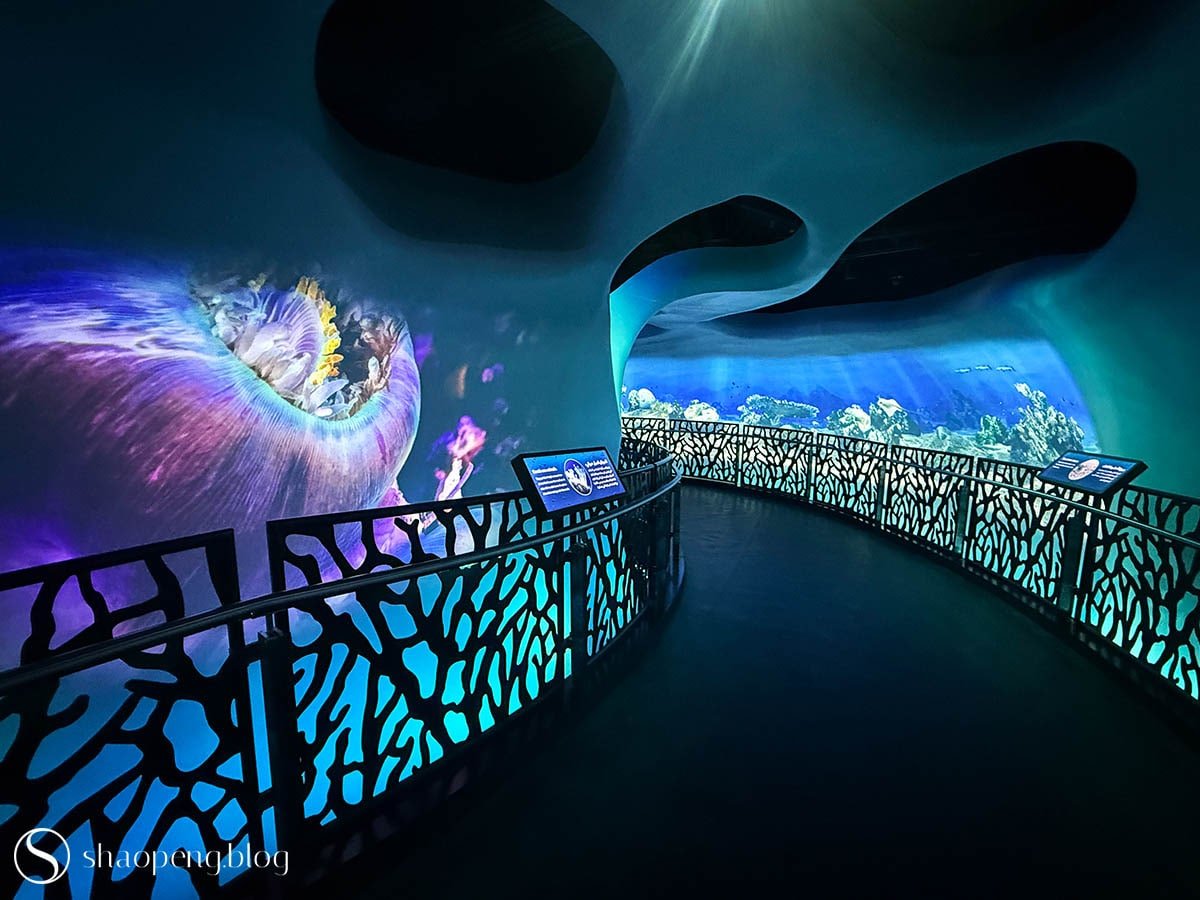
In Under the Ocean exhibition at Terra.
If Vision turns inward, Terra turns to outward to the ocean floor, the forest canopy, and everything we have been doing to both.
The visit begins underwater. A tunnel pulls you into a simulated ocean floor, where corals bloom across the walls and the low, groaning calls of marine creatures fill the air. Jellyfish drift past in silence. For a moment, you almost forget that you are standing in a pavilion in the middle of a desert.
Emerging from the tunnel, you step into the Sea of Consumption, a sobering account of the plastic waste we feed to the ocean each year. The exhibition doesn’t lecture so much as confront. My favourite corner is a section called Would You Rather? — a row of pull-bar stations that pose questions with no comfortable answer. Would you rather never see an ocean again, or never see a forest again? The questions are harder than they sound, and a scoreboard at the end tallies how visitors have responded, turning individual hesitation into something collective and unsettling.
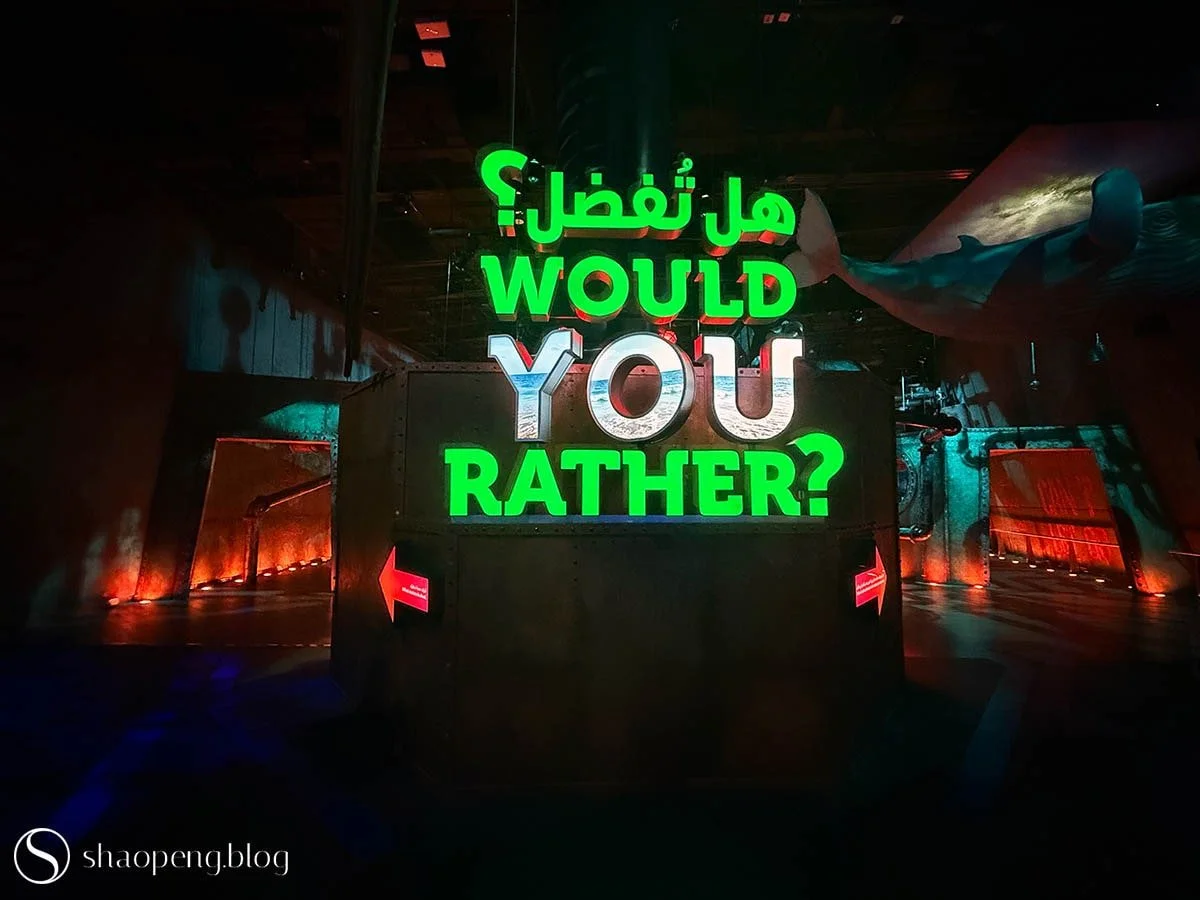
The “Would You Rather?” corner anchors the exhibition at Terra.
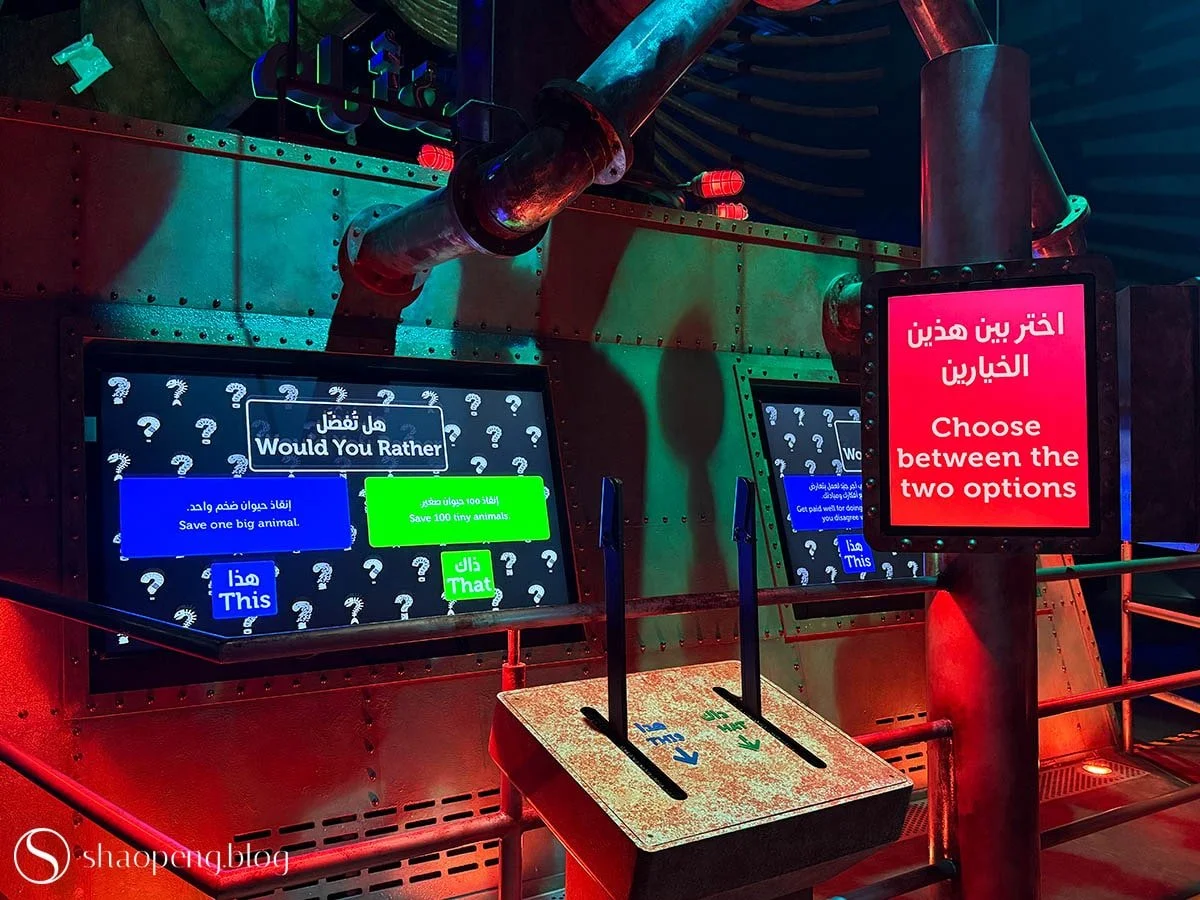
A row of pull-bar stations encourages visitors to reflect on some of life’s most difficult questions.
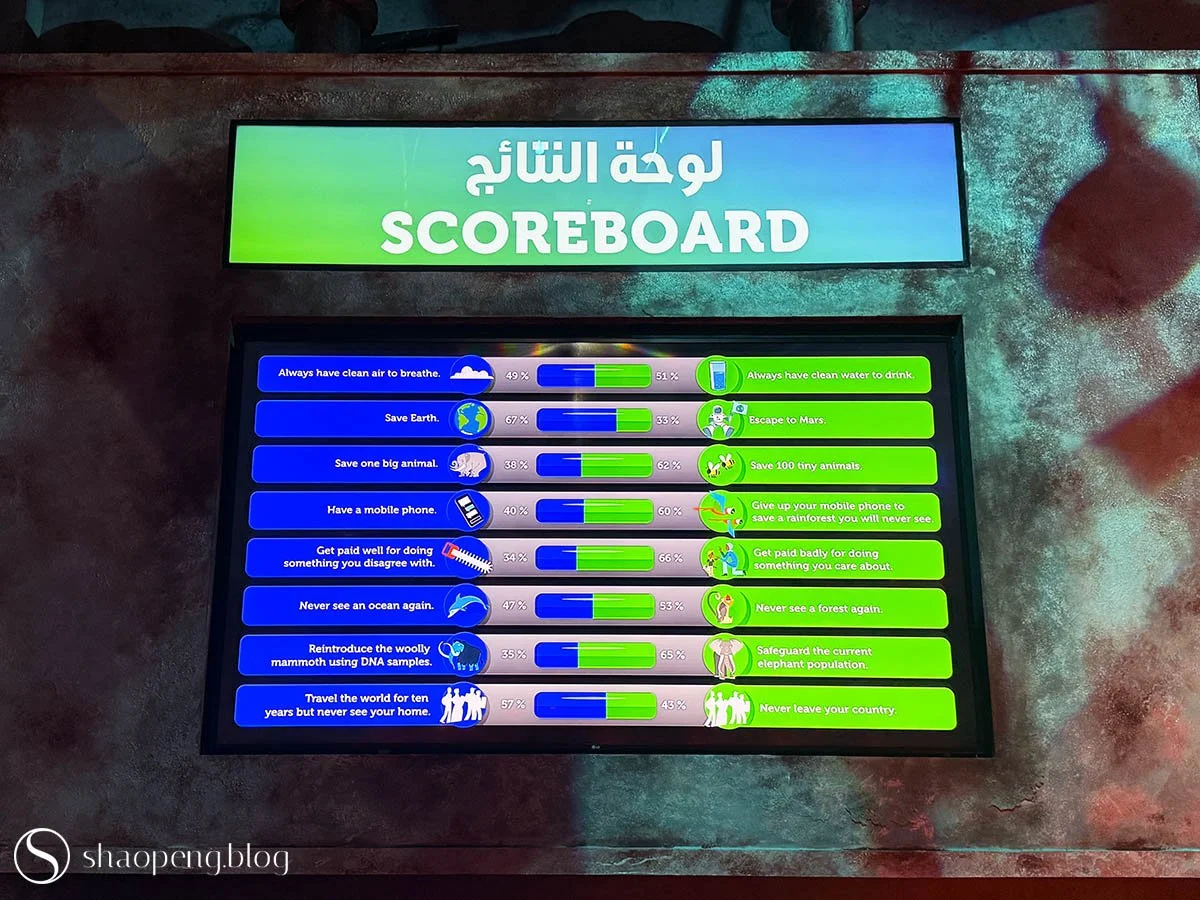
A live scoreboard tracking responses to the “Would You Rather” questions.
The other half of the pavilion takes you to a different direction: beneath the forest floor. Here, the scale of what happens underground would surprise you.
The largest trees, the exhibition notes, move two tonnes of water from soil to leaf every single day. Trees negotiate with fungi, offering sugary rewards in exchange for minerals and water, all through a vast underground network that researchers have taken to calling the “wood wide web” — a system of communication and exchange that stretches beneath entire forests.
Half of the forest, it turns out, exists below the soil entirely. Knowing this stirs something in how you see the world above ground.
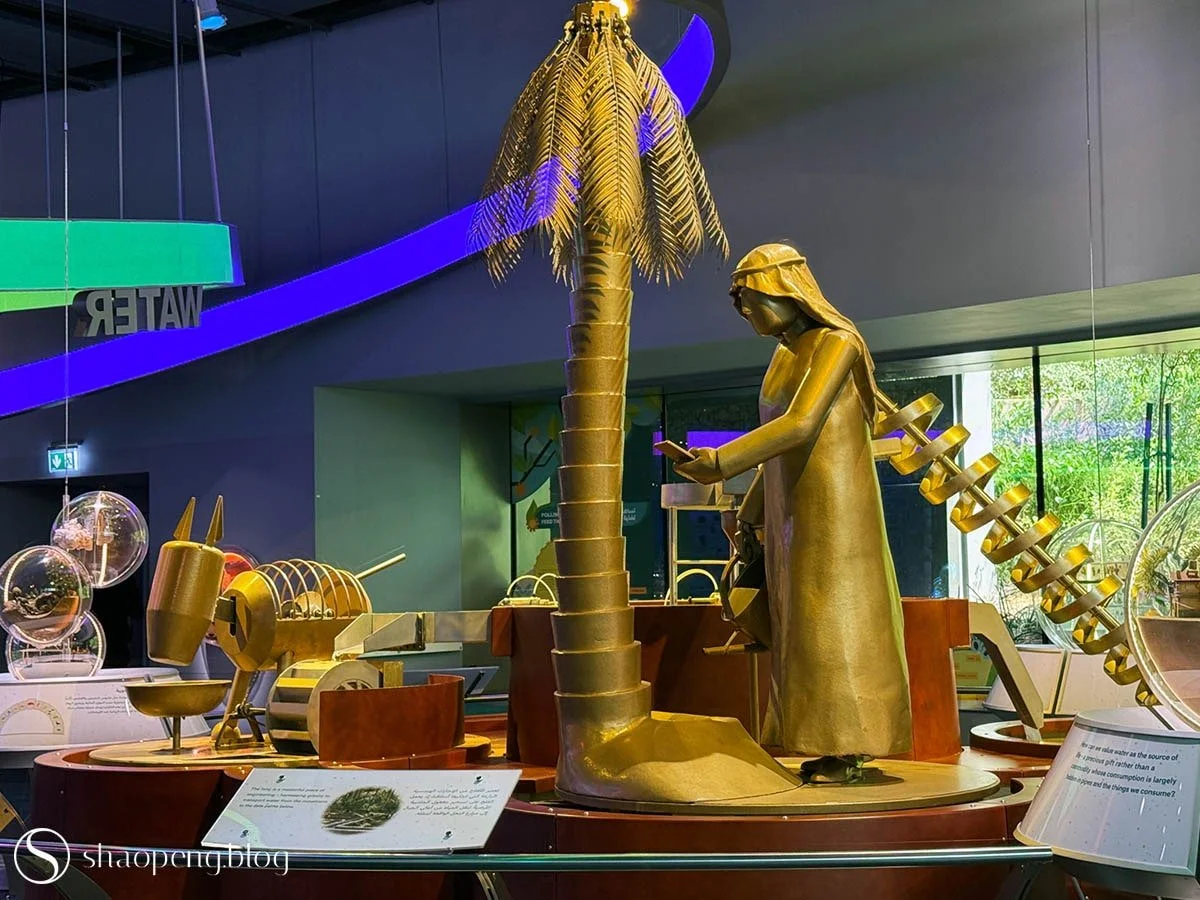
Falaj installation at Terra.
Between the two exhibitions, a falaj installation occupies the connecting hall — and it is, for me, the single most memorable thing in the pavilion. The falaj is an ancient feat of engineering: a system of channels that harnesses nothing but gravity to carry water down from the mountains to the date palms below. Here, visitors can turn a wheel to set the water moving, and if you stay long enough, you’ll notice the palm tree’s leaves begin to unfurl — opening, frond by frond, like a flower coming into bloom.
Wanderer’s tip — Complimentary buggy service runs between pavilions. Check with staff on site and they will coordinate the ride for you. Set aside at least an hour for your visit at Terra.
Alif
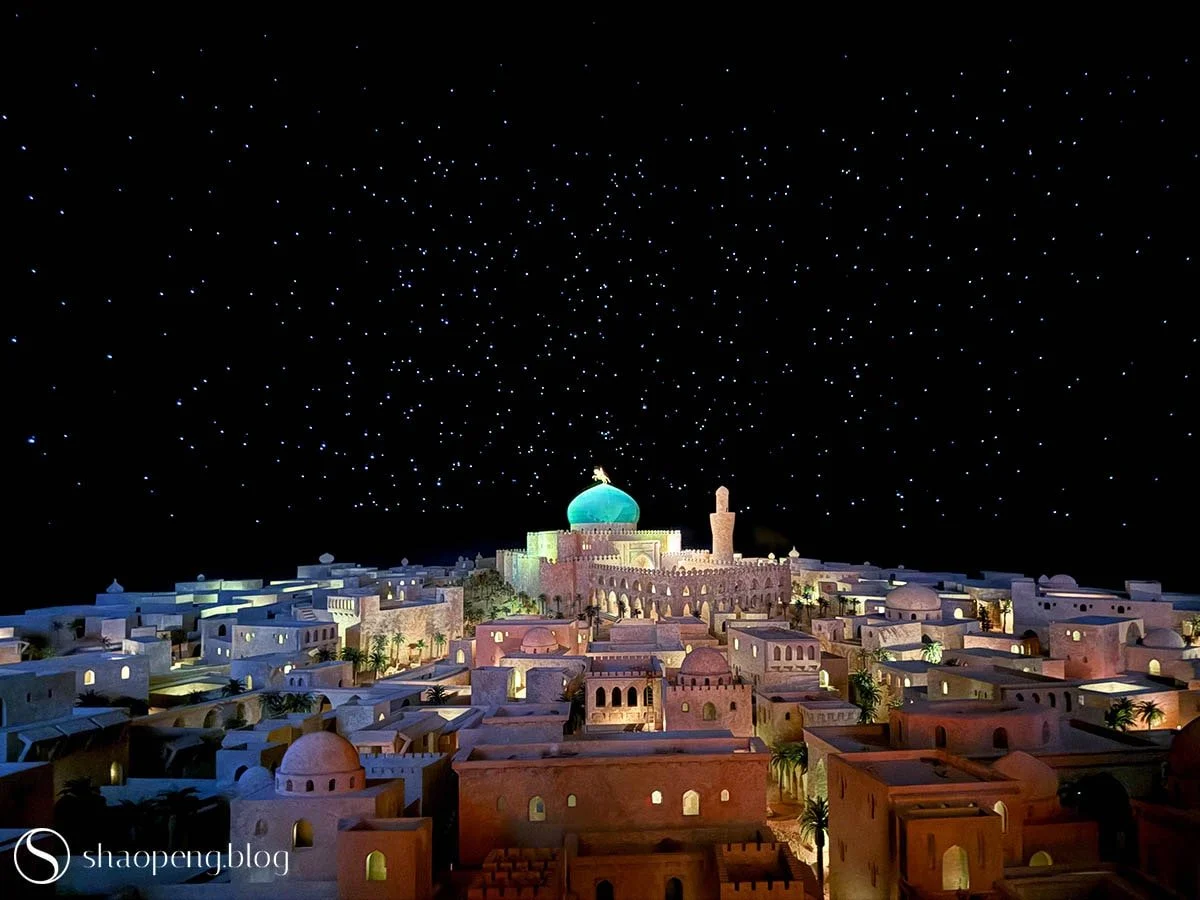
A miniature of Baghdad, the intellectual capital of the Islamic Golden Age.
Of the three pavilions, Alif is the one that surprises me most.
It is built around a single theme: mobility. I’ll admit that when I first read the word, my mind went somewhere predictable: cars, roads, the evolution of transport. I walk into the first gallery and immediately understand how small that thinking was.
A man is found seated at the corner of the room, with an open book resting in his lap. He is Abu Yusuf Ya’qub ibn Ishaq as-Sabbah Al-Kindi — a 9th-century Arab polymath born around 801, widely regarded as the father of Arab philosophy. You are standing in Al-Kindi’s study, inside the House of Wisdom: the great library and intellectual heart of the Abbasid world, where knowledge moved across borders like caravans. The first kind of mobility, the pavilion states, is the movement of ideas.
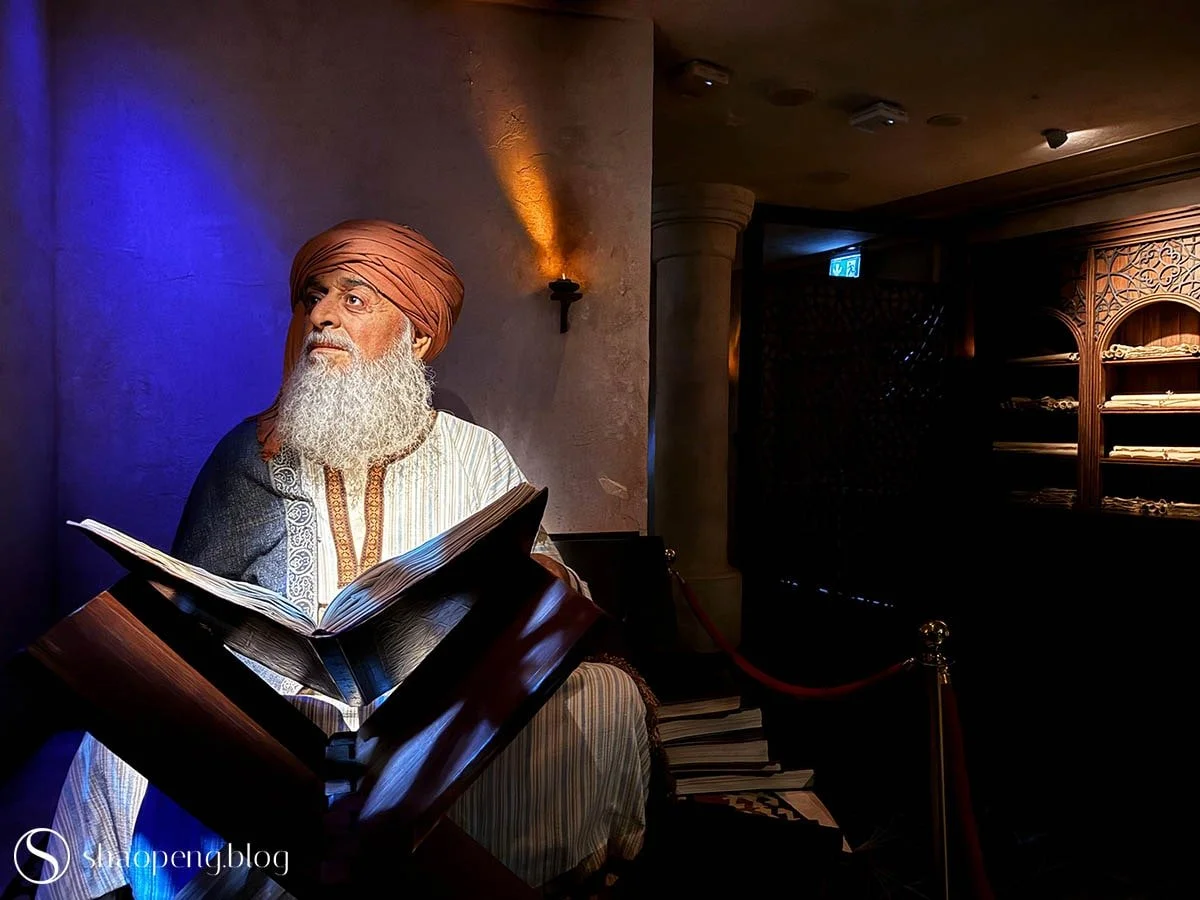
Inside Al-Kindi’s study at Alif.
On the wall, a quote by Sheikh Mohammed writes:
“Man’s development depends on the power of his ideas and his ability to spread them from one person to another across deserts, continents and oceans.”
I stand there contemplating longer than I probably should.
The next room opens onto a sweeping carved panel that lines the walls. A closer look reveals that it’s a continuous timeline of human movement, from the first stone-paved roads laid around 4,000 BCE, through the invention of the wheel, the canoe, the bridge, the automobile, Da Vinci’s flying machines, and onwards to the Apollo 11 launch and the UAE’s own Hope Probe, which left Earth in 2020 to study the Martian atmosphere. It is, in effect, the entire arc of human progression rendered in stone.
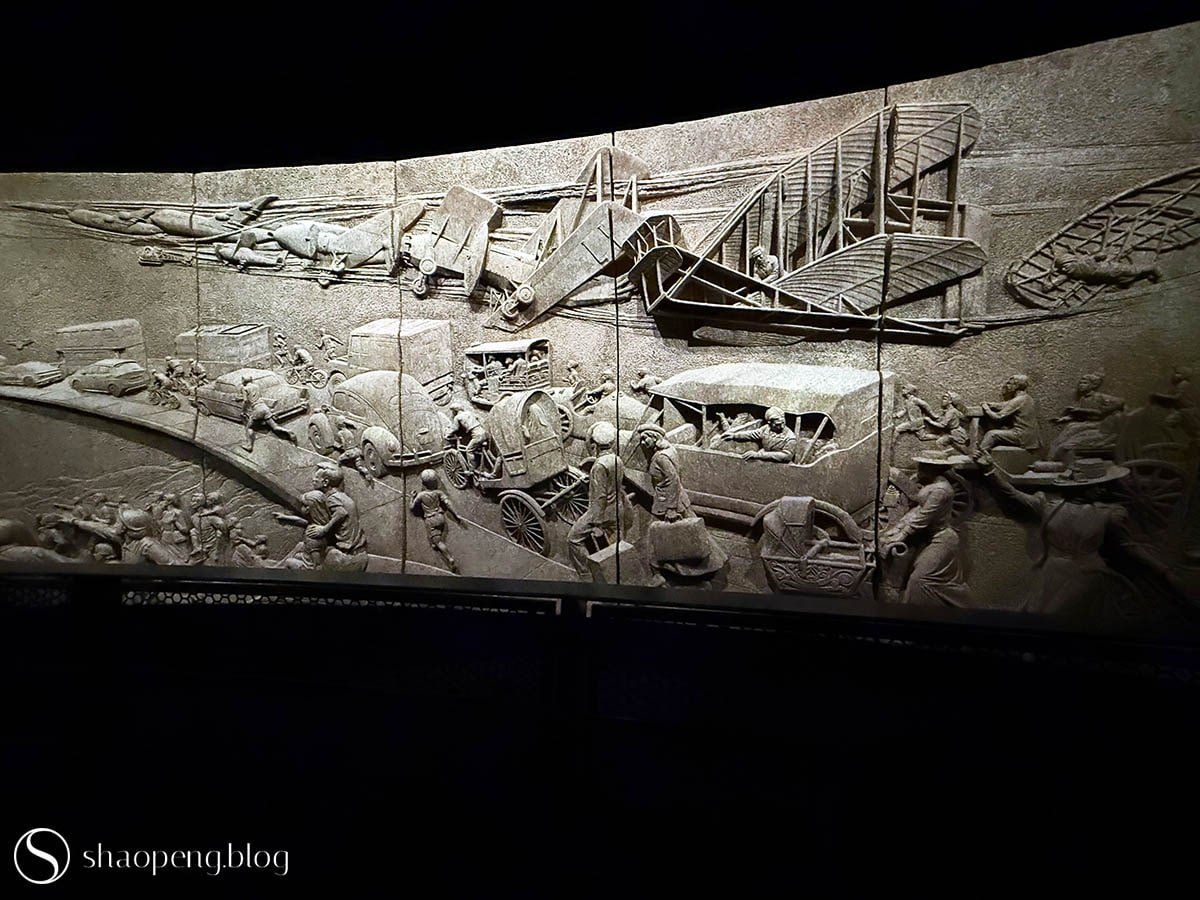
Modes of mobility tracing the progress of human civilisation.
Accompanying this panorama are three giant figures. The first is Abu Ubayd Al-Bakri, an 11th-century scholar who never left home yet mapped the world through the accounts of travellers and merchants, distilling their journeys into his Book of Highways and Kingdoms.
The second is Ibn Battuta. Born in Tangiers in 1304, he spent thirty years crossing Africa, the Middle East, and Asia, and returned with a record of the world that few before or since have matched, collected in his Rihla, or Book of Travels.
The third is Ahmad ibn Majid (1432-1500), a navigator born in Julfar, in today’s Ras Al Khaimah, whose writings charted the stars and the seas with a precision that guided sailors long after his time.
Three men, three kinds of movement: physical, intellectual, and celestial.
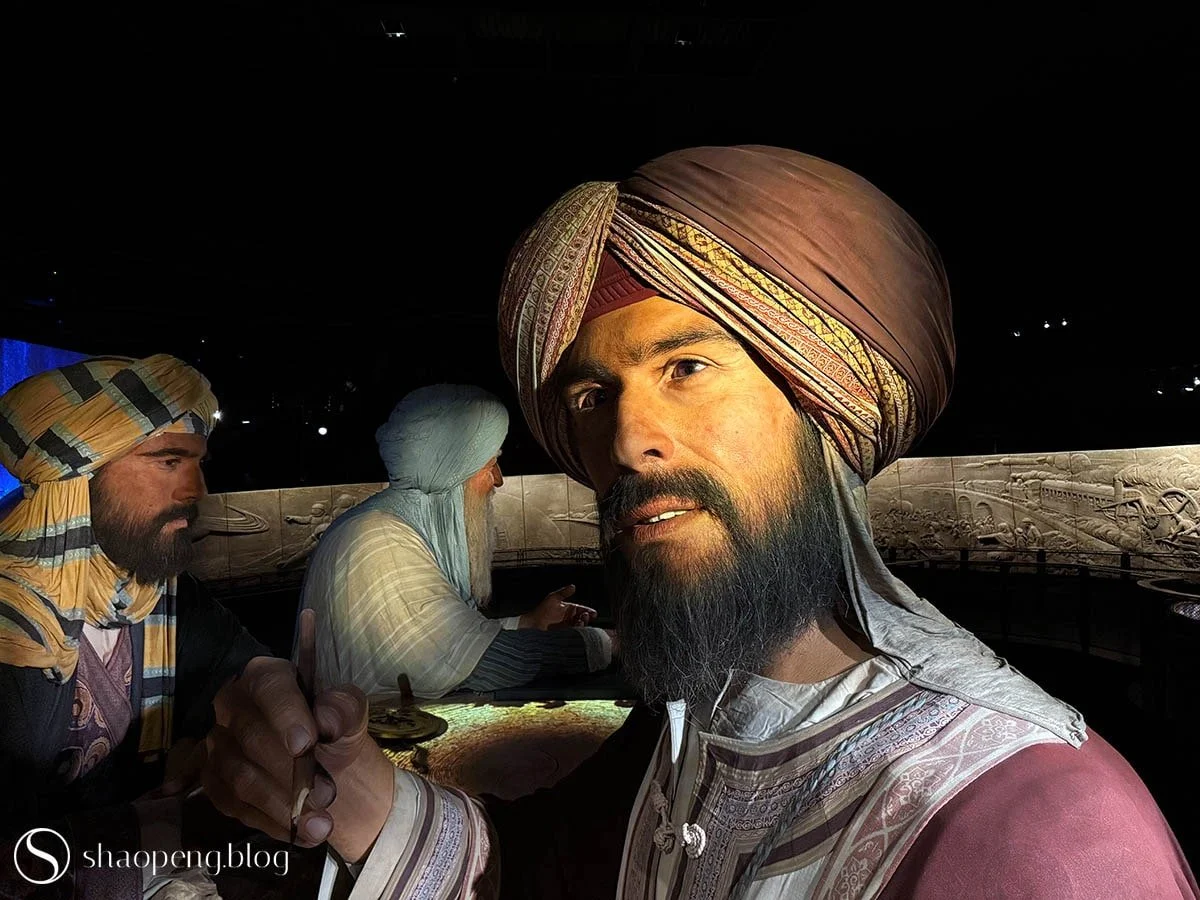
Abu Ubayd Al-Bakri
Venturing a little further and you will arrive at City of the Future.
As its name suggests, it envisions a city built around sustainability and human well-being, rendered in the visual language of a video game. What makes it remarkable is its creation: this city was designed by children from around the world, submitted through an open competition. This is a radical curatorial choice for a pavilion dedicated to human progress, and the vision of the future it chooses to end with belongs to its youngest participants.
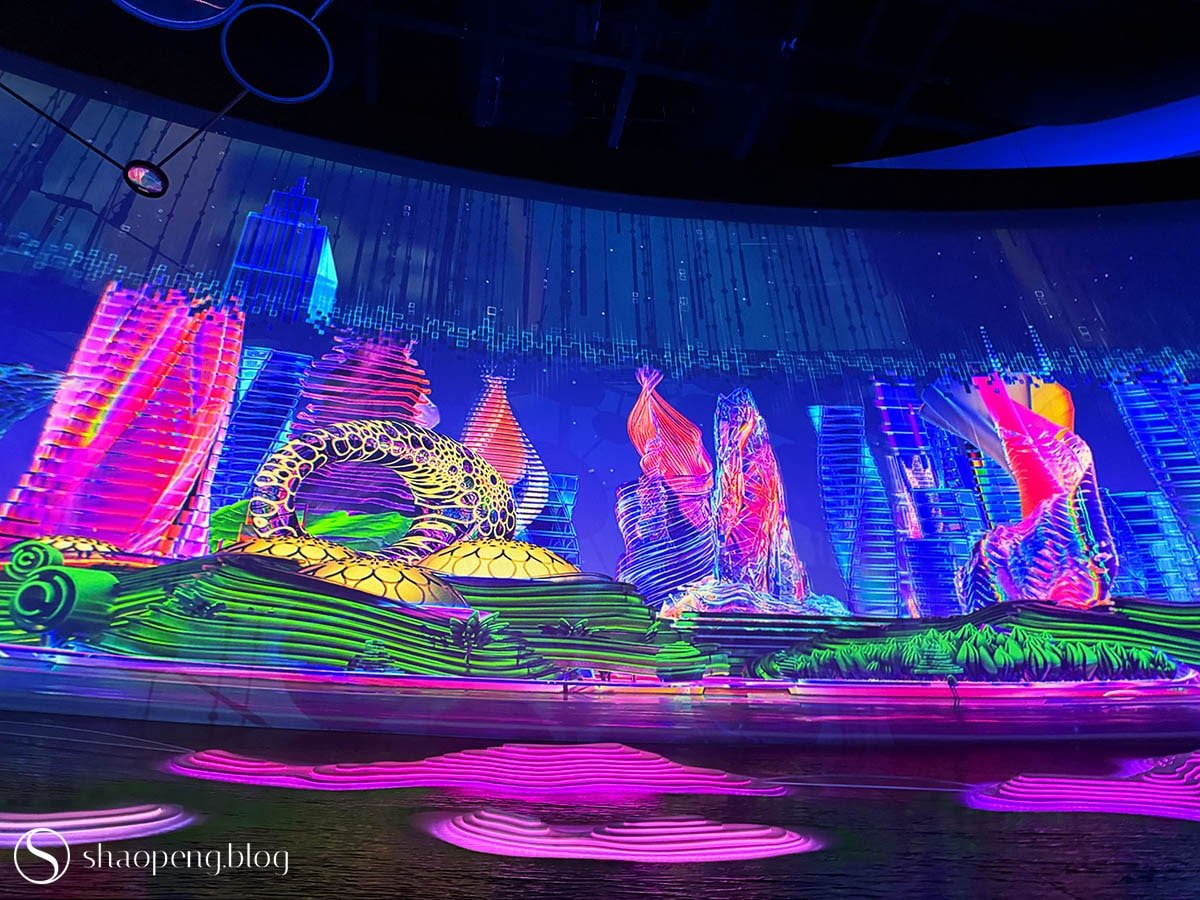
City of the Future at Alif
The pavilion concludes with a moving installation: a girl in a red robe stretching out her right hand — with a butterfly poised on her forefinger — reaching toward an abstract presence suspended from above, composed of hundreds of butterflies caught in eternal flight.
The installation is accompanied by a line from the French philosopher Gaston Bachelard:
“One must always maintain one’s connection to the past and yet ceaselessly pull away from it.”
It is the delicate dance between honouring the past and facing the future: heritage and wisdom as fuel for the world we are still trying to build.
Wanderer’s tip — Entry is by guided tour. Set aside at least 30 minutes for your journey.
Reference:
Al Maktoum, M. B. R. (2025). My Story: 50 Memories From 50 Years of Service. Explorer Publishing.