
Wander in AlUla: Hegra
At Hegra, women owned property and commissioned their own tombs, carving their names into rock that remains legible after two thousand years.
Sense of Wander: ★★★★☆
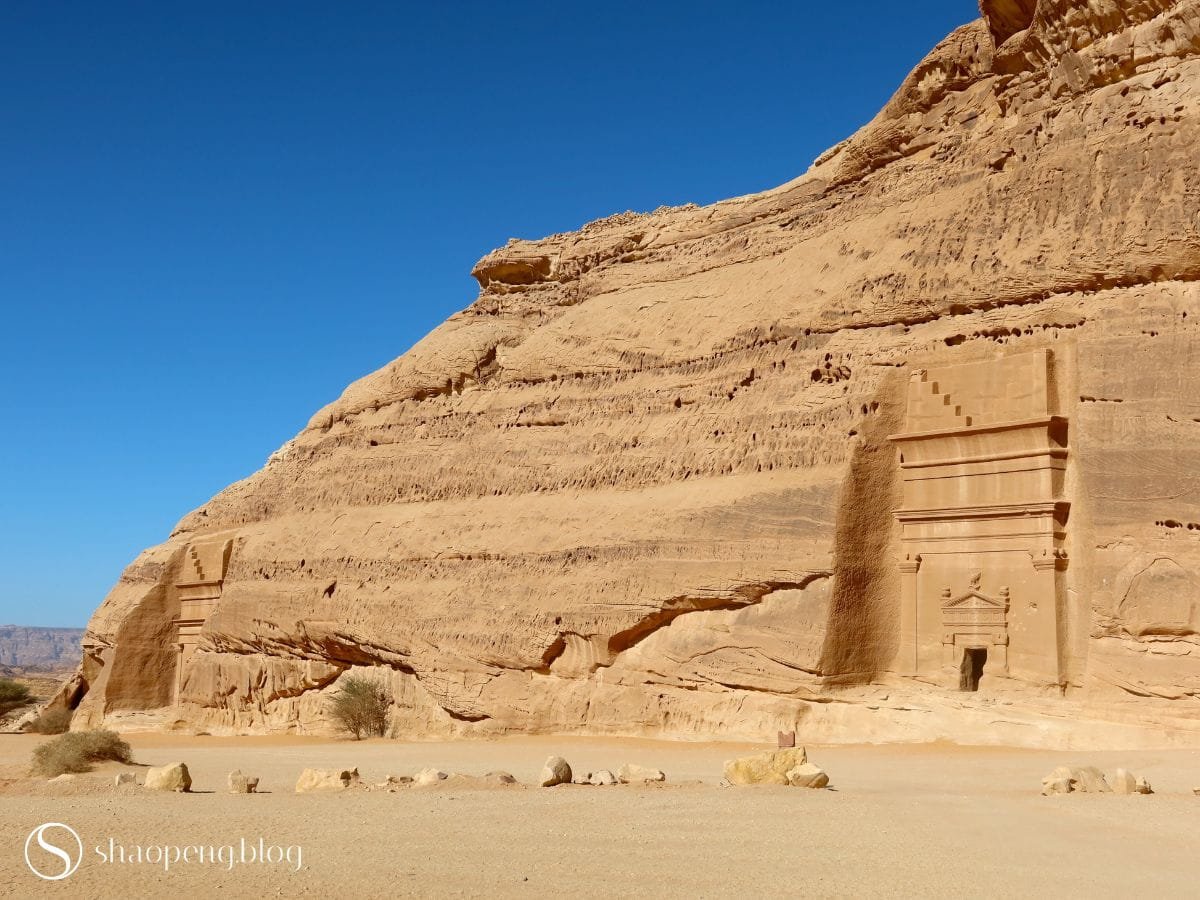
Jabal Al-Banat is home to a cluster of 29 Nabataean tombs.
HEGRA, Saudi Arabia — Long before this place had a name, this stretch of Wadi Al-Qura was already a crossroads. Camels had been threading through this valley for generations, carrying frankincense and myrrh north along the same Incense Road that once fed Dadan’s fortunes just a short distance away.
Before arriving in Hegra, I kept thinking about the many footsteps, traders’ voices, bargaining, dust, and thirst from the countless caravans that have passed through this seemingly empty landscape before anyone thought to carve tomb into the stone.
The tombs came later, but the settlement itself is far older than many people imagine. Hegra is believed to have been inhabited from around the 6th century BCE, first by the Dedanites and later the Lihyanites, before the Nabataeans — the same people who created Petra’s rose red facades in modern day Jordan — made it as the southern edge of their kingdom in the 1st century CE. By then, Hegra has grown into a city with homes, defensive walls, more than 130 wells, irrigation channels, and reservoirs designed to capture whatever precious rain that falls in this unforgiving desert.
It’s tempting to call Hegra “Petra’s little sibling,” and that is exactly how I think of it at first. But after much wandering through the landscape, I realise the comparison does it a disservice. This is the largest preserved Nabataean site south of Petra itself, the kingdom’s southern gateway and the last major stop before caravans continue towards Dadan, Yemen, and the Red Sea beyond.
Archaeologists have identified 111 monumental tombs here, 94 of them decorated, placing Hegra among the rarest surviving Nabataean landscapes in the world.
During the centuries around the turn of the era, Nabataean craftsmen carved some of their most elaborate facades into these mountains. Yet older inscriptions on nearby Jabal Ithlib preserve traces of Dedanite and Lihyanite rulers who walked this valley centuries before the first Nabataean chisel touched the rock.
I’ve been told that the tombs will be the highlight of Hegra. They are. But focusing only on their facades means missing what this place really is. Hegra is not simply a collection of beautiful tombs; it is a city, a religious centre, and a record of the people who passed through this valley.
A proper visit to Hegra takes you through several key locations:
Jabal Ithlib
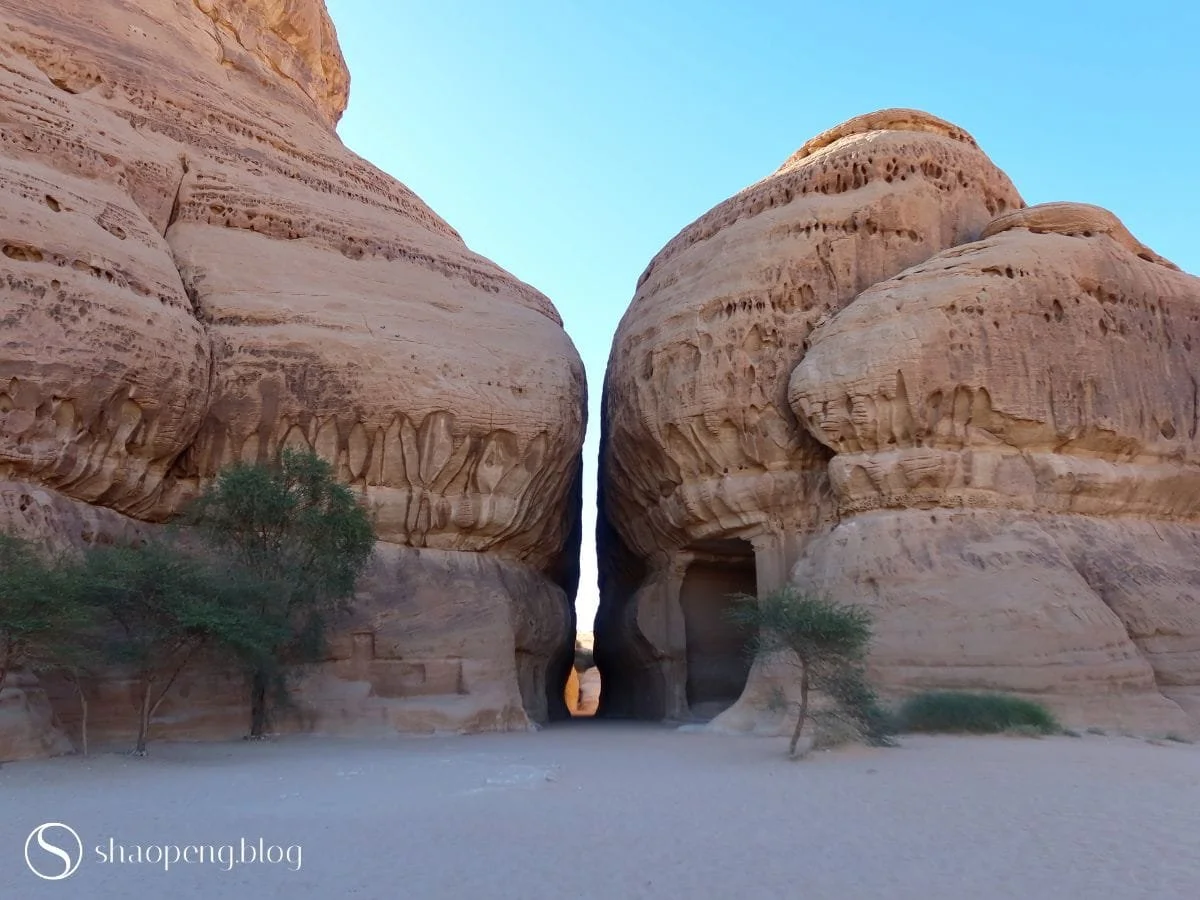
The siq is a narrow rock-cut passage at Jabal Ithlib that leads visitors into Hegra’s religious heart.
You do not walk straight into Hegra’s tombs.
Your journey begins at Jabal Ithlib, a dramatic sandstone outcrop that once served as the spiritual heart of the city.
Here, a narrow passage known as the siq, a smaller cousin of the famous corridor leading into Petra, cuts between towering rock walls. It feels like a natural threshold, inviting you to cross from the present world into that of the Nabataeans. This is an unexpected way to begin a journey through Hegra. Walking between these massive walls of stone feels almost ceremonial, as if crossing into another world where there is no turning back.
Just before the passage narrows, the Diwan appears on the right: a chamber carved directly into the mountain, believed to have been used for rituals, feasting, and political gatherings.
What makes it remarkable is not only its purpose but its construction. The Nabataeans have carved an entire rectangular hall out of solid rock, complete with straight walls, a flat ceiling, and columns. Benches cut into the stone line the interior, where guests once gathered for food, conversation, and music.
Standing inside, it’s easy to imagine the sounds that once filled the room: negotiations, celebrations, gossip, and the everyday conversations of people who lived more than two thousand years ago. Today, there is only the wind, and whatever sounds you bring with you.
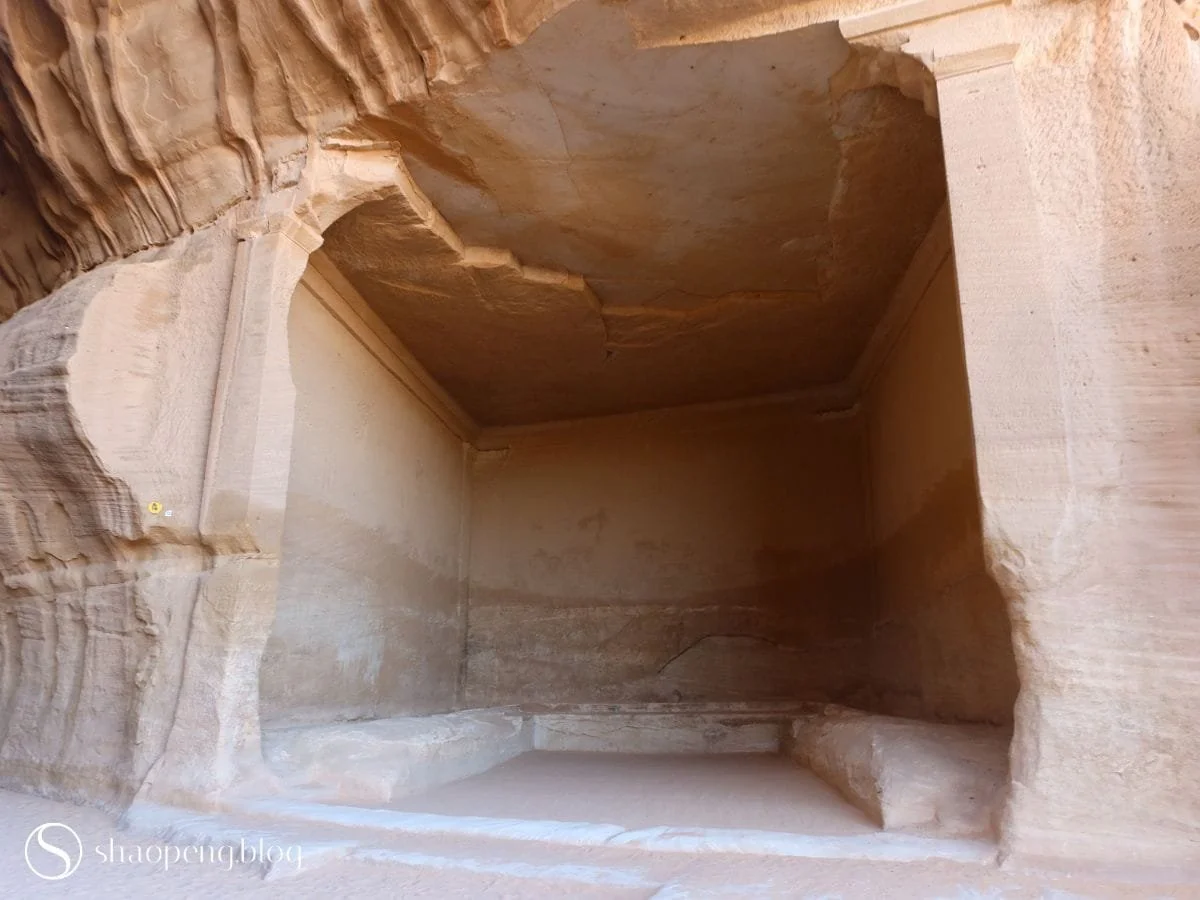
The Diwan at Jabal Ithlib, a Nabataean rock-cut chamber carved into the sandstone mountain.
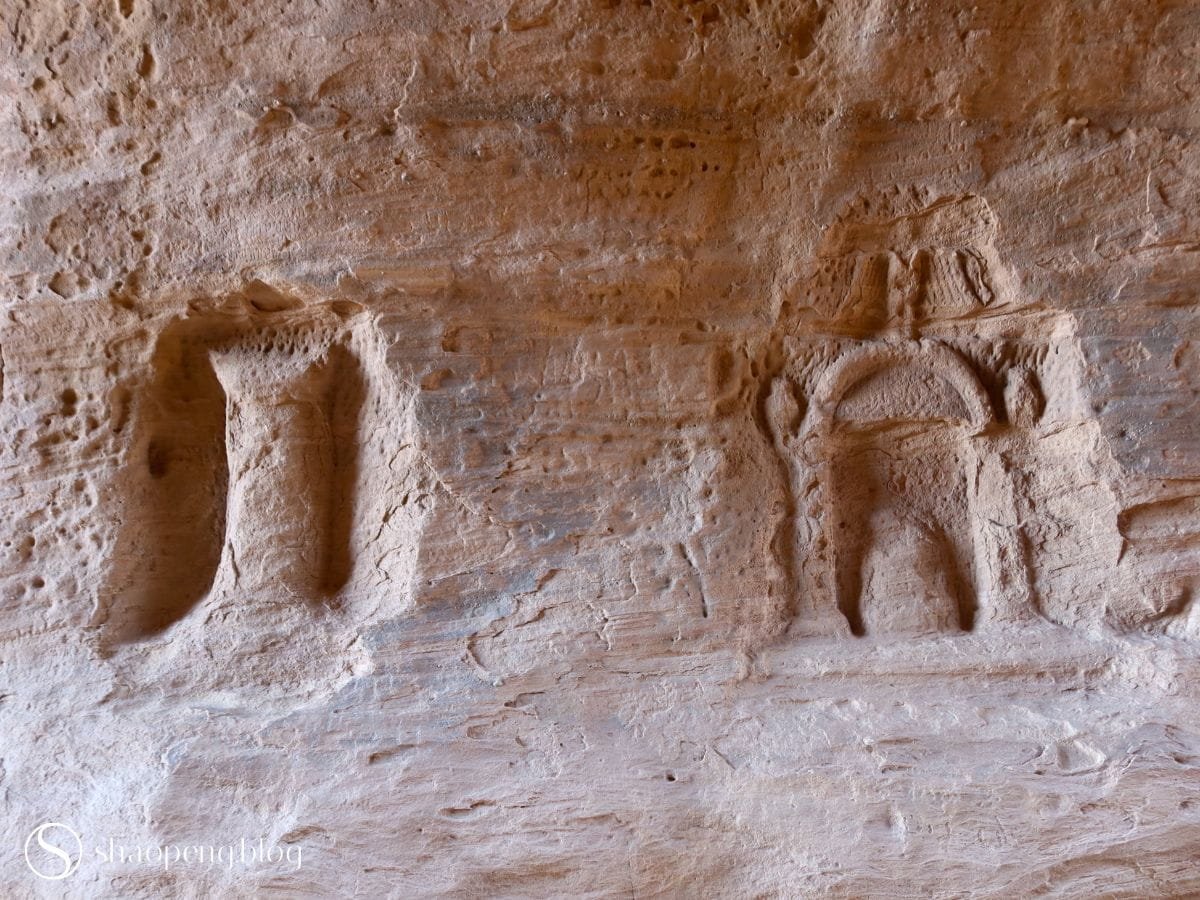
Rock-cut votive niches at Jabal Ithlib, dedicated to Nabataean deities.
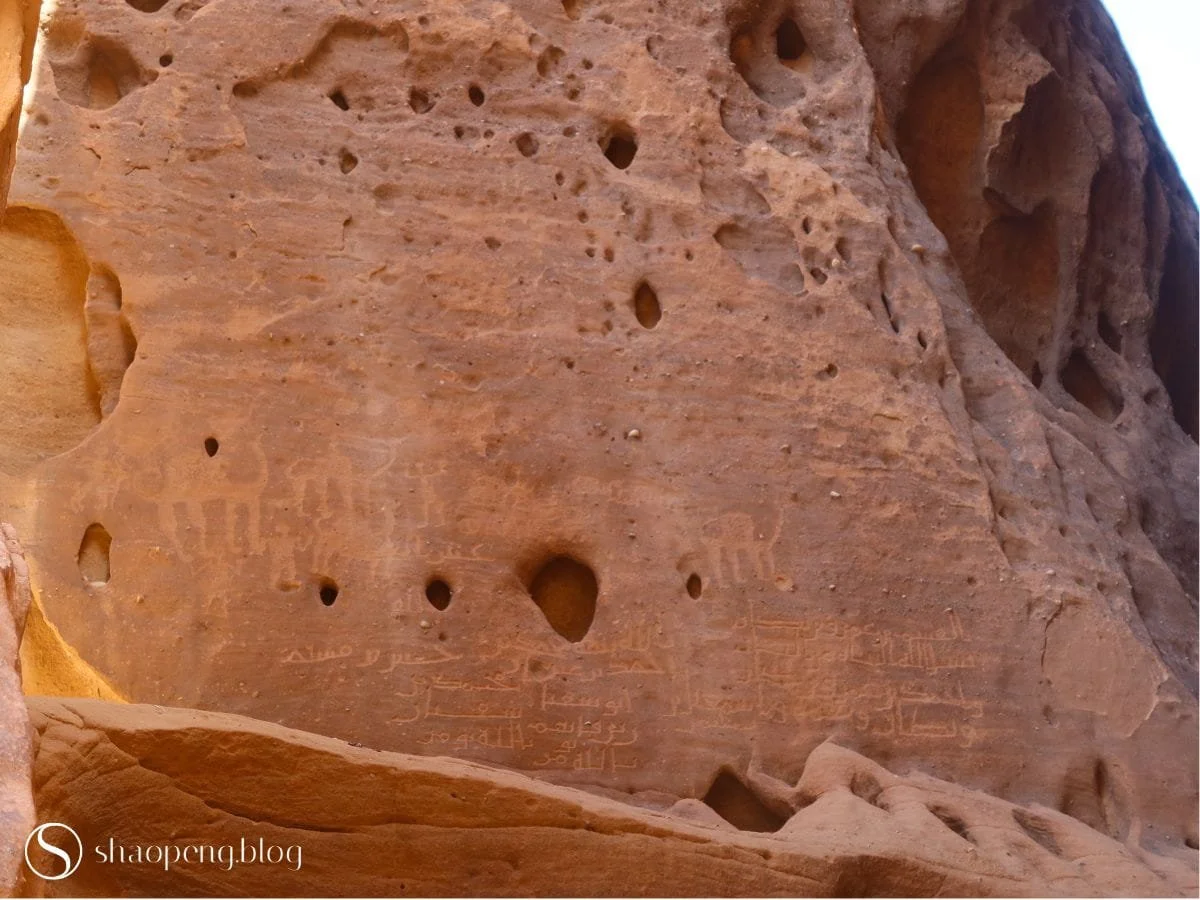
Carved images of camels emerge among the petroglyphs in Jabal Ithlib.
Coming out from the other side of the siq, the rock face begins to resemble a visitor’s book. Jabal Ithlib contains Hegra’s densest concentration of inscriptions, with well over a hundred texts written by different hands and in different languages. Some are personal messages left by travellers passing through; others are graffiti carved by soldiers stationed to guard the route towards nearby Dadan. More than a dozen inscriptions contain the phrase “ntr ddn,” meaning “the protected Dadan.”
This place recalls nearby Jabal Ikmah, where you find yourself surrounded by towering rock walls while searching for the next ancient inscription. Hidden among the writings are also several rock-cut niches known as “betyls,” sacred stones representing the deities worshipped by the Nabataeans.
At Jabal Ithlib, you are invited to meet the people behind Hegra: the gods they worshipped, the travellers who crossed the valley, the soldiers who guarded the routes, and the extraordinary amount of human movement that once flowed through this desert.
Only after understanding this human landscape do the tombs begin to reveal themselves as something more than magnificent facades carved into stone.
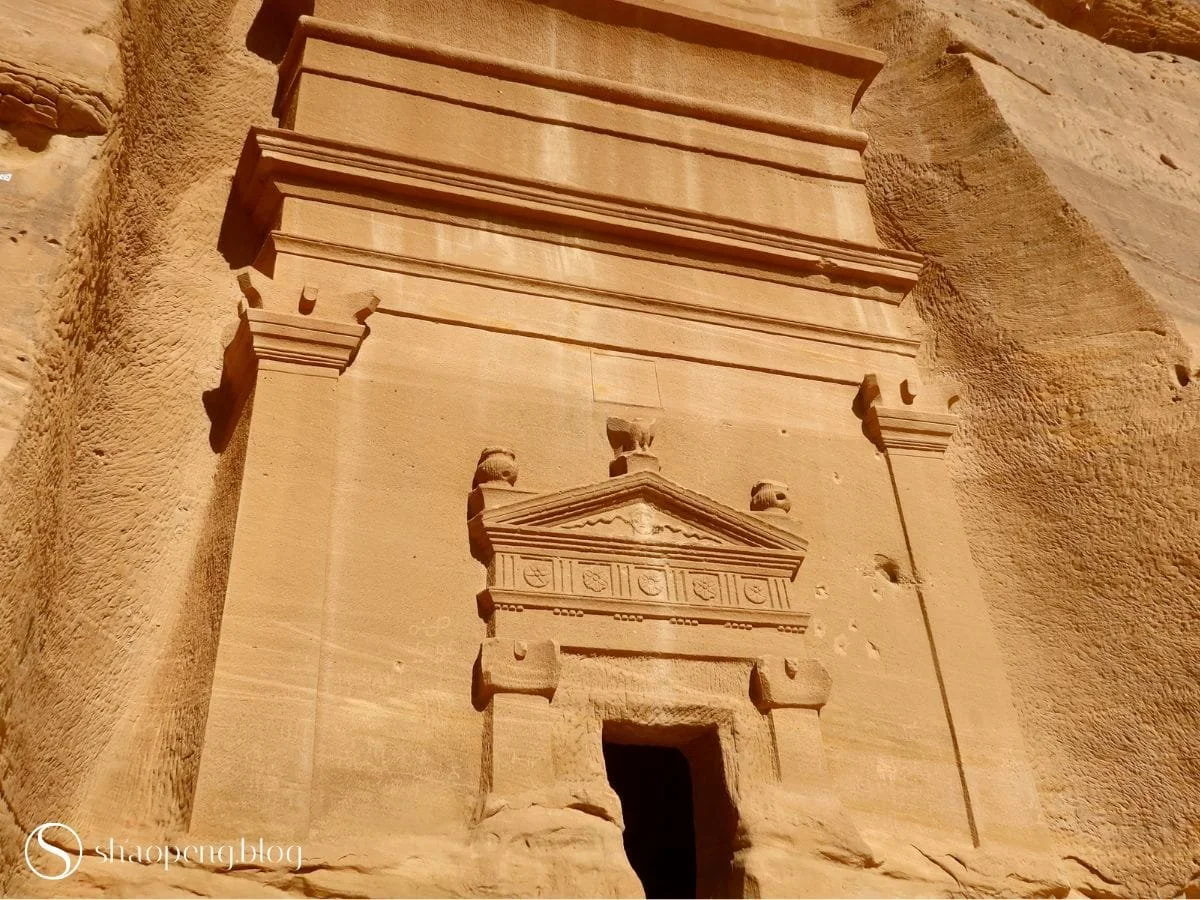
The facade of Tomb No. 45 at Jabal Al-Banat exhibits a blend of artistic influences.
Jabal Al-Banat
At Hegra, it’s a common sight to see the landscape opening onto a vast plain surrounded by mountains. These sandstone formations began taking shape hundreds of millions of years ago, before they became sculpted by wind and time into the landscape standing before your eyes.
The Nabataeans read these cliffs like a sculptor reads a block of stone. They carved their tombs directly into the natural rock faces, while the stone removed from the mountains was repurposed as building material for their settlement.
Jabal Al-Banat, also known as Qasr Al-Bint, is one of Hegra’s most impressive clusters, containing 29 tombs carved into a single massive sandstone outcrop. Wandering around its perimeter, I find myself moving from one facade to another, each revealing its own combination of symbols, architectural influences, and inscriptions.
What immediately draws the eye is the crowstep: the staircase-like silhouette rising above many of the facades, usually arranged in mirrored pairs climbing towards an empty centre. At first glance, it feels like a distinctive Nabataean design, but its roots stretch much further back. Similar stepped motifs appear in Mesopotamian brickwork as early as the 3rd millennium BCE.
At Hegra, the crowstep is believed to have carried symbolic meaning, connecting the tomb with the idea of a sacred elevated space. For the Nabataeans, these “high places” were important locations for worship, where the earthly and divine worlds could meet.
Below the crowsteps, the facades reveal the Nabataeans’ ability to absorb and transform different artistic traditions. Egyptian-inspired cornices sit alongside Hellenistic architectural elements, including flat pilasters framing the entrance like simplified columns. On more elaborate tombs, an eagle appears above the doorway, commonly interpreted as a representation of Dushara, the chief Nabataean deity, while urns, masks, and snakes appear as protective symbols.
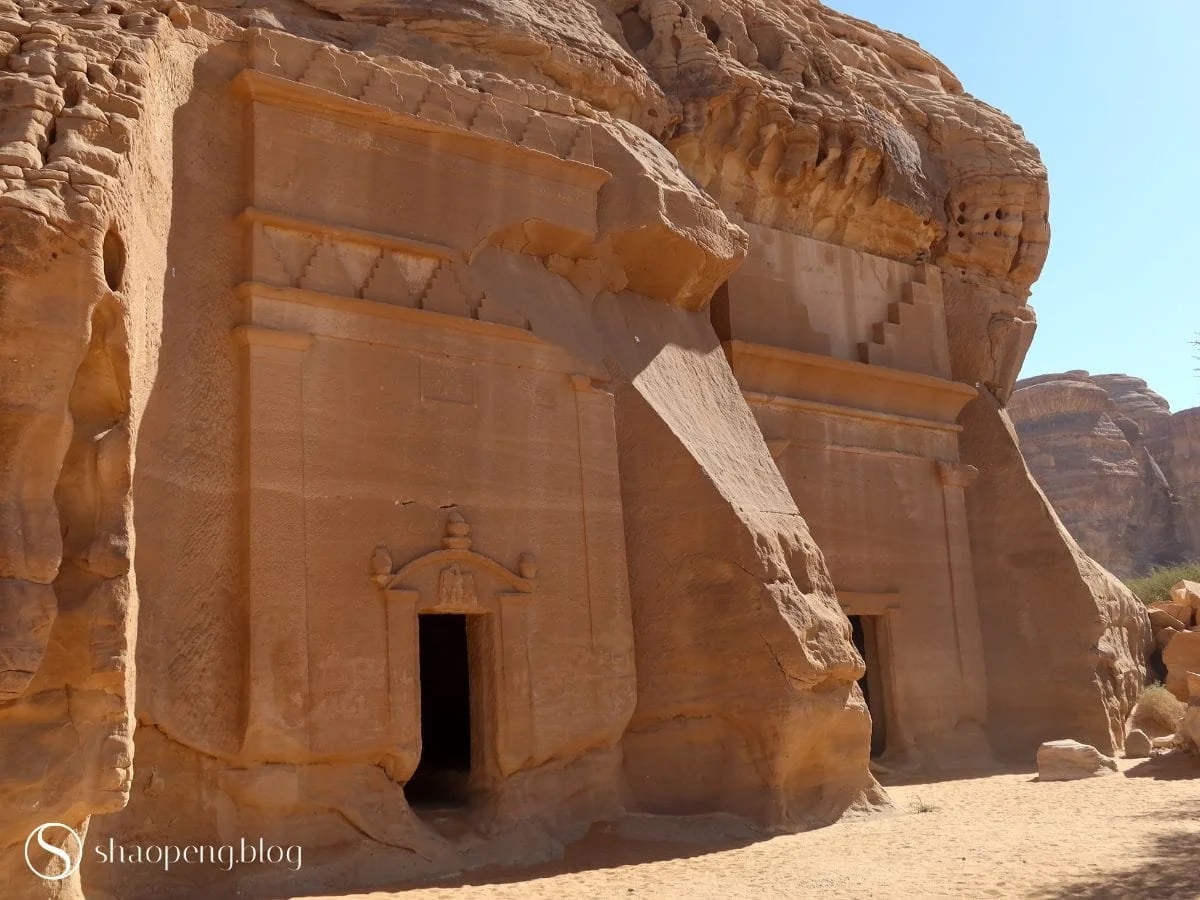
The tombs at Jabal Al-Banat showcase both elaborate and simpler facades.
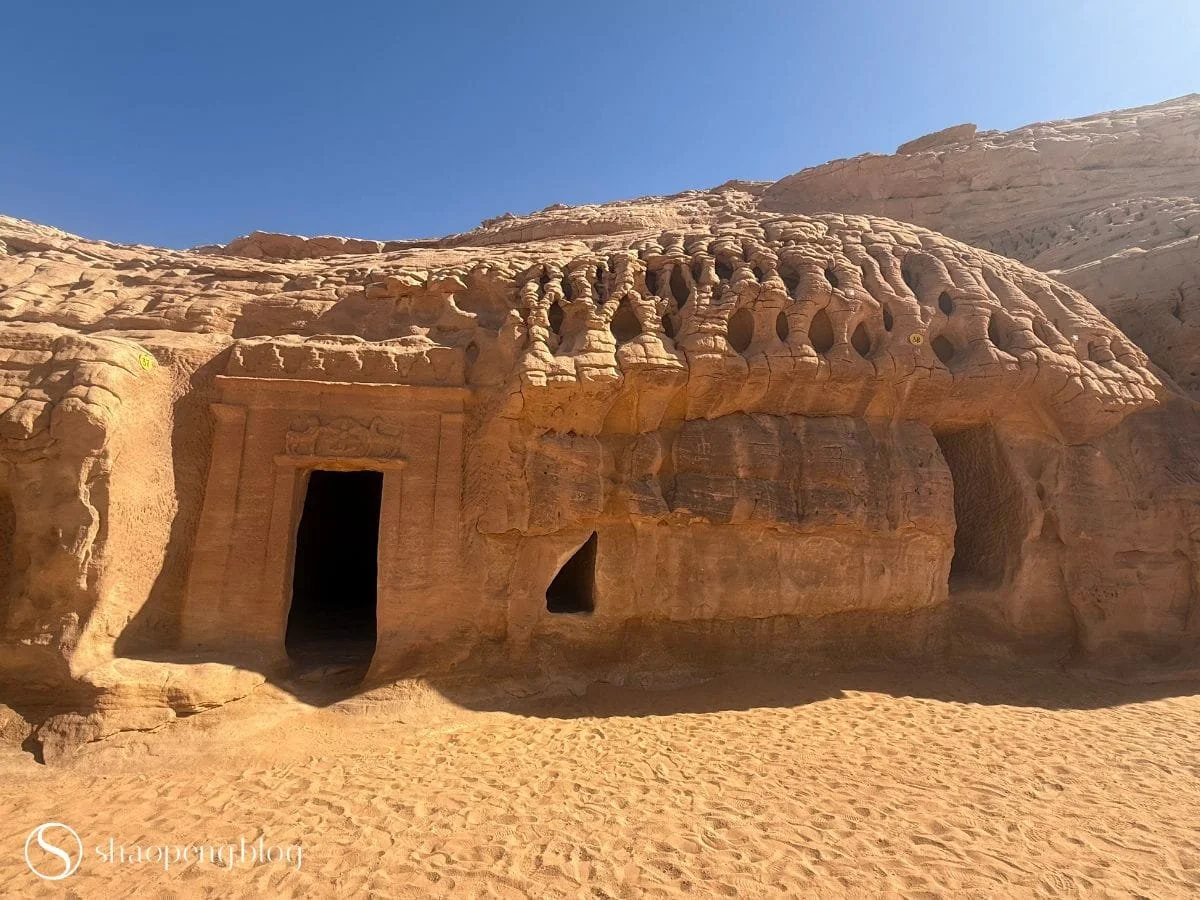
Tomb No. 37 at Jabal Al-Banat features a pair of stylized felines above the doorway.
The simpler tombs tell a different story. They often lack decorative elements, relying instead on inscriptions carved in Nabataean Aramaic. These texts record the names of those buried inside, their social status, and sometimes details of the legal protections surrounding the tomb.
Stepping into the tombs open to visitors, I find a stunnning contrast between the grandeur of the exterior and the simplicity within. The interiors are cool and quiet, with rectangular niches cut into the walls, designed to hold burial containers. Looking at these spaces, it is impossible not to wonder about the people whose final resting places were carved so meticulously into the mountain.
What fascinates me most is the story behind the name Jabal Al-Banat, meaning “Mountain of the Daughters.” Many tomb inscriptions here are associated with women, either as commissioners or beneficiaries of these burial spaces, offering rare insights into the rights and status women could hold in Nabataean society.
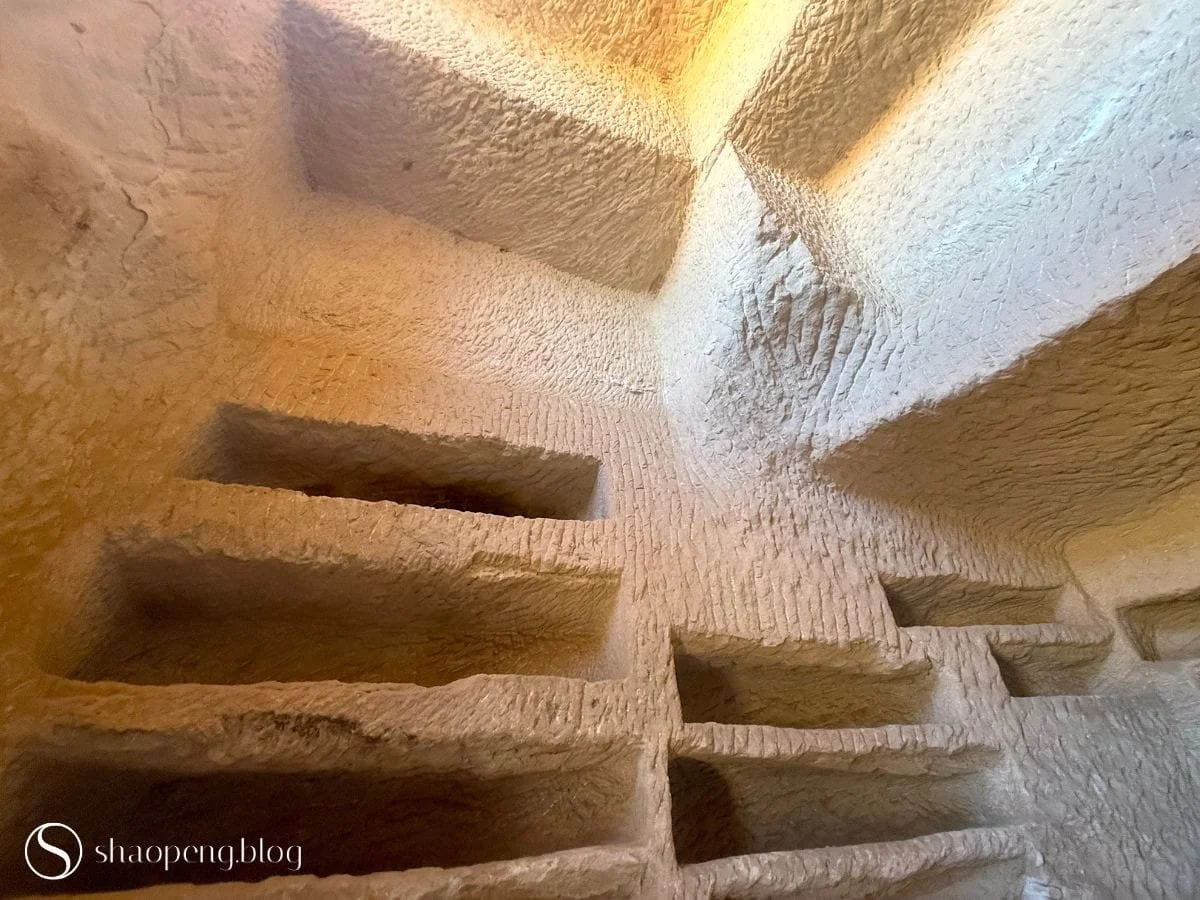
Inside Tomb No. 26 at Jabal Al-Banat, where burial niches are carved directly into the walls.
Jabal Al-Ahmar
A second cluster of tombs lies at Jabal Al-Ahmar, meaning “Red Mountain,” a name that becomes especially fitting at sunrise and sunset when the sandstone glows with a reddish hue.
Compared with Jabal Al-Banat, this area feels quieter. It contains 18 tombs, including one that has transformed how archaeologists understand the people behind Hegra’s monumental facades.
In 2008, during the first season of excavations at Hegra, archaeologists opened a tomb on the eastern slope of Jabal Al-Ahmar, later catalogued as IGN 117. Inside, they discovered an inscription identifying its owner: Hinat, daughter of Wahbu.
The inscription states that she built the tomb for herself and her descendants forever, while also warning that it could not be sold, pledged, or leased. A dating formula places the tomb around 60 CE.
Her tomb also reveals something important about women’s lives in Nabataean society. Inscriptions from Hegra show that women could own property, commission tombs, and have their legal rights recorded in stone. While scholars continue to debate the exact structure of Nabataean society, these records demonstrate that women could possess a degree of economic independence that was unusual in its neighbouring societies.
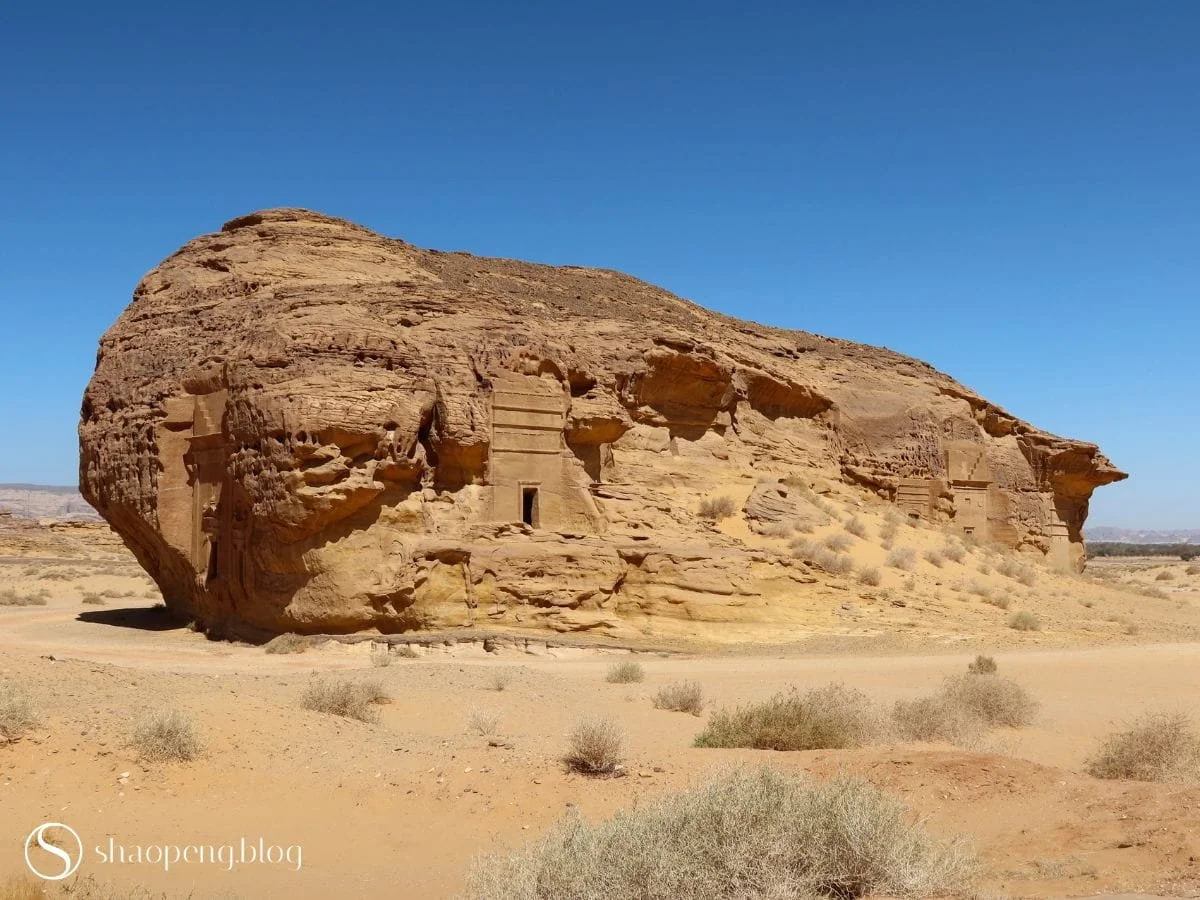
Jabal Al-Ahmar
Unlike many tombs at Hegra, this one had remained undisturbed. Inside, archaeologists discovered the remains of around 80 individuals, alongside preserved fragments of textiles, leather, hair, and skin that had survived for nearly two thousand years.
Among these remains was Hinat herself. Her skull was preserved well enough that archaeologists, forensic specialists, anthropologists, and model makers were able to create the first facial reconstruction of a Nabataean individual. This reconstruction offers something so rare that inscriptions alone cannot: a human face behind the history.
Today, Hinat’s reconstruction is displayed at Hegra’s visitor centre, allowing visitors to look into the face of someone who lived in this valley almost two thousand years ago.
Standing before Hinat, I’m reminded that Hegra was not simply built by anonymous craftsmen and wealthy rulers; it belonged to women whose names were carved into the landscape, attached to property, inheritance, and family legacy.
The evidence extends beyond Hegra as well. Nabataean queens appear alongside kings on coinage, suggesting that women could occupy significant positions of political authority. Their presence challenges the assumption that power in the ancient world always belonged exclusively to men.
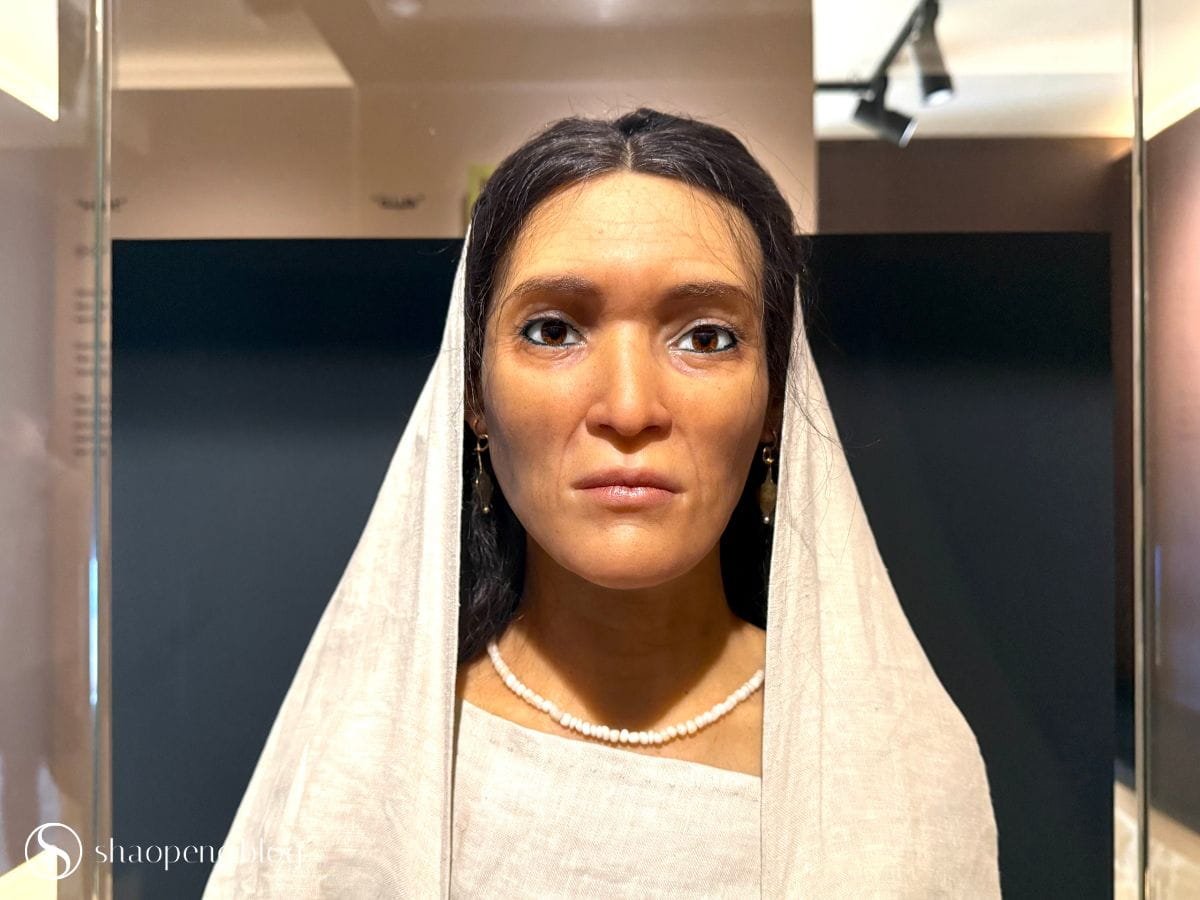
Facial reconstruction of Hinat, a Nabataean woman who lived in Hegra nearly 2,000 years ago.
Tomb of Lihyan son of Kuza
Qasr Al-Farid is the image of Hegra most often seen in photographs and travel stories, and it’s easy to understand why.
Officially known as the Tomb of Lihyan son of Kuza, it is the largest and most distinctive tomb at the site. After the dense clusters of Jabal Al-Banat and Jabal Al-Ahmar, its isolation feels almost surreal. It stands alone in the middle of the desert, carved into its own sandstone outcrop, rising approximately 22 metres above the ground.
Unlike other large facades at Hegra, which typically feature two pilasters, Qasr Al-Farid uses four. This unusual design suggests that its commissioner may have held considerable wealth or status. Yet the most fascinating thing about Qasr Al-Farid is what is missing: the tomb was never completed.
This incompletion offers archaeologists a rare opportunity to understand Nabataean construction techniques. Because craftsmen worked from the top of the cliff downward, the unfinished surface preserves the process of carving itself, revealing how the monument slowly emerged from the mountain.
Whoever commissioned Qasr Al-Farid never saw the tomb finished. Standing beneath it today, I find it strangely moving to see the tomb suspended somewhere between intention and completion. This is a monument that has spent two thousand years waiting for a final touch.
In many ways, that unfinished quality feels like a fitting symbol for Hegra, a place where history is still being uncovered, and where every excavation reveals more human stories hidden beneath the sand.
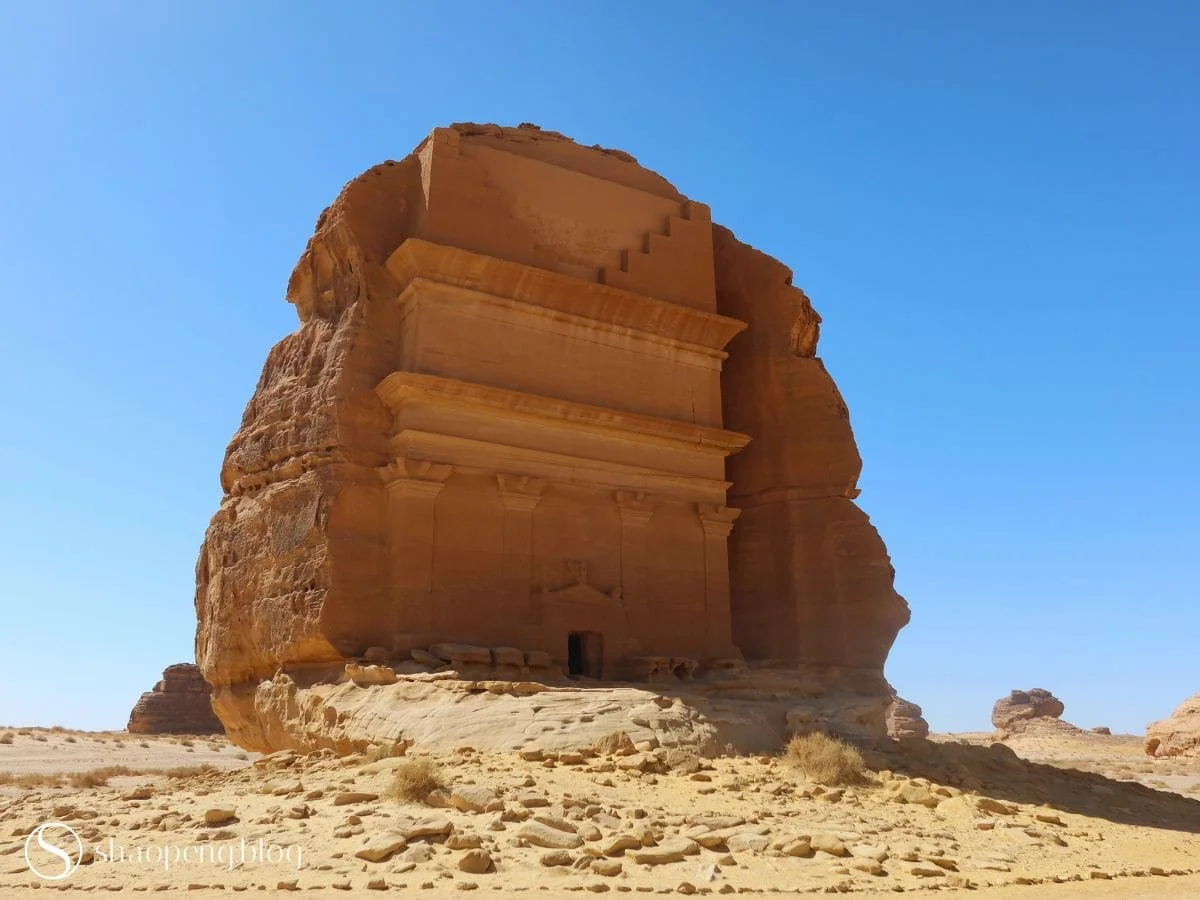
Tomb of Lihyan son of Kuza stands in solitude amid the desert landscape of Hegra.
Hegra never settled on just one identity.
To Greek and Roman writers such as Strabo, it was simply Hegra. To generations of Arab travellers, it became Mada’in Salih, meaning “the Cities of Salih,” a name rooted in Islamic tradition and the Quranic account of the Prophet Salih, who was sent to warn the ancient Thamud people after they rejected a divine sign involving a sacred she-camel. Another name, Al-Hijr, meaning “the rocky place,” turns away from legend and points instead to the landscape itself.
It’s worth noting that the sites open to visitors today — Jabal Ithlib, Jabal Al-Banat, Jabal Al-Ahmar, and Qasr Al-Farid — sit on the outskirts of what was once a thriving residential centre spread across the plain. Excavations have revealed one-storey houses, markets, workshops, and a sacred enclosure at the heart of the city, containing a temple that, according to a Nabataean inscription, was dedicated to a “God in the sky.”
For most of the past two thousand years, Hegra remained largely untouched, overshadowed by the fame of Petra to the north. That began to change in 2008, when UNESCO inscribed Hegra as Saudi Arabia’s first World Heritage Site, while a joint Franco-Saudi archaeological programme began excavations that continue today. Large areas of the site remain unexplored, which is one reason why access is still limited to guided visits.
With every excavation season, the Nabataeans come a little more into focus. They are no longer simply the builders of extraordinary tomb facades, but people with hopes, memories, and ambitions: women who owned property and commissioned their own tombs, travellers who carved their names into rock walls perhaps out of homesickness or a desire to be remembered, and a woman named Hinat, whose tomb held a necklace of dates.
Qasr Al-Farid, unfinished and standing alone at the edge of the plain, feels like the right place to leave them: unfinished, just as much of Hegra still is.
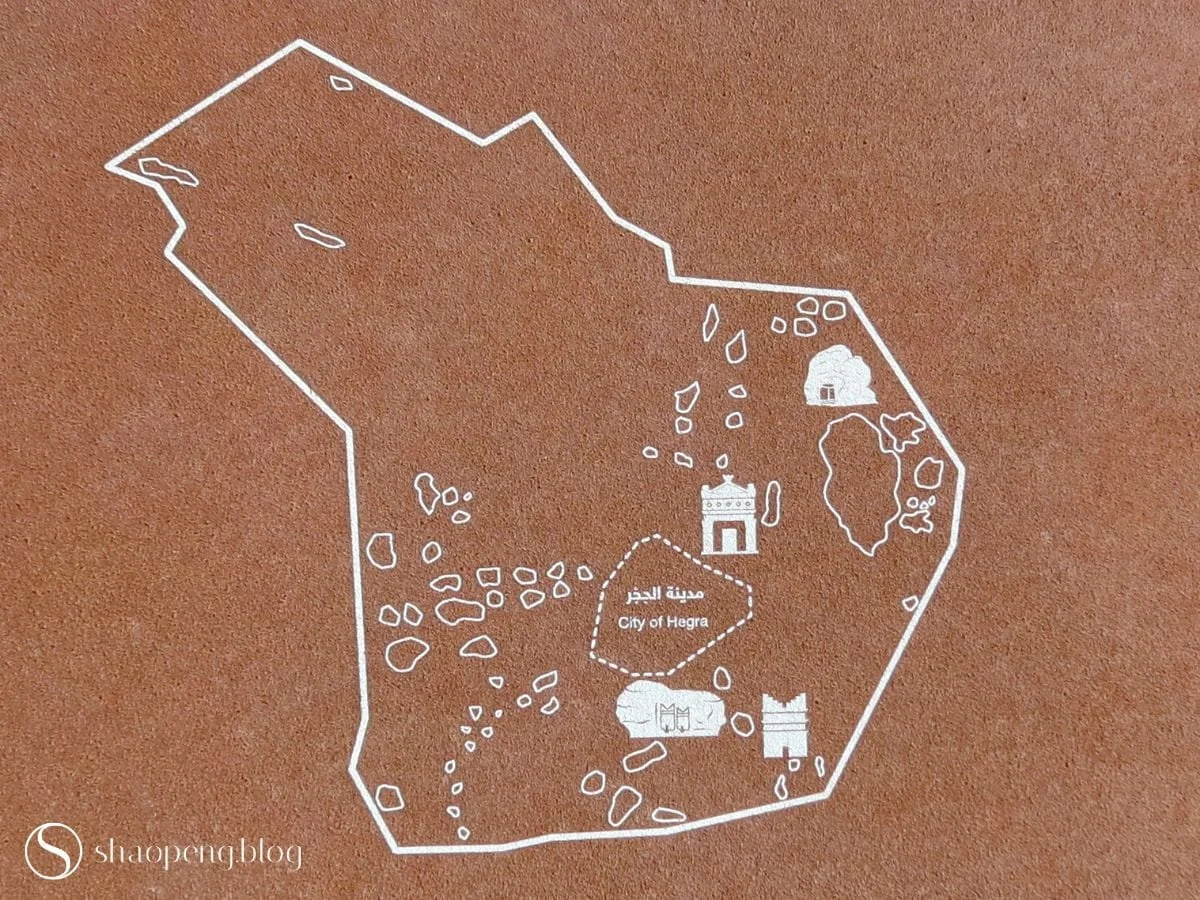
The ancient city of Hegra sits at the centre of the monumental tombs open to visitors today.
Wanderer’s tip — Access to Dadan is only possible through a pre-booked “Hegra Day Tour,” available via Experience AlUla or at any of its visitor centres.