
From a mudbrick citadel that gave birth to a kingdom to a forgotten 1980s mall reborn as a hub for contemporary art, Riyadh hides some of its best stories in plain sight. Here is where to find them.
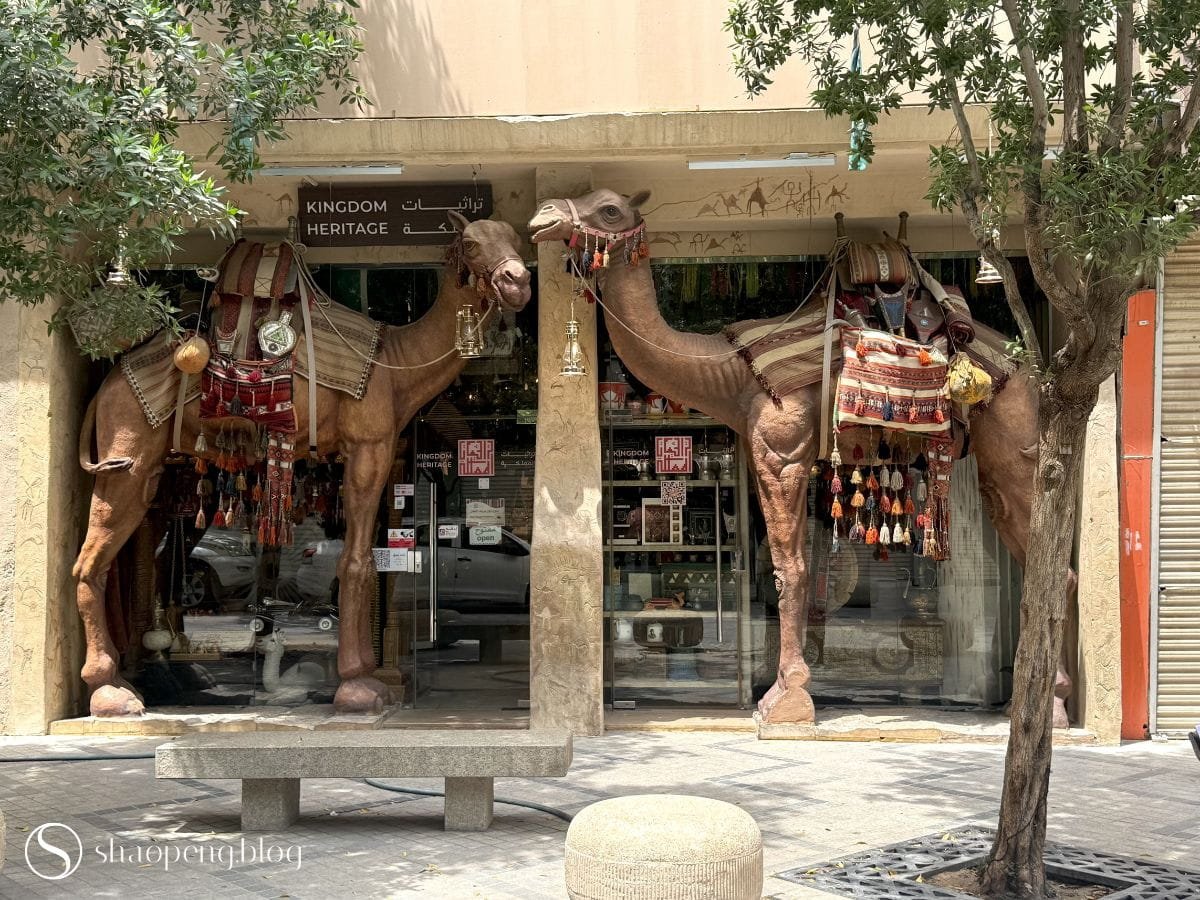
This pair of giant camels outside a shopfront in Riyadh is one of the city’s many unexpected sights.
RIYADH, Saudi Arabia — As my taxi pulls away from King Khalid International Airport, the sun rises in the distance, casting its golden light over the city as Riyadh begins a new day. This is my first time setting foot on the Arabian Peninsula, and before I know it, the glass towers in the distance appear to stand in dialogue — or perhaps competition — with the traditional houses lining the streets around me.
While the Islamic Arts Biennale in Jeddah was the main reason for my visit to the kingdom, I’m surprised by what Riyadh — a gateway to understanding Saudi culture — has revealed to me during my brief stay.
Often overlooked by travellers and wanderers chasing destinations like AlUla or the Red Sea coastline, Riyadh is emerging as one of the region’s most rewarding cities for those curious about how a place tells its own story.
What makes Riyadh fascinating is the tension between past and future: the Najdi mud-brick architecture of old Diriyah alongside the glass-and-steel towers that now define the city’s skyline; centuries-old souks excisting alongside contemporary galleries; and grandmothers preserving generations of traditions and knowledge while a new generation of Saudi artists imagines what “Saudi culture” can become on the global stage. And we, as wanderers, find ourselves standing in the now — the present moment where all these stories meet.
I’ve put together this guide for fellow wanderers who are seeking to embark on a cultural pilgrimage — a journey to uncover the arts, culture, and history of Riyadh, as well as the wider kingdom itself.
Whether this is your first time setting foot in Saudi Arabia or you are simply curious about a capital that has long remained under the radar, consider this your companion for wandering with intention: a blend of history lesson, part gallery crawl, and an invitation to slow down and look closer at a city that has a great deal to say.
Now, let’s wander through:
Addoho Neighbourhood
Sense of Wander: ★★★★☆
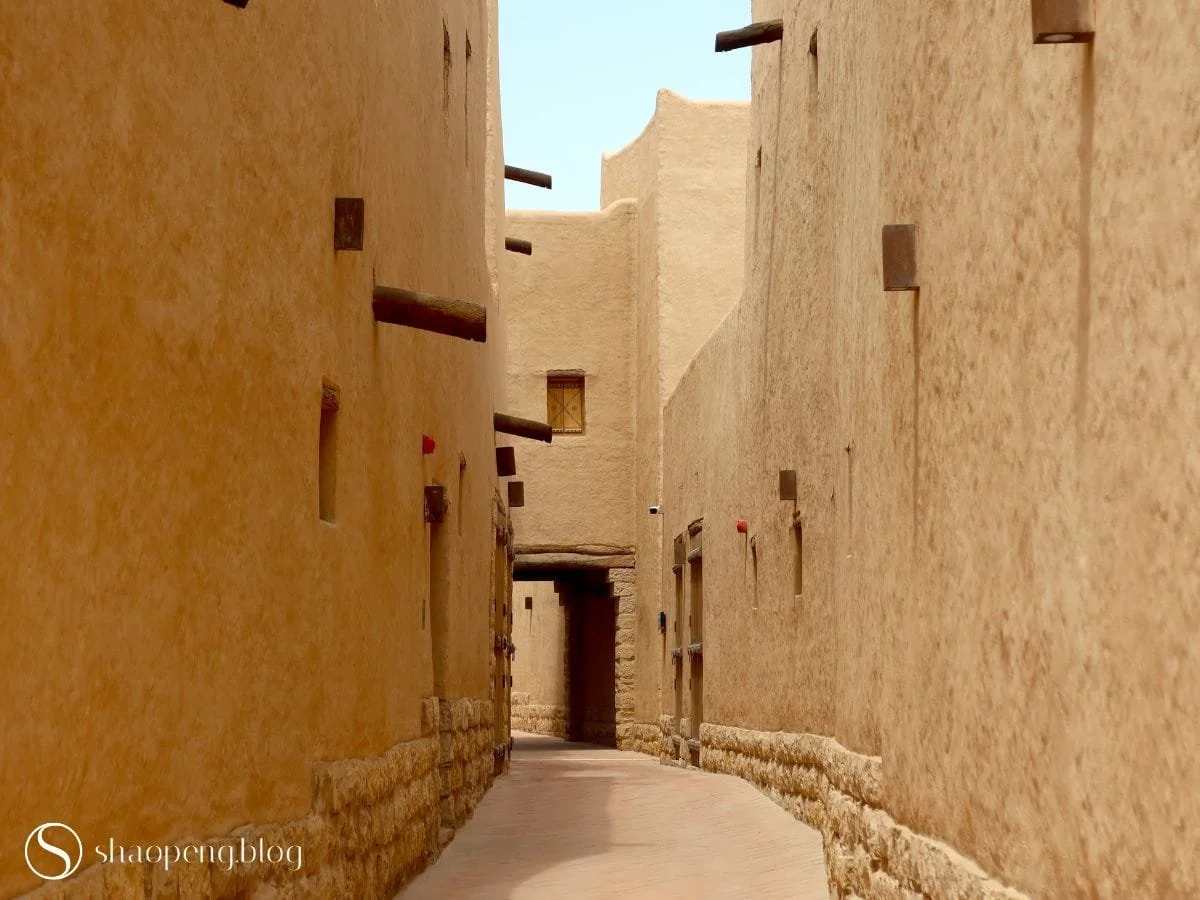
The Addoho Neighbourhood preserves its traditional mud-brick houses and lofty walls to this day.
Addoho is where the journey begins.
Addoho, or “Al-Doho” in Arabic, is said to mean “crowded,” a fitting name for one of Riyadh’s oldest surviving neighbourhoods and a reminder of the tightly knit community that once filled its winding lanes. This historic quarter emerged within Riyadh’s old city walls, first built in the mid 18th century, decades before the Al Saud family established control over the town in 1773 and eventually made it the seat of the Second, and later the modern, Saudi state. Traces of those old defensive walls can still be found today, if you know where to look.
Before Riyadh expanded from the mid 1930s through the 1950s, Addoho sat at the very heart of the city. That changed in 1938, when King Abdulaziz bin Abdulrahman Al Saud (reigned 1932–1953), the founder of Saudi Arabia, moved the seat of government from Qasr Al Hukm within the old city walls to the newly built Al Murabba Palace to the north.
As oil wealth transformed Riyadh in the decades that followed, residents gradually moved to newer northern districts with modern infrastructure. The old city walls were demolished in 1950 to make way for expansion, and Addoho slowly faded into the background. It remained largely forgotten until a major restoration in 2023 breathed new life into the quarter, reimagining it as a cultural destination.
Today, Addoho feels more like a memory than a neighbourhood, and that is precisely its charm. Wandering through its restored lanes, you pass traditional Najdi houses that have defined this landscape for more than two centuries. During my visit, not every part of the district is open to the public, and some corners remain fenced off. Even so, enough of the narrow mudbrick alleys are accessible to give you a genuine sense of the place.
What fascinates me most is the colour. A single cappuccino hue stretches from the ground to the walls of every building, creating a landscape that is simple, rustic, and full of character. Even the neighbourhood’s historic mosque follows the same Najdi architectural language, blending effortlessly into its surroundings.
The quarter may be quiet today, but it does not take much imagination to bring it back to life. You can almost picture neighbours exchanging gossip in the shade, vendors calling out over baskets of produce, and camels wandering among the palm trees, reminders of the desert civilisation that once flourished here.
Wanderer’s tip — Addoho sits next to Souk Al Zal, one of Riyadh’s oldest markets, and is a short walk from both Al Masmak Palace and the Imam Turki Bin Abdullah Grand Mosque. Together, they make an ideal itinerary for anyone exploring the heart of old Riyadh.
Al Murabba Palace
Sense of Wander: ★★★☆☆
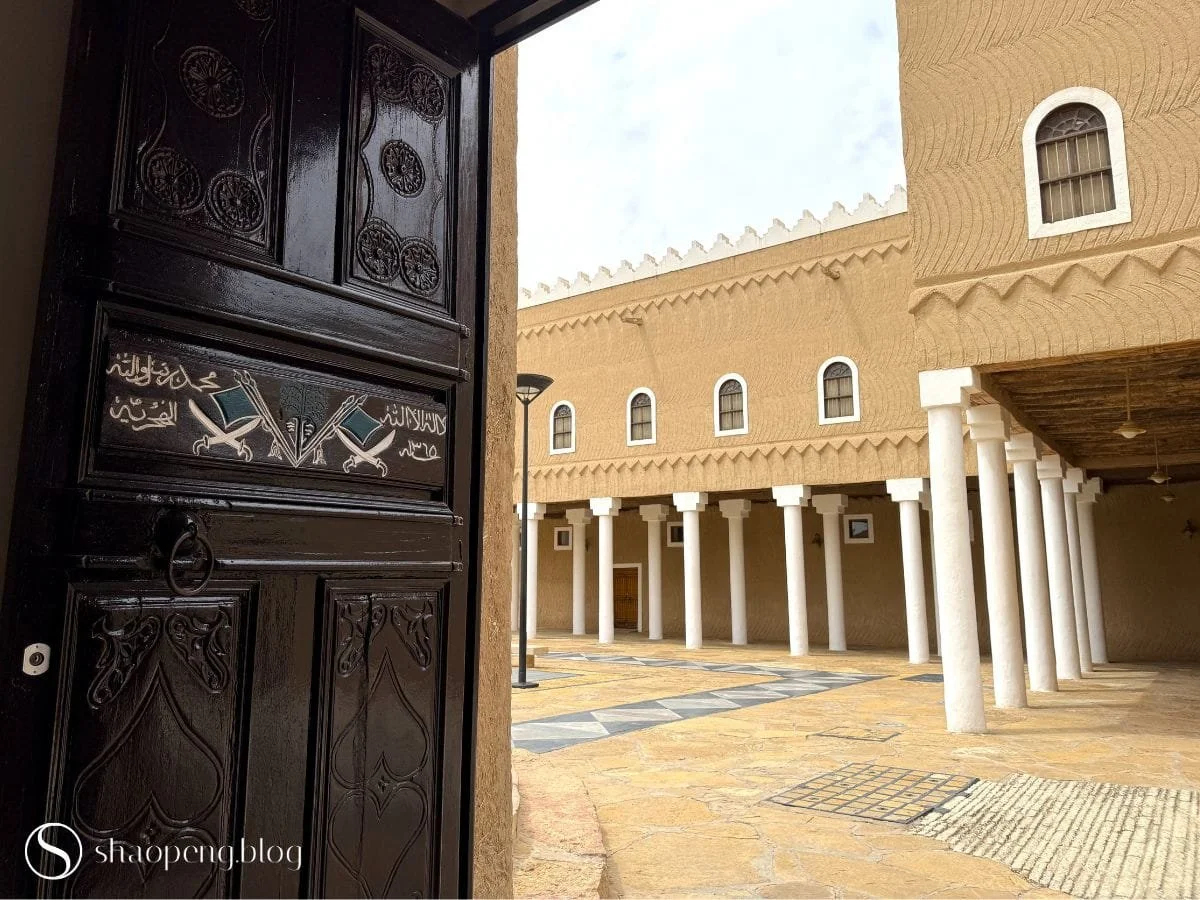
A peek into Al Murabba Palace through its entrance gate.
The story continues at Al Murabba Palace, where old Riyadh stepped outside its walled city and turned toward the future
Before setting foot inside, visitors are likely to feel intimated by the palace’s imposing exterior, especially its seven-metre-high wall. But at the same time, there is a certain beauty in the circular patterns pressed into the mudbrick surface and the band of triangular relief work running along the upper register This is Najdi architecture at work, the indigenous building style of Najd, the vast central plateau of the Arabian Peninsula where Riyadh itself sits.
Completed in 1938, the palace stands about two kilometres from the old city. It was built as part of a vision to facilitate Riyadh’s expansion, commissioned by King Abdulaziz.
Today, the palace gives its name to the surrounding neighbourhood, Al Murabba, which literally means “the square.” Interestingly, sources do not fully agree on the origin of the name. The more romantic account traces it to a broken square-shaped dry well that once stood on the site, around which the palace was later built. Others attribute it more simply to the palace’s own square 400-by-400-metre layout or its cubic Najdi form. Either way, the idea of the “square” runs through the story. It is something worth asking your guide about, since even Riyadh’s own historians seem to enjoy debating it.
The palace’s design reflects the principles of Najdi architecture, built from materials drawn from the surrounding landscape: stone for the foundations, mudbrick mixed with straw for the walls, and palm fronds and acacia trunks supporting the ceilings. The two-storey structure follows a geometric layout centred around an open courtyard.
At the heart of the courtyard stands a towering palm tree, a national symbol of prosperity. It also recalls the land’s earlier agricultural life. Before the palace was built, this area was known as “Murabba Al-Sufyan” and was farmed during the rainy season. The palm therefore serves as both a royal emblem and a reminder of the landscape that existed before the palace transformed it.
King Abdulaziz moved into the palace in 1938, and it soon became both his royal residence and the political nerve centre of the Kingdom. It was here that the young state’s earliest regulations were issued, and many of the royal decrees that shaped Saudi Arabia’s economic and political development were signed, making Al Murabba a symbol of the beginnings of modern governance.
Wanderer’s tip — Don’t miss the King Abdulaziz Grand Mosque within the complex, the king’s own private mosque. While exploring the grounds, keep an eye out for the vintage Rolls-Royce gifted to King Abdulaziz by Winston Churchill. It is an unexpected relic of the Kingdom’s early diplomacy tucked among the mudbrick walls.
National Museum of Saudi Arabia
Sense of Wander: ★★★★☆
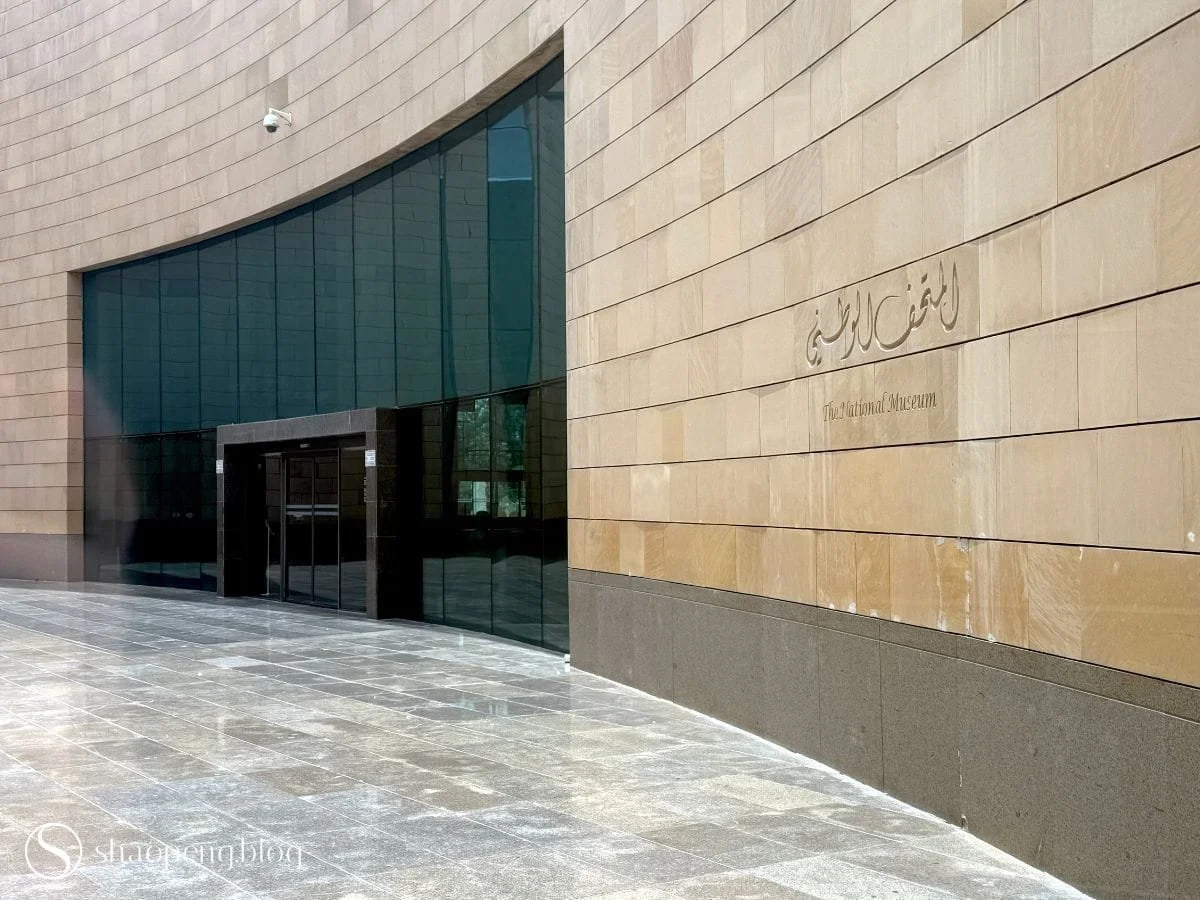
Entrance to the National Museum of Saudi Arabia
Just around the corner from Al Murabba Palace, nestled in the same neighbourhood, stands the National Museum of Saudi Arabia, a place where more than 4,000 artefacts invite you to wander through 3,700 years of history in a single visit.
Of course, the exhibition traces the kingdom’s story from pre-Islamic times to the present day. That much you would expect. What I do not expect is to be brought to a stop in the very first gallery. Inside the Man and Universe Hall, a mesmerising digital installation unfolds alongside a moving recitation of the Quran, and you find yourself standing there, invited to reflect on Allah’s creation of the universe before you have even properly begun your journey.
From there, I drift into the Arabian Kingdoms Hall, where pottery, architectural fragments, sculptures, jewellery, and ancient inscriptions trace the rise and fall of cities across the early and late Arabian kingdoms. Names I have never encountered before float past me: Qurayyah, the oasis of Dumat al-Jandal (once known as Adummatu), and the town of Al-Faw. Each becomes a small doorway into a past I never knew existed. Then, surprisingly, the gold treasures of Thaj appear before me, and as a jewellery designer, I feel my eyes widen a little.
The journey continues through the Pre-Islamic Era, then into The Prophet’s Mission and Islam and the Arabian Peninsula Hall, where relics from the great Islamic caliphates and empires are proudly on display. Finally, you arrive at the galleries devoted to the First and Second Saudi States, the historical foundations from which modern Saudi Arabia grew.
The National Museum was opened in 1999 to commemorate the centennial of King Abdulaziz’s recapture of Riyadh and has since formed the heart of the wider King Abdulaziz Historical Centre. The sheer breadth and depth of its collection alone make the museum a rewarding destination, especially at a time when few other history and culture museums exist in the city.
Stay tuned for a dedicated article exploring the museum’s collection in greater detail, inshallah.
Wanderer’s tip — Give yourself time. This museum is enormous, and it’s easy to lose half a day or more inside its galleries without even noticing.
The Royal Institute of Traditioanl Arts
Sense of Wander: ★★★☆☆
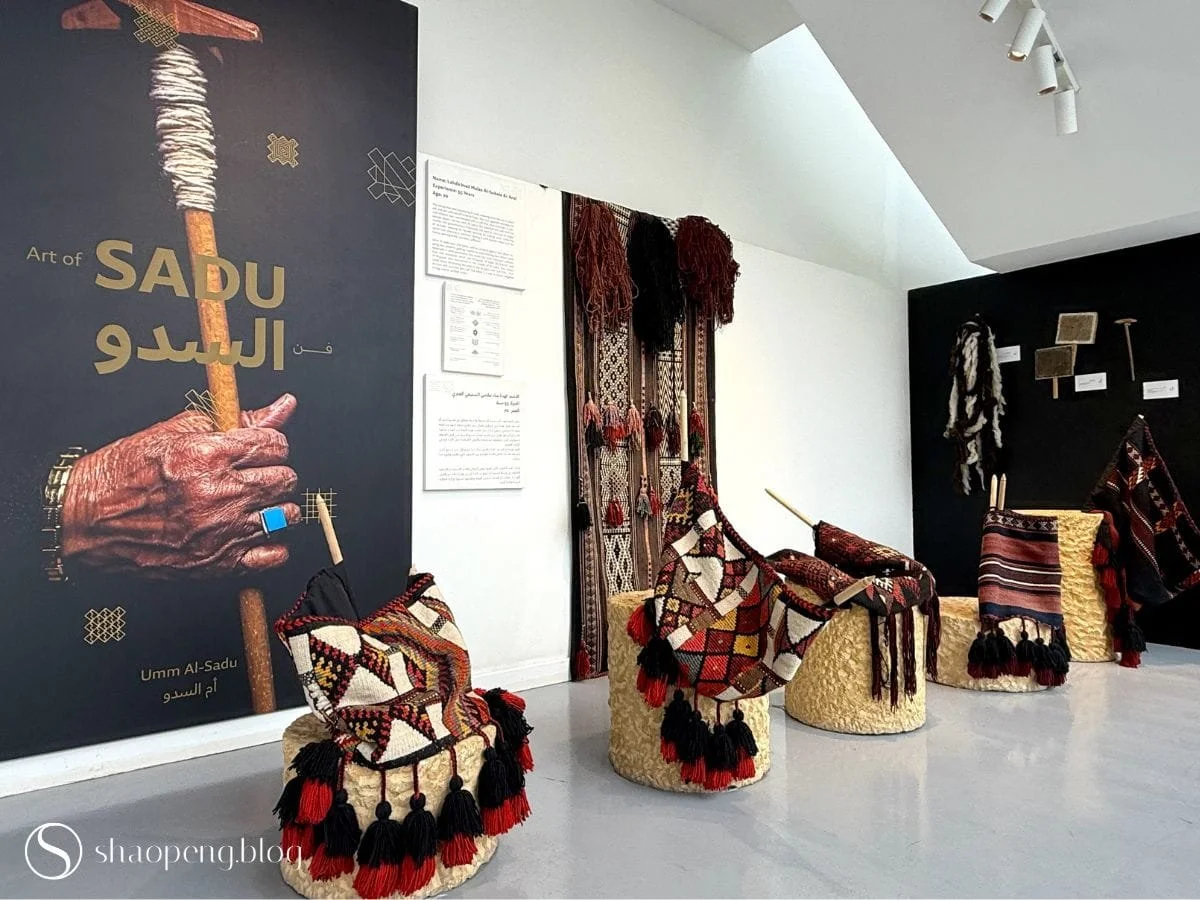
An exhibition at the Royal Institute of Traditional Arts explores the traditional art of weaving.
For those seeking to learn more about the Kingdom’s traditional arts, look no further than the Royal Institute of Traditional Arts, or Wrth, derived from the Arabic word for “heritage,” referring to the passing of skills and knowledge from one generation to the next. At the time of my visit, however, it was still known by its English acronym, TRITA, before the institute’s rebrand.
There was surprisingly little information about it online before my visit, so, driven purely by curiosity, I make my way to its headquarters in the heart of Riyadh. I walk in like a trespasser in another world, not quite knowing what awaits me or even what I am looking for.
It turns out that the institute is not the museum I had imagined, but a living centre dedicated to preserving and passing on traditional craftsmanship. It offers specialised programmes and short courses in pottery, metalwork, woodwork, embroidery, weaving, and many other traditional arts. Yet describing them as simply “traditional arts” hardly does them justice.
Here, you learn the specific: how to cut and stitch a Najdi maqta', the traditional dress worn by women; how to carve the gypsum motifs that adorn historic buildings; how to weave textiles that have long been part of everyday life; and how to embroider the ornate trim of a bisht with gold thread. This, I think to myself, is exactly the kind of place where I could happily spend an afternoon, or even a week, if only I had more time in the city.
Not being enrolled in a programme, I am not allowed beyond the receptionist, so I take the opportunity to wander through the hall’s small exhibition space instead. I stumble on an extraordinarily intricate silver Mecca incense burner (مبخرة مكة), crafted by Ahmad Ibrahim Badr, the same artisan who recast the Kaaba's golden door in 1979; a dallah coffee pot once used to prepare qishr (قشر), the ginger-spiced coffee of southern Arabian Peninsula; and several works showcasing al sadu weaving, whose geometric patterns somehow feel both centuries old and contemporary at the same time.
Wanderer’s tip — If traditional craftsmanship fascinates you as much as it does me, Wrth also offers self-paced online courses through its official website, so you do not need to book a flight to start learning.
Al Mousa Centre
Sense of Wander: ★★★★☆

Works by Saud Al Qahtani on display at Abstract Art Gallery.
Some of Riyadh’s best contemporary art is not found in a museum, but hidden in plain sight inside a building most people would otherwise walk straight past. I know this because I passed it twice myself without knowing what was inside.
Located on Olaya Street, Al Mousa Centre opened in the 1980s as one of the city’s premier destinations for wedding attire. Its corridors were once lined with fabric shops and tailors preparing brides for their big day. By the turn of the millennium, however, the centre’s foot traffic had thinned. Then a framing shop moved in. Artists followed, drawn by affordable rents and good lighting. Soon, galleries followed the artists.
Today, around twenty galleries share the same fluorescent-lit corridors and stairwells that once displayed veils and going-away dresses. I first discovered this place through Art Week Riyadh, when the building, behind its unassuming facade, comes alive with exhibition openings, artist talks, and public programmes.
Unlike the polished, white-cube galleries that can sometimes feel intimidating, wandering through the galleries at Al Mousa Centre feels relaxed and full of discovery. More importantly, it offers a different perspective on contemporary art, one that moves beyond the Western-dominated narratives often presented and gives the spotlight to the colours, forms, and aesthetics shaped by artists who call this region home.
Wanderer’s tip — Visit during Art Week Riyadh to experience the centre at its most vibrant, with exhibitions, talks, and events taking place throughout the building. Be aware that there is more than one location named Al Mousa Centre in Riyadh, so do not make the same mistake I did and head to the wrong one. This Al Mousa Centre is located on Olaya Street, directly opposite King Fahad National Library.
Jarir Bookstore
Sense of Wander: ★★★★☆
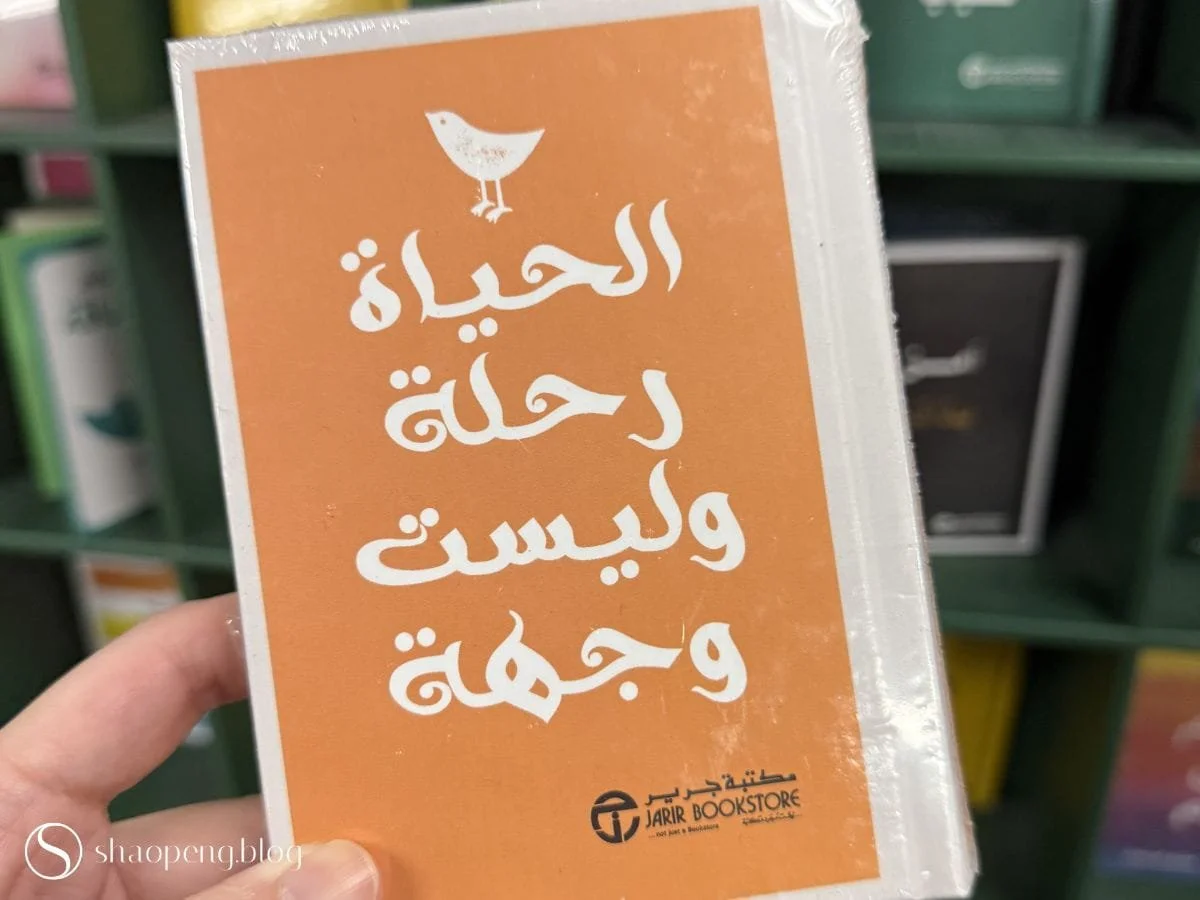
Book cover featuring the phrase “Life is a journey, not a destination” (الحياة رحلة وليست وجهة).
I didn’t expect a bookstore to make the list, but Riyadh doesn’t have many, and Jarir earns its place.
What began in 1974 as a humble secondhand shop, selling used books and artwork passed along by expats living in the city, has grown into one of the Middle East’s largest retail chains. Its shelves now span Arabic poetry and Islamic history, English-language fiction, art books, and stationery.
The bookstore takes its name from the street where it first opened, which in turn was named after Jarir ibn Atiyah, a 7th-century poet from Najd best known for his decades-long and famously fierce literary rivalry with his contemporary Al-Farazdaq. Such connection is a reminder of how deeply words and literary culture are valued in this part of the world. A poet’s name becomes a street, and eventually a bookstore that continues to celebrate the written word.
During my stay in Riyadh, I often visit the bookstore late in the evening before returning to my hotel, which is only a five-minute walk away. In fact, Jarir was one of the reasons I chose my hotel in the first place. I would wander between the aisles, half searching for a specific title and half simply getting lost among the sea of Arabic books, curious to see what a Saudi bookstore has to offer.
If you only have time for one bookstore in the city, make it this one.
Aseeb Restaurant
Sense of Wander: ★★★★☆
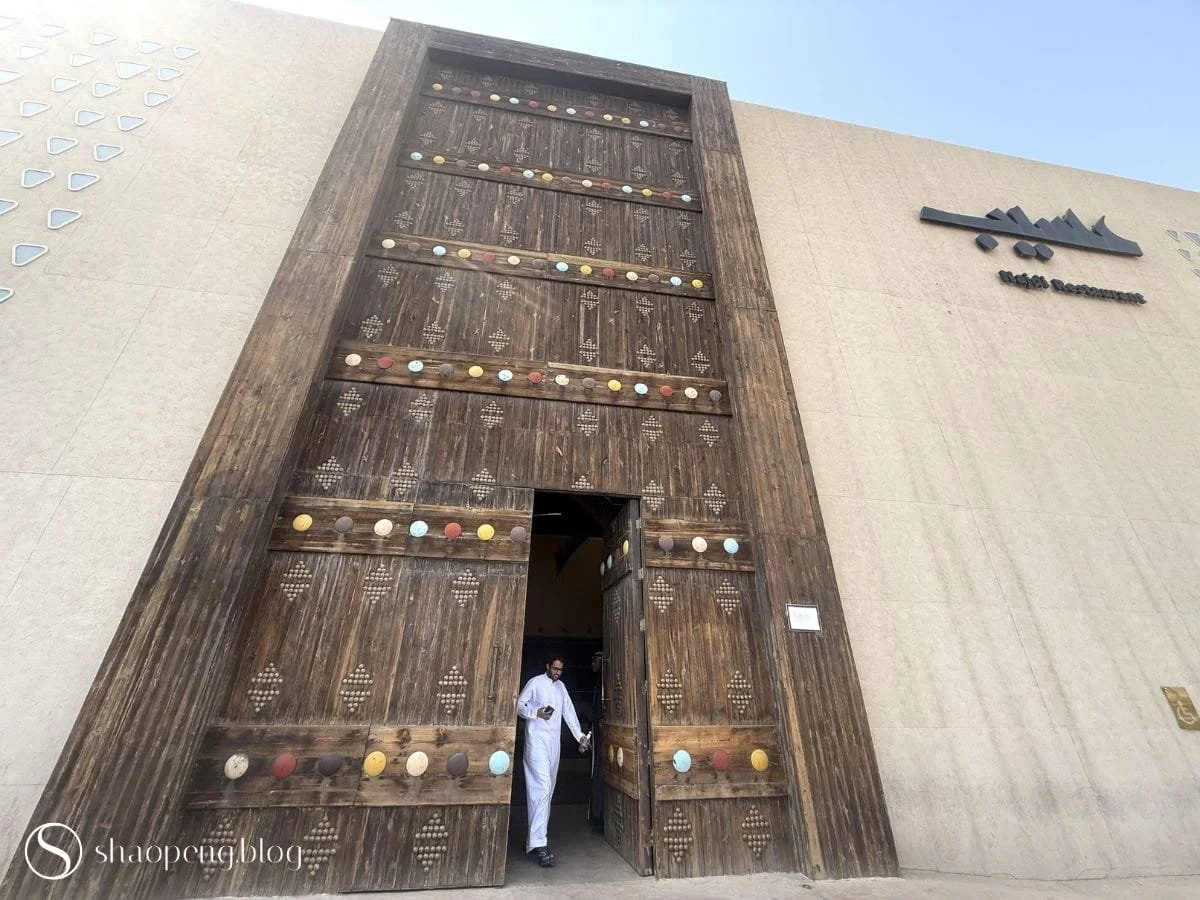
To enter Aseeb Restaurant in Riyadh, visitors pass through its grand entrance gate designed in Najdi style.
In Riyadh, you see Najdi traditions everywhere in its architecture, but have you ever wondered what its food tastes like?
At Aseeb, you feel the story before you even taste it. The entrance alone feels like a small ceremony: a colossal wooden door, as if built for camels and caravans rather than casual lunch reservations, swings open onto a foyer so vast that it briefly resets your sense of scale. Whatever century you walked in from, you are no longer in it.
Inside, you are welcomed into what feels like a grand majlis, where traditional arts and crafts stretch across the walls alongside Najdi architectural details. The inscriptions leave me wondering whether they are verses of Nabati poetry, giving voice to the desires and longings of the human heart.
Aseeb was founded by the husband-and-wife team Abu and Umm Saud, who set out to bring the flavours of their own home kitchen, and the wider culinary heritage of the Najd region, to a broader audience. The restaurant serves traditional dishes such as jareesh, qursan, saleeq, and marquq, among others. I order red jareesh, served with musamana spices, alongside hashi kebab, a dish rooted in Bedouin culinary traditions prepared with the tender meat of a young camel calf. It is my first time trying camel meat, and I’m glad that my first experience is such a memorable one.
What stays with me is not just the food. Inside Aseeb, the interior design, atmosphere, and warmth of the staff make me feel as though I have wandered into someone’s ancestral home rather than a restaurant in northern Riyadh.
Oh, I also end up ordering a date cheesecake to take away. My stomach may be full for now, but my curiosity is still hungry.
Wanderer’s tip — Reservation is recommended, especially on weekends.
At-Turaif
Sense of Wander: ★★★★★
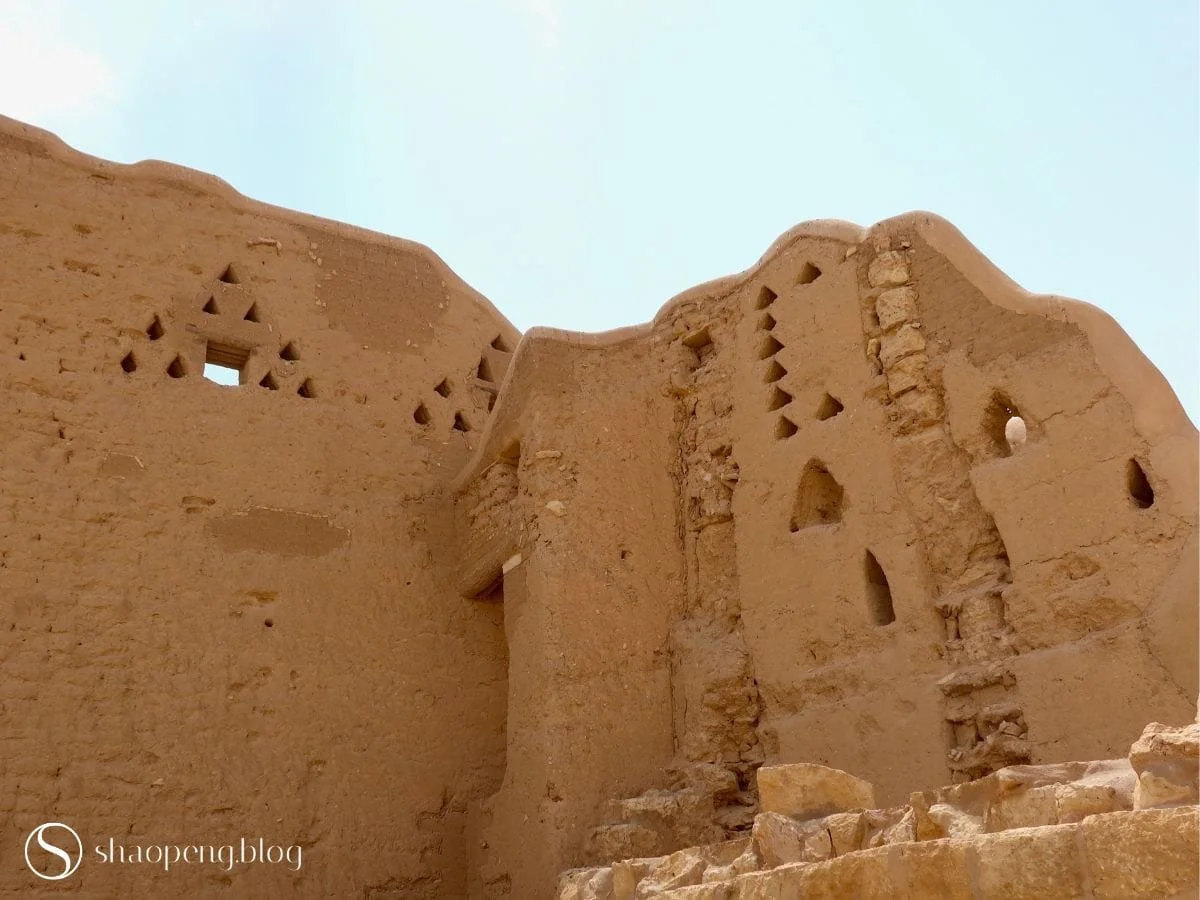
At-Turaif is a UNESCO World Heritage Site located in Diriyah.
Everything in this guide so far has been a short walk or a quick taxi ride from the centre of Riyadh. At-Turaif asks for slightly more — a 15 to 20 minute drive out past the edge of the city — and it is, without question, worth the trip.
At-Turaif, located in Diriyah, is where Saudi Arabia’s story actually starts. This mud-brick settlement on the banks of Wadi Hanifah dates back to the 15th century, but its real turning point came in 1727, when Imam Muhammad ibn Saud made Diriyah the seat of the First Saudi state (1727–1818), turning a desert oasis town into the political and intellectual capital of a rapidly growing empire. Everything that would eventually become the Kingdom of Saudi Arabia can trace its roots back to these walls.
Walking through At-Turaif feels a little like walking through a giant sandcastle frozen in time — golden mud-brick walls and narrow winding lanes and uphill pathwaysthat hasn't seem to change much even if everything else around it has.
At the centre of it all is Salwa Palace, the largest structure in the district: a multi-storey complex of reception halls and finely worked plasterwork that would have once hosted rulers, scholars, and the earliest architects of the modern Saudi state. It's no surprise that UNESCO named this Saudi Arabia's first World Heritage Site in 2010
You would be surprised to find that among the historic mud-brick buildings are a handful of galleries dedicated the history of the region, Arabian horses, military, among others.
Wanderer’s tip — Across the wadi sits Al-Bujairi, once Diriyah's centre of learning and scholarship, and now a lively terrace of restaurants and cafés with At-Turaif lit up gold in the near distance — the perfect place to sit down after a few hours of wandering and let the history settle in over dinner.