
Sharjah, named the cultural capital of the Arab world, is a city where heritage refuses to stay behind glass. It moves through its streets, slips through its souqs, and settles into the qahwa offered before you’ve thought to ask.
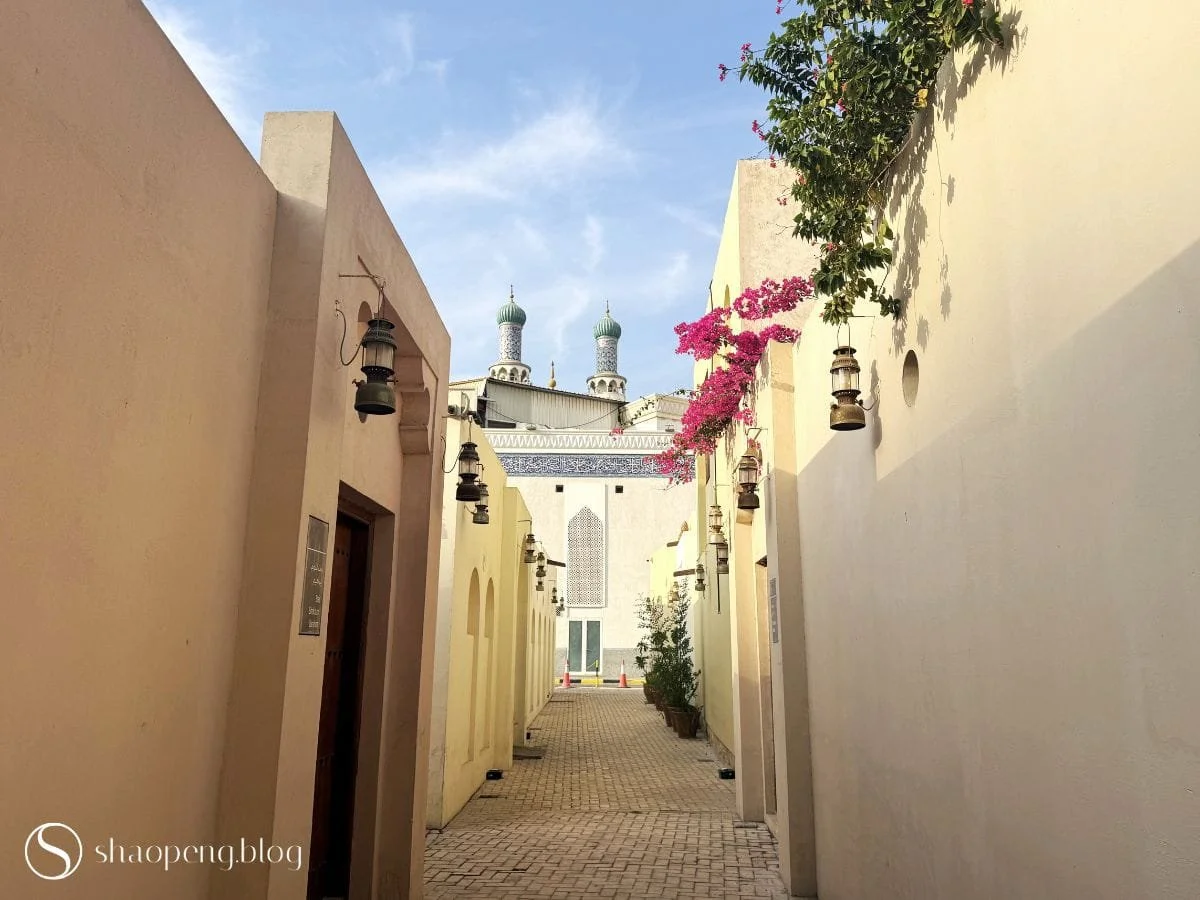
Wandering in Sharjah often leads to unexpected encounters.
SHARJAH, UAE — Outside rush hour, a taxi ride from Dubai to Sharjah takes less than half an hour, yet the distance between the two cities somehow feels longer. Somewhere along the highway, the skyline shifts from the vertical ambition of one city into something slower, more saturated with colour, and less hungry for attention.
Sharjah doesn’t promote itself the way its neighbours do. It is less known to visitors than Dubai or Abu Dhabi, and seems, in some ways, content with that. In 1998, UNESCO named it the cultural capital of the Arab world — a designation that continues to shape the city. While its neighbours sprint toward the next skyline, Sharjah strolls.
To wander through the historic heart of Sharjah is to feel time behaving differently. An old fort still holds its ground amid modern streets. A restored pearl merchant’s home takes you into a past the city still holds onto. The corridors of a historic souq twist and narrow just enough to slow your pace — which is, perhaps, the whole point.
Look up and you will find the golden dome of the Sharjah Museum of Islamic Civilisation catching the midday sunlight. On the city’s outskirts, the House of Wisdom is a modern library and community space built for a thinking public.
I have always believed the best way to understand a place is to follow what it chooses to preserve. In Sharjah, the answer is clear: traditions, heritage, art, and faith. The Calligraphy Museum alone could hold you for an afternoon, if you let it and resist the temptation to be somewhere else. That, I think, is the city’s real invitation.
For my fellow art and culture enthusiasts, here’s a guide to the stops worth your time. Come with a loose schedule and comfortable shoes, and you will leave a little changed.
Sharjah Fort (Al Hisn)
Sense of Wander: ★★★☆☆
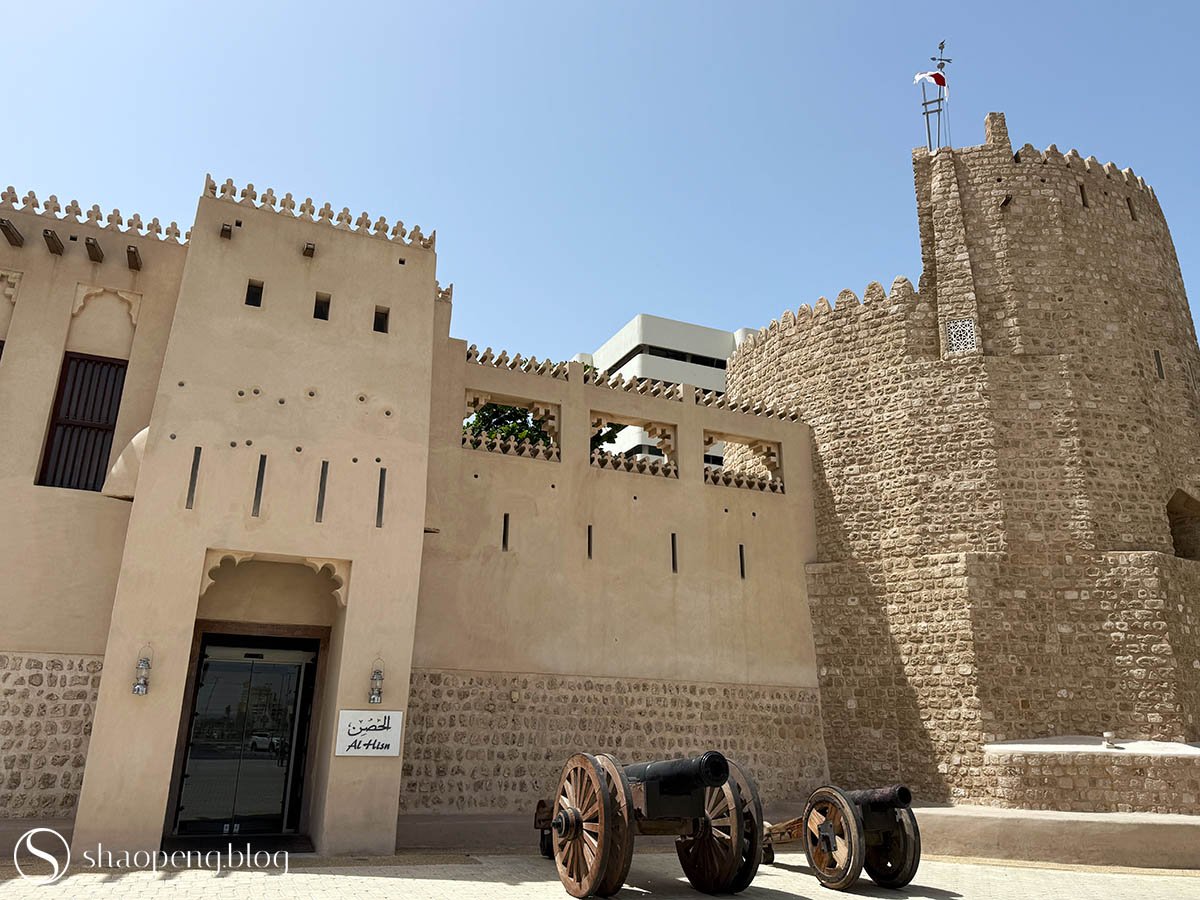
Entrance to the Sharjah Fort, also known as Al Hisn.
Al Hisn has stood its ground since 1823. Its two-storied structure of rock and coral rises around a central courtyard, its towers anchoring the trapezoid shape that has defined Sharjah for two centuries. For much of its life, this was the seat of government and the home of the ruling Al-Qasimi family.
Step inside and you will find Al Muhalwasa, a polygonal tower whose cells once held prisoners and those awaiting trial. It is also the room where Sharjah’s first system of jurisdiction took root. Its unusual shape is unlike anything else in the broader Gulf region — a small architectural anomaly that carries considerable historical weight.
Wander a little further and you will stumble upon Al Medbasa, a room unlike any other you have encountered. Here, date molasses — dibs — was traditionally pressed and stored, an ingenious act of self-sufficiency that kept dates available through the long months between harvests. There is something meditative about the space, about the idea of a ruling household tending to its own larder.
Elsewhere, the fort traces the origins of the Al Qawasim, the powerful tribal family who shaped this coast and eventually became Sharjah’s rulers. I did not expect to pause at a flag, but the Qawasim banner, which was once used to distinguish this family from other Arab states of the Gulf, is one of those artefacts that illuminates the story around it.
Outside the fort’s entrance stands Hatabat Al Tawba, translated as “Repentance Wood.” This modest column — easy to pass without notice — is a replica of a wooden post salvaged from the mast of a pearling ship that once burned. The original was placed here by Sheikh Saqr bin Khalid Al-Qasimi (reigned 1883–1914) as a post for punishing criminals. Yet the practice it recalls is older: pearl divers who refused to work were once tied to a ship’s mast.
Wanderer’s tip — Al Hisn is usually quiet during the day. There is a guest room inside where visitors are welcome to sit and rest, with complimentary qahwa and dates. Enjoy them, and let the fort keep you company.
Sharjah Heritage Museum
Sense of Wander: ★★★★☆
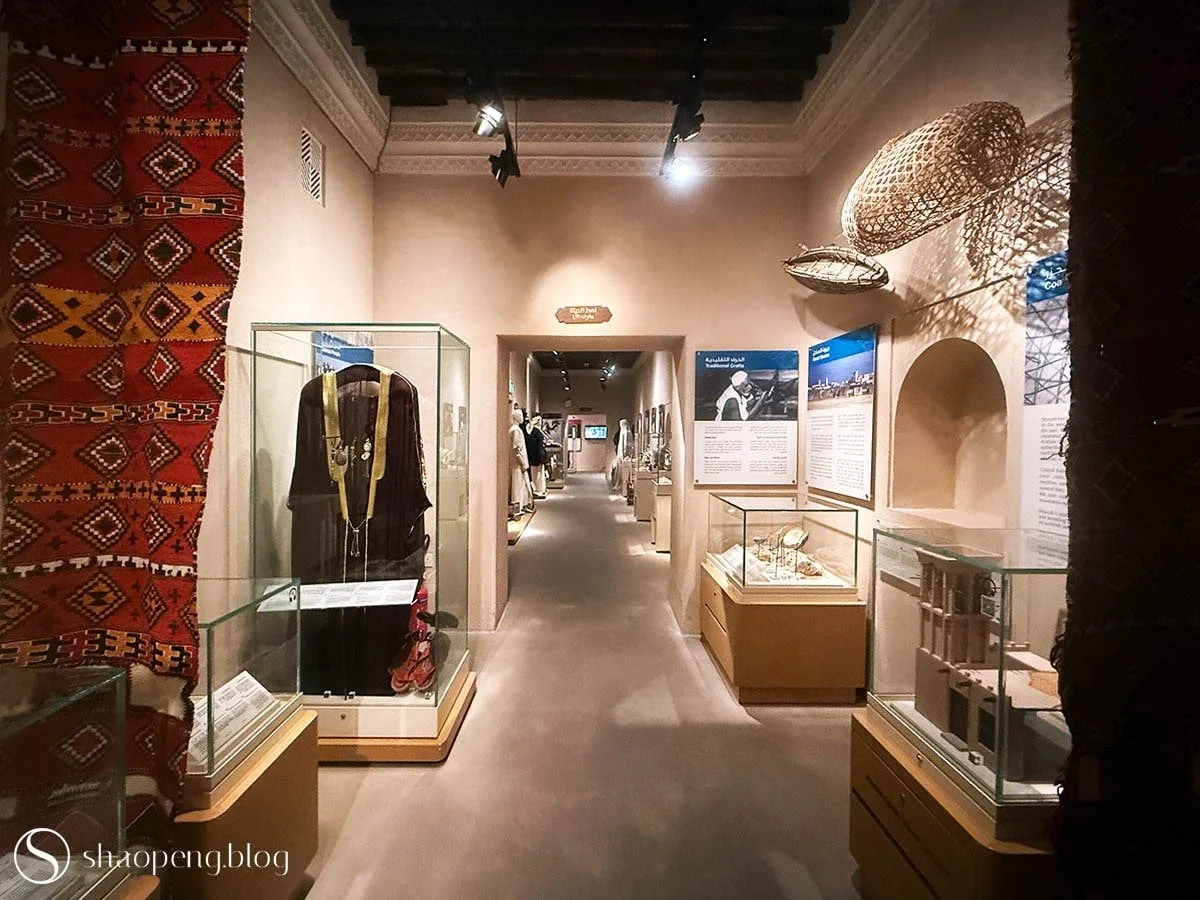
Inside Sharjah Heritage Museum.
A short walk from Al Hisn brings you to a house that has stood here since around 1795. It was built for Saeed Bin Mohammad Al Shamsi, the son of a chief from Buraimi and a tawash, or pearl merchant. Coral, chandal wood, palm, jus mortar, and plaster — materials shaped by necessity and place — come together in its construction. Restored in the 1990s, the house is now home to the Sharjah Heritage Museum.
Inside, the museum invites you into a slow immersion in the many facets of Emirati life. You move from one to another, exploring how people dressed, what they celebrated, how children were raised, how seasons were marked, and how unspoken codes of etiquette quietly held communities together. Children’s games find their own corner, as they should. So do jewellery and traditional dress, alongside miniature scenes that bring to life the folklore and stories passed down through generations.
If there is a thread that runs through it all, it is endurance. The desert was never a forgiving place, and nothing here suggests otherwise. You would find yourself in admiration of how people survived, and even flourished, in conditions that left very little room for error.
During my visit, one of the rooms held a temporary exhibition, Reflections and Inspirations from Emirati Heritage, featuring works by students from the University of Sharjah’s College of Fine Arts and Design. Paintings, objects, and garments reached back into heritage and returned with something reimagined, forming an ongoing dialogue between past and present.
Wanderer’s tip — Just around the corner, the Sharjah Calligraphy Museum continues the journey. A combined ticket covering this and several nearby attractions costs AED 20.
Sharjah Calligraphy Museum
Sense of Wander: ★★★☆☆
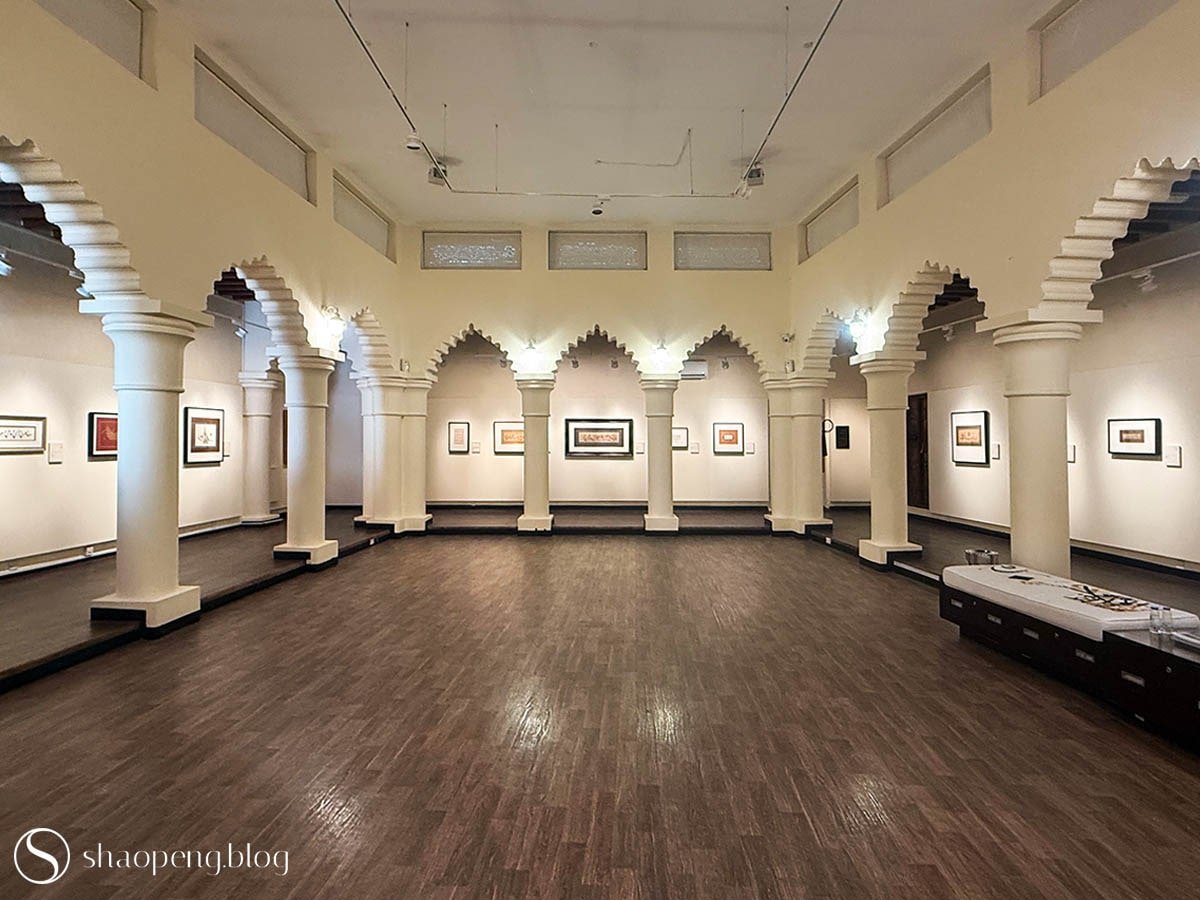
Inside Sharjah Calligraphy Museum.
A stone’s throw from the Sharjah Heritage Museum, Calligraphy Square centres itself around a single devotion. At its heart sits the Sharjah Calligraphy Museum, the only museum in the Gulf devoted entirely to the art of the written word.
I should confess that my first visit was a disappointment, though not the museum’s fault. The calligraphy works had been taken down to make room for the Sharjah Biennale, and I wandered through bare walls with the deflation of a traveller who has arrived one season too late. I returned a few months later, and this time, the museum’s collection has found its way back onto the walls.
The museum’s calligraphy collection is showcased along the corridors of an inner courtyard, and the visit begins to the right of the entrance, with a piece attributed to the Ottoman calligrapher Mustafa Kutahi (d. after 1787). Written in Thuluth script, it carries the phrase:
“رب يسر ولا تعسر رب تمم بالخير”
Loosely translated as “My Lord, make things easy, do not make them difficult; my Lord, bring this matter with goodness.” In the Ottoman tradition, this phrase marks the beginning of a student’s journey. To find it here, at the threshold of the exhibition, feels like a gesture of intention.
Thuluth script dominates the collection, but as you move along, other scripts begin to surface: Taliq, Tughra, Diwani. Each script comes with its own temperament and has its own way of moving across the page. As a calligraphy student, I find myself pausing before each piece in a way that is difficult to explain to someone who has never held a reed pen. You begin to notice different things when you understand how mischievous ink can be.
There are also two pieces by Hasan Çelebi (1937-2025), the celebrated Turkish calligrapher who devoted his life to keeping the classical tradition not just alive but luminous. I had not expected to find his work here, and that unexpected encounter alone makes the visit feel like a gift.
Wanderer’s tip — Calligraphy Square also hosts the annual Sharjah Islamic Arts Festival (SIAF), where an array of traditional and contemporary Islamic art gathers works by local and international artists. If your visit happens to coincide, consider yourself lucky!
Bait Al Naboodah
Sense of Wander: ★★★☆☆
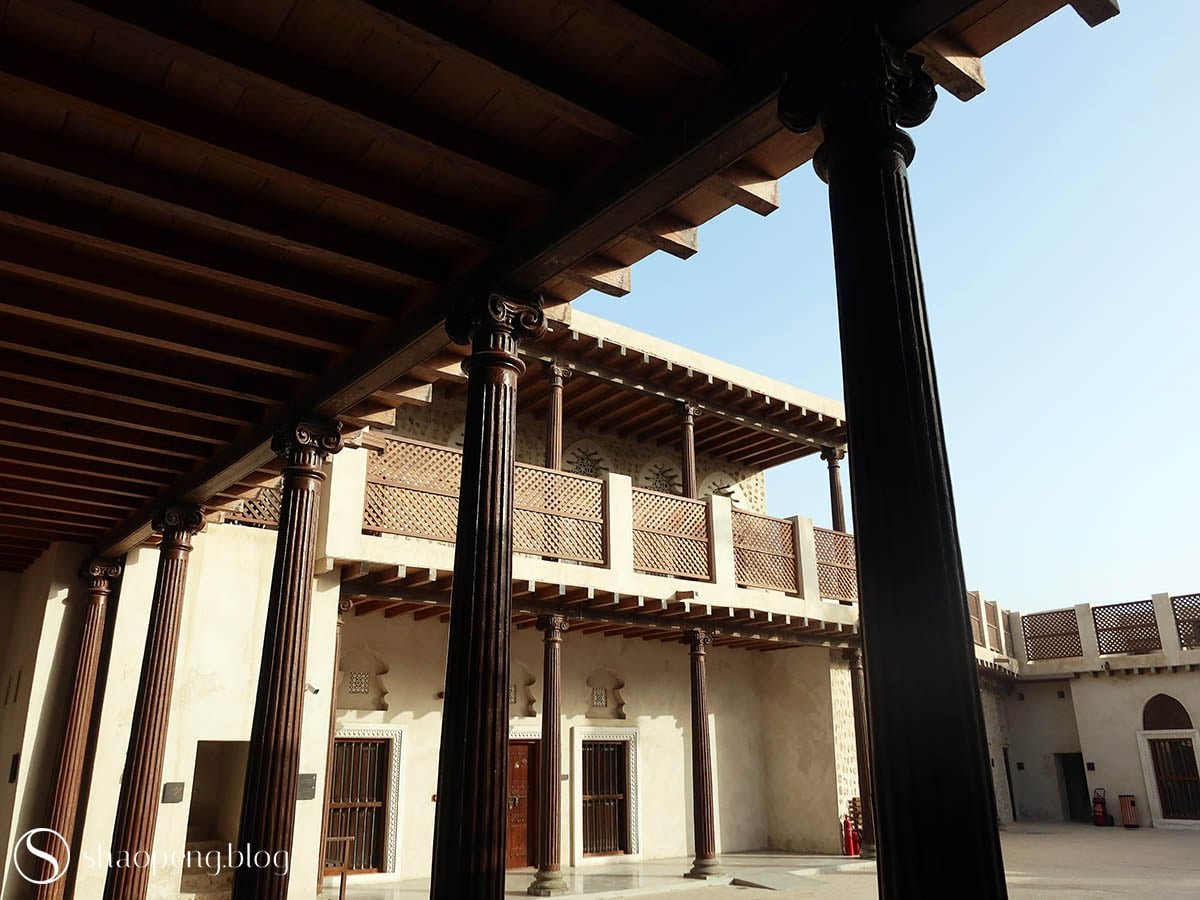
Inside Bait Al Naboodah.
Bait Al Naboodah is, similar to the building that houses the Sharjah Heritage Museum, the former residence of a pearl merchant known as Obaid Al Naboodah (1860–1940). But unlike the nearby museum, you can still get a clear sense of what life was like inside its walls.
By the mid-19th century, when this house was built, Obaid Al Naboodah had accumulated the kind of wealth and standing that leaves its mark on architecture. The house sits at the heart of old Sharjah, close to the harbour and next to Souq Al Arsah, once the centre of the pearl trade.
The building respects local tradition while absorbing the world beyond it. Teak columns imported from India line the courtyard, their classical design carrying an elegance that feels particular to this part of the world that is neither purely Arabian nor entirely foreign, but something shaped by the cosmopolitanism of a merchant who travelled far and returned with his eyes open. Persia leaves its traces here too, in details that reward a slow, attentive looking.
What surprises most are the three spiral staircases, each built for a separate family unit, preserving the privacy of a large and layered household. And then there is Obaid’s majlis, housed in a separate building, where he received merchants, dignitaries, and sheikhs — all kept at a deliberate distance from domestic life.
Today, Bait Al Naboodah is a museum, and it carries its new role without losing its old identity. Its exhibitions trace the history of pearl trading in Sharjah, a place that was, in the late 19th century, among the world’s largest pearl exporters.
Wanderer’s tip — Souq Al Arsah is just around the corner. Head over, and you may find yourself retracing the steps of the merchant into the market where his trade once flourished.
Souk Al Arsah
Sense of Wander: ★★★☆☆
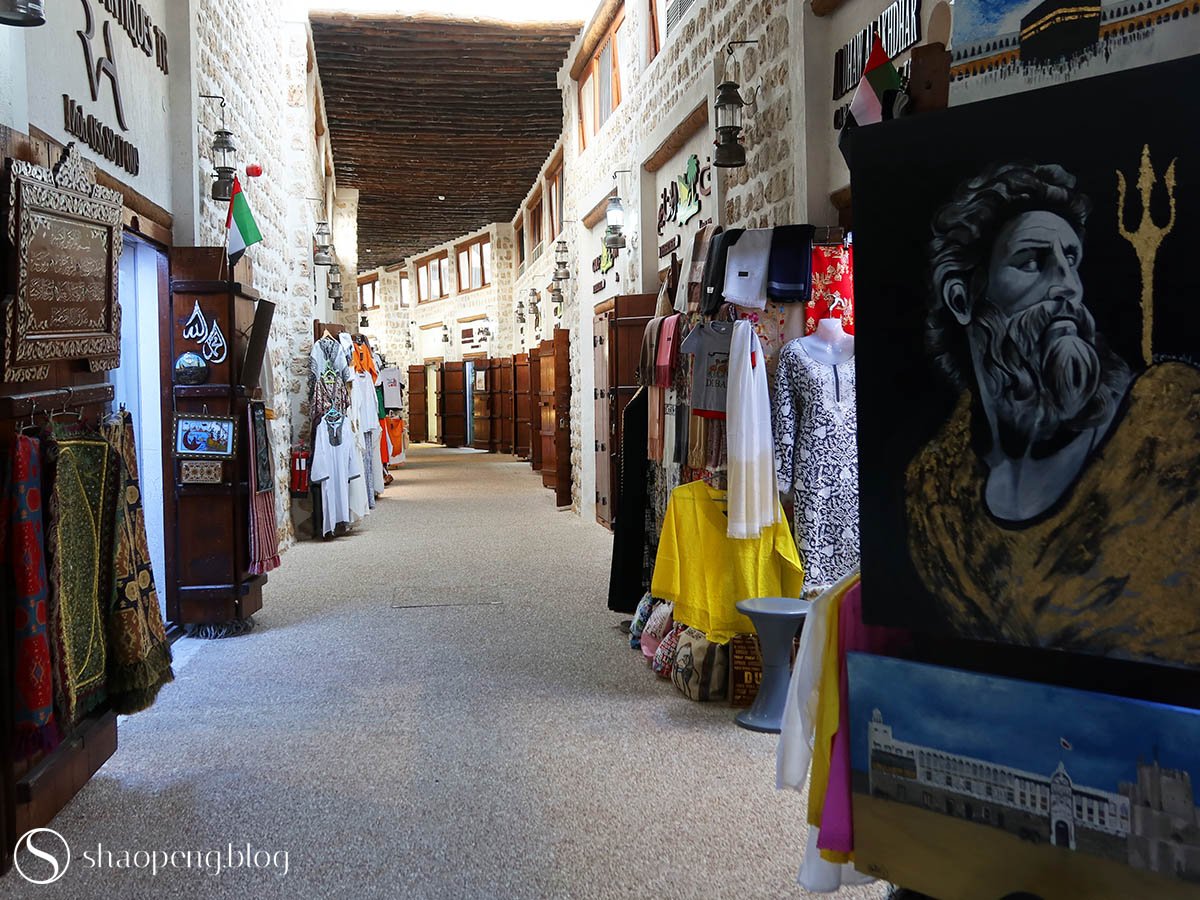
Inside Sharjah’s historic Souq Al Arsah.
Just around the corner from Bait Al Naboodah, the Hay Al Souq — the Neighbourhood of Markets — was once the beating heart of old Sharjah. It is difficult to hold that fact in mind as you walk through it today.
In its heyday, Souq Al Arsah was not just a marketplace but a meeting point for the known world. Merchants arrived with their camels loaded with goods. Ships came regularly from Persia, Iraq, India, and Yemen, their cargo holds filled with food and textiles that would change hands here before dispersing further inland. The pearl trade moved through these corridors with purpose and noise and that unique energy of a place that knows it matters. You can still see the bones of that world in the architecture: the narrow alleyways, the shaded passages, the proportions of a space built for crowds and commerce.
What you cannot find here today, though, are the crowds.
The souq has been renovated, and the shops that line its open spaces and winding corridors sell antiques, handicrafts, souvenirs, traditional garments, and a handful of eateries. The goods are here. The merchants are here. What the market is missing — and I say this with tenderness rather than criticism — is customers.
But perhaps that is not entirely a loss. To wander through a historic souq without the press of a crowd is to hear the place differently, and to notice that odd beautiful object sitting in a shop window with no one to admire it but you.
Wanderer’s tip — The souq is comfortably air-conditioned, with benches placed generously throughout, making it an easy place to pause on a hot Sharjah afternoon. For those with an eye for art, a small gallery is tucked within the market, easy to miss but worth seeking out.
Sharjah Art Museum
Sense of Wander: ★★★☆☆
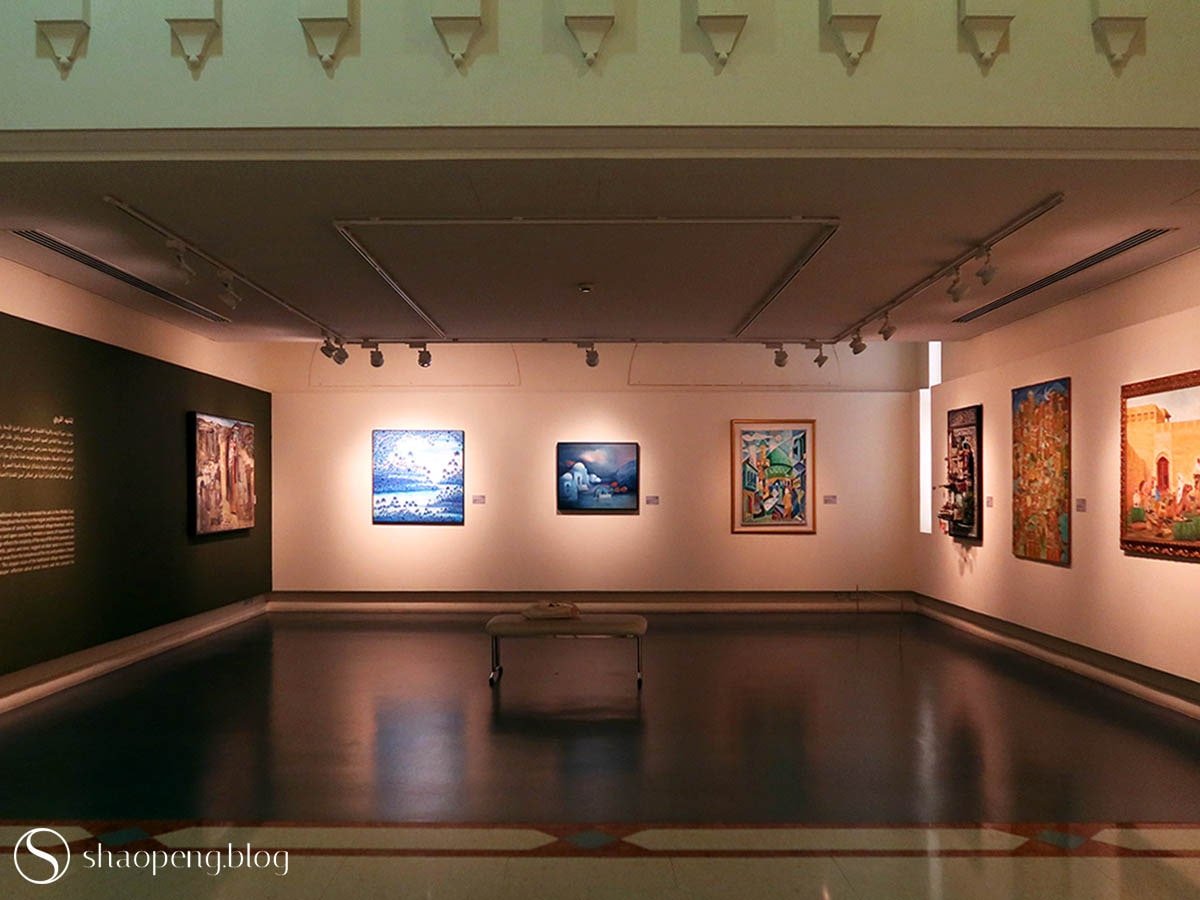
Inside Sharjah Art Museum.
Founded in 1997 under the patronage of Sheikh Sultan bin Muhammad Al-Qasimi, the Ruler of Sharjah, the Sharjah Art Museum stands as a modern counterpoint to the heritage sites clustered nearby. While Al Hisn and the Calligraphy Museum ask you to look backward, this one gestures toward what the region is becoming, through the hands of artists from the UAE and across the Arab world, working in every medium imaginable.
Its permanent galleries showcase highlights from Sheikh Sultan’s orientalist collection, and there is something unique about seeing the region rendered through that particular lens. The way outsiders once imagined this coast is juxtaposed alongside how its own artists have chosen to represent it. The distance between those two visions is, in itself, a kind of story.
But it is the temporary exhibitions that give the museum its heartbeat. Some are among the largest of their kind in the Gulf, and each one shifts the atmosphere of the space. On a recent visit, Parallel Histories from the Barjeel Art Collection explores how artists in the region responded to socio-political events and human condition over the last two centuries. It is kind of exhibition that stays with you long after your visit.
What I did not expect was the library, tucked beside the reception desk, holding over 4,000 books on Arab art in Arabic and English. It is the kind of place serious visitors stumble upon almost by accident, and linger in far longer than intended. If the galleries open a window onto the Arab art world, the library offers a door.
Wanderer’s tip — The museum’s official website has a habit of running behind. For current exhibitions and up-to-date information, the Sharjah Museums Authority’s social media accounts are the more reliable.
Sharjah Museum of Islamic Civilisation
Sense of Wander: ★★★★★
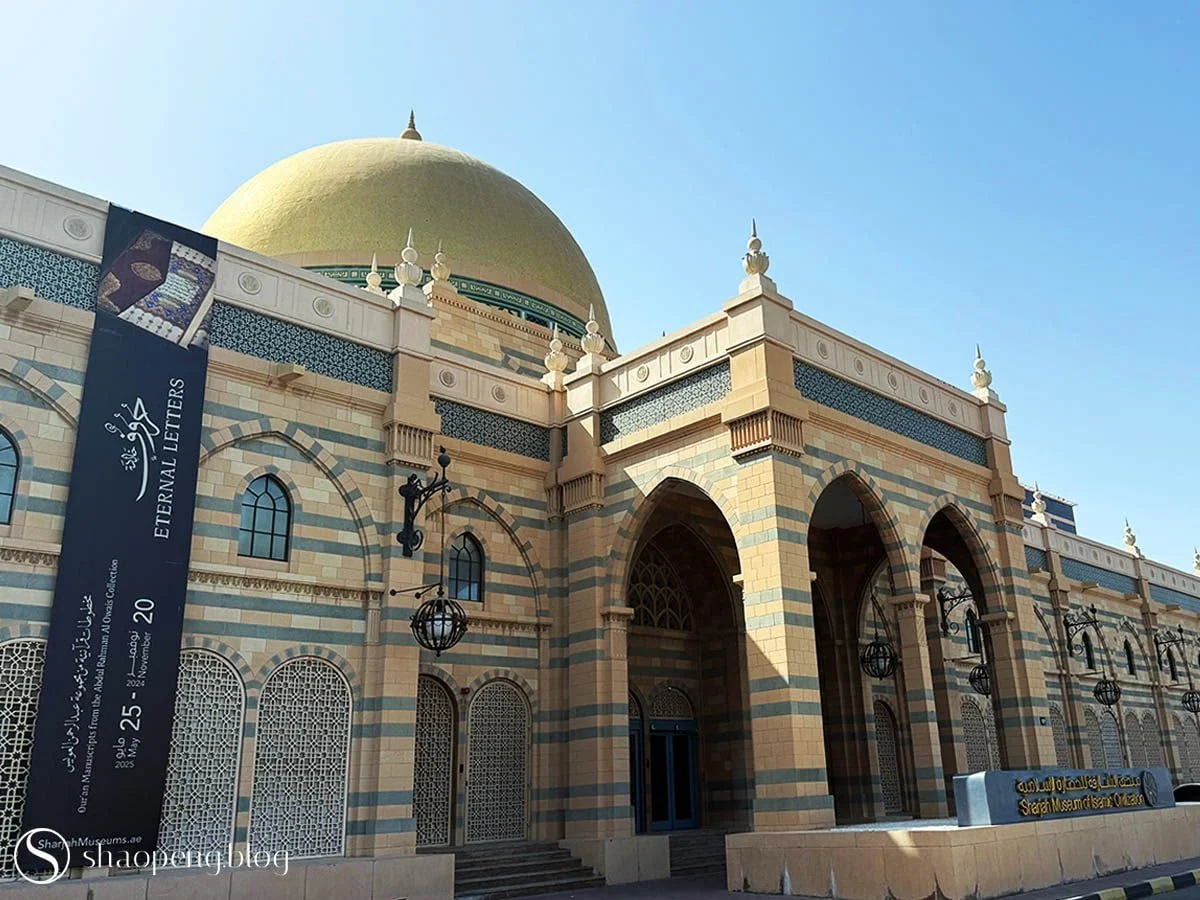
The golden dome of the Sharjah Museum of Islamic Civilisation is reminiscent of the Dome of the Rock in Jerusalem.
As you journey beyond old Sharjah, you will not miss the golden dome in the skyline that catches the sunlight with the confidence of a building that knows what it holds within.
Sharjah Museum of Islamic Civilisation holds over 5,000 artefacts from across the Islamic world, spanning more than 1,400 years of history. It is the kind of museum that contains so much it seems to ask you to return again and again for what it offers.
The ground floor orients you first in faith, then in knowledge, with galleries devoted to the pillars of Islam, followed by the remarkable achievements of Arab scientists whose names and discoveries shaped the medieval world and filtered, often unacknowledged, into the foundations of modern science.
Upstairs, the focus shifts from history to material culture, and here the museum opens into something close to wonder. The Islamic faith is rendered in every medium imaginable, where ceramics, glass, metalwork, jewellery, calligraphy, manuscripts, and textiles fill gallery after gallery with the accumulated beauty of a civilisation that saw no contradiction between devotion and craftsmanship. Each object seems to insist that the two were never separate.
The permanent exhibitions alone is worth the visit. But keep an eye out for what the museum hosts beyond them. On my first visit, I stumbled into Eternal Letters: Qur’an Manuscripts from the Abdul Rahman Al Owais Collection, the kind of exhibition that makes you forget your plans for the rest of the day and feel no regret about it.
Before you leave, look up. The central dome’s ceiling is adorned with mosaics mapping the zodiac constellations, a detail that is impossible to forget once you have seen it.
Wanderer’s tip — If time is short, begin your visit on the upper level. The material culture galleries offer the most comprehensive surveys of the Islamic world’s artistic legacy in the city.
Al Noor Island
Sense of Wander: ★★★★☆
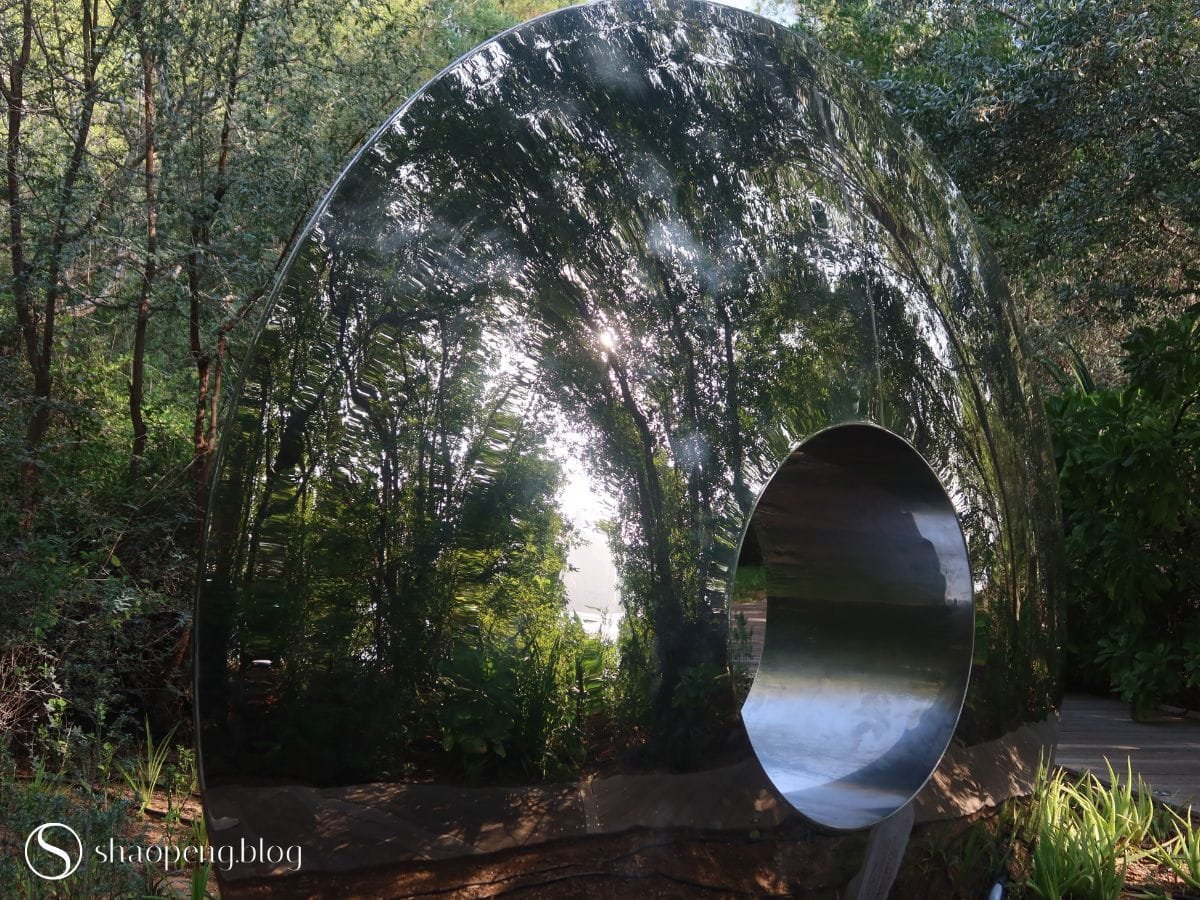
Torus Sculpture by David Harber
Not every cultural encounter in Sharjah happens indoors. Sitting on the edge of Khalid Lagoon, Al Noor Island offers something different: an oasis within reach of the city, where the context shifts from institutions to the open air.
Most visitors come for the butterfly house, but few seem to know about the constellation of artworks dispersed across the island, woven into the greenery as though they grew there.
I find myself most drawn to David Harber’s Torus Sculpture, a mirror-polished elliptical form whose surface distorts the surrounding landscape into something dream-like, bending trees and sky into a single reflection. You move around it and the world moves with you, in abstraction. Nearby stands a sphere constructed from Arabic calligraphy, also worth pausing for. The name of its creator is not mentioned, which lends it a certain anonymity that feels fitting: an object that belongs more to the landscape than to any individual hand.
What sets Al Noor Island apart from the museums and galleries in Sharjah is this: the experience here is not object-focused but spatial. Sunlight, water, and greenery become part of the work. Heritage and culture become something to be wandered through, which, upon reflection, feels like one of the most direct ways to encounter them.
Wanderer’s tip — Come early in the morning or late in the afternoon. The visit is far more enjoyable without the intensity of midday heat.
House of Wisdom
Sense of Wander: ★★★★☆
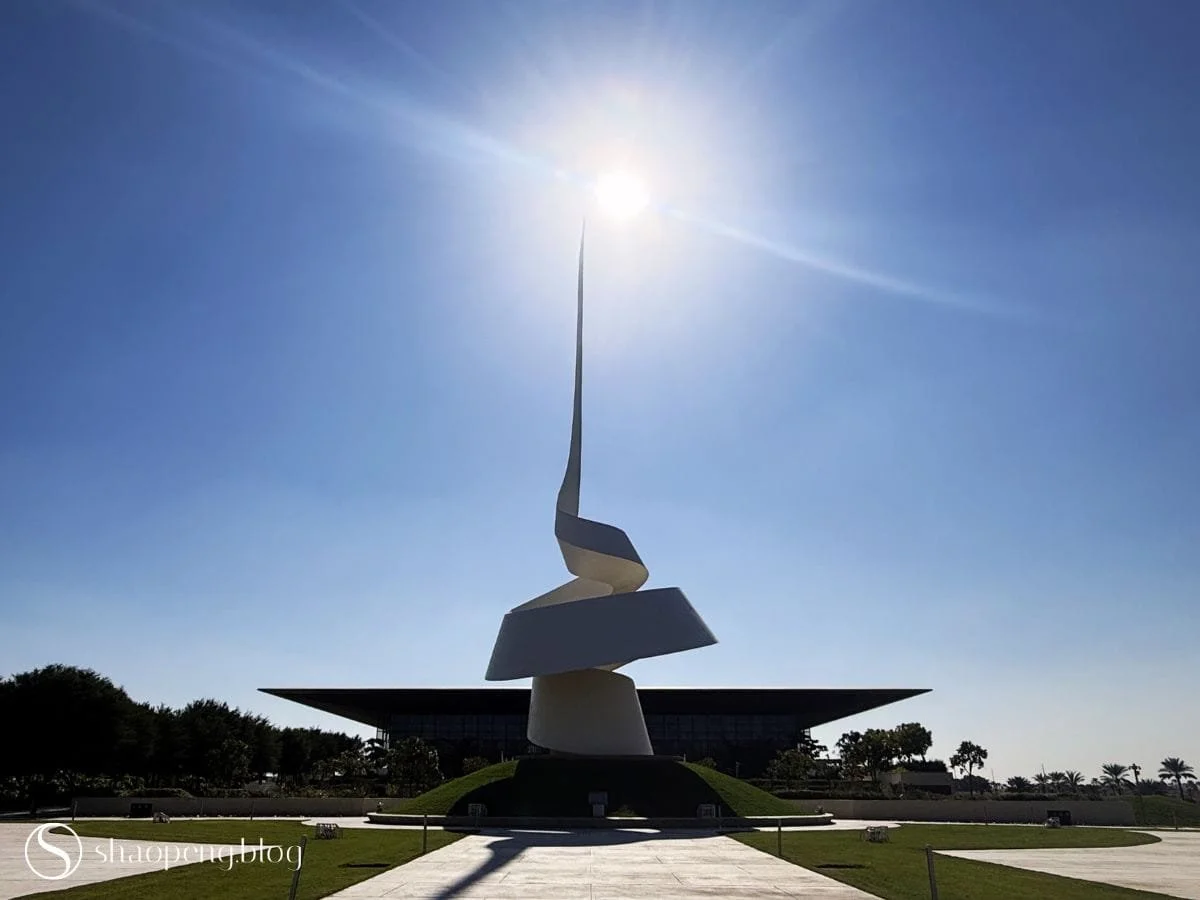
House of Wisdom, Sharjah.
About ten kilometres outside the city centre, the road opens into a newer, part of Sharjah, and House of Wisdom appears like something dreamed rather than built. For anyone who loves books, ideas, or architecture, the journey out here feels like a pilgrimage.
It was commissioned to mark Sharjah’s designation as UNESCO World Book Capital in 2019, and named after Baghdad’s legendary House of Wisdom, the great Abbasid institution that, for centuries, stood as one of the world’s most vital centres of knowledge and translation. The name carries weight, and the building seems aware of it.
Sunlight filters through the glass windows into the library’s bookshelves, as if illuminating every corner of knowledge. And the open-air garden at its centre slows everything down to the pace that good ideas actually need.
To call it a library would be accurate but insufficient. The House of Wisdom is a hub for learning and exchange. Exhibitions, talks, and community programmes run alongside the books, creating the atmosphere of a place that believes the act of gathering around ideas is, in itself, worth preserving.
During my visit, I stumbled upon The Dice Player: Mahmoud Darwish, an exhibition on the life and legacy of the Palestinian poet Mahmoud Darwish. It is the kind of encounter the House of Wisdom seems designed for, a contemplative experience that makes you sit down and reflect, without insisting on an outcome.
Wanderer’s tip — The House of Wisdom is further out than the other stops on this list but is easily reached by buses 88 or 99 from Rolla Terminal. The destination may seem out of reach, but it is worth every minute of the journey.