
Getting Lost in “Urdu Worlds”
At Ishara Art Foundation in Dubai, Urdu Worlds draws you into the worlds of Zarina and Ali Kazim, where the Urdu language becomes a wellspring of memory, imagination, and art, and you find yourself wonderfully lost.
Sense of Wander: ★★★★☆
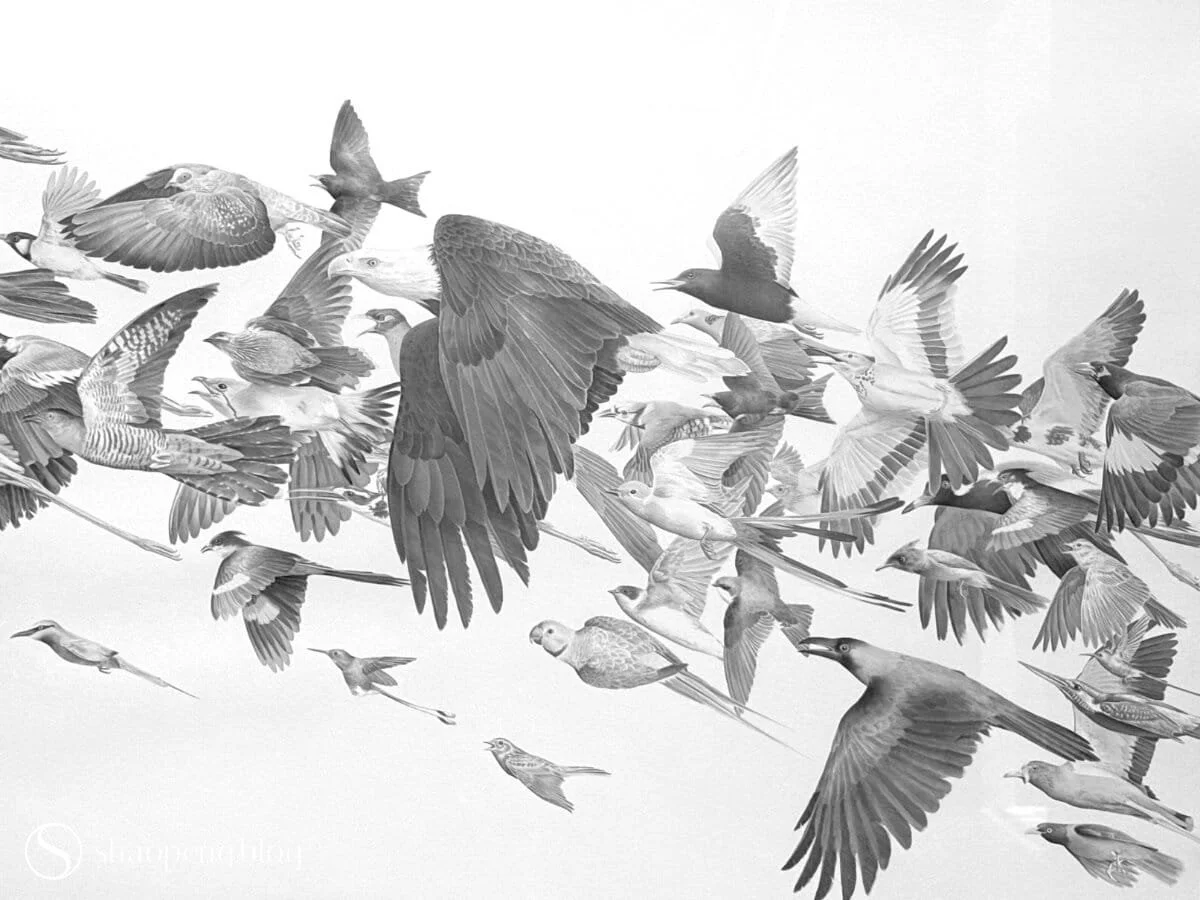
Detail of Ali Kazim’s Hudhud (Conference of the Birds).
DUBAI, UAE — There’s a curious sense of disorientation in seeing something familiar, yet not quite understanding it.
I remember it from my first day in New Delhi, where road signs bear a script that looks uncannily like Arabic, but it isn’t. The words carry no meaning for me. It is Urdu: a language of poetry and courtly refinement, rendered in the same flowing Nasta'liq hand as Persian, yet carrying an entirely different world within it.
Emerging in North India around Delhi, Urdu took shape through centuries of exchange — between local Khariboli dialects and Persian, Arabic, and Turkic influences — eventually becoming known as Zaban-e-Urdu, the “language of the exalted camp,” during the reign of the Mughal emperor Aurangzeb (1658-1707).
That memory returns to me in Dubai. Wandering its streets, Urdu surfaces in passing conversations, at chai stalls, on the metro — in the daily rhythm of a city shaped by its South Asian communities. Alongside Arabic, it feels like part of the city’s vernacular soundtrack: present, pervasive, yet often taken granted for.
Then I find myself walking into Ishara Art Foundation.
Urdu Worlds, curated by Hammad Nasar, is the first contemporary art exhibition in the UAE dedicated to the Urdu language — a fitting first, given how deeply the language has woven itself into the fabric of the country.
The exhibition brings together Zarina (1937–2020), born in Aligarh and later made New York her home, and Ali Kazim (born 1979), rooted in Lahore, Pakistan. Though separated by generation and geography, the two share a deep connection to Urdu as a source of artistic inspiration.
I’ll admit: I arrive expecting calligraphy, literally walls of elegant script and ink. But here, the presence of Urdu is less immediate, less legible, but no less powerful.
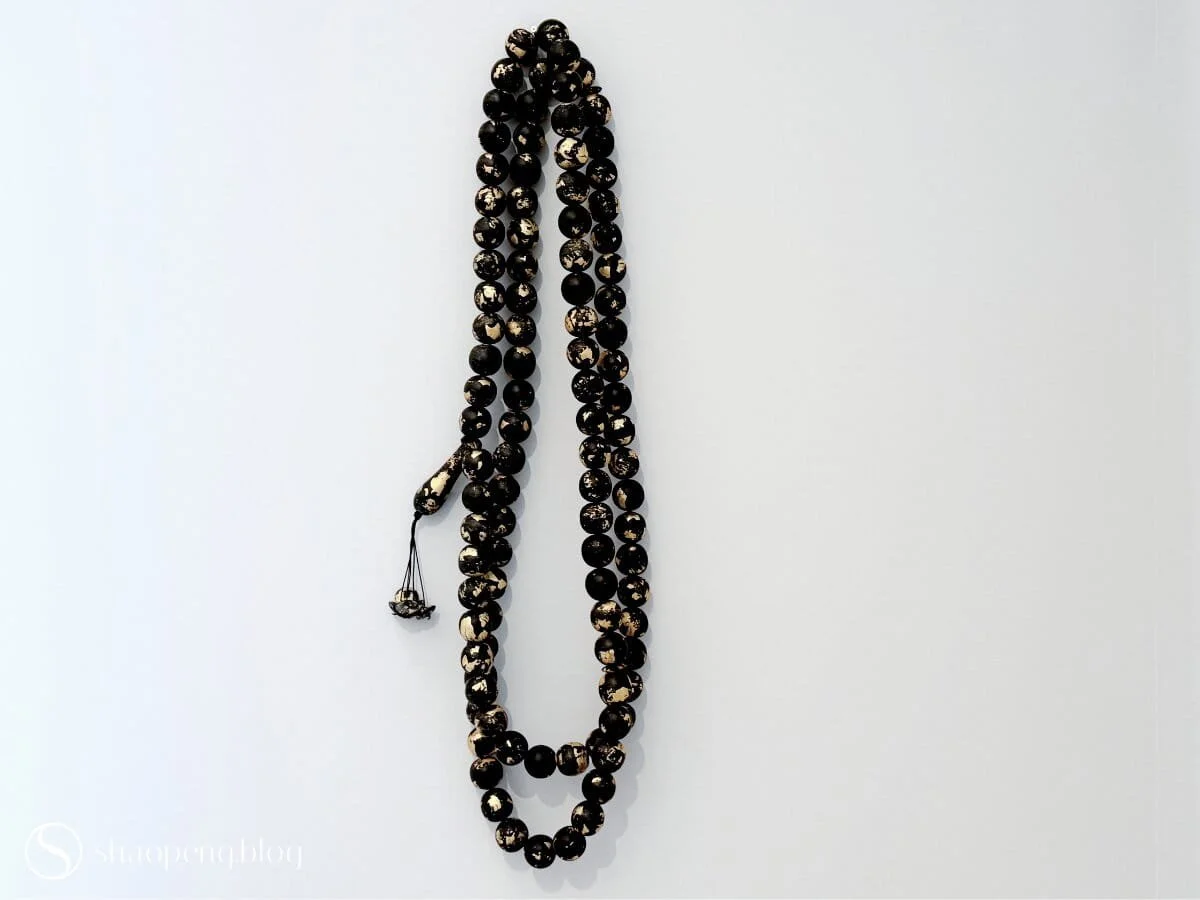
Tasbih by Zarina
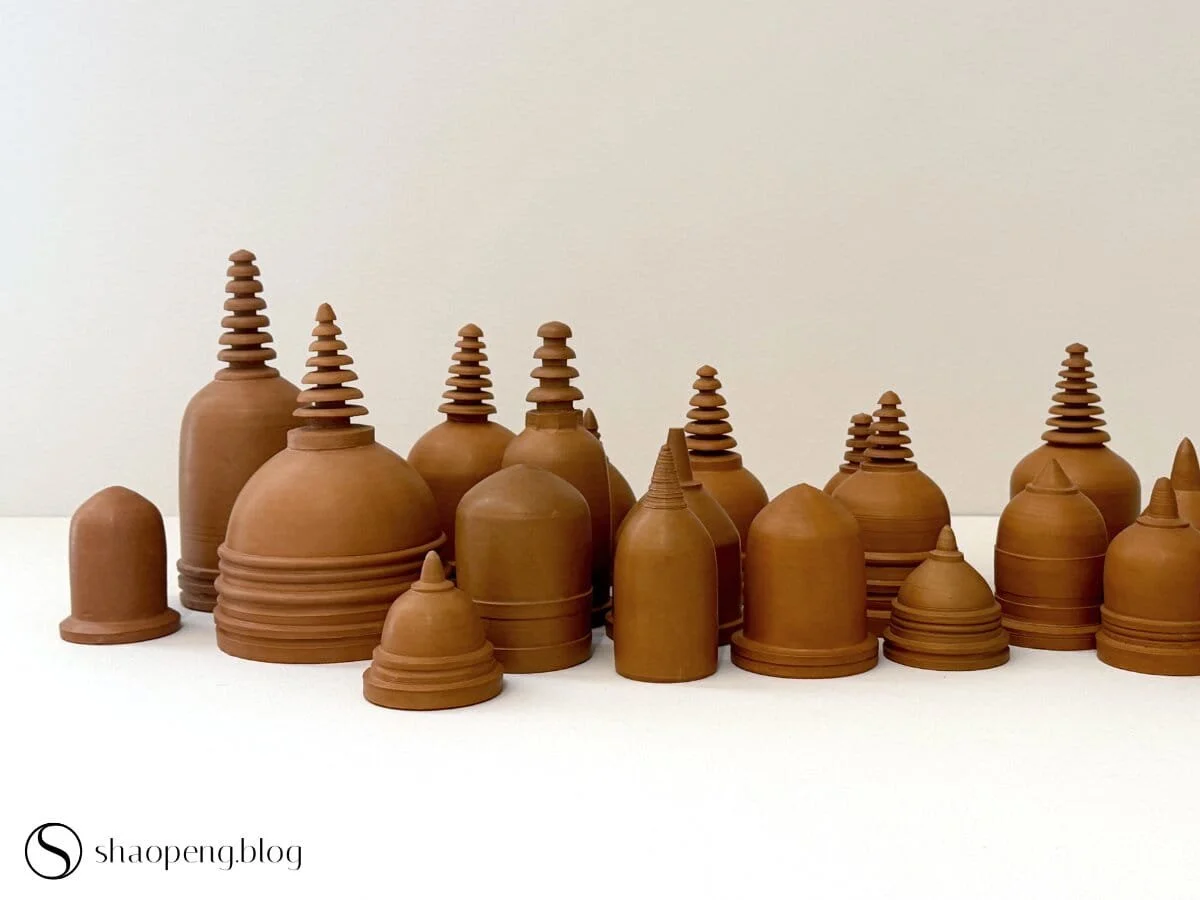
Untitled (Votive Objects) by Ali Kazim
Stepping into the gallery, the journey begins with Zarina’s oversized tasbih—ninety-nine beads of ink-stained maplewood, flecked with 22-carat gold. Here, devotion seems to gather weight and presence, as if faith itself might one day be returned in something luminous and rewarding.
Below it, almost as if in conversation, sits a terracotta installation by Ali Kazim: a cluster of votive objects shaped like stupas, those ancient hemispherical monuments built to house the sacred and draw pilgrims inward. The two works draw from different traditions of faith, yet they settle into the same contemplative frequency.
Moving further, Kazim’s portraits slow you down — the kind of paintings you would lean in without meaning to. A Muslim girl in hijab, a Buddhist monk with a shaved head, and an ordinary boy whose faith, if any, you simply can’t read. The attention to detail feels almost devotional: every strand of hair and every fold of cloth rendered with a patience of miniature painters of the Mughal and Safavid courts.
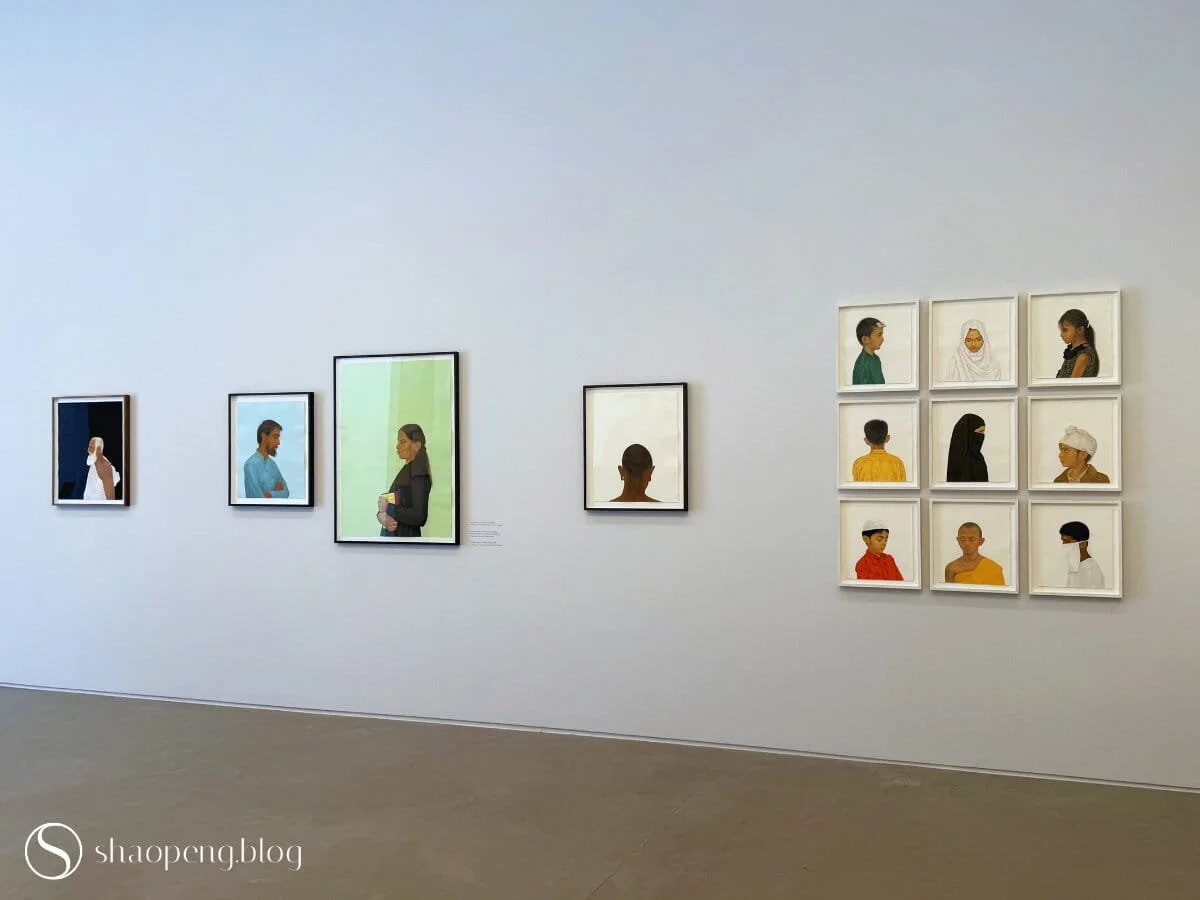
Ali Kazim’s portraits carry the meticulous touch of Persian miniature tradition.
Further in, books emerge as the heart of the exhibition. Zarina’s Urdu kay aik so aik mahavray (101 Urdu Proverbs) pairs selected proverbs with her woodcut prints. She gifted copies of her book to families raising children in the diaspora, as if offering language as something to be carried across distance. Kazim, meanwhile, contributed to Ali Kazim: Alphabet Book / Urdu Qaida, an introduction to the Urdu alphabet accompanied by illustrations of flora and fauna of South Asia.
Zarina once described herself as “too Muslim for the US and India, and too Indian for Pakistan.” After a life of movement across cities and continents, she arrived at a different kind of home: not a place, but a language. “Words inspired me,” she wrote. “Images came later.”
Her woodcut series Home is a Foreign Place makes this clear. Each print pairs an abstract form with a single Urdu word: door, entrance, rain, hot breeze, moon, stars, among others. From the everyday to the celestial, each word carries the weight of memory and longing. Standing before it, you begin to sense that Urdu was not simply Zarina’s medium, but an address that leads to where she belonged.
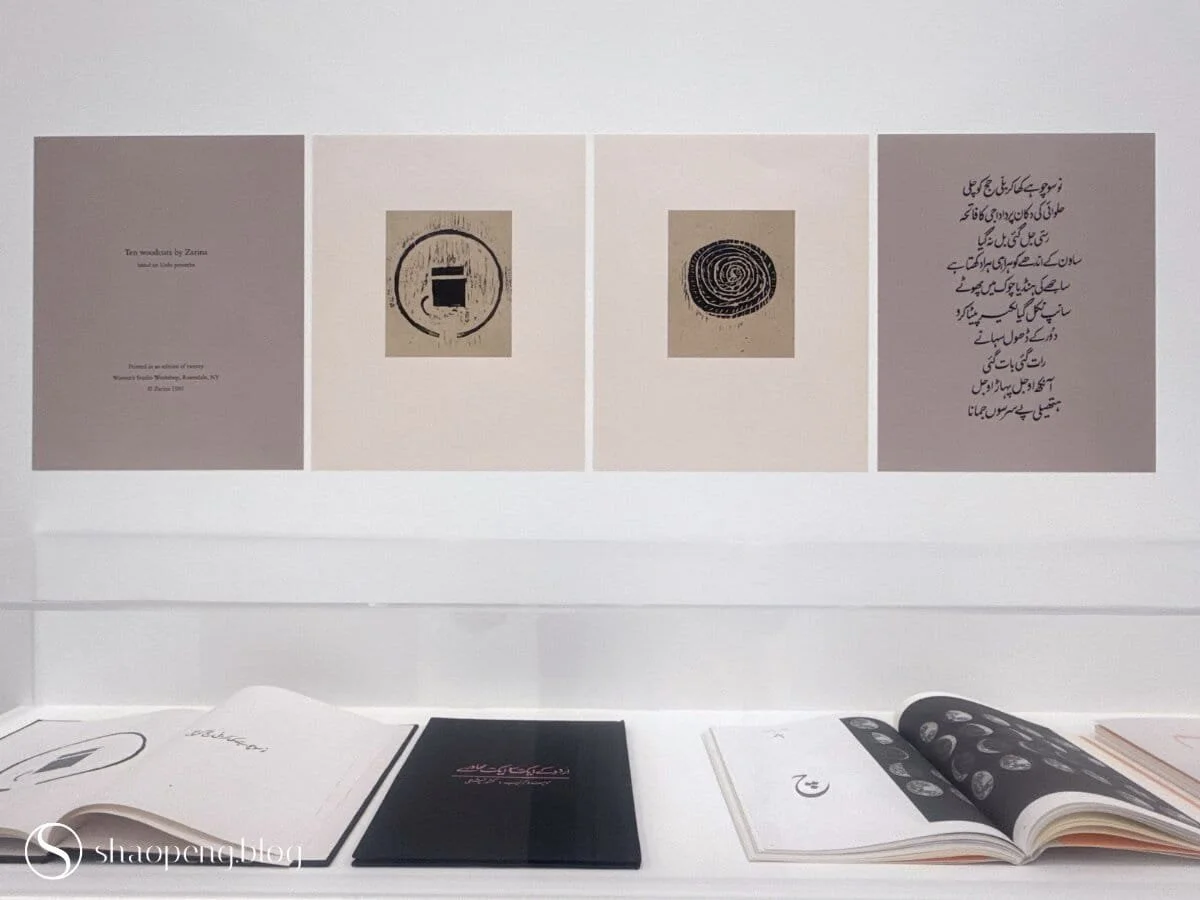
Folios from Zarina's artist book, Urdu kay aik so aik mahavray.
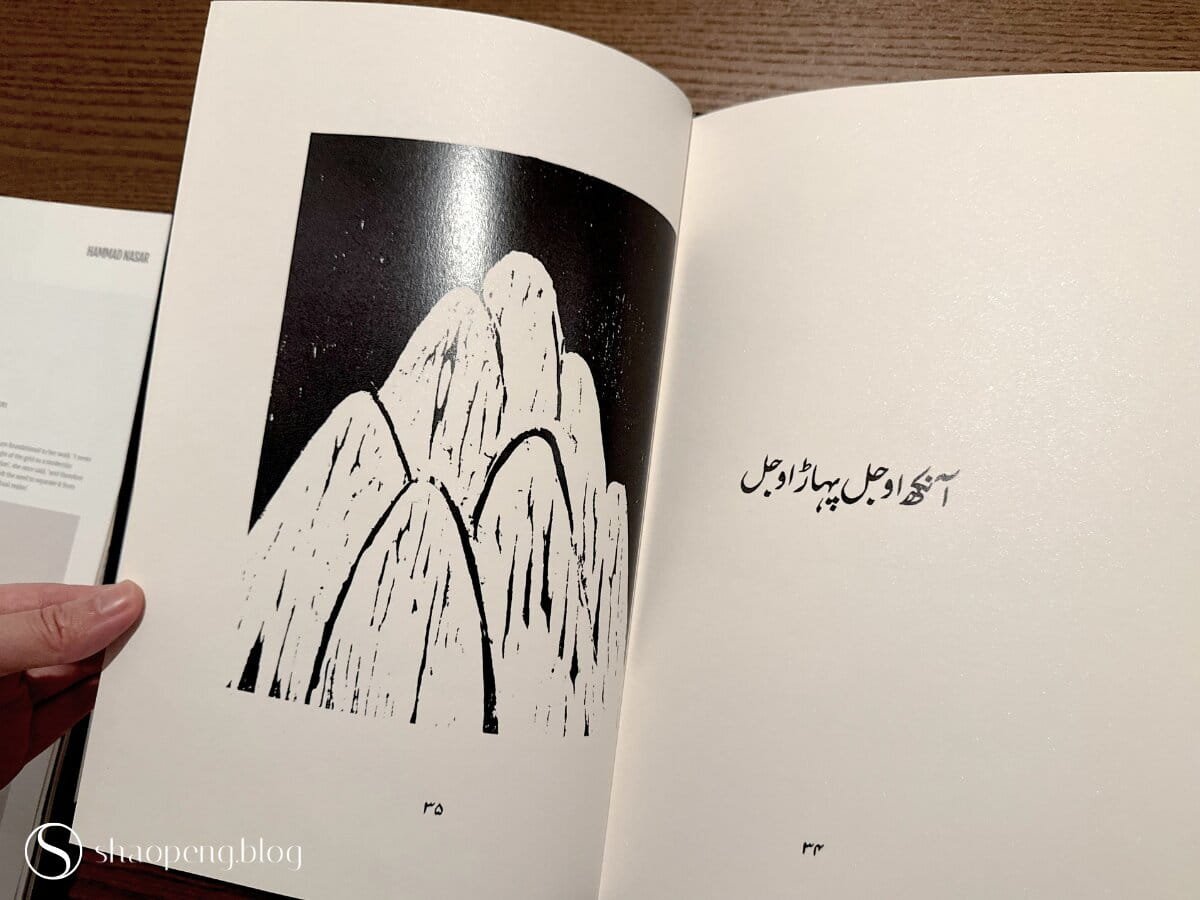
Visitors can browse Zarina’s book on the upper floor of the gallery.
Ali Kazim’s relationship to Urdu is no less profound. It is expressed through landscape, myth, and memory. His four-panel work Tteela traces the mounds of his ancestral village near the ancient Harappan Civilization, a world that flourished and vanished along the Indus between 3300 and 1300 BCE. Rendered in monochrome watercolour, the land reads almost like a palimpsest — layers of time pressed into a single surface.
But it is his Hudhud (Conference of the Birds) that I find myself returning to. A hoopoe presides over a gathering of birds — eagle, parrot, swallow, vulture, crow, crested guinea fowl — among dozens of species, each rendered with extraordinary, almost microscopic care. The work is a visual response to Conference of the Birds by Farid-ud-Din Attar, in which the birds embark on a spiritual journey in search of their king. Kazim’s precision gives the illusion that this timeless quest is unfolding right before you.
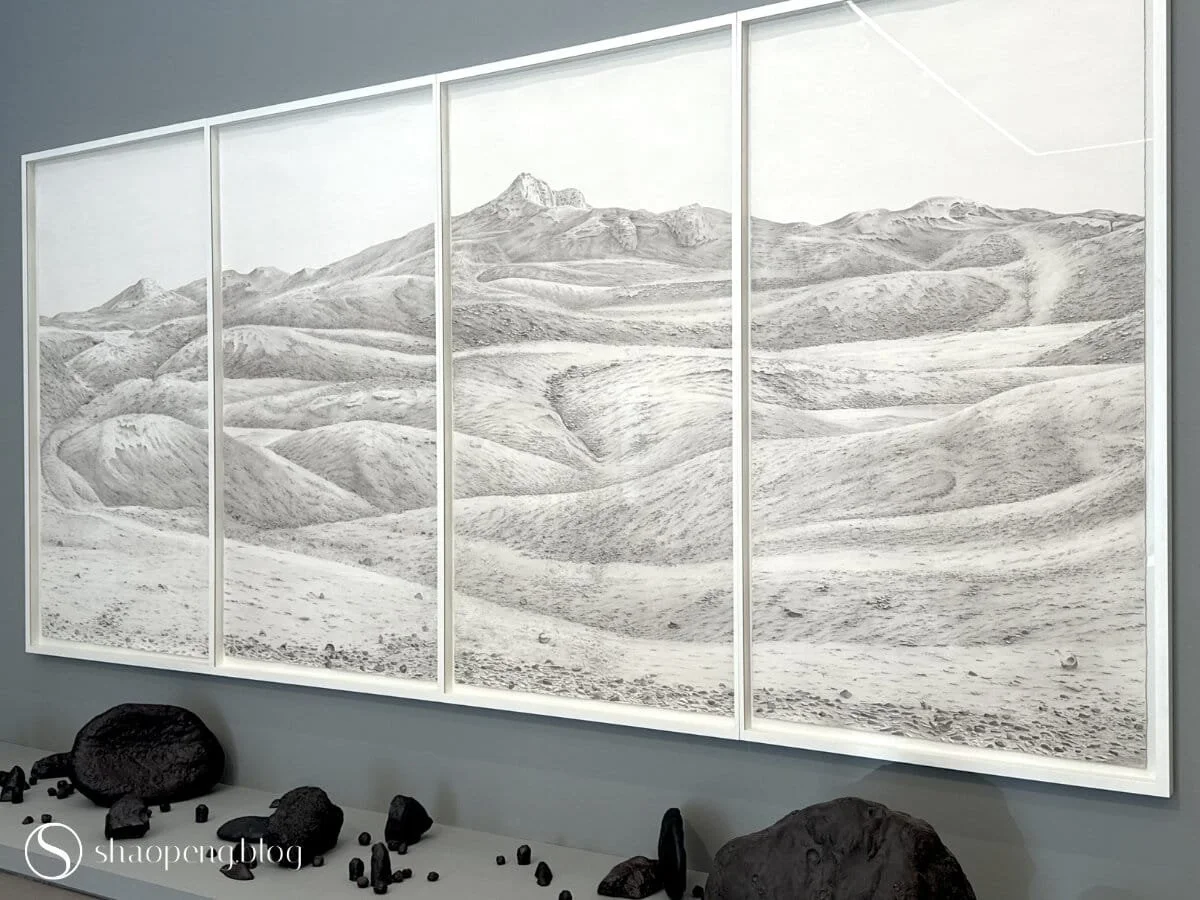
Tteela by Ali Kazim
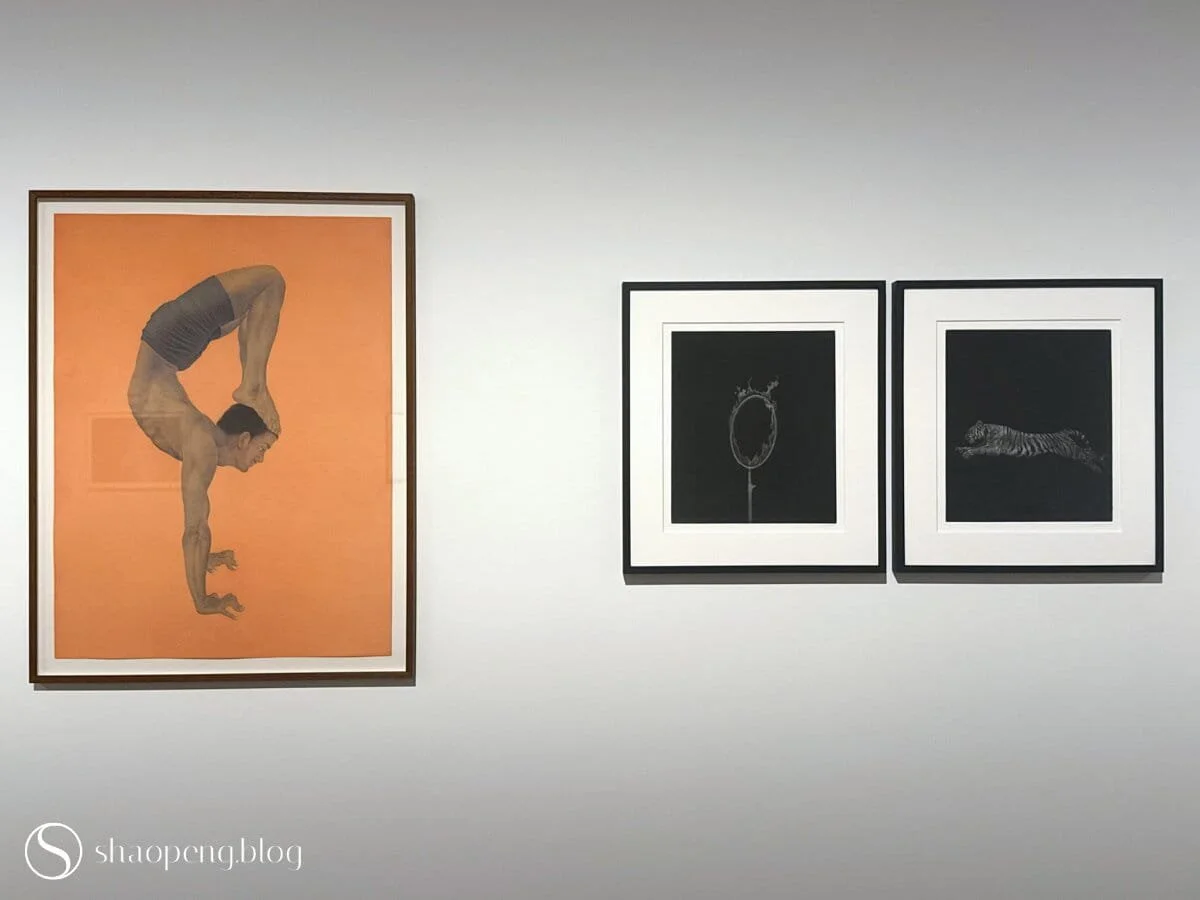
A selection of works by Ali Kazim
Upstairs, a scattering of prints and drawings lines the walls, but it is the tables at the centre of the room that draw me in. They’re filled with novels and poetry, many in Urdu. You are invited not only to browse what the artists have made, but what has made them.
Legend has it that all of humanity once shared a single language, before scattering into many. Urdu Worlds suggests another possibility: that language, rather than dividing, can also gather. By drawing two artists together across time and space, the exhibition reaches outward and connects with those who enter the gallery space. Here, translation feels almost beside the point. What is asked instead is an openness to feel and observe before fully understanding.
As I leave Urdu Worlds behind me, I step back out into the streets of Dubai. Urdu is still there, as it always is, threading through conversations, slipping between strangers, entirely at home in a city in constant motion. But I hear it differently now: not as background chatter, but as architecture. It is something that holds people up, something you might, if you are lucky, happily get lost in, again and again.
Urdu Worlds is on view at Ishara Art Foundation, Dubai, through May 31, 2026.